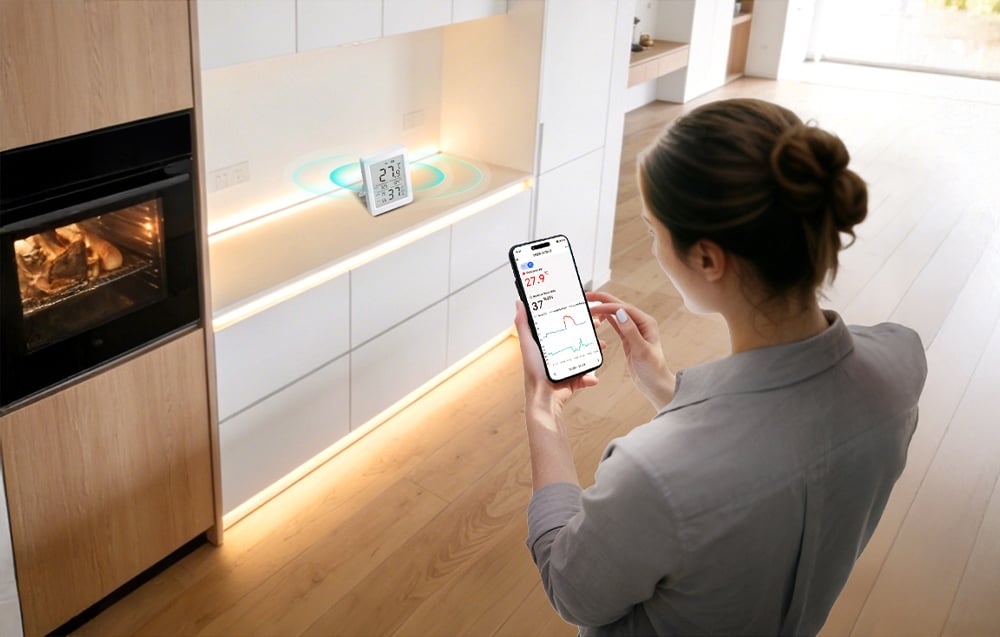
Humidity in the apartment should be within the range of 30–50% and not exceed 60%. This is recommended by the American Environmental Protection Agency (EPA). You can check this only by measurement, and the most convenient way is with a temperature and humidity sensor connected to your phone. The most accurate in our offer are SONOFF sensors, and the most convenient among them is the SNZB-02DR2 with a large screen. The simplest to set up is the Gosund S6, which works without any gateway.
The heating season is just beginning. Radiators dry out the air in the rooms, and in the bathroom and by the windows, where steam condenses, moisture accumulates. Both can be detected early, before mold appears or floorboards crack.
Below we explain what percentage of humidity is normal, where to place the sensor, and how the Wi-Fi model differs from ZigBee. We also compare four sensors available in the store.
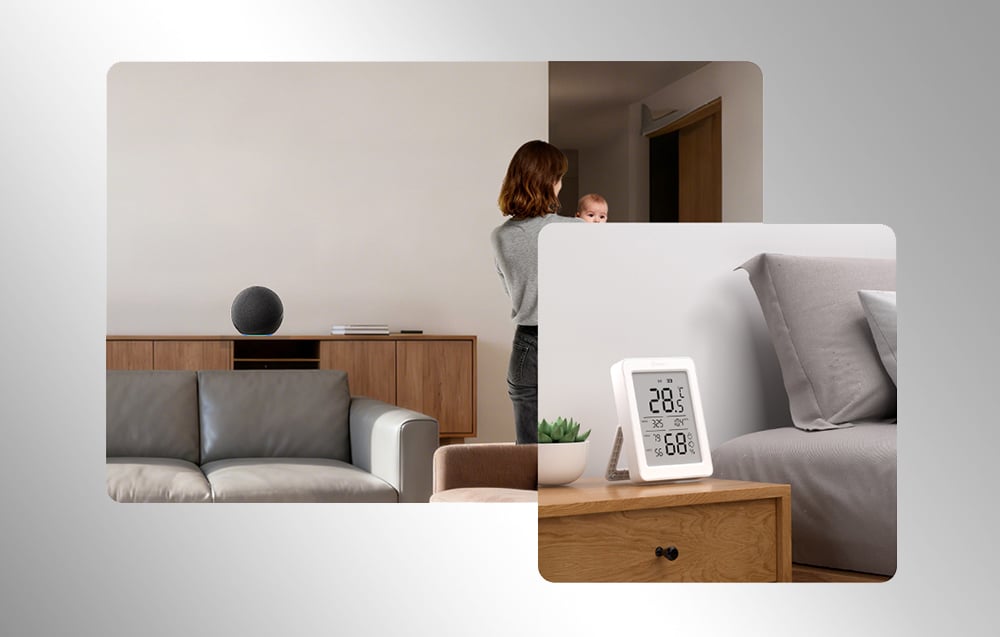
What humidity in the apartment is correct?
Relative humidity in the apartment should be from 30 to 50%, and the upper limit is 60%. Any room hygrometer will measure it, but a smart sensor will additionally save the history and send notifications. The range of 30–50% is provided by EPA in the guide on moisture and mold. According to the EPA, the risk of mold increases above 60%. Below 30%, the air is usually noticeably too dry, which often happens in heated apartments in winter.
| Humidity | What it means | What to do |
|---|---|---|
| Below 30% | Too dry, the air can be unpleasant for the throat and eyes | Do not overheat rooms, consider a humidifier |
| 30–50% | Comfort zone | Nothing, just keep it that way |
| 50–60% | Upper limit of the norm | Ventilate more often, especially after cooking and bathing |
| Above 60% | Too humid: condensation on windows, risk of mold | Ventilate, check ventilation, dry wet surfaces |
Why humidity drops in winter
Cold air from outside carries little water vapor. When the radiators heat it, the relative humidity drops because warmer air could hold more water than it actually does. Therefore, in a heated apartment, it is easy to drop below 30%, even though it is gray and wet outside.
Why mold still appears
Where there is a lot of steam, it is too humid in winter: in the bathroom, kitchen, and bedroom with the window closed. Warm, humid air condenses on the coldest surfaces, which are the windows and the corners of external walls. The EPA advises in such situations to quickly dry the wet surface and limit the source of moisture, for example by ventilating more frequently.
Tip: one sensor in the living room will not tell you what is happening in the bathroom or bedroom. Humidity varies between rooms, which is why we sell SONOFF sensors in sets of two.
Temperature and Humidity Sensor: Wi-Fi or ZigBee?
This choice determines whether the sensor will work immediately after being taken out of the box.
- Wi-Fi Humidity Sensor connects directly to the home router. You need nothing more than an app on your phone. Wi-Fi sensors usually drain batteries faster, and with several devices, they burden the network.
- ZigBee is an energy-efficient protocol designed for sensors. It operates on its own network, independent of Wi-Fi. For remote viewing, notifications, and automation, a ZigBee gateway is needed, which connects itself to the router.
If you are buying your first sensor and do not have a gateway at home, choose the Wi-Fi model. If you plan to have more sensors, for example for window openings or flooding, ZigBee with a gateway will be more convenient.
It also matters which gateway the sensor works with. Gosund ZigBee sensors are designed for the Tuya system, for example with the gateway Gosund ST21. According to the manufacturer, SONOFF sensors support ZigBee 3.0 gateways, including their own SONOFF hubs, the NSPanel Pro, and Amazon Echo speakers with a built-in ZigBee hub. The USB ZBDongle is an option for Home Assistant users, not a standalone gateway for the application.
Temperature and humidity sensors in our offer
In the store, we have four temperature and humidity sensors from two brands: SONOFF and Gosund. Three operate via ZigBee (two SONOFF and Gosund ST17), one via Wi-Fi.
1. SONOFF SNZB-02DR2: accurate, with a large screen
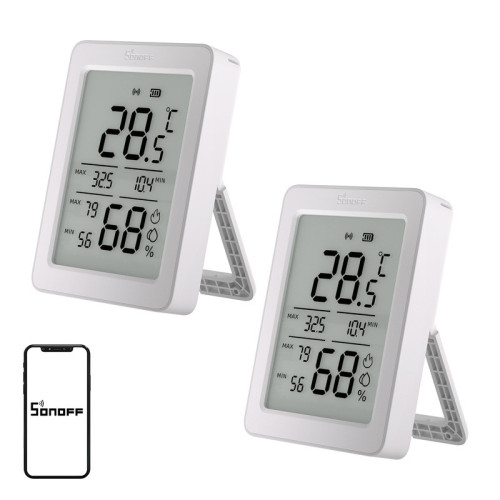
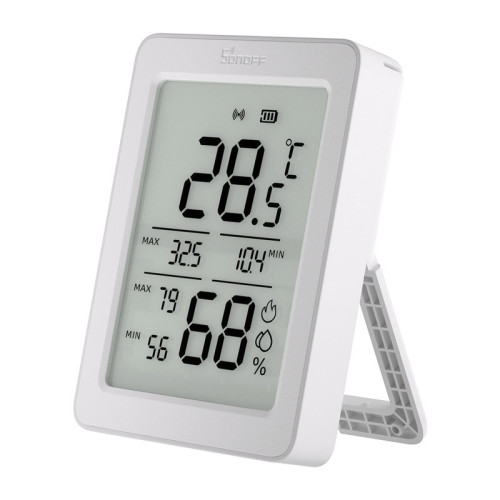
The SNZB-02DR2 screen shows the current measurement as well as the minimum and maximum from the last day.
Our choice if you have a ZigBee gateway. SONOFF SNZB-02DR2 has a Sensirion SHT40 sensor, used in measuring devices. The manufacturer states an accuracy of ±0.2°C and ±2% RH. The large 3.6″ screen displays current values, minimum and maximum from the last 24 hours, and a graphical comfort indicator. Without a gateway, you can connect to it up close via Bluetooth to read the data.
- ZigBee 3.0, powered by 2× AAA
- 3.6″ LCD screen with min/max and comfort indicator
- Measurement history and alerts in the app
- Set of two sensors
Advantages:
- Highest declared accuracy, along with SNZB-02D
- Readable screen from the other end of the room
Disadvantages:
- For the application and automation, a ZigBee gateway is needed, and we currently do not have SONOFF hubs in stock
2. Gosund S6: Wi-Fi humidity sensor without a gateway

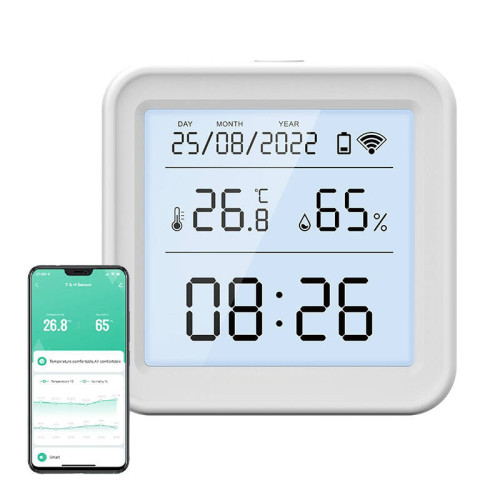
Gosund S6 connects to the Wi-Fi router, and the measurement history is in the app.
Gosund S6 is the simplest way to get your first sensor. It connects directly to your home Wi-Fi 2.4 GHz, so you only need the Gosund or Tuya Smart app. It has a backlit screen with a clock, and works with Google Assistant and Amazon Alexa.
- Wi-Fi 2.4 GHz, no gateway
- Accuracy ±1°C and ±5% RH
- Power supply: 3 AAA batteries
- History of measurements and automation in the application, e.g., turning on the humidifier when the air is too dry
Advantages:
- Works immediately, without additional equipment
- Backlit screen with a clock
Disadvantages:
- Lower accuracy than in SONOFF
- Wi-Fi drains batteries faster than ZigBee
3. SONOFF SNZB-02D: accurate and compact
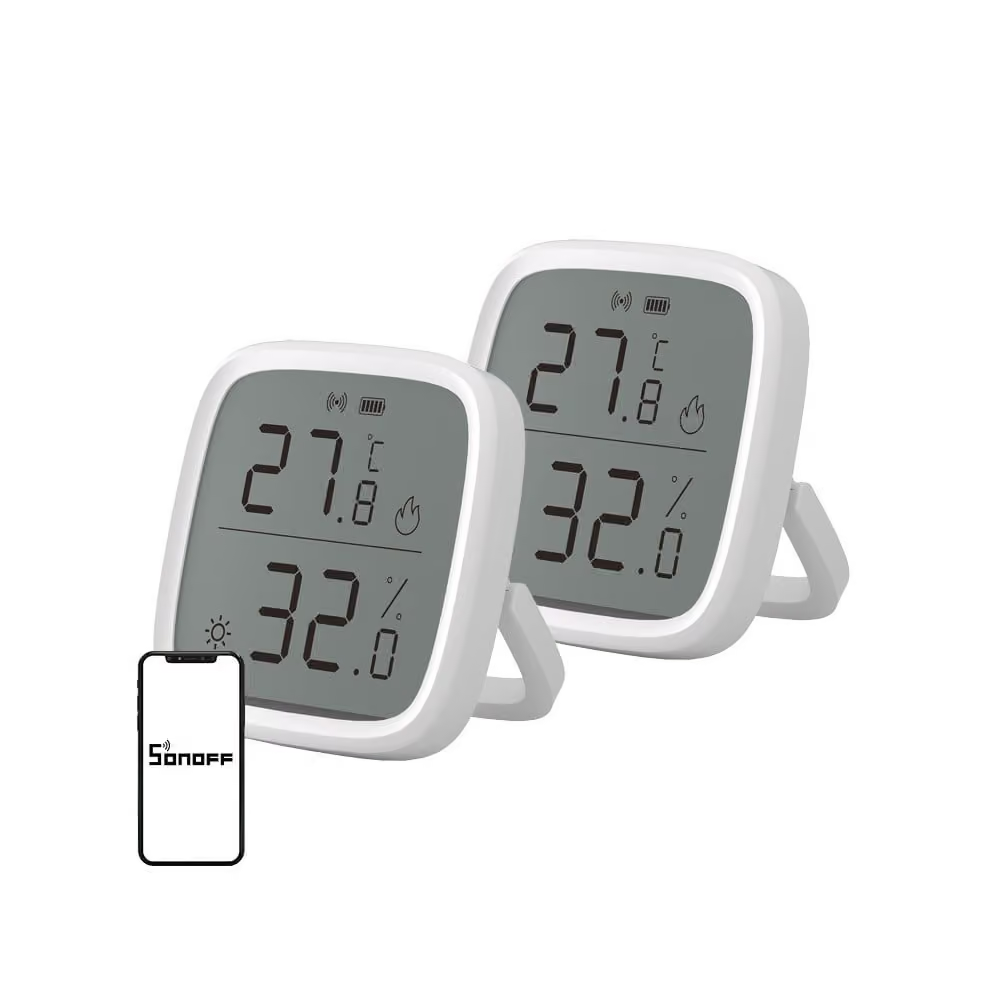
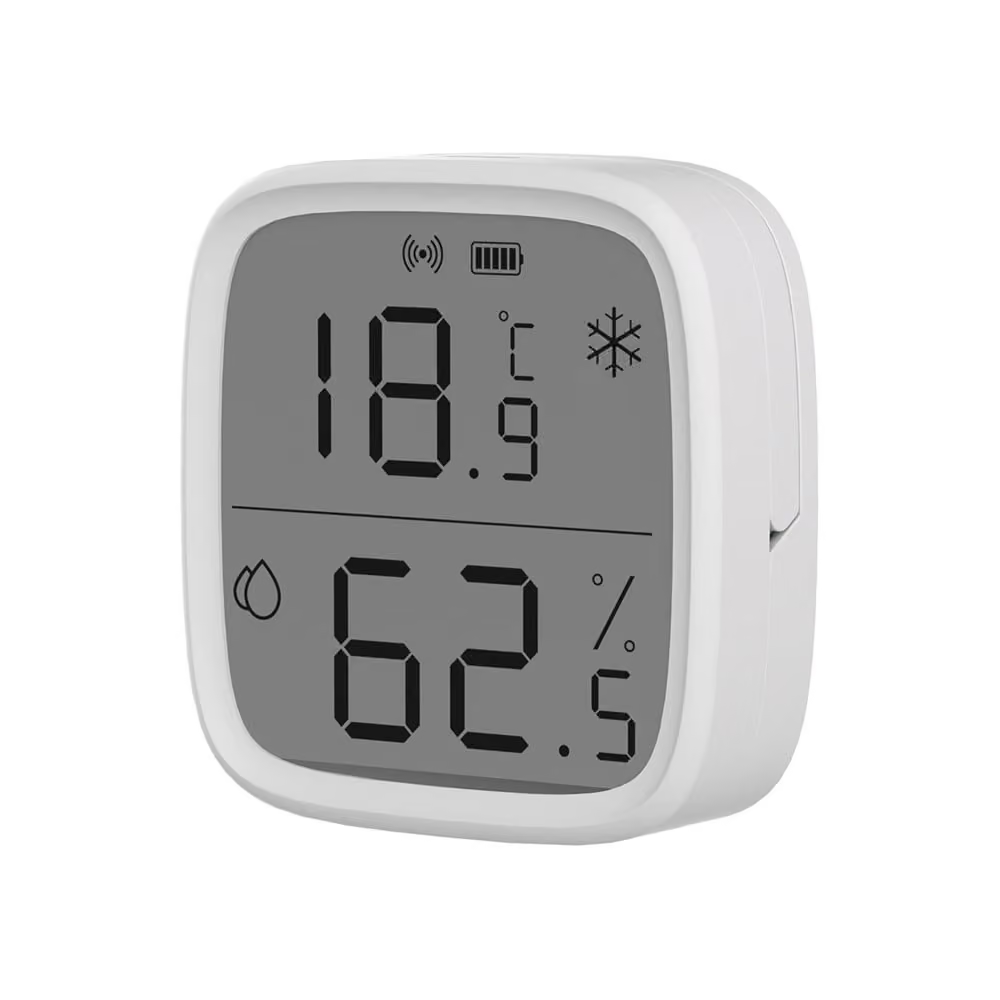
SONOFF SNZB-02D, also available in sets of two.
SONOFF SNZB-02D is an older model from the same series, with a smaller screen displaying temperature and humidity. The manufacturer specifies an accuracy of ±0.2°C and ±2% RH, with readings refreshing every 5 seconds, and the CR2450 battery lasts up to about 2 years according to specifications.
- ZigBee 3.0, CR2450 battery
- Readings every 5 seconds, notifications for threshold breaches
- Works with Amazon Alexa and Google Home
- Set of two sensors
Advantages:
- High accuracy in a small housing
- Long operation on a single battery
Disadvantages:
- Requires a ZigBee gateway, and we currently do not have SONOFF hubs in stock
- Smaller screen than in SNZB-02DR2
4. Gosund ST17 ZigBee: for the Tuya system
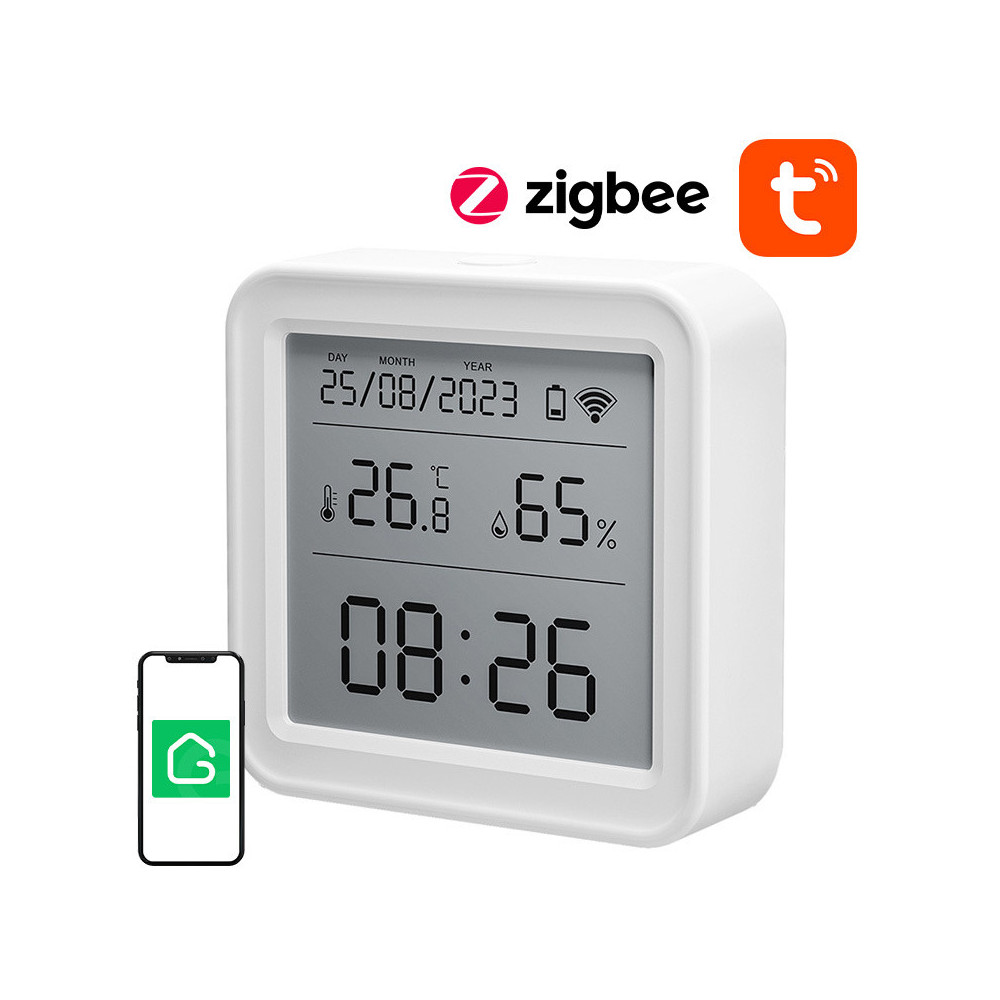
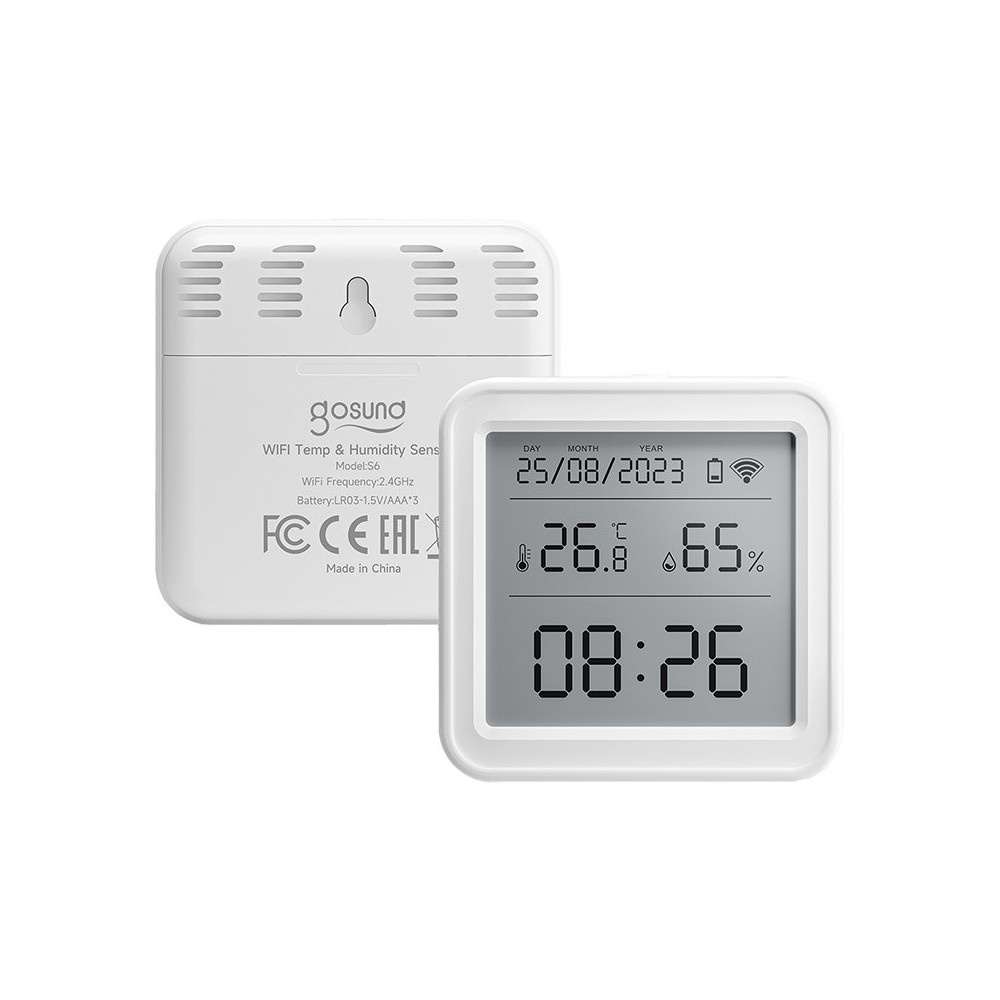
Gosund ST17 looks like S6, but connects via ZigBee.
Gosund ST17 is the ZigBee version of the S6 sensor: the same clock display and the same accuracy ±1°C and ±5% RH. Choose it if you already have a Tuya gateway or plan to have several Gosund sensors at once. You can export the measurement history from the app to your email.
Advantages:
- ZigBee usually consumes battery more efficiently than Wi-Fi
- Compatible with the Tuya system, e.g. with the Gosund ST21 gateway
Disadvantages:
- Without a gateway, you cannot connect it to your phone
- Accuracy like in the cheaper S6
[hs_products ids=»140615,139092,140616,139202″ cols=»4″]
Temperature and Humidity Sensor Comparison
| Feature | SONOFF SNZB-02DR2 | Gosund S6 | SONOFF SNZB-02D | Gosund ST17 |
|---|---|---|---|---|
| Connectivity | ZigBee 3.0 | Wi-Fi 2.4 GHz | ZigBee 3.0 | ZigBee |
| Works without a hub | ❌ no (close range via Bluetooth) | ✅ yes | ❌ no | ❌ no (Tuya hub needed) |
| Temperature accuracy | ±0.2°C | ±1°C | ±0.2°C | ±1°C |
| Humidity accuracy | ±2% RH | ±5% RH | ±2% RH | ±5% RH |
| Display | LCD 3.6″, min/max | LCD with clock | LCD | LCD with clock |
| Power supply | 2× AAA | 3× AAA | CR2450 | 3× AAA |
| Included | 2 pieces | 1 piece | 2 pieces | 1 piece |
How to choose briefly:
- First sensor, no hub? Gosund S6 Wi-Fi.
- Do you care about accurate measurement and have a ZigBee hub? SONOFF SNZB-02DR2 or SNZB-02D.
- Want to control two rooms and have a ZigBee hub? SONOFF sets with two pieces.
- Building a system on Tuya? Gosund ST17 with Gosund ST21 hub.
Where to place the humidity sensor
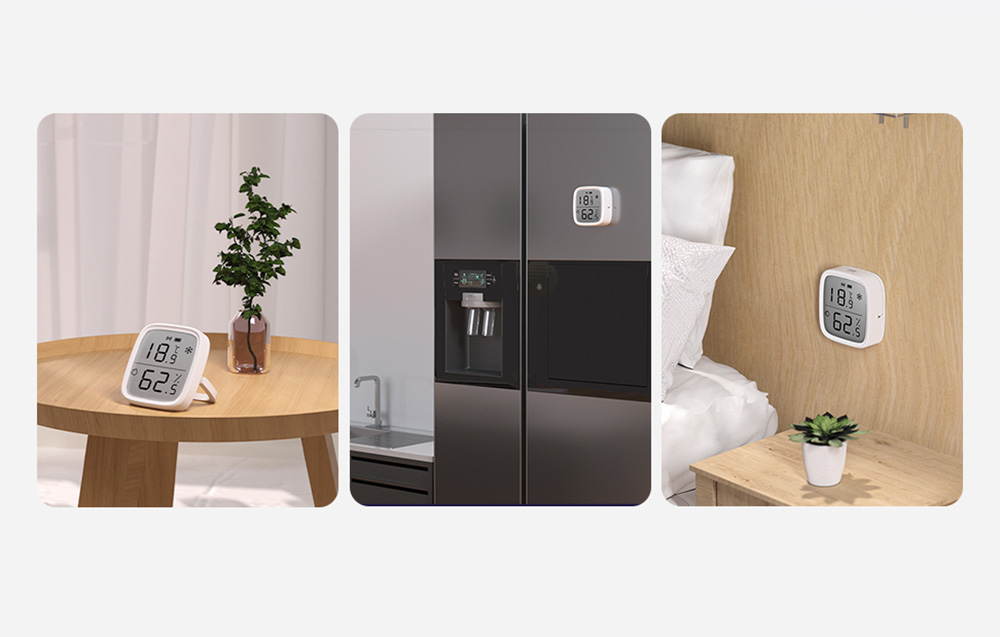
The sensor shows conditions where it is placed. If positioned incorrectly, it will measure the radiator instead of the room.
- Away from the radiator. Heat lowers relative humidity and raises temperature.
- Not right by the window. It is colder and more humid by the glass than in the rest of the room.
- At human height. About where you spend time. Not on the floor and not on a shelf under the ceiling.
- Also in the bedroom and bathroom. That’s where humidity changes the most.
Automations with the humidity sensor
The smart sensor can not only measure but also trigger a reaction before it gets too dry or too wet.
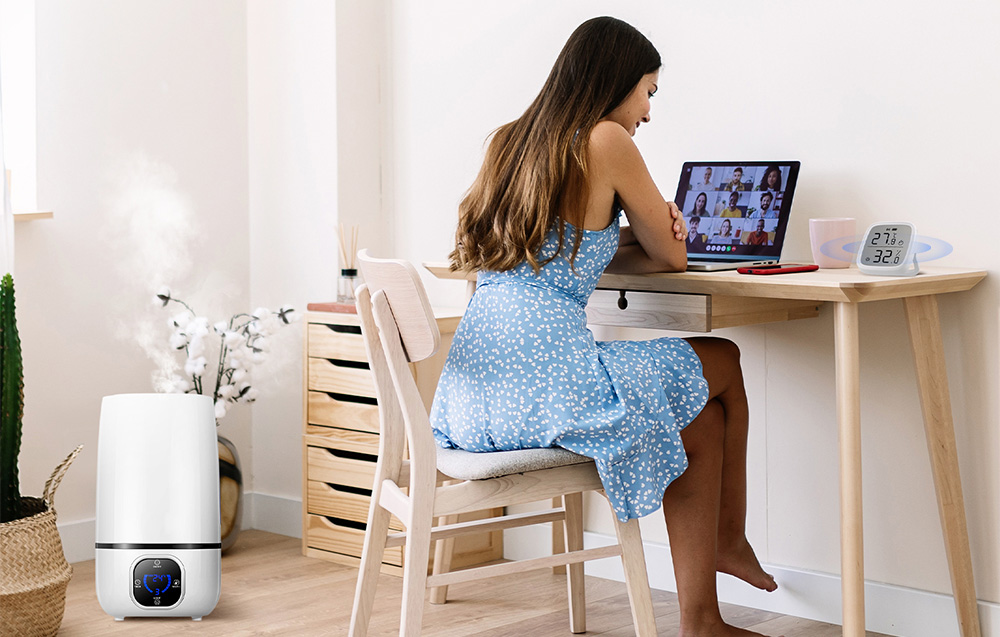
- Too dry? The sensor can turn on a humidifier plugged into a smart socket when humidity drops below the set threshold. Such an example appears in the descriptions of the Gosund S6 and SONOFF sensors.
- Too humid in the bathroom? A notification on your phone after exceeding 60% will remind you to ventilate.
- Ventilation control. Gosund S2 window opening sensor works via Wi-Fi without a gateway and will send a notification when the window is opened. Combined with a humidity sensor, you can see if ventilation actually lowers humidity.
All sensors, including window opening, flooding, and motion, can be found in the smart home sensors category. Outlets and other automation devices are in the home automation category.
Summary: which temperature and humidity sensor to choose
- Proper humidity in the apartment is 30–50%, and above 60% the risk of mold increases.
- The most accurate temperature and humidity sensors in our offer are SONOFF SNZB-02DR2 and SNZB-02D (±0.2°C, ±2% RH).
- The simplest start is the Gosund S6 Wi-Fi, which does not require a gateway.
- ZigBee requires a gateway, but saves batteries and performs better with multiple sensors.
The heating season is a good time to measure humidity in the apartment before the first mold spot appears by the window. You can find the entire selection of sensors in the smart home sensors category. Free shipping is available for orders over 100 PLN.
FAQ
What humidity should be in the apartment in winter? Just like throughout the year: from 30 to 50%, no more than 60%. In winter, a more common problem is excessively dry air in heated rooms and too humid air in the bathroom.
What is the difference between a humidity sensor and a room hygrometer? A hygrometer is a general term for a device that measures humidity. A smart temperature and humidity sensor does the same but additionally records history, sends notifications to your phone, and can control other devices.
Does a ZigBee sensor work without a gateway? For full functionality, meaning remote viewing, notifications, and automation, a gateway is needed. An exception is the SONOFF SNZB-02DR2, which will connect to your phone via Bluetooth up close. If you don’t have a gateway, the simplest option is to choose a Wi-Fi sensor, e.g., the Gosund S6.
Will the SONOFF sensor work with the Tuya gateway? The manufacturer lists compatible ZigBee 3.0 gateways, including SONOFF hubs, NSPanel Pro, ZBDongle key, and Amazon Echo with a ZigBee hub. Tuya gateways are not included in this list, so with the Tuya system, it is safer to choose the Gosund ST17.
Where is the best place to put the humidity sensor? Approximately at the height where you spend time, away from the radiator, window, and direct sunlight. It will tell you the most in the bedroom and bathroom.
How to reduce humidity in the apartment? Ventilate briefly and intensively, especially after cooking and bathing, and do not dry laundry in a closed room. Dry wet surfaces, e.g., condensation on windows, immediately.
Legg att eit svar