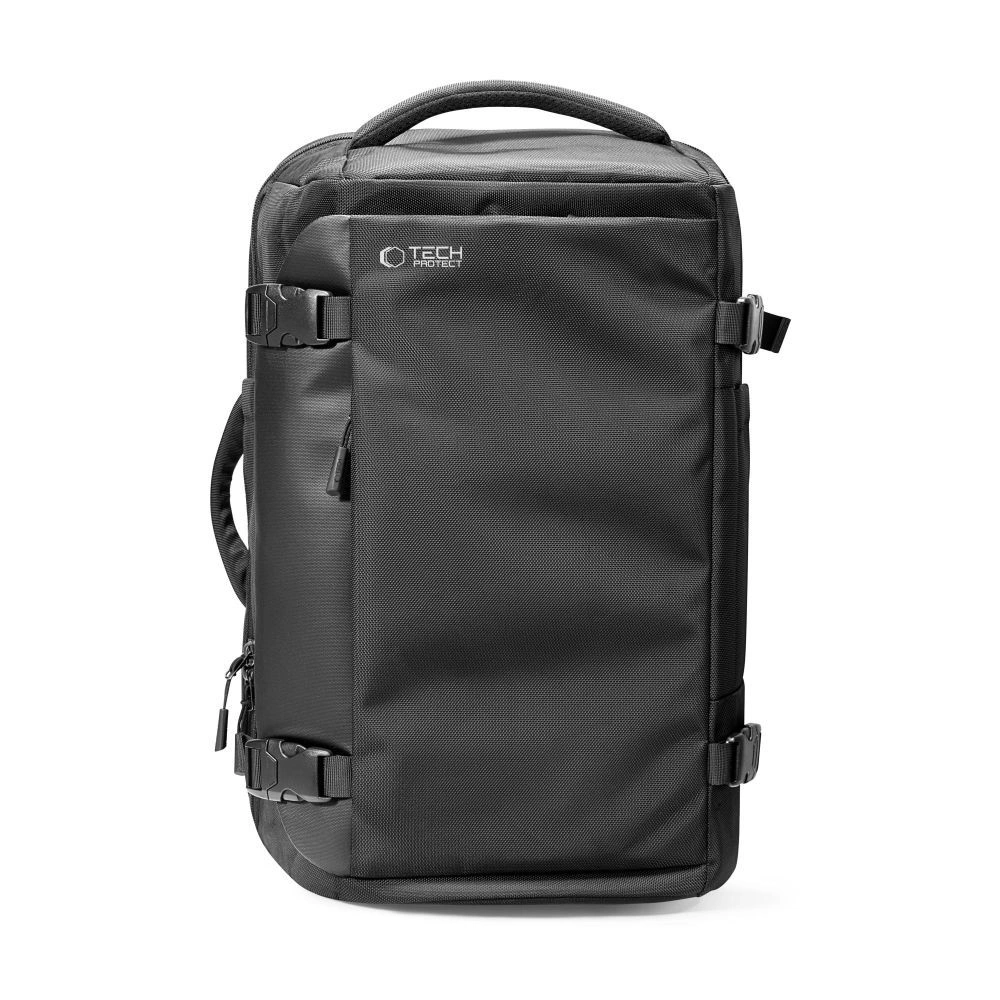
Free cabin baggage on Ryanair and Wizz Air has exactly the same dimensions: 40 × 30 × 20 cm. It must fit under the seat in front of you. Wizz Air adds a limit of 10 kg, Ryanair does not specify a weight limit. One well-chosen backpack will serve both airlines.
The problem is that backpack descriptions provide dimensions in different orders, and at the gate, there is a metal frame and an employee who does not discuss. A mistake costs up to £70 for checking baggage in the hold.
Below you will find a table of dimensions for both airlines, an explanation of why a backpack with «too large» dimensions still passes, and a list of models from our offer that have dimensions confirmed by the manufacturer.
Dimensions of cabin baggage — Ryanair and Wizz Air in one table
Let’s start with what is free.
| Ryanair | Wizz Air | |
|---|---|---|
| Free baggage under the seat | 40 × 30 × 20 cm | 40 × 30 × 20 cm |
| Weight limit | not specified | 10 kg |
| Paid baggage to the locker | 55 × 40 × 20 cm | 55 × 40 × 23 cm |
| Weight limit for paid baggage | 10 kg | 10 kg |
| Service name | Priority | WIZZ Priority |
Two things are worth remembering.
The free dimension is identical in both lines. This is a result of standardization in Europe and greatly simplifies shopping: you don’t need a separate backpack for Ryanair and a separate one for Wizz.
Paid baggage already differs. Wizz Air allows 23 cm in depth, Ryanair only 20 cm. A cabin suitcase purchased for Wizz Air may not pass at Ryanair — this is the most common trap when buying larger baggage.
Why does a backpack 40 × 20 × 25 cm fit in a frame 40 × 30 × 20
This question comes up most often and the answer is less obvious than it seems.
Many cabin backpacks have dimensions 40 × 20 × 25 cm in their name. The limit is 40 × 30 × 20 cm. You look at this and see 25 cm where the regulations say 20 cm. It seems like a discrepancy.
And yet such a backpack passes. The reason is simple: the frame at the gate is just a regular rectangular prism, not a set of walls assigned to specific sides of the backpack. You can insert it rotated.
Just arrange both sets of numbers from largest to smallest:
| Largest | Middle | Smallest | |
|---|---|---|---|
| Backpack | 40 cm | 25 cm | 20 cm |
| Frame | 40 cm | 30 cm | 20 cm |
| Verdict | 40 ≤ 40 ✅ | 25 ≤ 30 ✅ | 20 ≤ 20 ✅ |
Each dimension of the backpack is less than or equal to the corresponding dimension of the frame. The backpack fits only when rotated 90 degrees from how you intuitively try to insert it.
Tip: At the gate, insert the backpack into the frame vertically, with the longer side down. If you try to push it in «flat,» you may hit that wall it won’t pass through, even though the backpack meets the limit.
The order of dimensions in the product description is a remnant of an older version of the regulations when Ryanair listed the limit as 40 × 20 × 25 cm. The set of numbers itself hasn’t changed; the order in the regulations has.
How much can realistically fit in a 20-liter backpack
Twenty liters sounds abstract, so let’s translate it into the contents of a weekend trip:
- Two changes of clothes plus underwear for three days
- Toiletry bag with liquids in containers up to 100 ml
- 14–15 inch laptop in a dedicated compartment
- Charger, cables, power bank
- Rain jacket rolled at the bottom
- Water bottle in the side pocket
This is a realistic range for a three- or four-day trip without laundry. For a week, it will be tight unless you plan to do laundry on-site.
What you won’t fit: spare shoes besides those on your feet, a thick winter jacket, and a hard toiletry bag. On a winter flight, the thickest items are simply worn on top of each other.
Attention: The 10 kg limit with Wizz Air also applies to free baggage. A 20-liter backpack filled with clothes rarely exceeds 7 kg, but with a laptop, power bank, and a bottle of water, it can approach the limit.
Cabin backpacks in our offer
The following models have dimensions confirmed by the manufacturer and declared compliance with the requirements of both airlines.
[hs_products ids=»120015,120016,120017,114366″ cols=»4″ title=»Cabin backpacks Ryanair and Wizz Air»]
It is worth saying directly: these are the only models in our offer with confirmed cabin dimensions. We have over a thousand other items in the category of bags and backpacks, but manufacturers do not declare compliance with airline limits for them.
We will not guess. With a penalty of around £70 for a mistake at the gate, suggesting a backpack «that will probably fit» would be unfair.
Both models have the same dimensions, the same capacity, and the same set of solutions in the manufacturer’s description. The differences come down to two things: available colors and the declared diagonal of the laptop.
| Feature | Defender S50 | Defender S40 |
|---|---|---|
| Dimensions | 40 × 20 × 25 cm | 40 × 20 × 25 cm |
| Capacity | 20 l | 20 l |
| Laptop pocket | up to 15.6″ | ✅ (diagonal not specified) |
| Material | hybrid, moisture-resistant | hybrid, moisture-resistant |
| Luggage handle strap | ✅ | ✅ |
| Side pocket for bottle | ✅ | ✅ |
| Shaped back and straps | ✅ | ✅ |
| Colors | black, olive, powder pink | black |
If you carry a 15-inch laptop or larger, choose S50 — it is the only one of the two that explicitly states the diagonal. For smaller devices, the color is the deciding factor.
What to pay attention to when choosing
The dimension alone is not everything. Three things determine whether the backpack will work in practice.
Stiffness of the structure. A soft backpack can be compressed in a frame, while a hard one won’t forgive overloading. On the other hand, a soft one offers less protection for the laptop. A compromise is models with a reinforced back panel and soft sides.
Depth expansion. Many travel backpacks have a zippered compartment that adds a few centimeters of depth. This is convenient when traveling by car but can be a killer at the gate — once unzipped, the backpack no longer meets the limit. If you buy such a model, remember to fly with the compartment folded.
Access to the laptop. Security control requires removing the laptop from the luggage. An externally opening compartment saves unpacking the entire backpack at the conveyor belt.
Additionally, there’s something easy to forget: the backpack goes under the seat, not above your head. A height of 40 cm is the maximum, but in practice, the less it protrudes towards your legs, the more comfortably you fly.
Backpack or cabin suitcase?
With a free limit of 40 × 30 × 20 cm, the answer is clear: backpack.
A hard suitcase of these dimensions exists, but it has two disadvantages. First, the wheels and handle take up a few centimeters of usable depth — the declared 20 liters turns into a real 14–15. Second, the rigid shell does not forgive: if the suitcase is one centimeter too large, you won’t be able to squeeze it into the frame.
The backpack makes better use of the limit because the soft sides provide a margin, and the lack of wheels means that the entire volume is available for packing. Plus, you have free hands at the airport.
A cabin suitcase only starts to make sense with paid luggage — with a limit of 55 × 40 × 20 cm, the wheels are no longer a problem because there is clearly more volume.
How to measure the backpack you already have
Before you buy a new one, check the one that’s in the closet. You need a regular measuring tape and five minutes.
Measure the packed backpack, not the empty one. An empty backpack is flat and fits everywhere. A packed one grows in depth by several centimeters, and this dimension usually determines rejection at the gate.
Write down three numbers: height, width, and depth at the thickest point. Include everything that sticks out — side pockets with a bottle, buckles, rolled-up chest strap.
Then arrange your three numbers from largest to smallest and compare with the arranged limit: 40, 30, 20. If each of your numbers is less than or equal to the corresponding one, the backpack will pass.
Tip: Don’t trust the manufacturer’s declaration without checking. Dimensions in descriptions are usually given for an empty backpack without side pockets.
How to pack 20 liters to make it enough
A few techniques that realistically increase capacity without changing the backpack.
Rolling instead of folding. Rolled-up shirts and pants take up less space and wrinkle less. The difference when packing for a week is one additional change of clothes.
Heaviest against the back. Place the laptop and shoes as close to your back as possible, at the bottom. The backpack carries better and sticks out less, which matters when putting it in a frame.
Socks in shoes. The inside of the shoes is a volume that travels empty anyway.
Cosmetics in containers up to 100 ml, in one transparent bag. This is a safety control requirement, and at the same time a packing discipline: the bag has a specific size and limits how much you can take.
The thickest things on you. A jacket, a sweatshirt, and the heaviest shoes worn do not count towards your luggage. When flying to a cooler climate, this is the simplest way to reclaim a few liters.
Common mistakes that cost at the gate
Counting the bag or pouch separately. The free limit is one piece. A backpack plus a small bag counts as two, and the staff has the right to charge a fee. Hide the bag in the backpack before boarding.
Jacket draped over the shoulder. Outerwear carried in hand usually does not count towards the limit, but a shopping bag from the airport does. Stuff the items purchased after security into your backpack.
Power bank in checked luggage. This is not only a matter of fees but also of safety regulations: power banks must travel in carry-on luggage, never in the hold. The capacity limit is usually 100 Wh, which is about 27,000 mAh — a typical 10,000 mAh power bank fits with a huge margin.
Open compartment. Described above — the most common reason for rejecting a backpack that «always passed before.»
One organizational tip: instead of carrying three chargers, take a USB-C adapter or hub and one power supply. The saved space can be better used for clothes, and fewer cables mean fewer things to take out during security checks.
What else to take in your carry-on
A few items that take up little space but can save your trip.
| Equipment | Purpose | Note |
|---|---|---|
| 10,000 mAh power bank | Airports rarely have free outlets | Only in carry-on luggage |
| USB-C hub or adapter | One power supply instead of three | Saves space and time during checks |
| Short cable 30 cm | Charging in the seat pocket | Long cables get tangled under the seat |
| Document case | Passport and boarding passes in one place | Reduces wait time at the gate |
The power bank deserves a separate mention because it is subject to a strict rule: it can never go in checked luggage. Even if you pay extra for a suitcase in the hold, the power bank stays with you.
Summary
The most important things to remember:
- Free baggage on Ryanair and Wizz Air has the same dimensions: 40 × 30 × 20 cm — one backpack is enough for both airlines
- Wizz Air adds a limit of 10 kg, Ryanair does not specify the weight of free baggage
- Paid baggage already differs: 55 × 40 × 20 cm on Ryanair, 55 × 40 × 23 cm on Wizz Air
- A backpack of 40 × 20 × 25 cm fits in the frame — the set of three numbers matters, not their order
- The penalty at the gate reaches 70 pounds, which is a multiple of the price of a good backpack
- Watch out for expandable compartments and for adding a second piece of luggage
Airline regulations can change, so it’s worth checking the airline’s current website before your flight. The dimensions listed above are valid as of August 2026.
Are you packing for a trip? Check out the bags and backpacks category and see models with confirmed cabin dimensions.
FAQ — frequently asked questions
What are Ryanair’s cabin baggage dimensions in 2026?
Free personal baggage is 40 × 30 × 20 cm and must fit under the seat. With the Priority service, a second piece of baggage with dimensions of 55 × 40 × 20 cm and a weight of up to 10 kg can be placed in the overhead compartment.
Do Wizz Air and Ryanair have the same baggage dimensions?
Free baggage yes — both airlines specify 40 × 30 × 20 cm. Paid baggage already differs: Wizz Air allows 55 × 40 × 23 cm, while Ryanair allows 55 × 40 × 20 cm. Wizz Air additionally limits free baggage to 10 kg.
Will a backpack 40 × 20 × 25 cm pass in Ryanair?
Yes. When sorted by size from largest, the backpack measures 40, 25, and 20 cm, and the frame measures 40, 30, and 20 cm — each dimension fits within its corresponding side. It just needs to be placed in turned, with the longer side down.
How much does it cost to check baggage at the gate?
In 2026, the fee reaches 70 pounds per piece, depending on the route and carrier. This is a multiple of the price of a backpack that meets the requirements, so checking the dimensions before departure pays off immediately.
Can a power bank be carried in hand luggage?
Yes, and only there — regulations prohibit carrying power banks in checked baggage. The limit is usually 100 Wh, which is about 27,000 mAh, so typical models of 10,000 and 20,000 mAh fit without any problem.
Does the weight count towards Wizz Air’s free baggage?
Yes, Wizz Air specifies a limit of 10 kg for free baggage under the seat. Ryanair does not specify weight for the free piece, but the baggage must physically fit in the frame and under the seat.
External sources: Wizz Air — baggage rules, Ryanair — baggage, Which? — comparison of baggage limits in airlines.
Legg att eit svar