Skribent: Dawid Cylke

  • Best Handheld Fan: TOP 10 Fans for Summer 2026

    Best Handheld Fan: TOP 10 Fans for Summer 2026

    The best handheld fan for hot weather is the Spigen A905 Mini (85 zł), a pocket-sized model with a 1800 mAh battery and up to 11 hours of operation. The most powerful is the AWEI F38 MINI (89 zł) with a motor speed of 13,500 rpm, while you can cool down the cheapest with the USAMS Mini Pocket ZB354 for 15.90 zł. Below is the full ranking of the TOP 10 with prices and specifications.

    Summer is in full swing, and the heat can be tough in a tram, at a festival, or in a stuffy office without air conditioning. A small fan in your bag costs less than a meal out, and you feel the difference immediately. The problem is that the models look almost identical, and they differ in battery, airflow strength, and weight. We have gathered the ten best handheld fans available at homescreen.pl and suggest which one to choose for your scenario.

    How to choose a handheld fan? The most important criteria

    Before we move on to the ranking, it’s worth knowing what to pay attention to. A good handheld fan is a compromise between airflow strength and operating time. A stronger blast drains the battery faster.

    • Battery capacity (mAh): determines the operating time. 1200 mAh lasts a few hours on low speed, while 3600 mAh lasts all day outside the home.
    • Number of speeds: at least three speeds provide real control over strength and noise.
    • Waga: poniżej 100 g wentylator zniknie w kieszeni, powyżej 200 g lepiej sprawdzi się na biurku niż w dłoni.
    • Ładowanie USB-C: dziś standard w lepszych modelach. Naładujesz je tym samym kablem co telefon, także z powerbanku.
    • Głośność: na najwyższym biegu każdy mały wentylator szumi. Liczy się dobrze dobrany bieg średni, cichy, a wciąż wyczuwalny.
    • Typ: do ręki, na biurko, składany, na szyję czy wielofunkcyjny. Każdy pasuje do innej sytuacji.

    Nie daj się nabrać na hasła typu „turbo» bez podanych parametrów. Liczą się konkretne mAh, obroty i deklarowany czas pracy. Warto też zwrócić uwagę na materiały: obudowy z ABS i PP są lekkie i odporne na drobne upadki, co przy urządzeniu noszonym w torbie ma znaczenie. Jeśli szukasz sprzętu do plecaka, celuj w wentylator przenośny do 100 g z baterią co najmniej 1800 mAh.

    Porada: standard USB-C (USB-IF) sprawia, że jeden kabel obsłuży telefon, słuchawki i wentylator. To realna wygoda w podróży, dlatego traktujemy USB-C jako plus przy wyborze.

    Ranking: TOP 10 najlepszych wiatraków ręcznych 2026

    Ten models, som verkligen är värda att överväga, från en budgetvänlig liten sak för 15,90 zł till en multifunktionell kombinerad enhet. Var och en kom hit för en specifik egenskap, inte för en fin förpackning. Märkena Spigen, USAMS och AWEI erbjuder ett verkligt val mellan pris och möjligheter.

    1. Spigen A905 Mini: bästa fickfläkt

    Vårt val för vardagen. Spigen A905 Mini kombinerar ett solidt tillbehörsmärke (Spigen) med ett rimligt pris på 85 zł. Den fembladiga rotorn och den breda luftintaget ger en tydlig, jämn vind, och batteriet på 1800 mAh räcker i 11 timmar på lägsta hastighet (6 h på medelhastighet, 3 h på maximal).

    Den väger bara 95 g och får plats i byxfickan. Den halkfria silikonbasen gör att den kan ställas på skrivbordet, och den belysta knappen och den medföljande handledsremmen är trevliga detaljer. I paketet ingår en USB-C till USB-C-kabel (100 cm).

    • Bateria: 1800 mAh (do 11 h)
    • Prędkości: 3 biegi
    • Waga: 95 g
    • Ładowanie: USB-C, kabel w zestawie
    • Plus: pasek na rękę i podstawka 2w1

    2. AWEI F38 MINI: najmocniejszy wiatrak do ręki

    Wiatrak ręczny AWEI F38 MINI niebieski z wyświetlaczem LED
    Wentylator ręczny AWEI F38 MINI 3600mAh niebieski

    Dla tych, którzy chcą poczuć wiatr. AWEI F38 MINI (89 zł) to najmocniejszy i najbardziej wytrzymały handheld w zestawieniu. Silnik kręci się z prędkością 13 500 obr./min, a strumień powietrza osiąga do 10,5 m/s. Bateria 3600 mAh daje od 2 do nawet 10 godzin pracy, zależnie od biegu.

    Największy atut to płynna regulacja: aż 100 poziomów siły nawiewu i wyświetlacz LED pokazujący poziom baterii oraz aktualną moc. Ładowanie przez USB-C (5V/2A) trwa około 3 godzin. Przy 212 g to model, który dobrze leży w dłoni i wygląda elegancko.

    • Bateria: 3600 mAh (do 10 h)
    • Silnik: 13 500 obr./min, do 10,5 m/s
    • Regulacja: 100 poziomów, wyświetlacz LED
    • Waga: 212 g
    • Plus: największa bateria i najdłuższy czas pracy

    3. USAMS Ice-Cooling Digital High-Speed: najlepszy stosunek mocy do ceny

    Dużo mocy za mało pieniędzy. USAMS Ice-Cooling Digital High-Speed (49 zł) to najmocniejszy wentylator w swojej półce cenowej. Silnik High-Speed kręci się z prędkością do 14 000 obr./min i przy mocy 7 W generuje silny strumień powietrza. Technologia Ice-Cooling potęguje wrażenie chłodu.

    Bateria 2000 mAh jest jedną z pojemniejszych w rankingu, a cyfrowy wyświetlacz LED pokazuje dokładny poziom naładowania. Koniec ze zgadywaniem, ile zostało energii. Regulacja siły nawiewu jest płynna. Przy 115 g spokojnie wrzucisz go do plecaka, a ładowanie USB-C trwa około 2 godzin.

    • Bateria: 2000 mAh
    • Silnik: do 14 000 obr./min, 7 W
    • Wyświetlacz: cyfrowy LED (poziom baterii)
    • Waga: 115 g
    • Plus: najmocniejszy nawiew w cenie 49 zł

    4. USAMS magnetyczny na biurko: najlepszy do pracy i domu

    Wiatraczek magnetyczny na biurko USAMS biały
    Wentylator biurkowy USAMS z magnetycznym mocowaniem i regulacją 180 stopni

    The best when you don’t want to hold it in your hand. USAMS magnetic fan (49 zł) is a hybrid of a handheld and desktop fan. The base rotates 180°, and the magnetic mount allows you to attach it to a metal surface without drilling, for example, to a computer case, refrigerator, or shelf.

    A 2000 mAh battery provides up to 6 hours of operation on the first speed (3.5 h on the second, 2.5 h on the highest). The battery indicator informs about the charge level. Weighing 225 g, it is the heaviest in this group, but it is a model that is meant to stand, not lie in your pocket. Ideal for a desk in a stuffy office.

    • Battery: 2000 mAh (up to 6 h)
    • Mounting: magnetic, no drilling
    • Adjustment: base rotation 180°
    • Weight: 225 g
    • Plus: stands alone and can be attached to metal

    5. AWEI F45 with clip: the best desktop fan

    Mini desk fan AWEI F45 with clip white
    Desk fan AWEI F45 with rotating head and clip

    You can clip it wherever you want. AWEI F45 with clip (69 zł) is a desk fan with a sturdy clip that you can attach to the edge of your desk, shelf, or cart. The rotating head directs airflow exactly where needed, and the dense protective grille ensures finger safety.

    The 1200 mAh battery lasts up to 7 hours on the first speed (2.5 h on the second, 1.5 h on the third). Three speeds cover the range from a gentle breeze to intense cooling. Charging via USB takes about 2 hours. It’s a good choice if you want your hands free while working at the computer.

    • Battery: 1200 mAh (up to 7 h)
    • Mounting: clip + on desk
    • Adjustment: rotating head
    • Power: 5 W, 3 speeds
    • Plus: longest runtime among desk fans with 1200 mAh

    6. USAMS LiFE LU02: the most versatile

    Fan, phone, and tripod in one. USAMS LiFE LU02 (59 zł) stands out with its flexible gooseneck and magnetic phone holder. The bendable design can be set at any angle, and the steel ring allows you to hang the fan or rest it on a countertop.

    It is the lightest of the «desktop» models, weighing only 95 g with a slim body of 208 × 75 × 23 mm. The 900 mAh battery and 3.9 W power are sufficient for cooling while working, and the magnetic holder will keep your phone in place while watching movies. Charging takes about 2 hours. A versatile gadget for the desk and travel.

    • Battery: 900 mAh
    • Design: flexible gooseneck
    • Bonus: magnetic phone holder
    • Waga: 95 g
    • Plus: chłodzi i trzyma telefon jednocześnie

    7. Składany USAMS ZB352: najlepszy do podróży

    Składany wiatrak ręczny USAMS Mini ZB352 czarny
    Wentylator USAMS ZB352 składany z regulacją kąta i wyświetlaczem

    Raz w dłoni, raz na biurku. Składany USAMS ZB352 (49 zł) zmienia się z wentylatora ręcznego w biurkowy jednym ruchem. Regulacja kąta pozwala skierować powietrze dokładnie na siebie, a cyfrowy wyświetlacz pokazuje poziom baterii.

    Bateria 1200 mAh zasila aż pięć biegów, więc dobierzesz siłę nawiewu do sytuacji. Przy 92 g i kompaktowych wymiarach 148 × 51 × 37 mm bez trudu schowasz go do torby. Ładowanie USB-C trwa około 2 godzin. To najbardziej praktyczny „dwa w jednym» w rankingu.

    • Bateria: 1200 mAh
    • Konstrukcja: składany, ręczny i biurkowy
    • Prędkości: 5 biegów
    • Waga: 92 g
    • Plus: składa się na płasko, idealny w podróż

    8. USAMS Mini ZB288: najlepszy budżetowy handheld

    Tani, lekki, wystarczający. USAMS Mini ZB288 (29 zł) to świetny wybór na start lub jako drugi egzemplarz dla dziecka. Ergonomiczny uchwyt dobrze leży w dłoni, a trzy prędkości pokrywają większość sytuacji.

    Bateria 1200 mAh pracuje do 4,7 godziny na pierwszym biegu, 2,4 h na drugim i 1,5 h na trzecim. Przy 81 g to jeden z najlżejszych modeli w rankingu. Ładowanie USB-C i kabel w komplecie. Za tę cenę trudno o coś sensowniejszego.

    • Bateria: 1200 mAh (do 4,7 h)
    • Prędkości: 3 biegi
    • Waga: 81 g
    • Ładowanie: USB-C, kabel w zestawie
    • Plus: znakomity stosunek ceny do możliwości

    9. AWEI F40 3w1: najbardziej wielofunkcyjny

    Wiatrak, dmuchawa i odkurzacz w jednym. AWEI F40 3w1 (159 zł) to najbardziej rozbudowany model w zestawieniu. Bezszczotkowy silnik z aluminiowymi łopatkami rozpędza się do 82 000 obr./min, więc oprócz chłodzenia posłuży do zdmuchiwania kurzu z klawiatury, czyszczenia zakamarków czy suszenia sierści zwierzaka.

    W komplecie znajdziesz wymienne dysze (długą i krótką), dwie szczotki czyszczące oraz welurowe etui. Bateria 3300 mAh i cztery tryby prędkości dają dużą elastyczność, a ładowanie USB-C (5V/2A) trwa około 2 godzin. Przy 210 g to poręczny kombajn dla domu i biurka.

    • Bateria: 3300 mAh
    • Funkcje: wiatrak, dmuchawa, odkurzanie, suszenie
    • Silnik: bezszczotkowy, do 82 000 obr./min
    • Akcesoria: 2 dysze, 2 szczotki, etui
    • Plus: cztery urządzenia w cenie jednego

    10. USAMS Mini Pocket ZB354: najtańszy i najmniejszy

    Najmniej pieniędzy, najmniej miejsca. USAMS Mini Pocket ZB354 (15,90 zł) to najtańszy i najlżejszy mini wentylator w rankingu. Waży zaledwie 55 g i zmieści się w każdej kieszeni czy małej torebce. Trzy prędkości dają zakres od delikatnego powiewu po mocniejszy nawiew.

    Battery 500 mAh works for about 2 hours on the lowest setting and 36 minutes on maximum, so it’s more of a device for short outings than for a whole day. For less than 16 PLN, however, you get a fully functional fan for a hot afternoon. Great as a gift and for a child.

    • Battery: 500 mAh (up to 2 h)
    • Speeds: 3 settings
    • Weight: 55 g (lightest)
    • Price: 15.90 PLN
    • Pros: the cheapest fan in the comparison

    Comparison of handheld fans

    #ModelMarkaBateriaWagaWyróżnikCena
    1Spigen A905 MiniSpigen1800 mAh95 gdo 11 h, pasek + podstawka85 zł
    2AWEI F38 MINIAWEI3600 mAh212 g100 poziomów, wyświetlacz89 zł
    3USAMS Ice-Cooling High-SpeedUSAMS2000 mAh115 g14 000 obr./min49 zł
    4USAMS magnetyczny na biurkoUSAMS2000 mAh225 gmagnes, obrót 180°49 zł
    5AWEI F45 z klipsemAWEI1200 mAh,klips, do 7 h69 zł
    6USAMS LiFE LU02USAMS900 mAh95 ggęsia szyja + uchwyt59 zł
    7Składany USAMS ZB352USAMS1200 mAh92 gskładany, 5 biegów49 zł
    8USAMS Mini ZB288USAMS1200 mAh81 gbudżetowy, do 4,7 h29 zł
    9AWEI F40 3w1AWEI3300 mAh210 gwiatrak + dmuchawa159 zł
    10USAMS Mini Pocket ZB354USAMS500 mAh55 gnajtańszy, najlżejszy15,90 zł

    Chcesz zobaczyć pełną ofertę? Sprawdź wszystkie wentylatory i wiatraki ręczne w homescreen.pl →

    Wentylator ręczny, na biurko, składany czy na szyję?

    Not every scenario involves holding a fan in your hand. Match the type to the situation:

    • On the go (walking, festival, transportation): a classic handheld fan like Spigen A905, AWEI F38, or the budget-friendly ZB354. Lightweight, fits in your pocket.
    • At the desk and home: magnetic model USAMS or AWEI F45 with a clip. They stand independently and direct airflow where needed.
    • While traveling: foldable USAMS ZB352, which you can flatten and store in your bag.
    • With hands-free: neck fans. In the homescreen.pl fan category, there are also AWEI models worn around the neck, convenient for cooking or cleaning.

    How much power does a handheld fan consume?

    This is a common question, and the answer is reassuring: pennies. A small handheld fan consumes between 3 to 7 W. Even charging it daily throughout the summer, the annual energy cost amounts to a few złoty, not dozens of złoty.

    The key is the battery. A 2000 mAh model can be fully charged in about 2 hours, and then you can use it wirelessly for most of the day. Outdoors, you can recharge it from a power bank with the same USB-C cable that you use for your phone. Therefore, a battery-operated fan is more convenient and cheaper to use than 230 V mains models.

    How to take care of the fan battery

    The built-in lithium-ion battery will last for hundreds of cycles if treated wisely. A few simple rules will extend the fan’s life for years.

    • Do not leave it discharged for months: before long-term storage, charge the battery to about half.
    • Charge with a reasonable current: fans draw 5 V, so a regular smartphone charger or a USB port on a laptop will suffice. A powerful GaN charger will not charge it faster.
    • Avoid extreme temperatures: do not leave the device on a windowsill in full sun or in a heated car.

    On a trip, a fan plus a power bank will work well together. Thanks to it, you have coolness guaranteed all day outside the home.

    Which handheld fan to choose?

    Briefly and specifically, depending on your priorities:

    • Best for everyday use → Spigen A905 Mini. Long runtime, strap and stand, trusted brand.
    • Maximum power and battery → AWEI F38 MINI. 3600 mAh, 100 levels, LED display.
    • Most power for 49 PLN → USAMS Ice-Cooling High-Speed. 14,000 RPM motor and display.
    • On the desk → magnetic USAMS or AWEI F45 with a clip. Hands-free while working.
    • For travel → foldable USAMS ZB352. Flat, handy, five speeds.
    • Up to 30 PLN → USAMS Mini ZB288, and even cheaper USAMS Mini Pocket ZB354 for 15.90 PLN.
    • Something more than a fan → AWEI F40 3in1, which blows, vacuums, and dries.

    There is no bad choice here. The difference comes down to where and how often you will use it.

    Summary

    The best handheld fan for the 2026 season is the Spigen A905 Mini (85 PLN), which, thanks to 11 hours of operation, low weight, and practical accessories, will work almost anywhere. Do you care about power? Choose AWEI F38 MINI or the cheaper USAMS Ice-Cooling High-Speed. For the desk, go for the magnetic USAMS or AWEI F45, and for travel, take the foldable ZB352. Budget up to 30 PLN? USAMS Mini ZB288 and Mini Pocket ZB354 won’t disappoint.

    All recommended models can be charged with a USB cable (better through USB-C), so you can charge them together with your phone, even while traveling. Check the full offer and current prices in the category fans and handheld fans at homescreen.pl → and choose a model for your heat.

    FAQ: frequently asked questions about handheld fans

    Which handheld fan is best for hot weather?
    On a daily basis, the best choice is the Spigen A905 Mini with a 1800 mAh battery and up to 11 hours of operation. If you need the strongest airflow, choose the AWEI F38 MINI (3600 mAh) or the cheaper USAMS Ice-Cooling High-Speed with a motor of up to 14,000 RPM.

    What is a good and cheap handheld fan?
    The best price-to-quality ratio is offered by the USAMS Mini ZB288 for 29 PLN, while the cheapest option is the USAMS Mini Pocket ZB354 for 15.90 PLN. Both have three speeds and are very lightweight. They are a great choice for beginners or for a child.

    How much does it cost to run a handheld fan for an hour?
    Pennies. A small fan consumes 3-7 W, so an hour of operation costs just a fraction of a penny. Even daily charging throughout the summer amounts to an expense measured in zlotys per year.

    How long does a handheld fan run on a single charge?
    It depends on the battery and speed setting. A 500 mAh model runs for about 2 hours, a 1200 mAh for up to 4.7 hours, and a 3600 mAh for even up to 10 hours on low speed. At maximum speed, the runtime is cut in half or more.

    Does the handheld fan charge via USB-C?
    Better models, like the Spigen A905, AWEI F38, or USAMS Ice-Cooling, have a USB-C port and can be charged with the same charger as your phone. The cheapest fans may use an older USB port, which is worth checking in the specifications.

    What is better: a handheld fan or a tower fan?
    These are two different tools. The tower fan cools the whole room, but it stays in one place and requires power from an outlet. The handheld fan is portable and will cool you anywhere, even outside the house. It’s best to have both: the tower fan for the evening at home, the handheld one for your bag.

    Is a handheld fan noisy?
    On the lowest and medium settings, it operates quietly and does not interfere with conversation or work. The highest setting, especially in strong models like AWEI F38 or USAMS Ice-Cooling, is clearly audible, but you usually only use it during extreme heat.

  • Xiaomi 17 Ultra vs Galaxy S26 Ultra — which camera is better?

    Xiaomi 17 Ultra vs Galaxy S26 Ultra — which camera is better?

    Xiaomi 17 Ultra focuses on a 1-inch Leica sensor and a 200 MP periscope with smooth zoom, while the Galaxy S26 Ultra features a 200-megapixel main camera and two separate telephoto lenses (3x and 5x). Both flagships start at 6,499 PLN. Want a photographic character and a large sensor? Choose Xiaomi. Opting for versatile, reliable zoom and Galaxy AI? Go for Samsung.

    This is a duel of two completely different philosophies of mobile photography. The Xiaomi 17 Ultra (premiere in Poland on February 28, 2026) leans towards a «real camera» with Leica and a sensor reminiscent of compacts. The Galaxy S26 Ultra (from March 11, 2026) is a computational powerhouse with the most extensive focal length set on the market.

    In this comparison of the flagship cameras of 2026, we focus primarily on photography, as it is what divides these phones the most. We break down the main lens, zoom, ultra-wide angle, selfie, character of photos and videos. At the end, you will find a clear recommendation.

    Camera Specifications — Xiaomi 17 Ultra vs Galaxy S26 Ultra

    Let’s start with a complete overview of the optical systems. This is where we can see how different paths both manufacturers have taken.

    CameraXiaomi 17 UltraGalaxy S26 Ultra
    Main50 MP, 1″ Light Fusion 1050L (Leica), f/1.67200 MP, 1/1.3″, f/1.4, OIS
    Telephotono separate (zoom through periscope)10 MP, 3x optical, f/2.4, OIS
    Periscope200 MP, 1/1.4″, smooth optical zoom50 MP, 5x optical, f/2.9, OIS
    Ultrawide50 MP50 MP, f/1.9, 120°
    Selfie50 MP12 MP
    Color TuningLeica (Authentic and Vibrant profiles)Galaxy AI, ProVisual Engine
    Optical Zoomsmooth (periscope 200 MP)two ranges: 3x and 5x
    Videoup to 8Kup to 8K
    Special EditionLeica Edition with mechanical zoom ringnone

    At first glance, two ideas for the same thing are visible. Xiaomi focuses on two huge sensors (main and periscope), Samsung on four specialized lenses covering more focal lengths.

    Main camera — 1-inch sensor vs 200 megapixels

    This is the heart of both phones and the biggest difference in philosophy. Xiaomi 17 Ultra has a larger sensor, Galaxy S26 Ultra more pixels.

    Xiaomi montuje 50-megapikselowy sensor Light Fusion 1050L o przekątnej 1 cala, strojony z Leicą i z technologią LOFIC rozszerzającą zakres tonalny. Duża matryca to więcej światła na piksel, naturalne rozmycie tła i lepsze zdjęcia po zmroku bez agresywnego software’u. Wysokie noty w teście aparatu Xiaomi 17 Ultra w DXOMARK potwierdzają, że to jeden z najlepszych aparatów na rynku.

    Galaxy S26 Ultra odpowiada 200-megapikselowym sensorem 1/1.3″ z jaśniejszą przysłoną f/1.4 (rok wcześniej było f/1.7). Mniejsza matryca, ale gigantyczna rozdzielczość daje ogromny zapas detalu i swobodę kadrowania — możesz przyciąć zdjęcie i wciąż mieć ostry plik.

    W praktyce różnica wygląda tak:

    • Xiaomi — bardziej „aparatowy» charakter, ładniejszy bokeh, lepsza praca w trudnym świetle dzięki wielkiej matrycy.
    • Samsung — więcej detalu w dzień, większa elastyczność kadrowania i bardziej przewidywalny, obliczeniowy efekt.

    Conclusion: If the most important factor is the quality of the main camera at night and the photographic atmosphere, the Xiaomi 17 Ultra has the advantage. For photos in full light and maximum resolution, Samsung performs just as well.

    Zoom — one powerful periscope vs dual telephoto

    This is where the paths diverge the most, and often this element determines the choice.

    Xiaomi 17 Ultra has one, but exceptional telephoto lens: a 200 MP periscope on a 1/1.4″ sensor with smooth optical zoom. The enormous resolution ensures that even heavily cropped shots retain surprisingly much detail. This solution shines in medium and long zoom — portraits, architecture, details from a distance. Thanks to the pixel reserve, intermediate magnifications (e.g., 4x or 6x) are cut from the sensor without real loss of quality.

    Galaxy S26 Ultra focuses on the classic versatility typical of the Ultra series: two separate telephoto lenses — 10 MP with 3x zoom (f/2.4) and a 50-megapixel 5x periscope (f/2.9, with a brighter aperture than before). This gives you dedicated optics for portraits (3x) and for long zoom (5x), while the software smoothly combines the ranges up to 100x digital zoom.

    What does it mean in the field?

    • Xiaomi wins in raw detail at specific, long-range zoom.
    • Samsung wins in versatility — you have native focal lengths for different situations, from portrait to landscape from afar.

    If you take a lot of portraits, Samsung’s dual telephoto lens can be more convenient on a daily basis. If maximum detail in strong zoom matters to you, Xiaomi’s periscope is impressive.

    Ultrawide angle and selfies

    In the ultrawide angle, it’s a tie on paper — both phones have 50-megapixel sensors. The Galaxy S26 Ultra adds a bright aperture of f/1.9 and a 120-degree angle, which helps with architecture and landscapes. Xiaomi maintains a consistent level and color with the rest of the lenses thanks to Leica tuning.

    Selfies are Xiaomi’s advantage at least on the numbers: 50 MP versus 12 MP in Samsung. More pixels up front means sharper self-portraits and better framing for group photos. However, Samsung makes up for it with refined processing and natural skin rendering.

    Character of photos — Leica vs Galaxy AI

    Numbers are not everything. Whether you will like the photos is determined by their «character» — and here the difference is fundamental.

    Xiaomi 17 Ultra uses Leica tuning. You get two profiles: Leica Authentic (contrasty, with strong shadows, more documentary) and Leica Vibrant (brighter colors for social media). This sound is known from Leica cameras, which many photographers simply love. The Leica Edition adds a mechanical zoom ring on the body, allowing you to set the focal length, exposure, and white balance like in a real lens.

    Galaxy S26 Ultra is on a computational path. Galaxy AI and the ProVisual engine ensure a consistent, «safe» effect: readable colors, strong HDR, and plenty of automatic enhancements. It’s convenient, predictable, and great for those who want a good photo without fussing around.

    Tip: If you like to influence the photo and appreciate a characterful, photographic look, you will love Leica in Xiaomi. If you prefer the phone to «do well for you,» you will appreciate Samsung’s approach.

    Night photography — where a large sensor makes a difference

    After dark, Xiaomi 17 Ultra often wins. The 1-inch sensor of the main camera gathers more light, so night shots are brighter and less «processed» than in phones that have to compensate with algorithms. Less noise, more natural city lights, and better preserved neon colors.

    Galaxy S26 Ultra is not far behind. A brighter f/1.4 aperture and a strong night mode deliver very good results, although Samsung tends to brighten and smooth the scene more. It’s a matter of taste: Xiaomi keeps the night atmosphere, while Samsung prefers to show as many details as possible.

    In night zoom, Xiaomi maintains an advantage thanks to the 200 MP periscope, which retains more detail when zoomed in even in low light.

    Portrety i bokeh

    Do portretów liczą się dwie rzeczy: rozmycie tła i odwzorowanie skóry. Xiaomi 17 Ultra korzysta z dużej matrycy i strojenia Leiki, więc bokeh jest naturalny, a odcień skóry przyjemnie ciepły. Profile Leica Authentic i Vibrant pozwalają dobrać klimat pod nastrój zdjęcia.

    Galaxy S26 Ultra ma za to dedykowany teleobiektyw 3x — klasyczną „portretówkę», która daje pochlebną perspektywę bez podchodzenia zbyt blisko. Efekt jest spójny i przewidywalny, a Galaxy AI dba o czytelne odseparowanie postaci od tła.

    Wideo

    Both flagships record in up to 8K resolution and offer stabilization and pro modes. Samsung has long been a benchmark in video on Android — it has consistent color across lenses and very good sound. Xiaomi has caught up significantly, and the large sensor of the main camera helps in night recordings. For most users, the differences in filming will be subtle; only creators will fully appreciate the advantage.

    The rest of the specifications — display, battery, performance

    Cameras are not everything, so a brief note on the rest. Both phones have top processors, bright AMOLED displays, and fast charging. Xiaomi stands out here with a large 6800 mAh battery and a display brightness of 3500 nits, which translates to excellent readability in sunlight and long usage time.

    ParameterXiaomi 17 UltraGalaxy S26 Ultra
    Battery6800 mAhflagship, fast charging
    DisplayAMOLED, up to 3500 nitsAMOLED, high refresh rate
    System / AIHyperOS, AI assistantOne UI, Galaxy AI
    S PennoneS Pen

    One of Samsung’s advantages remains the S Pen — a stylus that Xiaomi does not offer. If you take notes, draw, or edit photos with your finger, this is a real advantage of the Galaxy.

    Price and availability in Poland

    The starting prices are identical: both flagships cost from 6,499 PLN. The Xiaomi 17 Ultra in the 16/512 GB version is 6,499 PLN, while the 16 GB/1 TB version is 6,999 PLN. The Galaxy S26 Ultra starts at 6,499 PLN for the 256 GB variant and can be significantly cheaper during promotions.

    Both phones are officially available in Poland, so you can buy them with a Polish warranty and support. This is important — with Xiaomi Ultra flagships, it has varied, but the 17 Ultra model has entered official sales.

    Which one to choose? Recommendations based on needs

    In terms of the camera, there is no single winner — there is a winner for a specific style of photography:

    • You want the largest sensor and photographic character → Xiaomi 17 Ultra (1-inch sensor, Leica tuning).
    • Maximum detail in strong zoom matters → Xiaomi 17 Ultra (200 MP periscope).
    • You value manual control over the frame → Xiaomi 17 Ultra Leica Edition (zoom ring).
    • Do you need a versatile, reliable zoom for everyday use → Galaxy S26 Ultra (3x and 5x).
    • Do you want maximum detail during the day and freedom in framing → Galaxy S26 Ultra (200 MP main).
    • Are you interested in the S Pen and Samsung ecosystem → Galaxy S26 Ultra.

    Our choice: For pure photographic pleasure and night shots — Xiaomi 17 Ultra. As a universal, reliable device with the best zoom package and S Pen — Galaxy S26 Ultra. Both are at the top of the 2026 rankings.

    Looking for a broader picture? Check out our ranking of the best phones for photos in 2026, and if you’re into photography with Xiaomi — also check out the comparison of Vivo X300 Ultra vs Xiaomi 17 Ultra.

    Accessories — how to secure a flagship for 6,499 PLN

    Telefon za ponad sześć tysięcy złotych warto chronić od pierwszego dnia — szkło hartowane i etui to ułamek ceny naprawy. Sprawdź dopasowane akcesoria do obu modeli: etui i ochronę do Xiaomi 17 Ultra, a po stronie Samsunga najlepsze etui do Galaxy S26 Ultra i szkło hartowane do Galaxy S26 Ultra. Przy tak rozbudowanych aparatach warto pomyśleć też o szkle na aparat Galaxy S26 Ultra, które ochroni obiektywy przed zarysowaniem. Konkretne modele podpowiadamy w rankingu najlepszych szkieł do Xiaomi 17 Ultra. Kupujesz u sprawdzonego sprzedawcy: ocena 4,9/5 w Google i 99,8% pozytywnych opinii na Allegro.

    Podsumowanie

    Xiaomi 17 Ultra i Galaxy S26 Ultra to dwa najlepsze aparaty w telefonie w 2026 roku, tyle że osiągają to inaczej. Xiaomi gra wielką, 1-calową matrycą Leica i peryskopem 200 MP, stawiając na charakter i detal w zoomie. Samsung odpowiada 200-megapikselowym głównym aparatem i podwójnym teleobiektywem, stawiając na wszechstronność i komputacyjną niezawodność.

    Najważniejsze wnioski:

    • Główny aparat: Xiaomi (większa matryca, nocne zdjęcia, bokeh) vs Samsung (więcej detalu w dzień).
    • Zoom: Xiaomi (peryskop 200 MP, detal) vs Samsung (3x i 5x, wszechstronność).
    • Character: Leica (Xiaomi) vs Galaxy AI (Samsung).
    • Price: identical, starting from 6,499 PLN.

    Choose Xiaomi 17 Ultra for photographic pleasure and a large sensor, and Galaxy S26 Ultra for versatility, S Pen, and ecosystem. Regardless of your decision, take care of the glass and case, as a camera worth thousands of PLN deserves protection.

    FAQ — frequently asked questions

    Xiaomi 17 Ultra or Galaxy S26 Ultra, which has a better camera?
    It depends on the style. Xiaomi 17 Ultra wins with sensor size (1 inch) and detail in strong zoom (periscope 200 MP), while Galaxy S26 Ultra excels in zoom versatility (3x and 5x) and main camera resolution (200 MP). For night shots, Xiaomi is better, for universal use — Samsung.

    Which takes better photos at night?
    Usually, Xiaomi 17 Ultra — thanks to the 1-inch main camera sensor that gathers more light. Galaxy S26 Ultra also performs well, but relies more on computational processing.

    Which has better zoom?
    It depends on the distance. Xiaomi provides more detail in one strong periscope 200 MP, while Samsung is more flexible with two telephoto lenses (3x and 5x) covering different focal lengths.

    How much do Xiaomi 17 Ultra and Galaxy S26 Ultra cost in Poland?
    Both start from 6,499 PLN. Xiaomi 17 Ultra in the 16/512 GB version is 6,499 PLN, and the 16 GB/1 TB version — 6,999 PLN. Galaxy S26 Ultra costs from 6,499 PLN for 256 GB and can be cheaper during promotions.

    What is the Leica edition in Xiaomi 17 Ultra?
    It is a variant with a unique design and a mechanical zoom ring on the body, allowing you to set the focal length, exposure, and white balance like in a classic lens. The camera specifications are the same as in the standard version.

    Does the Galaxy S26 Ultra have an S Pen, while the Xiaomi 17 Ultra does not?
    Yes. The Galaxy S26 Ultra retains the S Pen stylus, which the Xiaomi 17 Ultra does not offer. For those who take notes and draw, this is a significant advantage for Samsung.

  • Galaxy Watch Ultra 2 – specifications, price, and release date

    Galaxy Watch Ultra 2 – specifications, price, and release date

    Galaxy Watch Ultra 2 is set to debut on July 22, 2026, at Samsung Unpacked in London, alongside the Galaxy Z Fold 8, Z Fold 8 Wide, and Z Flip 8. The key changes in the watch include a new processor in 3 nm lithography, an 800 mAh battery (35% larger), and Samsung’s first-ever 5G. Note: these are findings from leaks, Samsung has not yet officially confirmed the date or name.

    Summer is traditionally the time for Samsung’s foldables and watches. This year, the Korean manufacturer is expected to showcase the second generation of its most powerful smartwatch, while also refreshing the entire line of wearable devices and foldables. Below, we have gathered everything that is known about the Galaxy Watch Ultra 2 premiere: the date, leaked specifications, expected price, and a list of phones that will be released on the same day.

    When is the Galaxy Watch Ultra 2 premiere?

    The Galaxy Watch Ultra 2 is set to be presented on July 22, 2026 during the Galaxy Unpacked conference. According to reports, Samsung is organizing a summer Unpacked in London for the first time, moving away from the previous pattern with Korea and the USA.

    The date is consistently reported by tech outlets, including Tom’s Guide and PhoneArena. An additional signal that the premiere is near was the passage of the Galaxy Watch 9 and Watch Ultra 2 through the American FCC in mid-June 2026.

    Attention: As of the publication date, Samsung has not yet sent out an official invitation for Unpacked nor has it used the name «Galaxy Watch Ultra 2». Treat the date of July 22 and the specifications as highly probable leaks, not data confirmed by the manufacturer. Official information will appear on the Samsung newsroom.

    Pre-orders usually start on the day of the conference, with retail sales occurring 1–2 weeks later. If the pattern repeats, you will be able to buy the watch in stores at the turn of July and August 2026.

    What’s new in the Galaxy Watch Ultra 2?

    The second generation Ultra is expected to be an evolution, not a revolution — Samsung is refining what was lacking in the first model. Three changes make the biggest difference.

    • New 3 nm processor — the watch is set to receive a next-generation Snapdragon Wear chip (Wear Elite), focused on AI tasks. The lower lithography means higher performance with lower power consumption.
    • 800 mAh battery — an increase of about 35% compared to 590 mAh in the first Ultra. This was the biggest drawback of its predecessor, so a longer battery life will be noticeable on a daily basis.
    • 5G — the Galaxy Watch Ultra 2 is expected to be Samsung’s first smartwatch with a 5G modem. However, the 5G versions will only be available in select markets (USA, Korea), while in Europe we will receive 4G/LTE variants.

    The rest of the construction is to remain verified: a 47 mm titanium case, a bright AMOLED display, an additional programmable Quick Button, and resistance to extreme conditions. This is a watch for runners, divers, and those who need equipment that can withstand more than a classic smartwatch.

    Parameter (leak)Galaxy Watch Ultra 2
    PremiereJuly 22, 2026 (Galaxy Unpacked)
    ProcessorSnapdragon Wear Elite, 3 nm
    Batteryapprox. 800 mAh
    Connectivity5G (USA/Korea), 4G/LTE (Europe)
    CaseTitanium, 47 mm
    SystemWear OS / One UI Watch

    Design of the Galaxy Watch Ultra 2 — what leaks reveal

    The most excitement surrounds the appearance. According to the GalaxyTechie account on X, the second Ultra is said to be more angular than its predecessor, and there will be an engraving with numbers from 1 to 12 around the display. This detail is reminiscent of classic mechanical watches, which could clearly distinguish the Ultra 2 from the rest of the smartwatch market.

    One question remains open: will this ring be rotatable, like in diving watches, or will it serve solely as decoration? For now, it is unknown.

    The same reports indicate thinner bezels around the display and redesigned buttons on the right side of the case. The round Quick Button is set to be replaced by a flat, wider button in a vivid orange color. These may seem like minor changes, but in a watch worn on the wrist daily, the look makes a big difference.

    Note: The above design information is unofficial leaks from social media, not data confirmed by Samsung. The final look will only be revealed at the premiere.
    Galaxy Watch Ultra 2 vs Galaxy Watch Ultra — what is changing

    If you have the first Ultra, you will most notice the jump in battery and performance. The rest is cosmetic.

    CechaGalaxy Watch Ultra (2024)Galaxy Watch Ultra 2 (przeciek)
    ProcesorExynos W1000Snapdragon Wear Elite (3 nm)
    Bateria590 mAhok. 800 mAh
    5G✅ (wybrane rynki)
    KopertaTytan, 47 mmTytan, 47 mm
    Premieralipiec 2024lipiec 2026

    Dla posiadaczy modelu z 2024 roku to upgrade „dla chcących», a nie konieczność. Dłuższy czas pracy i szybszy chip kuszą, ale tytanowa koperta i czujniki zdrowotne pozostają na podobnym poziomie. Większy sens przesiadka ma dla osób z Galaxy Watch 6 lub starszym sprzętem.

    Jakie telefony pojawią się razem z Galaxy Watch Ultra 2?

    Unpacked to nie tylko zegarki. Tego samego dnia Samsung ma pokazać nową generację składaków — i to właśnie one będą gwiazdami konferencji. Poniższe parametry pochodzą z przecieków i nie są potwierdzone przez Samsunga.

    • Galaxy Z Fold 8 — większa bateria 5000 mAh (z 4400 mAh), ładowanie 45 W, aparat ultraszerokokątny 50 MP i procesor Snapdragon 8 Elite Gen 5. Spodziewana cena startowa to ok. 1 999 dolarów.
    • Galaxy Z Fold 8 Wide — nowy, lżejszy wariant o proporcjach bliższych tabletowi: wewnętrzny ekran 7,6″ w formacie 4:3, masa około 200 g i podwójny aparat 50 MP bez teleobiektywu.
    • Galaxy Z Flip 8 — składak z klapką z ekranem wewnętrznym 6,9″ i dużym wyświetlaczem zewnętrznym 4,1″ otaczającym aparaty.

    Do tego dojdą Galaxy Watch 9 (w tej generacji bez wersji Classic, według zgłoszeń FCC) oraz okulary Galaxy Glasses, pierwsze inteligentne okulary Samsunga. Więcej o samych składakach pisaliśmy w artykule o premierze Galaxy Z Fold 8 i Z Fold 8 Wide.

    Jeśli planujesz kupić nowego folda lub flipa, etui i folie warto mieć od pierwszego dnia. Sprawdź akcesoria do Galaxy Z Fold i Galaxy Z Flip, kategorie aktualizujemy wraz z premierą nowych modeli.

    Cena i dostępność w Polsce

    Samsung nie podał jeszcze cen, ale punktem odniesienia jest poprzednik. Galaxy Watch Ultra z 2024 roku startował w Polsce od około 3 299 zł, więc druga generacja powinna utrzymać się w podobnym przedziale, ewentualnie z niewielką podwyżką.

    W Europie, w tym w Polsce, spodziewaj się wariantu 4G/LTE zamiast 5G. W praktyce różnica jest niewielka — zegarek i tak najczęściej korzysta z łączności przez telefon, a samodzielne 5G w smartwatchu to bardziej ciekawostka niż realna potrzeba.

    Akcesoria do Galaxy Watch Ultra — co warto przygotować

    Galaxy Watch Ultra 2 retains a 47 mm titanium case, so bands and screens compatible with the current Ultra should also work with the new generation. We will confirm the final compatibility right after the launch.

    If you want protection ready for day one, check out the accessories for Galaxy Watch Ultra category — you’ll find among others watch bands and protective screens for the display.

    Summary

    Galaxy Watch Ultra 2 promises to be a solid upgrade where it hurt the most: the 800 mAh battery and new 3 nm chip address the biggest flaws of its predecessor, and 5G is a novelty in Samsung smartwatches. The launch is set for July 22, 2026, at Galaxy Unpacked in London, alongside the Galaxy Z Fold 8, Z Fold 8 Wide, Z Flip 8, and Galaxy Glasses.

    The key takeaways:

    • Launch: July 22, 2026 (leak, no official confirmation from Samsung).
    • Key changes: 3 nm chip, 800 mAh battery, 5G (4G/LTE in Europe).
    • Price: likely starting from around 3,299 PLN, based on the predecessor.

    Are you waiting for a new watch or foldable? Prepare your protection in advance, bands and screens for Galaxy Watch Ultra are available immediately, and we update the categories of new models right after the launch.

    FAQ — frequently asked questions

    When is the Galaxy Watch Ultra 2 premiere?
    According to leaks, the premiere will take place on July 22, 2026, during Galaxy Unpacked in London. Samsung has not officially confirmed this date yet, but the watch’s submission to the FCC suggests that the debut is very close.

    How much will the Galaxy Watch Ultra 2 cost?
    There is no official price yet. The previous generation started in Poland at around 3,299 PLN, so the second Ultra should remain in a similar range, possibly with a slight increase.

    Will the Galaxy Watch Ultra 2 have 5G in Poland?
    Probably not. According to reports, 5G versions will only be available in selected markets (USA, Korea), and in Europe, including Poland, 4G/LTE variants will be available.

    What phones will Samsung showcase alongside the watch?
    At Unpacked on July 22, 2026, the Galaxy Z Fold 8, Galaxy Z Fold 8 Wide, and Galaxy Z Flip 8 are expected, as well as the Galaxy Watch 9 and the smart glasses Galaxy Glasses.

    Do straps from the Galaxy Watch Ultra fit the Ultra 2?
    Most likely yes. The Galaxy Watch Ultra 2 retains the 47 mm case, so straps and glasses for the 2024 and 2025 model should also fit the new generation. Final compatibility will be confirmed after the premiere.
    Is it worth waiting for the Galaxy Watch Ultra 2?
    If you have the first Ultra, upgrading is not necessary — it’s an evolution, not a revolution. If you are using the Galaxy Watch 6 or an older watch, the longer battery life and new processor will be a real quality leap.

  • Best Glasses and Films for MacBook Neo 13 — 2026 Ranking

    Best Glasses and Films for MacBook Neo 13 — 2026 Ranking

    The best glass for the MacBook Neo 13 is the Spigen Glas.tR Slim FC (115 zł), tempered 9H with full coverage and an oleophobic coating. The best price-to-protection ratio is offered by the hybrid 3MK FlexibleGlass (79 zł). For working in an open space, choose the Spigen Safe View privacy film.

    The MacBook Neo 13 is the cheapest Mac in history, but its glossy Liquid Retina screen scratches just as easily as in more expensive models. The good news: protection costs from 79 zł, which is less than 3% of the laptop’s price.

    In this guide, you will find a ranking of glasses and films for the MacBook Neo 13 available at the Home Screen store, from classic tempered glass, through matte and anti-reflective films, to privacy overlays. Each product is described with a price, specifications, and specific indications of who it is suitable for.

    Does the MacBook Neo 13 even need glass or film?

    Let’s be honest: on a laptop, screen protection is not as essential as on a phone that you carry in your pocket with keys. But there are three real reasons to consider glass or film for the MacBook Neo 13.

    • Scratches and keyboard imprints — when the lid is closed, the keys almost touch the screen. Crumbs or grains of sand can leave permanent scratches on the display coating.
    • Privacy — in a train, café, or open space office, the privacy film obscures the screen from people on the side.
    • Antireflectiveness — the glossy Liquid Retina panel strongly reflects light. The matte film reduces glare and fingerprints.

    Additionally, there is the economic aspect. The MacBook Neo 13 costs from 2,999 PLN, and repairing the display out of warranty is an expense ranging from several hundred to over a thousand PLN. Glass for 79–115 PLN is a cheaper insurance than any service visit.

    The glass is best treated as part of a larger set. It is worth pairing it with a case for MacBook Neo 13 and USB-C charger, which Apple does not include with the MacBook Neo 13 in Europe.

    Note: The MacBook Neo 13 screen is not touch-sensitive, so you don’t have to worry about touch sensitivity after applying the glass. Clarity, fit, and coating quality are what matters.

    What to pay attention to when choosing glass or film for MacBook Neo 13

    Before we move on to the ranking, a brief note on the criteria. The display of the MacBook Neo 13 has a diagonal of 13″, a resolution of 2408 × 1506 px, and a brightness of 500 nits according to the official Apple specifications. It is a flat, glossy panel without curves, so any overlay adheres across the entire surface.

    Key parameters when choosing:

    • Type of protection: tempered glass (the hardest), hybrid glass (flexible, does not crack) or film (the thinnest, matte or privacy).
    • Hardness: scale from 7H to 9H. The higher, the better resistance to scratches.
    • Coatings: oleophobic (fewer fingerprints), anti-reflective (fewer reflections), privacy (viewing angle filter).
    • Installation: positioning frame or magnetic system makes it easier to align perfectly without bubbles.
    • Contents of the set: cloths, dust removal strips, and installation frame realistically shorten the installation of a large screen.

    In the Home Screen store, there are glasses and films from three brands available for this model: Spigen, 3MK, and GrizzGlass. Below are the best products from each category of protection.

    Ranking of glasses and films for MacBook Neo 13

    1. Spigen Glas.tR Slim FC — best tempered glass (115 zł)

    Tempered glass Spigen Glas.tR Slim FC for MacBook Neo 13 in black frame
    Spigen Glas.tR Slim FC for MacBook Neo 13, installation kit

    Our choice in the tempered glass category

    Classic tempered glass with a hardness of 9H, the highest on the scale. Spigen Glas.tR Slim FC features a Full Cover design with an elegant black frame that covers the entire panel with some margin (dimensions 292.38 × 186.74 mm).

    What distinguishes Spigen glass:

    • Oleophobic coating — the screen collects fewer fingerprints and is easier to clean.
    • Anti-Dust Nano Coating — additional coating from Spigen that reduces dust accumulation under the edges.
    • Installation kit included — makes it easier to apply evenly over a large surface.

    To najlepszy wybór, jeśli chcesz maksymalnej ochrony przed zarysowaniami i zachować oryginalną, błyszczącą czytelność wyświetlacza. Jedyny kompromis? Szkło 9H jest sztywne i nie wybacza błędów przy montażu. Warto się nie spieszyć.

    ParametrWartość
    TypSzkło hartowane
    Twardość9H
    PokrycieFull Cover (czarna ramka)
    PowłokiOleofobowa + Anti-Dust Nano
    Cena115 zł

    2. 3MK FlexibleGlass — najlepszy stosunek ceny do ochrony (79 zł)

    Najlepsza cena w rankingu

    Najtańsza ochrona w zestawieniu i jednocześnie świetny kompromis między szkłem a folią. 3MK FlexibleGlass to szkło hybrydowe wzmocnione warstwą ceramiczną, twardość 7H, grubość poniżej 0,5 mm i elastyczność, dzięki której nie pęka tak łatwo jak zwykłe szkło.

    Mocne strony:

    • Wzmocnienie ekranu o 250% przy uderzeniu, według producenta.
    • Powłoka antybakteryjna — ogranicza rozwój bakterii na powierzchni.
    • Powłoka oleofobowa i system Fit-In™ z nakładkami pozycjonującymi.

    Jeśli zdarzyło Ci się kiedyś rozbić klasyczne szkło hartowane, hybryda 3MK będzie trwalszą i wyraźnie tańszą alternatywą. Za 79 zł to najrozsądniejszy zakup dla większości użytkowników.

    ParametrWartość
    TypSzkło hybrydowe
    Twardość7H
    Grubość< 0,5 mm
    PowłokiCeramiczna + oleofobowa + antybakteryjna
    Cena79 zł

    3. GrizzGlass HybridGlass Easy — bogaty zestaw montażowy (86,99 zł)

    Second proposal in the hybrid glass category. GrizzGlass HybridGlass Easy combines glass with film and according to the manufacturer strengthens the screen by up to 400% upon impact.

    The biggest advantage is the addition of «Easy» in the name: a complete mounting kit that makes a difference with a 13-inch screen:

    • Eco-friendly positioning frame made of cellulose, perfectly aligning the glass.
    • Wet and dry cloth and the DustStix tool for removing dust particles.
    • Oleophobic coating reducing fingerprints.

    You pay a few zlotys more compared to 3MK, but you get a more comprehensive set and higher declared impact resistance. A good choice if installing large glass stresses you out.

    ParametrWartość
    TypHybrydowe szkło
    Wzmocnienie+400% (wg producenta)
    PowłokiOleofobowa
    ZestawRamka celulozowa, ściereczki, DustStix
    Cena86,99 zł

    4. Spigen Safe View — folia prywatyzująca z montażem magnetycznym (126,65 zł)

    Folia prywatyzująca Spigen Safe View na MacBook Neo 13
    Spigen Safe View do MacBook Neo 13, montaż magnetyczny bez kleju

    Nasz wybór dla pracy mobilnej

    Pracujesz z poufnymi danymi w pociągu albo w open space? Spigen Safe View to folia prywatyzująca, która zaciemnia ekran dla osób patrzących pod kątem, a Tobie pozostawia pełną czytelność na wprost.

    Najciekawsza jest tu metoda montażu:

    • System magnetyczny, bez kleju. Folię nakładasz i zdejmujesz w sekundę, np. tylko na czas podróży.
    • Wielokrotnego użytku — warstwa mocująca regeneruje się po przemyciu wodą.
    • Grubość 0,65 mm i pełne dopasowanie do panelu (292,38 × 186,74 mm).

    To rozwiązanie premium dla osób, które cenią dyskrecję, ale nie chcą na stałe przyciemniać ekranu. Zdejmiesz folię w domu i odzyskasz pełną jasność Liquid Retina.

    ParametrWartość
    TypFolia prywatyzująca
    MontażMagnetyczny, bez kleju
    Grubość0,65 mm
    Wielokrotny montaż
    Cena126,65 zł

    5. GrizzGlass SecretGlass Easy — szkło prywatyzujące (129,99 zł)

    Szkło prywatyzujące GrizzGlass SecretGlass Easy na MacBook Neo 13
    GrizzGlass SecretGlass Easy do MacBook Neo 13, prywatność i wzmocnienie ekranu

    Alternatywa dla folii prywatyzującej, jeśli wolisz sztywniejsze szkło. GrizzGlass SecretGlass Easy łączy prywatyzację z ochroną mechaniczną, uniemożliwia podglądanie z boku i jednocześnie wzmacnia ekran o 250% dzięki warstwie ceramicznej.

    W zestawie znajdziesz pełen komplet „Easy»: biodegradowalną ramkę pozycjonującą, ściereczki na mokro i sucho oraz narzędzie DustStix. To dwie funkcje w jednym produkcie: prywatność i ochrona przed zarysowaniami — kosztem tego, że filtr przyciemniający działa na stałe.

    ParametrWartość
    TypSzkło prywatyzujące
    Wzmocnienie+250% (warstwa ceramiczna)
    FunkcjaFiltr prywatyzujący (na stałe)
    ZestawRamka celulozowa, ściereczki, DustStix
    Cena129,99 zł

    6. 3MK PaperFeeling [2 PACK] — folia matowa do pisania (119 zł)

    Folia matowa 3MK PaperFeeling na MacBook Neo 13 w zestawie 2 sztuk
    3MK PaperFeeling do MacBook Neo 13, matowa powłoka redukująca odciski

    The best option if a shiny screen bothers you. 3MK PaperFeeling is a matte film with a thickness of only 0.18 mm, which gives the surface a delicate, paper-like texture and significantly reduces glare and fingerprints.

    Two arguments in favor:

    • 2 PACK set — two films for the price, meaning a spare or material for a second installation attempt.
    • Reinforcement up to 200%, Inviscid-Sil™ adhesive, Fit-In™ system, and Dust-Fix™ strips.

    The matte coating costs a bit of transparency and color saturation, so it’s not a choice for graphic designers working with color. But for writing, reading, and working in a bright room, it works great.

    ParameterValue
    TypeMatte film
    Thickness0.18 mm
    Content2 pieces (2 PACK)
    Reinforcementup to 200%
    Price119 zł

    7. GrizzGlass MatteScreen Easy — anti-reflective film (99.99 zł)

    Folia matowa GrizzGlass MatteScreen Easy na MacBook Neo 13
    GrizzGlass MatteScreen Easy do MacBook Neo 13, antyrefleksyjna folia z ramką montażową

    Druga folia matowa w rankingu i tańsza o 20 zł od 3MK PaperFeeling. GrizzGlass MatteScreen Easy redukuje refleksy świetlne i odciski palców, a do tego dostajesz pełen zestaw montażowy „Easy» z ramką z celulozy.

    W ofercie ma ocenę 4,5/5 i jest dobrym wyborem, jeśli zależy Ci na efekcie antyrefleksyjnym, ale nie potrzebujesz zapasowej sztuki z kompletu 2 PACK. Materiał jest elastyczny i nie pęka, więc montaż wybacza drobne pomyłki.

    ParametrWartość
    TypFolia matowa antyrefleksyjna
    EfektRedukcja refleksów i odcisków
    Ocena4,5/5
    ZestawRamka celulozowa, ściereczki, DustStix
    Cena99,99 zł

    Porównanie szkieł i folii do MacBook Neo 13

    ProductBrandTypeKey ParameterPrice
    Glas.tR Slim FCSpigenTempered GlassHardness 9H, Full Cover115 zł
    FlexibleGlass3MKHybrid Glass7H, +250%, antibacterial79 zł
    HybridGlass EasyGrizzGlassHybrid Glass+400%, full set86,99 zł
    Safe ViewSpigenPrivacy FilmMagnetic installation126,65 zł
    SecretGlass EasyGrizzGlassPrivacy GlassPrivacy + 250%129,99 zł
    PaperFeeling [2 PACK]3MKMatte Film0.18 mm, 2 pcs.119 zł
    MatteScreen EasyGrizzGlassMatte FilmAnti-reflective, 4.5/599,99 zł

    Our choice: Spigen Glas.tR Slim FC (115 zł) for maximum protection and original readability. If you are counting every zloty, 3MK FlexibleGlass for 79 zł offers nearly full protection for two-thirds of the price.

    Glass, matte film or privacy film — what to choose for MacBook Neo 13?

    The choice depends on how and where you use your laptop. Here are simple recommendations:

    • Chcesz po prostu chronić ekran i zachować oryginalny, błyszczący obraz → szkło hartowane Spigen Glas.tR Slim FC (9H, 115 zł).
    • Szukasz najtańszej, solidnej ochrony → hybrydowe 3MK FlexibleGlass (79 zł). Nie pęka i ma powłokę antybakteryjną.
    • Boisz się montażu dużego szkłaGrizzGlass HybridGlass Easy z ramką pozycjonującą i kompletem ściereczek.
    • Pracujesz z poufnymi danymi w miejscach publicznych → szkło GrizzGlass SecretGlass
    • Przeszkadzają Ci odbicia światła → folia matowa 3MK PaperFeeling (2 szt.) lub tańszy GrizzGlass MatteScreen.

    Co jeszcze warto dokupić do MacBook Neo 13

    Glass is not everything. When purchasing the MacBook Neo 13, remember two things that Apple does not include in the package in Europe: charger and cable. The laptop charges via USB-C with a power of 20 W, so any good USB-C charger and USB-C cable will work.

    For a complete set, it’s worth considering:

    Tip: If you already have a USB-C charger from your phone (20 W or more), you can charge the MacBook Neo with it without buying a new one. It’s worth investing in a good cable and case, as they often determine the comfort of daily use.

    How to apply glass or film on MacBook Neo 13 step by step

    Summary

    The screen protection for MacBook Neo 13 starts at 79 PLN. That’s less than 3% of the laptop’s price and definitely less than repairing a scratched display. Regardless of your budget, you will find a suitable product from one of three brands: Spigen, 3MK, and GrizzGlass.

    Key takeaways:

    • Best tempered glass: Spigen Glas.tR Slim FC (115 PLN), 9H, full coverage, oleophobic coating.
    • Best price-to-protection ratio: 3MK FlexibleGlass (79 PLN), hybrid, antibacterial, does not crack.
    • Best privacy: Spigen Safe View (126.65 PLN), magnetically removable film.

    Before choosing accessories, it’s worth knowing the device itself — read the full specifications and prices of MacBook Neo. You can compare a set of glasses and films for this model in one place at Home Screen’s offer.

    FAQ — frequently asked questions

    Is it worth putting glass on the MacBook Neo 13 since the screen is not touch-sensitive?
    Yes, if you want to avoid scratches from the keyboard when closing the lid and fingerprints. Glass or film protects the glossy Liquid Retina panel, which costs significantly more to repair than the cover priced at 79–115 PLN.

    Tempered glass or film — which is better for the MacBook Neo 13?
    Tempered glass (e.g., Spigen Glas.tR Slim FC, 9H) provides the best protection against scratches and maintains a glossy image. The film is thinner and allows for a matte or privacy effect but slightly reduces brightness. For regular protection, choose glass.

    How does a privacy film work on the MacBook Neo 13?
    The darkening filter narrows the viewing angle, so people sitting next to you see a dark screen while you read without any problems straight ahead. The Spigen Safe View is magnetically mounted, so you can put it on only while working in public places.

    How much does glass or film cost for the MacBook Neo 13?
    Prices start at 79 PLN for the hybrid 3MK FlexibleGlass. The Spigen tempered glass costs 115 PLN, while privacy and matte films range from 99.99 to 129.99 PLN. All products are available at the Home Screen store.

    Does a matte film degrade image quality on the MacBook Neo 13?
    A matte film, e.g., 3MK PaperFeeling, reduces glare and fingerprints but at the cost of a slight loss of sharpness and color saturation. For writing and reading, this is an advantage; for color work (graphics, photography), clear glass would be better.

    Is it difficult to install glass on the MacBook Neo 13?
    The large screen requires attention, but products with the «Easy» (GrizzGlass) label and the Fit-In™ system (3MK) include positioning frames and cloths that make it easier to apply evenly without bubbles. Hybrid glass forgives more mistakes than rigid 9H.

  • Best Power Bank 2026 – Ranking (MagSafe, 20,000 mAh)

    Best Power Bank 2026 – Ranking (MagSafe, 20,000 mAh)

    The best power bank of 2026 is Ugreen PB550 20,000 mAh 67 W (199 zł) — it will charge your phone and laptop, has a built-in USB-C cable, and power that will last all day outside the home. For the iPhone, the best choice is Spigen Essential MagSafe 5,000 mAh (155 zł), as it magnetically attaches to the back of the phone and charges wirelessly. Below is the complete ranking of power banks for 2026 with prices, power, and division by needs.

    Summer is the peak season for power banks: festivals, vacations, long trips, and navigation that drains the battery in a few hours. We have gathered specific models available at Home Screen, each from a different manufacturer, and we suggest which one to choose for the iPhone, for the car, and on board the airplane. No beating around the bush.

    What to pay attention to when choosing a power bank?

    A good power bank is not just about large capacity. What matters most is the charging power and the standards it supports. Here are the key parameters:

    • Capacity (mAh) — 10,000 mAh is one to two full phone charges, 20,000 mAh is 2–3 charges or a boost for a laptop
    • Power (W) — 20–30 W is enough for a phone, 65 W and more will also charge a laptop; the higher the power, the faster
    • USB Power Delivery (PD) and PPS — these are standards for fast charging, without them you won’t utilize the full power of new phones
    • MagSafe / Qi2 — magnetic versions charge the iPhone wirelessly, without a cable
    • Built-in cable — convenience while traveling, one less item to forget
    • Number of ports — an additional USB-C or USB-A port allows charging two devices simultaneously
    • Weight — 20,000 mAh usually weighs 350–450 g; for pockets, a 10,000 mAh model will be more convenient
    • Level display — a digital percentage indicator is clearer than four LEDs
    • Airplane limit — in carry-on luggage, power banks up to 100 Wh (about 27,000 mAh) are allowed, as we discuss below

    Tip: if you have an iPhone 15 or newer and an Android with USB-C, look for a power bank with PD and at least one 30 W USB-C port. This is the sweet spot between price and speed.

    Power Bank Ranking 2026 — the best models 20,000 mAh and more

    We selected one model from various manufacturers for different applications — from pocket-sized to powerful stations for laptops. All are available at Home Screen.

    1. Ugreen PB550 20 000 mAh 67 W — najlepszy ogólnie (199 zł)

    Powerbank Ugreen PB550 20000mAh 67W

    Najlepszy powerbank do większości osób. Ugreen PB550 łączy pojemność 20 000 mAh z mocą 67 W, więc naładuje nie tylko telefon, ale i większość laptopów. Ma wbudowany kabel USB-C, więc nie musisz nic dokładać.

    Dla kogo: dla osób, które chcą jednego powerbanka do wszystkiego — telefonu, tabletu i laptopa.

    2. Spigen Essential MagSafe 5 000 mAh — najlepszy do iPhone’a (155 zł)

    Powerbank Spigen Essential MagSafe 5000mAh do iPhone

    Jeśli masz iPhone’a, Spigen Essential MagSafe to strzał w dziesiątkę. Przyczepia się magnetycznie do pleców telefonu i ładuje bezprzewodowo w standardzie Qi2 (15 W), a przewodowo do 22,5 W. Jest lekki i płaski, więc zmieści się w każdej kieszeni.

    Dla kogo: dla użytkowników iPhone’a 12 i nowszych, którzy cenią wygodę MagSafe.

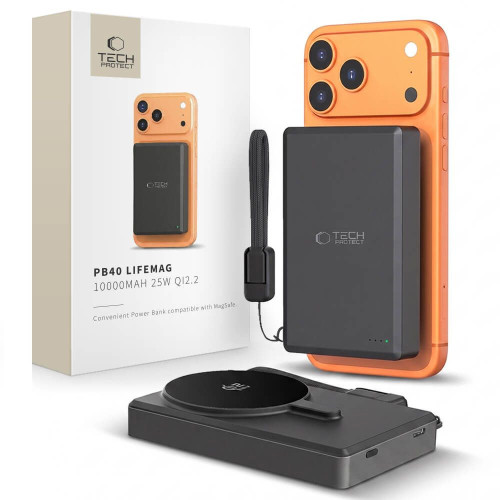
    3. Tech-Protect PB15 LifeMag 10 000 mAh — best MagSafe 10 000 (from 126.65 zł)

    Powerbank Tech-Protect PB15 LifeMag MagSafe 10000mAh

    Tech-Protect PB15 LifeMag is a wireless MagSafe power bank with a capacity of 10 000 mAh at a very good price. Twice the energy of the pocket-sized Spigen, yet still convenient magnetic charging without a cable.

    For whom: for iPhone users who find the small MagSafe insufficient and do not want to overpay.

    4. Baseus Nomos Qi2 10 000 mAh 45 W — best magnetic with fast charging (189.90 zł)

    Magnetic power bank Baseus Nomos Qi2 10000mAh 45W

    Baseus Nomos combines Qi2 magnetic charging with powerful wired charging 45 W via USB-C. You can attach it to your iPhone without a cable, and when you’re in a hurry, just plug in the cable and charge your phone much faster.

    For whom: for those who want both MagSafe convenience and fast wired charging.

    5. 4smarts Lucid Air 26 800 mAh 65 W — the most powerful, for laptops and outdoors (499 zł)

    Powerbank 4smarts Lucid Air 26800mAh 65W for laptop

    4smarts Lucid Air is a true powerhouse: 26 800 mAh, 65 W and a water and dust resistant casing rated IP67. It will charge a laptop at full speed, and multiple ports allow charging several devices at once, even in challenging conditions.

    For whom: for field workers, travelers, and those with a powerful laptop (USB-C PD).

    6. AWEI PA-92 20 000 mAh 22.5 W — the best budget option (75 zł)

    Powerbank AWEI PA-92 20000mAh budget option

    AWEI PA-92 proves that large capacity doesn’t have to cost a fortune. 20 000 mAh, two USB-C ports, and 22.5 W PD support for less than 80 zł is a great price-to-performance ratio.

    For whom: for those looking for a cheap, spacious power bank for backup and for the backpack.

    Power bank comparison — summary table

    Power bank Brand Capacity Power Wireless Price
    PB550 Ugreen 20,000 mAh 67 W 199 zł
    Essential MagSafe Spigen 5,000 mAh 22.5 W (wired) ✅ Qi2 15 W 155 zł
    PB15 LifeMag Tech-Protect 10,000 mAh wireless ✅ MagSafe from 126.65 zł
    Nomos Qi2 Baseus 10,000 mAh 45 W ✅ Qi2 189.90 zł
    Lucid Air 4smarts 26,800 mAh 65 W 499 zł
    PA-92 AWEI 20,000 mAh 22.5 W 75 zł

    Which power bank for what? Recommendations based on needs

    The choice depends on how and where you most often charge your phone. Here are some tips:

    • To iPhone → Spigen Essential MagSafe (155 zł) or larger Tech-Protect PB15 (from 126.65 zł)
    • To the car → Ugreen PB550 20,000 mAh (199 zł) — large capacity for long trips; in the car pair it with a car charger
    • To the airplane → Tech-Protect PB15 10,000 mAh (from 126.65 zł) — lightweight and safely below the 100 Wh limit
    • To the laptop → 4smarts Lucid Air 26,800 mAh 65 W (499 zł) — full USB-C PD power and IP67 resistance
    • For festivals and vacations → AWEI PA-92 20,000 mAh (75 zł) — a lot of energy at a low price

    Tip: for quick charging of the power bank at home, a good USB-C PD wall charger and a USB-C to USB-C cable will be useful. iPhone users will also appreciate MagSafe accessories.

    Do you want to understand the parameters step by step first? Check out the guide which power bank to choose for your phone. And if you are planning a vacation trip, check our compilation of the best power banks for travelers.

    How many mAh will actually charge the phone?

    The declared capacity is not the same as the energy that the phone will actually receive. During voltage conversion, the power bank loses about 20–30%, so from 10,000 mAh you will realistically use about 6,500–7,000 mAh.

    In practice: 10,000 mAh is about 1.5 full charges of a modern phone, 20,000 mAh is 2–3 charges, and 26,800 mAh will allow you to charge your phone even four times or recharge a laptop once. The larger the battery in your phone, the fewer charges you will get from the same capacity.

    Power bank for the airplane — how many Wh can you take?

    A power bank on a plane can only be carried in hand luggage and only up to 100 Wh without the airline’s consent. You can calculate the capacity in watt-hours by multiplying mAh by 3.7 V and dividing by 1000.

    Capacity Energy (Wh) Airplane
    5,000 mAh ~18.5 Wh ✅ allowed
    10,000 mAh ~37 Wh ✅ allowed
    20,000 mAh ~74 Wh ✅ allowed
    26,800 mAh ~99 Wh ✅ at the limit
    30,000 mAh ~111 Wh ❌ requires consent

    All power banks from our ranking (up to 26,800 mAh) can fit in hand luggage. Units of 100–160 Wh require prior consent from the carrier, and those above 160 Wh are prohibited.

    MagSafe and wireless power bank — for whom?

    If you have an iPhone 12 or newer, the MagSafe power bank (Qi2) is quite convenient — you attach it magnetically to the back of the phone and charge without a cable. It’s handy on the go when you want to use your phone while charging.

    Remember two things. Wireless charging is slower (usually 15 W) and less energy-efficient than wired charging, so for a quick battery top-up, a USB-C cable is better. That’s why models like Baseus Nomos combine a magnet with a powerful 45 W port — you get both.

    Summary — which power bank to choose?

    The best power bank of 2026 for most people is the Ugreen PB550 20,000 mAh 67 W (199 PLN) — universal, powerful, and with a built-in cable. iPhone users should opt for the Spigen Essential MagSafe (155 PLN) or the larger Tech-Protect PB15 (from 126.65 PLN), while those with a powerful laptop should consider the 4smarts Lucid Air 26,800 mAh (499 PLN). Looking for high capacity at a low price? The AWEI PA-92 for 75 PLN offers the best value.

    You can find the full offer and current prices in the power banks category on Home Screen (ratings: Allegro 99.8%, Google 4.9/5), with free delivery from 100 PLN.

    FAQ — frequently asked questions about power banks

    What power bank can you take on a plane?

    Na długą trasę w samochodzie warto zabrać powerbank o pojemności 20 000 mAh lub więcej, aby mieć pewność, że naładujesz wszystkie urządzenia. Dobrze jest również wybrać model z funkcją szybkiego ładowania i wieloma portami, aby móc ładować kilka urządzeń jednocześnie.

    For a long trip, a 20,000 mAh power bank with a power of at least 45–67 W, such as the Ugreen PB550, is the best choice. It will charge your phone several times during navigation, and the built-in cable makes it easy to use in the car.

    How long does it take to charge a power bank?

    It depends on the capacity and charging power. A 20,000 mAh power bank with a 65 W port can be charged in about 1.5–2 hours, while an older 18 W model of the same capacity may take 6–8 hours. Therefore, it’s worth choosing power banks that support USB Power Delivery and charging them with a strong wall charger.

    Can you charge a phone and a power bank at the same time?

    Yes, but only if the power bank supports pass-through charging. In that case, you connect the power bank to the outlet and the phone to the power bank, and both charge. Not all models can do this, so check the specifications before purchasing.

  • Best Glass for Vivo X300 Ultra — Ranking and Guide

    Best Glass for Vivo X300 Ultra — Ranking and Guide

    The best glass for the vivo X300 Ultra is Bizon Glass Clear (25 zł) for the screen and Bizon Glass Lens (25 zł) for the camera — a complete protection set for about 50 zł. The X300 Ultra screen is flat, so classic tempered glass adheres perfectly, and the huge camera module practically begs for separate lens protection. Below, we describe all available options, guide you on how to apply the glass step by step, and explain whether budget glass is sufficient for such an expensive phone.

    The vivo X300 Ultra is one of the most expensive camera smartphones on the market, but its protection doesn’t have to cost a fortune. Good glass for a dozen or so złoty can save you from replacing the screen or camera for hundreds. Check what to choose and how to install it.

    What to pay attention to when choosing glass for the vivo X300 Ultra?

    Choosing screen protection is not complicated, but there are a few things worth knowing:

    • Flat screen — the vivo X300 Ultra has a flat display, so full-size tempered glass adheres across the entire surface and does not peel off at the edges
    • Hardness 9H — standard for tempered glass, protects against scratches from keys or sand
    • Oleophobic coating — repels grease from fingers, the screen is easier to clean and remains smooth to the touch
    • Camera protection — with such a large camera module, a separate glass for the lenses is a reasonable expense
    • Touch sensitivity and under-screen fingerprint reader — good glass does not impair the touch functionality or the fingerprint reader
    • Glass or film — glass provides harder protection against drops, film is thinner and handles curves and the back of the case better

    Advice: For the flat screen of the X300 Ultra, classic tempered glass works best. Consider film as an addition for the back of the case or if you prefer a matte, anti-reflective finish.

    Best screen glass for vivo X300 Ultra

    1. Bizon Glass Clear — best overall (25 zł)

    Bizon Glass Clear is a full-size, transparent 9H tempered glass. It provides solid protection against drops and scratches, and thanks to the flat screen of the phone, it adheres to the entire surface. The best choice for most people.

    For whom: for anyone who wants simple, effective screen protection without complications.

    2. GrizzGlass HybridGlass — budget hybrid (13.64 zł)

    GrizzGlass HybridGlass is a flexible hybrid glass at the lowest price. It is thinner than classic glass and resistant to cracks, although it offers slightly less protection against strong impacts.

    For whom: for those looking for savings or preferring a thinner layer.

    3. GrizzGlass SecretGlass — privacy glass (31.84 zł)

    GrizzGlass SecretGlass is a matte glass with a privacy filter — from the side, the screen is unreadable, so no one can peek at what you’re doing. The matte finish also reduces glare.

    For whom: for those concerned about privacy on the train, in the office, or in public transport.

    Tempered glass or hybrid — what to choose?

    This is a common question. Tempered glass is harder (9H), thicker, and better protects against screen breakage when dropped — it is the default choice for flat screens. Hybrid glass is thinner and flexible, making it harder to break, but it absorbs strong impacts less effectively. If you care about maximum protection, choose tempered (Bizon Glass Clear). If you prefer minimal thickness and low price — hybrid (GrizzGlass).

    Camera glass — don’t forget about the lenses

    The camera module of the vivo X300 Ultra protrudes and is prone to scratches when placing the phone down. Separate glass for the lenses is a cheap way to avoid costly repairs — replacing the camera module in this class of phone can cost several hundred zlotys.

    Bizon Glass Lens [2-pack] — the best for the camera (25 zł)

    Bizon Glass Lens is a set of two camera glasses (one spare). It protects the lenses without affecting photo quality.

    GrizzGlass HybridGlass Camera — budget-friendly (9.09 zł)

    GrizzGlass HybridGlass Camera is the cheapest lens protection. A thin, hybrid layer for just under 10 zł.

    Protective films — an alternative and back protection

    If you prefer a film instead of glass or want to protect the back of the case as well, you have three options from GrizzGlass:

    2-in-1 Set — Case plus Glass

    If you want to get protection all at once, check out Bizon Angelo Pack (45 zł) — a smoky case with a black frame, complete with tempered glass. It’s the cheapest way to fully protect your phone and screen.

    Comparison of glasses and films for vivo X300 Ultra

    ProductTypeProtectionPrice
    Bizon Glass Cleartempered glass (screen)full, 9H25 zł
    GrizzGlass HybridGlasshybrid glass (screen)good, thin13,64 zł
    GrizzGlass SecretGlassprivacy glass (screen)full + privacy31,84 zł
    Bizon Glass Lens [2-pack]glass for cameralenses25 zł
    GrizzGlass HybridGlass Cameraglass for cameralenses9,09 zł
    GrizzGlass CeramicFilmfilm (screen)flexible12,73 zł
    GrizzGlass PaperScreenmatte film (screen)anti-glare14,55 zł
    GrizzGlass SatinSkinfilm (back)back of the case14,55 zł
    Bizon Angelo Packcase + glassset45 zł

    How to apply tempered glass on vivo X300 Ultra — step by step

    Applying the glass yourself takes a few minutes. The most important thing is the cleanliness of the screen — it determines whether air bubbles will remain.

    1. Clean the screen — wipe it with a microfiber cloth, and if necessary, with a tissue soaked in isopropyl alcohol. Finally, remove dust particles with a sticker (usually included in the set).
    2. Choose a dust-free place — preferably the bathroom after a shower, where steam has settled the dust.
    3. Test the glass dry — check how the cutouts for the speaker and camera fit before removing the film.
    4. Remove the bottom protective layer from the glass and align it evenly from one edge.
    5. Lower the glass — it will stick by itself. Any air bubbles can be pushed out with your finger or a cloth from the inside out.
    6. Remove the top film and wipe the screen. Small bubbles at the edges usually disappear after a few hours.

    Tip: If dust remains under the glass, gently lift the glass with tape, remove the particle, and reapply. Do not touch the sticky side with your fingers.

    Which glass to choose? Recommendations based on needs

    • Best screen protection → Bizon Glass Clear (25 zł) — full-size 9H glass
    • Cheapest → GrizzGlass HybridGlass (13,64 zł) for the screen + HybridGlass Camera (9,09 zł) for the camera
    • Privacy → GrizzGlass SecretGlass (31,84 zł)
    • Matte, anti-reflective → PaperScreen film (14,55 zł)
    • Everything at once → Bizon Angelo Pack — case + glass (45 zł)

    Summary

    The best glass for the vivo X300 Ultra is the classic Bizon Glass Clear for flat screens, ideally paired with Bizon Glass Lens for the camera — a complete protection set for about 50 zł. Looking to save? Opt for hybrid GrizzGlass glasses starting at 9 zł. Prefer a film or back protection? GrizzGlass offers matte PaperScreen and SatinSkin. All of these are budget brands, but they protect just as effectively as more expensive options on a flat screen.

    All tempered glasses, films, and sets for this model can be found in the category accessories for vivo X300 Ultra at Home Screen (ratings: Allegro 99.8%, Google 4.9/5), with free delivery from 100 zł. Curious why this phone takes such great photos? Check out our ranking of the best phones for photos 2026, where the vivo X300 Ultra ranks first.

    FAQ — glass for vivo X300 Ultra

    Does the vivo X300 Ultra have a flat screen?

    Yes, the vivo X300 Ultra has a flat display. This allows classic, full-sized tempered glass (e.g., Bizon Glass Clear) to adhere across the entire surface and not peel off at the edges, as was the case with older curved screens.

    How to apply tempered glass on vivo X300 Ultra?

    Thoroughly clean the screen with a cloth and dust sticker, dry-fit the glass, remove the bottom film, and align the glass evenly from one edge. The glass will adhere itself, and you can push air bubbles from the inside out. We described the entire process step by step above.

    Tempered glass or hybrid for vivo X300 Ultra?

    For a flat screen, tempered glass is better — it is harder (9H) and provides better protection against breakage when dropped. Hybrid glass is thinner and more flexible, harder to break, but absorbs strong impacts less effectively. Choose tempered for maximum protection, hybrid for minimal thickness and the lowest price.

    How much does glass for vivo X300 Ultra cost?

    Screen glasses start at around 14 PLN (GrizzGlass HybridGlass), while classic tempered glass Bizon Glass Clear costs 25 PLN. Glass for the camera ranges from 9 to 25 PLN. A complete set for screen and camera protection will cost you around 35–50 PLN.

    Is it worth buying glass for the camera of vivo X300 Ultra?

    Yes. The camera module in the X300 Ultra is large and protrudes, so lenses can easily get scratched when putting the phone down. A glass protector for a dozen or so zlotys protects against costly repairs and does not worsen photo quality.

    Does budget glass protect an expensive phone well?

    Yes. The most important factor is the hardness of 9H and a good fit, which are also provided by cheaper brands like Bizon or GrizzGlass. With a flat screen, you don’t need expensive molded glass, and it’s easier to replace cheaper options after scratching.

  • WWDC 2026 — what to expect? iOS 27 and the new Siri

    WWDC 2026 — what to expect? iOS 27 and the new Siri

    WWDC 2026 starts on June 8, and the highlight of the keynote (at 7:00 PM Polish time) will be iOS 27 along with a thoroughly redesigned Siri based on Apple Intelligence. Apple will showcase six new systems: iOS 27, iPadOS 27, macOS 27, watchOS 27, tvOS 27, and visionOS 27. This is a fully software-focused conference, so we probably won’t see any new hardware.

    Looking for specifics, not marketing fluff? Below we have gathered everything that is known about iOS 27 before the official feature presentation: key new features, a list of supported iPhones, the release date, and what WWDC 2026 means for your phone. No beating around the bush.

    When is the iOS 27 release?

    The iOS 27 developer beta will appear on June 8, 2026, right after the keynote. The public iOS 27 beta is expected in July, and the final, stable version will be available to everyone in the fall of 2026, shortly after the September launch of the iPhone 18 series (iOS 27 release date).

    When is WWDC 2026 and how to watch the keynote?

    WWDC 2026 runs from June 8 to June 12, 2026. The keynote opening the conference takes place on Monday June 8 at 10:00 AM Pacific Time, which is 7:00 PM in Poland. It is during this presentation that Apple will showcase all the new operating systems.

    You can watch the stream for free live on the Apple Developer website, in the Apple TV app, and on Apple’s YouTube channel. The conference has a hybrid format: online sessions for developers from around the world and an in-person event at Apple Park.

    W skrócie: jeśli interesuje Cię tylko to, co dostaniesz na swój iPhone, wystarczy keynote 8 czerwca. Reszta tygodnia to sesje techniczne dla programistów.

    iOS 27 — co nowego w aktualizacji?

    iOS 27 to największa premiera WWDC 2026. Według zgodnych doniesień Apple skupia się tym razem na stabilności, wydajności i czasie pracy baterii, a nie na rewolucji wizualnej. Wewnętrznie projekt porównywany jest do legendarnego „Snow Leoparda» — wydania, które dopracowało system zamiast dokładać dziesiątki funkcji.

    To nie znaczy, że nowości zabraknie. Oto najważniejsze zmiany, których spodziewamy się w iOS 27:

    • Nowa Siri z Apple Intelligence — funkcje obiecane jeszcze przy iOS 18 mają w końcu trafić do użytkowników
    • Siri jako chatbot — pełnoprawny tryb konwersacyjny, działający podobnie do ChatGPT czy Claude, z osobną aplikacją Siri
    • Osoblig kontekst — Siri ma rozumieć, co jest na ekranie, i wykonywać akcje wewnątrz oraz pomiędzy aplikacjami
    • Regulacja Liquid Glass — systemowy suwak do dostosowania intensywności efektu Liquid Glass w całym systemie
    • Inteligentne zdjęcia — edycja oparta o AI w aplikacji Zdjęcia oraz nowe funkcje Visual Intelligence w aparacie
    • Optymalizacje pod składany iPhone — tryb dwóch aplikacji obok siebie, przygotowujący grunt pod iPhone’a Fold

    Odnowiona Siri — najważniejsza zmiana

    Przebudowa Siri to gwóźdź programu. Asystent ma zyskać „pamięć» kontekstu, świadomość tego, co widzisz na ekranie, i zdolność do realnego działania w aplikacjach — np. „wyślij zdjęcia z wczorajszego spaceru do Ani». Po latach obietnic Siri ma wreszcie dogonić konkurencję.

    Po raz pierwszy pojawi się też samodzielna aplikacja Siri w trybie czatu. To duża zmiana filozofii: zamiast krótkich komend, prowadzisz rozmowę.

    iOS 27 — jakie telefony obsługują aktualizację?

    iOS 27 obsługuje iPhone’y od modelu 12 wzwyż oraz iPhone SE 3. generacji (tzw. iOS 27 supported devices). Z listy wypadają iPhone 11, 11 Pro, 11 Pro Max oraz iPhone SE 2. generacji (2020) — to one tracą wsparcie w tym roku.

    Co ważne, sama aktualizacja to nie wszystko. Apple Intelligence wymaga mocniejszego procesora, dlatego pełnię funkcji AI dostaną tylko nowsze modele. Kompatybilność dzieli się na trzy poziomy:

    iPhoneiOS 27Apple Intelligence
    iPhone 17, Air, 17 Pro, 17 Pro Max
    iPhone 16, 16 Plus, 16 Pro, 16 Pro Max, 16e
    iPhone 15 Pro, 15 Pro Max
    iPhone 15, 15 Plus
    iPhone 14 (wszystkie)
    iPhone 13 (wszystkie)
    iPhone 12 (wszystkie)
    iPhone SE (3. gen)
    iPhone 11 i starsze

    W praktyce: jeśli masz iPhone’a 15 Pro lub nowszego, dostaniesz pełnię iOS 27 z funkcjami AI. Masz iPhone’a 12-15 (bez Pro)? Zaktualizujesz system, ale bez Apple Intelligence. iPhone 11 i starsze zostają na iOS 26.

    Planujesz przesiadkę na nowszy model? Jeśli zależy Ci na pełnej Apple Intelligence, celuj minimum w iPhone’a 15 Pro. Najnowsze flagowce z pełnym wsparciem AI znajdziesz wraz z akcesoriami do iPhone’a w Home Screen — od etui po szkła hartowane.

    Nowości w iPadOS 27, macOS 27, watchOS 27 i pozostałych systemach

    WWDC 2026 is not just about the iPhone. Apple is unifying the experience across all devices, and the «27» numbering encompasses the entire portfolio.

    • iPadOS 27 — further development of multitasking and windows, bringing the iPad closer to the Mac
    • macOS 27 — another release for Macs, focusing on performance and integration with Apple Intelligence
    • watchOS 27 — new watch faces, including the Modular Ultra variant with a large clock and three complications
    • visionOS 27 — development of the system for Apple Vision Pro
    • tvOS 27 — a refresh for Apple TV, with rumors of new hardware in the background

    The consistent «27» numbering means that your iPhone, iPad, Apple Watch, and Mac will receive updates in the same cycle. This is convenient if you use multiple Apple devices at once.

    Will there be new hardware at WWDC 2026?

    Probably not. WWDC has been a software conference for years, and Apple reserves hardware launches for the fall. There are whispers about a new Apple TV and a refreshed Mac mini, but none of these devices have been confirmed.

    If you’re waiting for a new iPhone, the real launch will take place in September 2026 along with the iPhone 18 series. WWDC is a preview of how your current phone will change after the fall update. And if you’re comparing cameras before making a purchase, check out our ranking of the best phones for photos 2026.

    What does WWDC 2026 mean for your iPhone?

    The biggest benefits will go to owners of the iPhone 15 Pro and newer — they will receive the full Apple Intelligence and the new Siri. If you have an older model, iOS 27 will still bring better stability and longer battery life, which is more important for many people than additional AI features.

    The new system is also a good time to take care of your hardware. The update doesn’t change the physical protection of the phone, and a well-chosen case and glass still protect against the most common cause of service, which is dropping. Check out cases for the iPhone 17 Pro Max if you’re using the latest flagship.

    Owners of newer iPhones will also appreciate the wireless charging ecosystem. After the update, it’s worth supplementing your set with MagSafe accessories and a power bank for a longer day, especially when new AI features drain the battery.

    A since the «27» systems cover the entire Apple portfolio, it’s a good opportunity to organize accessories for other devices: AirPods case and iPad accessories will be useful for anyone using multiple devices at once.

    Summary — key facts about WWDC 2026

    WWDC 2026 is primarily about software and artificial intelligence. Here are the key takeaways:

    1. Keynote on June 8 at 19:00 Polish time, free online broadcast
    2. iOS 27 focuses on stability, battery life, and a new Siri with Apple Intelligence
    3. Siri gains a chatbot mode, personal context, and a separate app
    4. Support from iPhone 12, but full AI features only from iPhone 15 Pro
    5. No new hardware — device launches only in the fall

    The best time to make a purchasing decision will come after the keynote when we learn the full list of features. If you’re already planning a new phone or want to secure your current one, check out the full range of iPhone accessories at Home Screen (ratings: Allegro 99.8%, Google 4.9/5), with free delivery from 100 PLN.

    FAQ — frequently asked questions about WWDC 2026 and iOS 27

    When is the iOS 27 premiere?

    The developer version of iOS 27 usually appears right after the keynote, on June 8, 2026. The public beta is expected in July, and the final, stable version will be available to everyone in the fall of 2026, shortly after the September launch of the iPhone 18 series.

    What’s new in iOS 27?

    The most significant change is the revamped Siri with Apple Intelligence: a chatbot mode, context understanding, and a separate app. Additionally, Apple focuses on stability and longer battery life, adds a system-wide Liquid Glass adjustment slider, AI-based photo editing, and new Visual Intelligence features in the camera.

    Which iPhones will get iOS 27?

    iOS 27 supports iPhones from model 12 and above, as well as the iPhone SE 3rd generation. Support is dropped for the iPhone 11, 11 Pro, 11 Pro Max, and iPhone SE 2nd generation (2020). The full Apple Intelligence will only be available on the iPhone 15 Pro models and newer.

    Will the new Siri be available in Polish?

    Apple Intelligence gradually adds more languages, but Polish has not yet been among the first supported. The official list of languages is usually provided by Apple at the premiere, so it’s worth checking the availability of the new Siri in Polish after the keynote.

    Will they show a new iPhone at WWDC 2026?

    No. WWDC is a software conference. Apple presents new iPhones every fall, so we expect the iPhone 18 series only in September 2026.

    Is it worth waiting to buy an iPhone until WWDC?

    WWDC does not introduce new phones, so it does not directly affect hardware prices. If you need an iPhone now, there is no point in waiting for the keynote. It is worth knowing that the full iOS 27 with AI will be available on models from iPhone 15 Pro and above.

    Where to watch the WWDC 2026 keynote live?

    You can watch the keynote for free on the Apple Developer website, in the Apple TV app, and on Apple’s official YouTube channel. The broadcast starts on June 8 at 19:00 Polish time.

  • Best phone for photos 2026 – TOP 6 flagship ranking

    Best phone for photos 2026 – TOP 6 flagship ranking

    What is the best smartphone for photos in 2026? The answer is not straightforward — each manufacturer focuses on different strengths.

    In this ranking of photo phones, we compare six flagships sorted by camera quality (DxOMark) — from the record-breaking sensor of the vivo X300 Ultra with ZEISS optics, through the dual 200 MP camera of the Oppo Find X9 Ultra with Hasselblad, to the 8x zoom of the iPhone 17 Pro Max and the 1-inch sensor of the Xiaomi 17 Ultra with Leica optics.

    Ranking of the best photo phones 2026 — quick overview

    Before we move on to a detailed analysis, here is a summary of our top six at a glance:

    PositionModelDxOMarkMain sensorOptical zoomPrice from
    1.vivo X300 Ultra170 points200 MP, Sony LYTIA-901 (1/1.12″)3.5x (17x with ZEISS extender)8,499 PLN
    2.Oppo Find X9 Ultraexpected*200 MP, Hasselblad (1/1.12″)10x (periscope 230 mm)7,399 PLN
    3.Apple iPhone 17 Pro Max168 points48 MP, sensor 1/1.28″8x (tetra-prism, 200 mm)6,299 PLN
    4.Xiaomi 17 Ultra166 points50 MP, Light Fusion 1050L (1″)4.3x (mechanical zoom Leica)6,499 PLN
    5.Google Pixel 10 Pro163 points50 MP, Samsung GNK (1/1.31″)5x (100x Pro Res Zoom)~3,450 PLN
    6.Samsung Galaxy S26 Ultra157 points200 MP, ISOCELL HP2 (1/1.3″)2x/3x/5x/10x6,499 PLN

    *Oppo Find X9 Ultra — DxOMark score not yet published; sibling Find X9 Pro scored 166 points (worldwide TOP 6).


    1. Vivo X300 Ultra — record sensor 1/1.12″ and ZEISS optics

    vivo X300 Ultra is the best camera phone of 2026 according to DxOMark (170 pts) — the highest score in the entire ranking. Equipped with a record sensor Sony LYTIA-901 sized 1/1.12″ and full ZEISS T* APO optical certification, it approaches the capabilities of mirrorless cameras more than any competitor.

    Camera System

    LensResolutionSensorFocal Length
    Main200 MPSony LYTIA-901 (1/1.12″)35 mm
    Ultrawide50 MPSony LYTIA-818 (1/1.28″)14 mm
    Periscope Telephoto200 MPSamsung ISOCELL HP01 (1/1.4″)3.5x
    Multispectral5 MP
    Front50 MP (AF)

    Why Number 1?

    vivo X300 Ultra leads the DxOMark ranking with a score of 170 pts (Photo 174, Video 162) — higher than the iPhone 17 Pro Max (168 pts). A key element is the accessory ZEISS Telephoto Extender Gen 2 Ultra — an attachable lens that increases zoom from 3.5x to 17x optical (equivalent to 400 mm). It is the only smartphone on the market capable of achieving such zoom fully optically. With the extender, you maintain the full resolution of 200 MP.

    Główny sensor 1/1.12″ zbiera jeszcze więcej światła niż 1-calowy sensor Xiaomi 17 Ultra. Ultraszeroki 50 MP z sensorem 1/1.28″ jest większy niż główne sensory wielu flagowców — to unikalna cecha vivo.

    Wideo i funkcje specjalne

    Nagrywanie 4K przy 120 kl/s Dolby Vision HDR na wszystkich obiektywach tylnych z trybem 10-bit Log. vivo oferuje też ekosystem akcesoriów SmallRig (klatka wideo). Warto wiedzieć, że to właśnie wideo (162 pkt) — zwłaszcza w słabym świetle — jest jedynym obszarem, w którym X300 Ultra nieznacznie ustępuje siostrzanemu X300 Pro.

    Porada: vivo X300 Ultra jest już dostępne w Polsce (od 8 499 zł). Zabezpiecz rekordowy moduł aparatu — sprawdź etui i akcesoria do vivo X300 Ultra w Home Screen.

    Mocne i słabe strony

    Mocne strony: Najwyższy wynik DxOMark (170 pkt), największe sensory (1/1.12″ i 1/1.28″), 17x zoom optyczny z extenderem ZEISS, podwójne aparaty 200 MP, 4K 120 fps Dolby Vision.

    Weaknesses: The most expensive option in the ranking (8,499 zł), the ZEISS extender is an additional purchase, video in low light is weaker than photo (162 points), the 35 mm focal length may be too wide for portraits.


    2. Oppo Find X9 Ultra — dual camera 200 MP and 10x Hasselblad zoom

    The Oppo Find X9 Ultra is a direct competitor to vivo for the crown of the best camera in 2026. It combines record-breaking main sensor 1/1.12″ (the same size as in vivo) with something that no other competitor in this comparison has — dual telephoto lens, including a true 10x optical periscope. The whole is complemented by Hasselblad color calibration.

    Camera system

    LensResolutionSensorApertureFocal length
    Main (Hasselblad)200 MP1/1.12″f/1.523 mm
    Ultrawide50 MP1/1.95″f/2.014 mm
    3x Telephoto (periscope)200 MP1/1.28″f/2.270 mm
    10x Telephoto (periscope)50 MP1/2.75″f/3.5230 mm
    Front50 MP (AF)1/2.75″f/2.421 mm

    What distinguishes the Oppo Find X9 Ultra?

    The strongest point is the dual telephoto lens setup — 200 MP periscope 3x (70 mm) for portraits and 50 MP periscope 10x (230 mm) for distant shots, with a range of up to 120x hybrid zoom. It is the only phone in the ranking with two periscopes and true 10x optical zoom without additional accessories. The main sensor 1/1.12″ with Hasselblad optics and a bright f/1.5 aperture collects as much light as the record holder vivo.

    Powered by the Snapdragon 8 Elite Gen 5 processor and a 7050 mAh battery (100 W wired, 50 W wireless), the Find X9 Ultra is also a marathon of performance. The Hasselblad Portrait mode and LUMO True Face algorithm ensure natural skin tones and bokeh.

    Video and special features

    Recording 8K at 30 fps and 4K at 120 fps in Dolby Vision, with 10-bit O-Log2 format and cinematic LUT support on multiple lenses. It is a fully-fledged tool for both photo and video.

    Advice: Oppo Find X9 Ultra debuted in Poland at a price of 7,399 PLN (12/512 GB). The Hasselblad module is worth protecting — check cases and glass for Oppo Find X9 Ultra at Home Screen.

    Strengths and weaknesses

    Strengths: Dual telephoto lens with true 10x optical zoom (230 mm), main sensor 1/1.12″ 200 MP, Hasselblad calibration, 8K recording, 7050 mAh battery, price lower than vivo (7,399 PLN).

    Weaknesses: Official DxOMark score not yet published, ultra-wide sensor smaller than in vivo, lack of extender increasing zoom beyond 10x.


    3. Apple iPhone 17 Pro Max — 8x tetraprism zoom and video master

    Apple iPhone 17 Pro Max (168 points DxOMark) is the best phone for video recording in 2026 and the most powerful iPhone in history in terms of camera. A huge leap in telephoto — from 5x to 8x optical zoom with a new tetraprism and 48 MP sensor — places it among the top photographic smartphones.

    Camera system

    ObiektywRozdzielczośćSensorPrzysłonaOgniskowa
    Główny48 MP Fusion1/1.28″f/1.524 mm
    Ultraszeroki48 MPf/2.213 mm
    Teleobiektyw 8x (tetrapryzmat)48 MP56% większy sensorf/2.8200 mm
    Przedni (Centre Stage)18 MPkwadratowy sensorf/2.2

    Co wyróżnia iPhone’a?

    iPhone 17 Pro Max wprowadza przełomowy teleobiektyw — 48 MP sensor z 8-krotnym zoomem optycznym (200 mm) na tetrapryzmie nowej generacji. To najdłuższa ogniskowa w historii iPhone’a. Dzięki crop z sensora 48 MP, jakość optyczna utrzymuje się nawet przy 16-krotnym zakresie zoomu. To ogromny postęp względem 12 MP teleobiektywu w poprzedniku.

    Wideo pozostaje wizytówką Apple — 4K Dolby Vision, ProRes Log, Cinematic Mode i Spatial Video dla Apple Vision Pro. Nowa kamera przednia 18 MP z kwadratowym sensorem Centre Stage pozwala obracać orientację zdjęcia bez obracania telefonu. Fizyczny przycisk Camera Control zamienia iPhone’a w intuicyjny aparat.

    Porada: Sprawdź etui i szkła hartowane do iPhone 17 Pro Max w Home Screen — zabezpieczysz aparat i wyświetlacz jednocześnie.

    Mocne i słabe strony

    Mocne strony: Wysoki wynik DxOMark (168 pkt), 8x zoom optyczny 48 MP (200 mm), najlepsze wideo (4K ProRes Log), Camera Control, Spatial Video.

    Słabe strony: Brak 8K wideo, wysoka cena od 6 299 zł, mniejszy główny sensor niż vivo, Oppo i Xiaomi.


    4. Xiaomi 17 Ultra — 1-calowy sensor i mechaniczny zoom Leica

    Xiaomi 17 Ultra is a smartphone designed for photography — the 1-inch main sensor Light Fusion 1050L and mechanical optical zoom certified by Leica APO blur the line between a smartphone and a mirrorless camera more than ever.

    Camera System

    LensResolutionSensorApertureFocal Length
    Main50 MPLight Fusion 1050L (1″)f/1.6723 mm
    Ultrawide50 MPf/2.214 mm
    Telephoto (mechanical zoom)200 MP1/1.4″75–100 mm (4.3x)
    Front32 MPf/2.0

    What distinguishes Xiaomi 17 Ultra?

    Xiaomi 17 Ultra has a 1-inch sensor in the main camera — it is one of the largest sensors among smartphones in 2026; only the vivo X300 Ultra and Oppo Find X9 Ultra have larger 1/1.12″ sensors. The Light Fusion 1050L sensor with LOFIC HDR technology offers a full well capacity 6.3 times greater than its predecessor, the Xiaomi 15 Ultra. In practice, this means phenomenal dynamic range — details in both bright and dark areas of the photo.

    Telephoto 200 MP z sensorem 1/1.4″ to rewolucja — mechaniczny system optycznego zoomu z trzema grupami soczewek zmienia ogniskową od 75 do 100 mm. Leica APO eliminuje aberracje chromatyczne, a zoom optycznej jakości sięga ekwiwalentu 400 mm. Specjalna edycja Leica Leitzphone dodaje fizyczny pierścień zoomu na obudowie.

    Wideo i funkcje specjalne

    Nagrywanie 8K przy 24 kl/s, 4K przy 120 kl/s Dolby Vision, tryb Movie z pełną kontrolą manualną i wsparciem 10-bit Log. Xiaomi 17 Ultra to poważne narzędzie dla twórców wideo.

    Porada: Xiaomi 17 Ultra z modułem aparatu Leica wymaga solidnej ochrony — sprawdź etui do Xiaomi 17 Ultra w Home Screen.

    Mocne i słabe strony

    Mocne strony: 1-calowy sensor główny, mechaniczny zoom optyczny, 200 MP teleobiektyw, optyka Leica APO, 6 500 mAh bateria.

    Słabe strony: Brak wersji z extenderem (jak vivo), 32 MP kamera selfie słabsza niż Pixel 10 Pro, cena od 6 499 zł.


    5. Google Pixel 10 Pro — mistrz sztucznej inteligencji z 100x Pro Res Zoom

    Google Pixel 10 Pro to najlepszy telefon do zdjęć 2026 dla osób, które chcą zrobić idealne zdjęcie bez zastanawiania się nad ustawieniami. Chip Tensor G5 z ulepszoną jednostką TPU napędza potężne funkcje AI, a nowy 100x Pro Res Zoom wreszcie stawia Pixela na równi z Samsungiem w kwestii zbliżeń. Wynik 163 pkt w DxOMark to mocne miejsce w światowej czołówce.

    System aparatów

    ObiektywRozdzielczośćSensorPrzysłonaOgniskowa
    Główny50 MPSamsung GNK (1/1.31″)f/1.6824 mm
    Ultraszeroki (AF)48 MP1/2.55″f/1.712 mm
    Teleobiektyw 5x (peryskop)48 MP1/2.55″f/2.8110 mm
    Przedni42 MPf/2.218 mm

    Co wyróżnia Pixela 10 Pro?

    Google Pixel 10 Pro dziedziczy najlepsze cechy poprzednika i dodaje kluczowe ulepszenia:

    • 100x Pro Res Zoom — AI-wspomagany zoom z jakością optyczną do 10x
    • 50 MP portrety — nowa jakość zdjęć portretowych dzięki Tensor G5
    • 8K wideo — upscaling chmurowy do 8K z 4K, nowa funkcja Pixela
    • Magic Eraser — usuwanie niechcianych obiektów i osób ze zdjęć
    • Magic Editor — generatywna AI do modyfikacji elementów zdjęcia
    • Best Take — składanie najlepszych min z wielu ujęć
    • Night Sight Video — nagrywanie wideo w słabym oświetleniu z AI

    Ultraszeroki obiektyw z autofocusem (f/1.7!) to jeden z najjaśniejszych w branży. Przedni aparat 42 MP z najszerszym kątem widzenia (18 mm) robi najlepsze selfie w tym zestawieniu.

    Porada: Pixel 10 Pro to najkorzystniej wyceniony flagowiec w tym zestawieniu — od ~3 450 zł. Sprawdź dostępne akcesoria do Google Pixel 10 Pro w Home Screen.

    Mocne i słabe strony

    Mocne strony: DxOMark 163 pkt, najlepsze funkcje AI, 50 MP portrety, naturalne odwzorowanie kolorów, najlepsza kamera selfie (42 MP), najniższa cena.

    Słabe strony: 8K tylko przez upscaling chmurowy, Tensor G5 słabszy w ogólnej wydajności niż Snapdragon, mniejsze sensory niż Xiaomi, vivo i Oppo.


    6. Samsung Galaxy S26 Ultra — king of zoom and versatility

    Samsung Galaxy S26 Ultra (157 pts DxOMark) is the best camera phone of 2026 for those who value versatility. The quadruple camera system covers every photographic scenario — from ultra-wide landscapes to details of distant objects thanks to 100x Space Zoom.

    Camera system

    LensResolutionSensorApertureFocal Length
    Main200 MPSamsung ISOCELL HP2 (1/1.3″)f/1.423 mm
    Ultra-wide50 MPSamsung ISOCELL JN3 (1/2.5″)f/1.9120° FoV
    3x Telephoto10 MPSony IMX754 (1/3.94″)f/2.467 mm
    5x Telephoto (periscope)50 MPSony IMX854 (1/2.52″)f/2.9111 mm
    Front12 MPf/2.226 mm

    Why is it still in the TOP 6?

    Samsung Galaxy S26 Ultra inherits the proven quad zoom system from the S25 Ultra, but introduces key optical improvements — aperture f/1.4 in the main lens (47% brighter than f/1.7 in its predecessor) and f/2.9 in the periscope (37% brighter than f/3.4). Four optical focal lengths (23, 67, 111 mm + ultra-wide) still represent the widest zoom range among smartphones — no competitor offers this.

    Video on this smartphone is in a league of its own — recording 8K at 30 fps on three lenses, Galaxy Log mode, and new 60 W charging. DxOMark points out issues with exposure and AF in low light, but in everyday use, the Galaxy S26 Ultra remains an incredibly versatile tool.

    Advice: Samsung Galaxy S26 Ultra is a premium flagship — it’s worth protecting it with a solid case for Galaxy S26 Ultra that will protect the titanium frame and glass back.

    Strengths and weaknesses

    Strengths: The widest zoom range (4 focal lengths), brighter aperture f/1.4, 8K recording, 60 W charging, Galaxy Log mode.

    Weaknesses: DxOMark 157 points (lowest in the ranking), 3x telephoto only 10 MP, unstable exposure according to DxOMark, high price starting from 6,499 PLN.


    Best phone for photos 2026 — comparison in every scenario

    The best flagship for photos is not just about specifications — it’s also about software, AI processing, and the accessory ecosystem. The following comparison of phones with the best camera considers key photographic scenarios.

    ScenarioBest ChoiceWhy?
    Highest DxOMark Scorevivo X300 Ultra170 points — leader of the entire ranking
    Daytime Photosvivo X300 UltraLargest sensor 1/1.12″, 200 MP
    Night PhotosXiaomi 17 Ultra1-inch sensor + LOFIC HDR, phenomenal dynamic range
    Long Zoom (>5x)Oppo Find X9 UltraTrue 10x optical zoom (230 mm) + 120x hybrid
    PortraitXiaomi 17 UltraMechanical Leica zoom 75-100 mm, natural bokeh
    SelfieGoogle Pixel 10 Pro42 MP, widest angle 18 mm
    Professional VideoiPhone 17 Pro Max4K ProRes Log, Dolby Vision
    Casual VideoSamsung Galaxy S26 Ultra8K on three lenses
    Action Photos (Sports)vivo X300 Ultra17x optical zoom with ZEISS extender
    AI PhotographyGoogle Pixel 10 ProMagic Eraser, Best Take, 100x Pro Res Zoom
    Price to Quality RatioGoogle Pixel 10 ProFrom ~3,450 PLN for a flagship camera

    Best Phone for Photos 2026 — Which One to Choose?

    The choice of the best phone for photos in 2026 depends on your photography style and budget.

    For maximum photo quality: vivo X300 Ultra — DxOMark leader (170 pts) with a record 1/1.12″ sensor and 17x optical zoom with ZEISS extender. The best choice if you take mobile photography seriously.

    For zoom and Hasselblad fans: Oppo Find X9 Ultra — dual telephoto lens with a true 10x optical zoom (230 mm) and 1/1.12″ sensor, priced lower than vivo (7,399 PLN).

    For versatile photographers: Samsung Galaxy S26 Ultra — covers every scenario from ultra-wide to 100x zoom. A brighter f/1.4 aperture is a clear improvement over its predecessor.

    For photography enthusiasts: Xiaomi 17 Ultra — 1-inch sensor and Leica mechanical zoom offer image quality unavailable on any other smartphone at this price.

    For filmmakers and video creators: iPhone 17 Pro Max — ProRes Log, 8x zoom 48 MP, and Spatial Video are professional tools in a smartphone.

    For those who value simplicity and value: Google Pixel 10 Pro — Google’s artificial intelligence with 100x Pro Res Zoom does most of the work for you, and the price starting at ~3,450 PLN is unbeatable.

    Our verdict: vivo X300 Ultra is the best phone for photos in 2026 according to DxOMark (170 pts) — the record 1/1.12″ sensor and ZEISS optics give it the crown. Right behind it is the Oppo Find X9 Ultra with a dual 200 MP camera and true 10x Hasselblad zoom, as well as the iPhone 17 Pro Max (168 pts) — the best for video. For those looking for the best value for money, the Google Pixel 10 Pro (163 pts, starting at ~3,450 PLN) remains unmatched.

    Flagshipy z dużymi sensorami zużywają więcej energii podczas fotografowania — sprawdź ładowarki sieciowe z USB-C PD, by szybko naładować telefon po całodniowej sesji zdjęciowej. Na dłuższą sesję w plenerze warto zabrać powerbank — zwłaszcza że nagrywanie 4K i 8K potrafi wyczerpać nawet baterię 7 000 mAh w kilka godzin.


    Najczęściej zadawane pytania (FAQ)

    Jaki jest najlepszy telefon do zdjęć w 2026 roku?

    Najlepszym telefonem do zdjęć w 2026 roku jest vivo X300 Ultra z wynikiem 170 pkt w DxOMark — rekordowy sensor 1/1.12″, optyka ZEISS i 17x zoom optyczny z extenderem. Tuż za nim Oppo Find X9 Ultra (podwójny aparat 200 MP, prawdziwy 10x zoom Hasselblad), Apple iPhone 17 Pro Max (168 pkt) z 8x zoomem i najlepszym wideo oraz Xiaomi 17 Ultra (166 pkt) z 1-calowym sensorem Leica.

    Który telefon robi najlepsze zdjęcia nocne?

    Xiaomi 17 Ultra z 1-calowym sensorem Light Fusion 1050L i technologią LOFIC HDR oferuje fenomenalny zakres dynamiczny w słabym oświetleniu. vivo X300 Ultra i Oppo Find X9 Ultra z sensorami 1/1.12″ również radzą sobie doskonale po zmierzchu, a Samsung Galaxy S26 Ultra z przysłoną f/1.4 (47% jaśniejszą niż poprzednik) świetnie sprawdza się w nocy.

    Is the vivo X300 Ultra available in Poland?

    Yes — the vivo X300 Ultra has been available in Poland since April 16, 2026, priced at 8,499 PLN (16 GB/1 TB version). The smartphone can be purchased at Media Expert, RTV Euro AGD, x-kom, and from the operator Plus, in the colors Steppe Green and Volcanic Black.

    Which flagship has the best zoom?

    In terms of pure optical zoom without accessories, the best is the Oppo Find X9 Ultra with a true 10x periscope (230 mm) and a range of up to 120x. The Samsung Galaxy S26 Ultra offers a quadruple optical system (2x/3x/5x/10x) and Space Zoom 100x, while the vivo X300 Ultra with the ZEISS extender achieves 17x pure optical zoom. The iPhone 17 Pro Max features a new 8x optical zoom 48 MP (200 mm).

    Oppo Find X9 Ultra or vivo X300 Ultra — which one to choose?

    Both have the same record-breaking main sensor 1/1.12″ 200 MP. The vivo X300 Ultra leads in DxOMark (170 points) and offers 17x optical zoom with an additional ZEISS extender and a larger ultra-wide. The Oppo Find X9 Ultra features a built-in dual telephoto lens with a true 10x zoom (without accessories), Hasselblad calibration, and a lower price (7,399 PLN vs 8,499 PLN). Choose vivo for maximum quality and zoom range, Oppo for convenience and better price.

    Is the Google Pixel 10 Pro a good choice for mobile photography?

    Yes — Google Pixel 10 Pro is an excellent choice, especially at its price (from ~3,450 PLN). The Tensor G5 powers unique AI features like Magic Eraser, 100x Pro Res Zoom, and Best Take. Natural color reproduction and Night Sight Video mode set it apart from the competition.

    Samsung Galaxy S26 Ultra or Xiaomi 17 Ultra — which is better for photos?

    Samsung Galaxy S26 Ultra excels in zoom versatility (4 focal lengths) and 8K recording on three lenses. Xiaomi 17 Ultra dominates in single photo quality thanks to its 1-inch sensor and Leica APO optics with mechanical zoom. Samsung is better for sports and wildlife photography, while Xiaomi is better for portraits and street photography.

  • Best phone for photos 2026 — TOP 6 flagship ranking

    Best phone for photos 2026 — TOP 6 flagship ranking

    What is the best smartphone for photos in 2026? The answer is not straightforward — each manufacturer focuses on different strengths.

    In this ranking of photo phones, we compare six flagships sorted by camera quality (DxOMark) — from the record-breaking sensor of the vivo X300 Ultra with ZEISS optics, through the dual 200 MP camera of the Oppo Find X9 Ultra with Hasselblad, to the 8x zoom of the iPhone 17 Pro Max and the 1-inch sensor of the Xiaomi 17 Ultra with Leica optics.

    Ranking of the best photo phones 2026 — quick overview

    Before we move on to a detailed analysis, here is a summary of our top six at a glance:

    PositionModelDxOMarkMain sensorOptical zoomPrice from
    1.vivo X300 Ultra170 pts200 MP, Sony LYTIA-901 (1/1.12″)3.5x (17x with ZEISS extender)8,499 PLN
    2.Oppo Find X9 Ultraexpected*200 MP, Hasselblad (1/1.12″)10x (periscope 230 mm)7,399 PLN
    3.Apple iPhone 17 Pro Max168 pts48 MP, sensor 1/1.28″8x (tetraprism, 200 mm)6,299 PLN
    4.Xiaomi 17 Ultra166 pts50 MP, Light Fusion 1050L (1″)4.3x (mechanical zoom Leica)6,499 PLN
    5.Google Pixel 10 Pro163 pts50 MP, Samsung GNK (1/1.31″)5x (100x Pro Res Zoom)~3,450 PLN
    6.Samsung Galaxy S26 Ultra157 pts200 MP, ISOCELL HP2 (1/1.3″)2x/3x/5x/10x6,499 PLN

    *Oppo Find X9 Ultra — DxOMark score not yet published; sibling Find X9 Pro scored 166 pts (world TOP 6).


    1. vivo X300 Ultra — record sensor 1/1.12″ and ZEISS optics

    vivo X300 Ultra is the best camera phone of 2026 according to DxOMark (170 pts) — the highest score in the entire ranking. Equipped with a record sensor Sony LYTIA-901 sized 1/1.12″ and full ZEISS T* APO optical certification, it approaches the capabilities of mirrorless cameras more than any competitor.

    Camera System

    LensResolutionSensorFocal Length
    Main200 MPSony LYTIA-901 (1/1.12″)35 mm
    Ultrawide50 MPSony LYTIA-818 (1/1.28″)14 mm
    Periscope Telephoto200 MPSamsung ISOCELL HP01 (1/1.4″)3.5x
    Multispectral5 MP
    Front50 MP (AF)

    Why Number 1?

    vivo X300 Ultra leads the DxOMark ranking with a score of 170 pts (Photo 174, Video 162) — higher than the iPhone 17 Pro Max (168 pts). A key element is the accessory ZEISS Telephoto Extender Gen 2 Ultra — an attachable lens that increases zoom from 3.5x to 17x optical (equivalent to 400 mm). It is the only smartphone on the market capable of achieving such zoom fully optically. With the extender, you maintain the full resolution of 200 MP.

    Główny sensor 1/1.12″ zbiera jeszcze więcej światła niż 1-calowy sensor Xiaomi 17 Ultra. Ultraszeroki 50 MP z sensorem 1/1.28″ jest większy niż główne sensory wielu flagowców — to unikalna cecha vivo.

    Wideo i funkcje specjalne

    Nagrywanie 4K przy 120 kl/s Dolby Vision HDR na wszystkich obiektywach tylnych z trybem 10-bit Log. vivo oferuje też ekosystem akcesoriów SmallRig (klatka wideo). Warto wiedzieć, że to właśnie wideo (162 pkt) — zwłaszcza w słabym świetle — jest jedynym obszarem, w którym X300 Ultra nieznacznie ustępuje siostrzanemu X300 Pro.

    Porada: vivo X300 Ultra jest już dostępne w Polsce (od 8 499 zł). Zabezpiecz rekordowy moduł aparatu — sprawdź etui i akcesoria do vivo X300 Ultra w Home Screen.

    Mocne i słabe strony

    Mocne strony: Najwyższy wynik DxOMark (170 pkt), największe sensory (1/1.12″ i 1/1.28″), 17x zoom optyczny z extenderem ZEISS, podwójne aparaty 200 MP, 4K 120 fps Dolby Vision.

    Weaknesses: The most expensive option in the ranking (8,499 PLN), the ZEISS extender is an additional purchase, video in low light is worse than photo (162 points), the 35 mm focal length may be too wide for portraits.


    2. Oppo Find X9 Ultra — dual camera 200 MP and 10x Hasselblad zoom

    The Oppo Find X9 Ultra is a direct rival to vivo for the crown of the best camera of 2026. It combines record-breaking main sensor 1/1.12″ (the same size as in vivo) with something that no other competitor in this comparison has — dual telephoto lens, including a true 10x optical periscope. The whole is complemented by Hasselblad color calibration.

    Camera System

    LensResolutionSensorApertureFocal Length
    Main (Hasselblad)200 MP1/1.12″f/1.523 mm
    Ultrawide50 MP1/1.95″f/2.014 mm
    3x Telephoto (periscope)200 MP1/1.28″f/2.270 mm
    10x Telephoto (periscope)50 MP1/2.75″f/3.5230 mm
    Front50 MP (AF)1/2.75″f/2.421 mm

    What distinguishes the Oppo Find X9 Ultra?

    The strongest point is the dual telephoto lens setup — 200 MP periscope 3x (70 mm) for portraits and 50 MP periscope 10x (230 mm) for distant shots, with a range of up to 120x hybrid zoom. It is the only phone in the ranking with two periscopes and true 10x optical zoom without additional accessories. The main sensor 1/1.12″ with Hasselblad optics and a bright f/1.5 aperture gathers as much light as the record-holder vivo.

    Powered by the Snapdragon 8 Elite Gen 5 processor and a 7050 mAh battery (100 W wired, 50 W wireless), the Find X9 Ultra is also a performance marathon. The Hasselblad Portrait mode and LUMO True Face algorithm ensure natural skin tones and bokeh.

    Video and special features

    Recording 8K at 30 fps and 4K at 120 fps in Dolby Vision, with 10-bit O-Log2 format and cinematic LUT support on multiple lenses. It’s a full-fledged tool for both photo and video.

    Tip: Oppo Find X9 Ultra debuted in Poland at a price of 7,399 PLN (12/512 GB). The Hasselblad module is worth protecting — check out cases and glasses for Oppo Find X9 Ultra at Home Screen.

    Strengths and Weaknesses

    Strengths: Dual telephoto lens with true 10x optical zoom (230 mm), main sensor 1/1.12″ 200 MP, Hasselblad calibration, 8K recording, 7050 mAh battery, price lower than vivo (7,399 PLN).

    Weaknesses: Official DxOMark score not yet published, ultra-wide sensor smaller than in vivo, lack of extender to increase zoom beyond 10x.


    3. Apple iPhone 17 Pro Max — 8x tetraprism zoom and video master

    Apple iPhone 17 Pro Max (168 points DxOMark) is the best phone for video recording in 2026 and the most powerful iPhone in history in terms of camera. A huge leap in telephoto — from 5x to 8x optical zoom with a new tetraprism and 48 MP sensor — places it among the top photographic smartphones.

    System aparatów

    ObiektywRozdzielczośćSensorPrzysłonaOgniskowa
    Główny48 MP Fusion1/1.28″f/1.524 mm
    Ultraszeroki48 MPf/2.213 mm
    Teleobiektyw 8x (tetrapryzmat)48 MP56% większy sensorf/2.8200 mm
    Przedni (Centre Stage)18 MPkwadratowy sensorf/2.2

    Co wyróżnia iPhone’a?

    iPhone 17 Pro Max wprowadza przełomowy teleobiektyw — 48 MP sensor z 8-krotnym zoomem optycznym (200 mm) na tetrapryzmie nowej generacji. To najdłuższa ogniskowa w historii iPhone’a. Dzięki crop z sensora 48 MP, jakość optyczna utrzymuje się nawet przy 16-krotnym zakresie zoomu. To ogromny postęp względem 12 MP teleobiektywu w poprzedniku.

    Wideo pozostaje wizytówką Apple — 4K Dolby Vision, ProRes Log, Cinematic Mode i Spatial Video dla Apple Vision Pro. Nowa kamera przednia 18 MP z kwadratowym sensorem Centre Stage pozwala obracać orientację zdjęcia bez obracania telefonu. Fizyczny przycisk Camera Control zamienia iPhone’a w intuicyjny aparat.

    Porada: Sprawdź etui i szkła hartowane do iPhone 17 Pro Max w Home Screen — zabezpieczysz aparat i wyświetlacz jednocześnie.

    Mocne i słabe strony

    Mocne strony: Wysoki wynik DxOMark (168 pkt), 8x zoom optyczny 48 MP (200 mm), najlepsze wideo (4K ProRes Log), Camera Control, Spatial Video.

    Słabe strony: Brak 8K wideo, wysoka cena od 6 299 zł, mniejszy główny sensor niż vivo, Oppo i Xiaomi.


    4. Xiaomi 17 Ultra — 1-calowy sensor i mechaniczny zoom Leica

    Xiaomi 17 Ultra to smartfon stworzony z myślą o fotografii — 1-calowy sensor główny Light Fusion 1050L i mechaniczny zoom optyczny z certyfikacją Leica APO sprawiają, że granica między smartfonem a aparatem bezlusterkowym zaciera się bardziej niż kiedykolwiek.

    System aparatów

    ObiektywRozdzielczośćSensorPrzysłonaOgniskowa
    Główny50 MPLight Fusion 1050L (1″)f/1.6723 mm
    Ultraszeroki50 MPf/2.214 mm
    Teleobiektyw (mechaniczny zoom)200 MP1/1.4″75–100 mm (4,3x)
    Przedni32 MPf/2.0

    Co wyróżnia Xiaomi 17 Ultra?

    Xiaomi 17 Ultra ma 1-calowy sensor w aparacie głównym — to jeden z największych sensorów wśród smartfonów w 2026 roku; większe 1/1.12″ mają tylko vivo X300 Ultra i Oppo Find X9 Ultra. Sensor Light Fusion 1050L z technologią LOFIC HDR oferuje pełną pojemność studni (full well capacity) 6,3 razy większą niż w poprzedniku Xiaomi 15 Ultra. W praktyce oznacza to fenomenalny zakres dynamiczny — detale zarówno w jasnych, jak i ciemnych partiach zdjęcia.

    Teleobiektyw 200 MP z sensorem 1/1.4″ to rewolucja — mechaniczny system optycznego zoomu z trzema grupami soczewek zmienia ogniskową od 75 do 100 mm. Leica APO eliminuje aberracje chromatyczne, a zoom optycznej jakości sięga ekwiwalentu 400 mm. Specjalna edycja Leica Leitzphone dodaje fizyczny pierścień zoomu na obudowie.

    Wideo i funkcje specjalne

    Nagrywanie 8K przy 24 kl/s, 4K przy 120 kl/s Dolby Vision, tryb Movie z pełną kontrolą manualną i wsparciem 10-bit Log. Xiaomi 17 Ultra to poważne narzędzie dla twórców wideo.

    Porada: Xiaomi 17 Ultra z modułem aparatu Leica wymaga solidnej ochrony — sprawdź etui do Xiaomi 17 Ultra w Home Screen.

    Mocne i słabe strony

    Mocne strony: 1-calowy sensor główny, mechaniczny zoom optyczny, 200 MP teleobiektyw, optyka Leica APO, 6 500 mAh bateria.

    Słabe strony: Brak wersji z extenderem (jak vivo), 32 MP kamera selfie słabsza niż Pixel 10 Pro, cena od 6 499 zł.


    5. Google Pixel 10 Pro — mistrz sztucznej inteligencji z 100x Pro Res Zoom

    Google Pixel 10 Pro to najlepszy telefon do zdjęć 2026 dla osób, które chcą zrobić idealne zdjęcie bez zastanawiania się nad ustawieniami. Chip Tensor G5 z ulepszoną jednostką TPU napędza potężne funkcje AI, a nowy 100x Pro Res Zoom wreszcie stawia Pixela na równi z Samsungiem w kwestii zbliżeń. Wynik 163 pkt w DxOMark to mocne miejsce w światowej czołówce.

    System aparatów

    ObiektywRozdzielczośćSensorPrzysłonaOgniskowa
    Główny50 MPSamsung GNK (1/1.31″)f/1.6824 mm
    Ultraszeroki (AF)48 MP1/2.55″f/1.712 mm
    Teleobiektyw 5x (peryskop)48 MP1/2.55″f/2.8110 mm
    Przedni42 MPf/2.218 mm

    Co wyróżnia Pixela 10 Pro?

    Google Pixel 10 Pro dziedziczy najlepsze cechy poprzednika i dodaje kluczowe ulepszenia:

    • 100x Pro Res Zoom — AI-wspomagany zoom z jakością optyczną do 10x
    • 50 MP portrety — nowa jakość zdjęć portretowych dzięki Tensor G5
    • 8K wideo — upscaling chmurowy do 8K z 4K, nowa funkcja Pixela
    • Magic Eraser — usuwanie niechcianych obiektów i osób ze zdjęć
    • Magic Editor — generatywna AI do modyfikacji elementów zdjęcia
    • Best Take — składanie najlepszych min z wielu ujęć
    • Night Sight Video — nagrywanie wideo w słabym oświetleniu z AI

    Ultraszeroki obiektyw z autofocusem (f/1.7!) to jeden z najjaśniejszych w branży. Przedni aparat 42 MP z najszerszym kątem widzenia (18 mm) robi najlepsze selfie w tym zestawieniu.

    Porada: Pixel 10 Pro to najkorzystniej wyceniony flagowiec w tym zestawieniu — od ~3 450 zł. Sprawdź dostępne akcesoria do Google Pixel 10 Pro w Home Screen.

    Mocne i słabe strony

    Mocne strony: DxOMark 163 pkt, najlepsze funkcje AI, 50 MP portrety, naturalne odwzorowanie kolorów, najlepsza kamera selfie (42 MP), najniższa cena.

    Słabe strony: 8K tylko przez upscaling chmurowy, Tensor G5 słabszy w ogólnej wydajności niż Snapdragon, mniejsze sensory niż Xiaomi, vivo i Oppo.


    6. Samsung Galaxy S26 Ultra — king of zoom and versatility

    Samsung Galaxy S26 Ultra (157 points DxOMark) is the best phone for photography in 2026 for those who value versatility. The quadruple camera system covers every photographic scenario — from ultra-wide landscapes to details of distant objects thanks to 100x Space Zoom.

    Camera system

    LensResolutionSensorApertureFocal Length
    Main200 MPSamsung ISOCELL HP2 (1/1.3″)f/1.423 mm
    Ultra-wide50 MPSamsung ISOCELL JN3 (1/2.5″)f/1.9120° FoV
    Telephoto 3x10 MPSony IMX754 (1/3.94″)f/2.467 mm
    Telephoto 5x (periscope)50 MPSony IMX854 (1/2.52″)f/2.9111 mm
    Front12 MPf/2.226 mm

    Why is it still in the TOP 6?

    Samsung Galaxy S26 Ultra inherits the proven quadruple zoom system from the S25 Ultra, but introduces key optical improvements — aperture f/1.4 in the main lens (47% brighter than f/1.7 in its predecessor) and f/2.9 in the periscope (37% brighter than f/3.4). Four optical focal lengths (23, 67, 111 mm + ultra-wide) still represent the widest zoom range among smartphones — no competitor offers this.

    Video on this smartphone is in a separate league — recording 8K at 30 fps on three lenses, Galaxy Log mode, and new 60 W charging. DxOMark points out issues with exposure and AF in low light, but in everyday use, the Galaxy S26 Ultra remains an incredibly versatile tool.

    Advice: Samsung Galaxy S26 Ultra is a premium flagship — it’s worth securing it with a solid case for Galaxy S26 Ultra that will protect the titanium frame and glass back.

    Strengths and Weaknesses

    Strengths: The widest zoom range (4 focal lengths), brighter aperture f/1.4, 8K recording, 60 W charging, Galaxy Log mode.

    Weaknesses: DxOMark 157 points (lowest in the ranking), 3x telephoto only 10 MP, unstable exposure according to DxOMark, high price starting from 6,499 PLN.


    Best phone for photos 2026 — comparison in every scenario

    The best flagship for photos is not just about specifications — it’s also about software, AI processing, and the accessory ecosystem. The following comparison of phones with the best camera considers key photographic scenarios.

    ScenarioBest ChoiceWhy?
    Highest DxOMark Scorevivo X300 Ultra170 points — leader of the entire ranking
    Daytime Photosvivo X300 UltraLargest sensor 1/1.12″, 200 MP
    Night PhotosXiaomi 17 Ultra1-inch sensor + LOFIC HDR, phenomenal dynamic range
    Long Zoom (>5x)Oppo Find X9 UltraTrue 10x optical zoom (230 mm) + 120x hybrid
    PortraitXiaomi 17 UltraMechanical Leica zoom 75-100 mm, natural bokeh
    SelfieGoogle Pixel 10 Pro42 MP, widest angle 18 mm
    Professional VideoiPhone 17 Pro Max4K ProRes Log, Dolby Vision
    Casual VideoSamsung Galaxy S26 Ultra8K on three lenses
    Motion Photos (Sports)vivo X300 Ultra17x optical zoom with ZEISS extender
    AI PhotographyGoogle Pixel 10 ProMagic Eraser, Best Take, 100x Pro Res Zoom
    Price to Quality RatioGoogle Pixel 10 ProFrom ~3,450 PLN for a flagship camera

    Best Phone for Photos 2026 — Which to Choose?

    The choice of the best phone for photos in 2026 depends on your photography style and budget.

    For maximum photo quality: vivo X300 Ultra — DxOMark leader (170 pts) with a record 1/1.12″ sensor and 17x optical zoom with ZEISS extender. The best choice if you take mobile photography really seriously.

    For zoom and Hasselblad fans: Oppo Find X9 Ultra — dual telephoto lens with a true 10x optical zoom (230 mm) and 1/1.12″ sensor, priced lower than vivo (7,399 PLN).

    For versatile photographers: Samsung Galaxy S26 Ultra — covers every scenario from ultra-wide to 100x zoom. A brighter f/1.4 aperture is a clear improvement over its predecessor.

    For photography enthusiasts: Xiaomi 17 Ultra — 1-inch sensor and mechanical Leica zoom offer image quality unavailable on any other smartphone at this price.

    For filmmakers and video creators: iPhone 17 Pro Max — ProRes Log, 8x zoom 48 MP, and Spatial Video are professional tools in a smartphone.

    For those who value simplicity and value: Google Pixel 10 Pro — Google’s artificial intelligence with 100x Pro Res Zoom will do most of the work for you, and the price starting at ~3,450 PLN is unbeatable.

    Our verdict: vivo X300 Ultra is the best phone for photos in 2026 according to DxOMark (170 pts) — the record 1/1.12″ sensor and ZEISS optics give it the crown. Right behind it is the Oppo Find X9 Ultra with a dual 200 MP camera and true 10x Hasselblad zoom, as well as the iPhone 17 Pro Max (168 pts) — the best for video. For those looking for the best value for money, the Google Pixel 10 Pro (163 pts, starting at ~3,450 PLN) remains unmatched.

    Flagships with large sensors consume more energy while photographing — check out network chargers with USB-C PD to quickly charge your phone after a full day of shooting. For a longer outdoor session, it’s worth taking a power bank — especially since recording in 4K and 8K can drain even a 7,000 mAh battery in a few hours.


    Frequently Asked Questions (FAQ)

    What is the best phone for photography in 2026?

    The best phone for photography in 2026 is the vivo X300 Ultra with a score of 170 points in DxOMark — a record 1/1.12″ sensor, ZEISS optics, and 17x optical zoom with an extender. Right behind it is the Oppo Find X9 Ultra (dual 200 MP camera, true 10x Hasselblad zoom), Apple iPhone 17 Pro Max (168 points) with 8x zoom and the best video, and the Xiaomi 17 Ultra (166 points) with a 1-inch Leica sensor.

    Which phone takes the best night photos?

    The Xiaomi 17 Ultra with a 1-inch Light Fusion 1050L sensor and LOFIC HDR technology offers phenomenal dynamic range in low light. The vivo X300 Ultra and Oppo Find X9 Ultra with 1/1.12″ sensors also perform excellently after dark, while the Samsung Galaxy S26 Ultra with an f/1.4 aperture (47% brighter than its predecessor) excels at night.

    Is the vivo X300 Ultra available in Poland?

    Yes — the vivo X300 Ultra has been available in Poland since April 16, 2026, priced at 8,499 PLN (16 GB/1 TB version). The smartphone can be purchased at Media Expert, RTV Euro AGD, x-kom, and from the operator Plus, in Steppe Green and Volcanic Black colors.

    Which flagship has the best zoom?

    In terms of pure optical zoom without accessories, the best is the Oppo Find X9 Ultra with a true 10x periscope (230 mm) and a range of up to 120x. The Samsung Galaxy S26 Ultra offers a quad optical system (2x/3x/5x/10x) and Space Zoom 100x, while the vivo X300 Ultra with the ZEISS extender achieves 17x pure optical zoom. The iPhone 17 Pro Max features a new 8x optical zoom 48 MP (200 mm).

    Oppo Find X9 Ultra or vivo X300 Ultra — which one to choose?

    Both have the same record-breaking main sensor 1/1.12″ 200 MP. The vivo X300 Ultra leads in DxOMark (170 points) and offers 17x optical zoom with an additional ZEISS extender and a larger ultra-wide. The Oppo Find X9 Ultra features a built-in dual telephoto lens with true 10x zoom (without accessories), Hasselblad calibration, and a lower price (7,399 PLN vs 8,499 PLN). Choose vivo for maximum quality and zoom range, Oppo for convenience and better pricing.

    Is the Google Pixel 10 Pro a good choice for mobile photography?

    Yes — Google Pixel 10 Pro is an excellent choice, especially at its price (from ~3,450 PLN). The Tensor G5 powers unique AI features like Magic Eraser, 100x Pro Res Zoom, and Best Take. Natural color reproduction and Night Sight Video mode set it apart from the competition.

    Samsung Galaxy S26 Ultra or Xiaomi 17 Ultra — which is better for photos?

    Samsung Galaxy S26 Ultra wins in zoom versatility (4 focal lengths) and 8K recording on three lenses. Xiaomi 17 Ultra dominates in single photo quality thanks to its 1-inch sensor and Leica APO optics with mechanical zoom. Samsung is better for sports and wildlife photography, while Xiaomi excels in portraits and street photography.

  • What is the best glass for Xiaomi 17T and 17T Pro? Ranking 2026

    What is the best glass for Xiaomi 17T and 17T Pro? Ranking 2026

    The best glass for Xiaomi 17T and 17T Pro is Tech-Protect Glass Fit+ (25 zł) — a two-pack of classic 9H tempered glasses with full adhesion and Case Friendly construction. For those who drop their phone more often, a better choice would be the flexible GrizzGlass HybridGlass (14.99 zł), which does not crack like classic tempered glass.

    In this ranking, we compare 9 screen protection models — from tempered glasses to hybrid ones, as well as matte and privacy films. The hardness of 9H is the highest resistance to scratches on the pencil scale, which is the standard for good glass.

    However, before you choose, remember one thing: the glass for Xiaomi 17T does not fit 17T Pro. These are two different phones with different screens — the 17T has a 6.59″ AMOLED 120 Hz display, while the 17T Pro has a larger, flat 6.83″ AMOLED 144 Hz panel. The housings have different dimensions, so the glasses and films are not interchangeable — accessories from the main Xiaomi 17 series also do not fit. When purchasing, always check if the product is dedicated to your model.

    Xiaomi 17T or 17T Pro — what is the difference in screen protection?

    Both models look similar, but from the perspective of choosing glass, there are two important issues that divide them: size and curvature of the screen.

    • Xiaomi 17T — 6,59″ AMOLED 120 Hz screen with 1.5K resolution and Dimensity 8500-Ultra processor. Smaller, slightly curved panel, narrower body, and 6500 mAh battery.
    • Xiaomi 17T Pro — larger, flat 6,83″ AMOLED 144 Hz screen, flagship Dimensity 9500, 7000 mAh battery (100 W), and Leica camera with 5x periscope. The flat surface makes glass installation easier and allows for full coverage «from edge to edge».

    In practice, this means that the glass labeled «for Xiaomi 17T Pro» will not physically fit the 17T (and vice versa) — they differ in cutouts for the speaker, camera, and fingerprint reader under the screen. On homescreen.pl, you will find separate categories for Xiaomi 17T and Xiaomi 17T Pro, so you will find exactly the products for your phone.

    Tech-Protect Glass Fit+ tempered glass for Xiaomi 17T two-pack black frame
    Elastyczne szkło hybrydowe Bizon Hybrid Mule Duo do Xiaomi 17T Pro dwupak

    What to pay attention to when choosing glass for Xiaomi 17T?

    Before we move on to the ranking, it’s worth knowing what to consider when choosing screen protection. Here are the key parameters — common for 17T and 17T Pro.

    Type of protection — tempered glass (hardness 9H) best protects against scratches, but can break upon a strong fall. Hybrid glass combines glass with a flexible film — it doesn’t break, although it has a lower hardness (6–7H). Films (ceramic, hydrogel) are the thinnest and cheapest, but mainly protect against scratches, not breakage.

    Full Glue — the best glasses have a layer of glue over the entire surface, not just along the edges. This eliminates air bubbles and prevents the corners from peeling off.

    Oleophobic coating — repels grease from fingers, makes cleaning easier, and improves the smoothness of finger movement across the screen.

    Compatibility with fingerprint reader — both models have a fingerprint sensor under the display. Standard 9H glasses and films work correctly with it, but matte privacy glasses may reduce the effectiveness of fingerprint recognition.

    Case Friendly — glasses with a narrower outline do not interfere with cases with high edges. This is important if you use a thicker armored case.

    Camera protection — in the 17T Pro, the Leica module with a periscope protrudes beyond the housing. It is worth complementing the screen glass with a separate lens glass.

    Ranking of glasses and films for Xiaomi 17T / 17T Pro

    1. Tech-Protect Glass Fit+ — a two-pack of tempered glasses 9H (25 zł)

    Our choice

    Tech-Protect Glass Fit+ is a classic tempered glass for Xiaomi 17T and 17T Pro with a hardness of 9H in a convenient two-pack — two glasses for the price of 25 zł, which is 12.50 zł each. Treat the second glass as a spare when the first one breaks after a fall. The Case Friendly design means a narrower outline that does not conflict with cases with high edges.

    Full adhesion eliminates air bubbles and ensures even contact with the screen, while the black frame masks the transition between the glass and the housing. The oleophobic coating reduces fingerprints, and the set includes a complete mounting kit with a positioning frame. This offers the best price-to-quality ratio for both models.

    Advantages:
    – Two 9H tempered glasses for 25 PLN
    – Full adhesion and black frame
    – Case Friendly construction — no collision with the case
    – Oleophobic coating
    – Mounting frame included

    Disadvantages:
    – Classic tempered — may crack on a strong fall
    – Black frame visible on a light app background

    Check Tech-Protect Glass Fit+ for Xiaomi 17T → or Xiaomi 17T Pro →

    2. GrizzGlass HybridGlass — the cheapest hybrid glass (14.99 PLN)

    Best price in the ranking

    For 14.99 PLN you get hybrid glass from the Polish brand GrizzGlass, which combines glass with a flexible film. This means it doesn’t crack like classic tempered glass — upon impact, it disperses the energy of the blow instead of shattering. It’s a good choice for those who tend to drop their phone.

    The surface has an oleophobic coating, and the precise laser cut ensures a perfect fit to the display. The manufacturer guarantees full compatibility with the under-screen fingerprint reader and face unlock, and the thin layer remains virtually invisible after installation.

    Advantages:
    – The lowest price for glass in the comparison — 14.99 PLN
    – Flexible — does not crack like tempered glass
    – Oleophobic coating and precise laser cut
    – Compatible with the fingerprint reader
    – Polish production

    Disadvantages:
    – Lower hardness than classic 9H glass
    – Single piece in the set

    Check GrizzGlass HybridGlass for Xiaomi 17T or Xiaomi 17T Pro

    3. Bizon Hybrid Mule Duo — flexible hybrid glass in a two-pack (35 zł)

    Best hybrid with a spare

    Bizon Hybrid Mule Duo includes two flexible hybrid glasses in one box for 35 zł (17.50 zł each). The hybrid construction combines scratch resistance of glass with the flexibility of film — the glass does not break and works well for everyday use. The second glass serves as a spare in case the first one gets damaged.

    The oleophobic coating makes it easier to clean the screen and reduces streaks, and the thin layer does not interfere with the fingerprint reader.

    Advantages:
    – Two flexible glasses for the price of 35 zł
    – Hybrid construction — does not break upon falls
    – Oleophobic coating
    – Thin layer — works with the fingerprint reader
    – Also available in a single version (25 zł)

    Disadvantages:
    – Lower hardness than classic 9H glass

    4. 3MK ARC+ — full-screen film with rounded edges (39 zł)

    Best full-screen film

    3MK ARC+ is a flexible protective film that covers the entire screen along with the rounded edges. Unlike rigid glass, it lays evenly across the entire surface of the display, without protruding corners and air gaps. This is a solution for those who want maximum coverage without a visible frame.

    The film has self-healing properties — minor scratches disappear on their own. The oleophobic coating reduces fingerprints, and wet installation allows for bubble-free adjustment of the film. 3MK ARC+ does not protrude above the casing, so it works great with any case.

    Advantages:
    – Full screen coverage with rounded edges
    – Self-healing of minor scratches
    – Does not interfere with cases (no protruding edge)
    – Oleophobic coating
    – Flexible — conforms to the curves

    Disadvantages:
    – The film protects against scratches, less so against breakage
    – Wet installation requires some practice

    Check 3MK ARC+ for Xiaomi 17T → or Xiaomi 17T Pro →

    5. 3MK SilverProtection+ — antimicrobial film for hygiene (49.90 zł)

    Our choice in the hygiene category

    3MK SilverProtection+ is a film with a antimicrobial coating that limits the growth of bacteria and fungi on the screen surface. This is a rare feature in this segment, particularly useful for those who frequently use their phone in public places, in jobs with a high number of contacts, or in the food and healthcare industries.

    The flexible film covers the entire screen, has an oleophobic coating, and self-healing properties. The manufacturer claims a reduction of microorganisms by up to 99%. Wet installation allows for precise fitting of the film to the rounded edges of the display.

    Advantages:
    – Antimicrobial coating (reduces microorganisms by 99%)
    – Full screen coverage
    – Self-healing of minor scratches
    – Oleophobic coating

    Disadvantages:
    – Film — protection mainly against scratches

    Check out 3MK SilverProtection+ for Xiaomi 17T → or Xiaomi 17T Pro →

    6. GrizzGlass SecretGlass / Bizon Hybrid Shadow — privacy glasses (from 34.99 PLN)

    Our choice in the privacy category

    Hvis du arbejder med fortrolige data eller rejser meget med offentlig transport, så vælg et privatlivsglas. GrizzGlass SecretGlass (34,99 kr) og Bizon Hybrid Shadow (35 kr) er matte glas, der begrænser synsvinklen — personen ved siden af ser kun en mørk overflade, mens du har fuld indsigt i skærmen lige foran.

    Den matte overflade eliminerer desuden refleksioner og fingeraftryk. Begge modeller er hybrid, så de går ikke i stykker som klassisk hærdet glas. Husk dog — den matte privatlivsbelægning kan nedsætte effektiviteten af fingeraftrykslæseren under skærmen, så hvis du låser din telefon op primært med fingeraftryk, er det værd at teste.

    Fordele:
    – Begrænset synsvinkel — beskyttelse af privatliv
    – Mat overflade uden refleksioner
    – Eliminerer fingeraftryk
    – Hybridkonstruktion — går ikke i stykker

    Ulemper:
    – Kan nedsætte effektiviteten af fingeraftrykslæseren
    – Let mørkere, mat billede

    Check GrizzGlass SecretGlass for Xiaomi 17T → or Xiaomi 17T Pro →. Prefer Bizon? Check Hybrid Shadow for Xiaomi 17T → or Xiaomi 17T Pro →

    7. GrizzGlass CeramicFilm — ceramic film (13.99 zł)

    GrizzGlass CeramicFilm is a flexible ceramic film for 13.99 zł — one of the cheapest options in the ranking. The ceramic layer is more resistant to impacts than regular PET film and does not crack when bent. It works well on rounded edges where rigid glass protrudes.

    The film has an oleophobic coating and precise laser cut for the display. This is a solution for those looking for cheap, discreet protection against scratches without changing the appearance of the screen.

    Advantages:
    – Very low price — 13.99 PLN
    – Flexible — does not break like glass
    – Good for rounded edges
    – Oleophobic coating

    Disadvantages:
    – Lower protection against breakage than glass
    – Single piece

    Check GrizzGlass CeramicFilm for Xiaomi 17T → or Xiaomi 17T Pro →

    8. GrizzGlass Hydrofilm — hydrogel film with self-healing (13.99 PLN)

    GrizzGlass Hydrofilm is a hydrogel film for 13.99 PLN with a self-healing effect — minor scratches disappear automatically when exposed to heat. The soft, flexible material covers the entire screen along with the curved edges and is practically invisible after installation.

    The hydrogel conforms perfectly to rounded panels, where tempered glass would have trouble adhering. The film has an oleophobic coating and does not affect the operation of the fingerprint reader. It is the cheapest way to fully and discreetly cover the display.

    Advantages:
    – Lowest price in the comparison — 13.99 PLN
    – Self-healing minor scratches
    – Full coverage of curved edges
    – Invisible after installation

    Disadvantages:
    – Scratch protection, not shatterproof
    – Wet installation requires precision

    Check GrizzGlass Hydrofilm for Xiaomi 17T → or Xiaomi 17T Pro →

    9. GrizzGlass PaperScreen — matte film for notes and drawing (15.99 PLN)

    GrizzGlass PaperScreen is a matte film for 15.99 PLN with a paper effect. The matte surface provides a noticeable resistance when writing and drawing with a stylus and completely eliminates light reflections. It’s a choice for those who take a lot of notes, sketch, or simply cannot stand reflections on the screen.

    Matowa tekstura ukrywa też odciski palców, dzięki czemu ekran zawsze wygląda czysto. Folia ma powłokę oleofobową i pełne pokrycie wyświetlacza. Minusem jest lekkie zmatowienie obrazu — kolory tracą trochę nasycenia, a tekst jest minimalnie mniej ostry.

    Zalety:
    – Efekt papieru — komfortowe pisanie rysikiem
    – Całkowita eliminacja refleksów
    – Ukrywa odciski palców
    – Powłoka oleofobowa

    Wady:
    – Lekko zmatowiony, mniej nasycony obraz
    – Folia — ochrona przed rysami, nie przed stłuczeniem

    Sprawdź GrizzGlass PaperScreen do Xiaomi 17T → lub Xiaomi 17T Pro →

    Nie zapomnij o ochronie aparatu w Xiaomi 17T Pro

    Glass on the screen is half the protection. In the Xiaomi 17T Pro, the Leica periscope 5x camera module protrudes beyond the casing and is particularly vulnerable to scratches when you place the phone on a surface. The dedicated GrizzGlass HybridGlass Camera lens protector costs only 9.99 PLN and protects the lenses without affecting photo quality. It’s the cheapest insurance for the most expensive component of a camera phone.

    Comparison of tempered glass and films for Xiaomi 17T / 17T Pro

    ModelCenaTypOchrona przed upadkiemDla kogo
    Tech-Protect Glass Fit+25 złHartowane 9H (2-pack)✅ DobraNajlepszy stosunek ceny do jakości
    GrizzGlass HybridGlass14,99 złHybrydowe✅ Bardzo dobraNajtańsze szkło, nie pęka
    Bizon Hybrid Mule Duo35 złHybrydowe (2-pack)✅ Bardzo dobraHybryd z zapasem (17T Pro)
    3MK ARC+39 złFolia pełnoekranowa⚠️ Tylko rysyPełne pokrycie bez ramki
    3MK SilverProtection+49,90 złFolia antymikrobowa⚠️ Tylko rysyHigiena, miejsca publiczne
    GrizzGlass SecretGlass34,99 złHybrydowe prywatyzujące✅ DobraOchrona prywatności
    GrizzGlass CeramicFilm13,99 złFolia ceramiczna⚠️ Tylko rysyTania ochrona, zakrzywione krawędzie
    GrizzGlass Hydrofilm13,99 złFolia hydrożelowa⚠️ Tylko rysyNajtańsze pełne pokrycie
    GrizzGlass PaperScreen15,99 złFolia matowa⚠️ Tylko rysyPisanie rysikiem, brak refleksów

    FAQ — najczęściej zadawane pytania

    Does the glass for Xiaomi 17T fit the 17T Pro?

    No. The Xiaomi 17T has a 6.59″ screen, while the 17T Pro has a larger, flat 6.83″ panel — the housings have different dimensions and different cutout placements. The glasses and films are not interchangeable between these models. Accessories from the main Xiaomi 17 series also do not fit. Always buy a product dedicated to a specific model.

    What is the best glass for Xiaomi 17T Pro?

    For most users, the best choice is the Tech-Protect Glass Fit+ (25 PLN) — a two-pack of tempered 9H glasses with full adhesion. If you care about drop resistance, a better option would be the flexible hybrid glass Bizon Hybrid Mule Duo or GrizzGlass HybridGlass, which does not crack.

    Tempered or hybrid glass for Xiaomi 17T?

    Tempered glass (9H) best protects against scratches from keys and coins, but it can crack on a hard fall. Hybrid glass has a lower hardness (6–7H), but it is flexible and does not crack — it works well for people who often drop their phones. If you are mostly worried about scratches, choose tempered; if drops — hybrid.

    Does glass affect the fingerprint reader on Xiaomi 17T?

    Standard 9H tempered glasses and transparent films work properly with the under-display fingerprint reader. Matte privacy glasses (e.g., GrizzGlass SecretGlass, Bizon Hybrid Shadow) may pose a problem — their coating limiting the viewing angle can reduce the effectiveness of fingerprint recognition.

    How much does glass for Xiaomi 17T / 17T Pro cost?

    Prices start from 13.99 PLN for GrizzGlass Hydrofilm and CeramicFilm. The classic Tech-Protect Glass Fit+ tempered glass in a two-pack costs 25 PLN, while privacy glasses and full-screen 3MK films range from 34.99 to 49.90 PLN. The dedicated glass for the 17T Pro camera is only 9.99 PLN.

    Does the film protect the phone as well as glass?

    Not exactly. Films (ceramic, hydrogel, matte) protect well against scratches and fit nicely on curved edges, but they absorb impacts less effectively than glass. If protection against screen breakage is the most important, choose tempered or hybrid glass. Film is a good, inexpensive choice for scratch protection.