The best MagSafe power bank is the Tech-Protect PB40 LifeMag: according to the manufacturer it is Qi2.2 certified, charges wirelessly at up to 25 W and delivers up to 45 W over USB-C. The UGREEN PB775 has the largest capacity with 25 W charging (20,000 mAh), and the slimmest is the PITAKA Aramid Fiber: 8.8 mm and 118 g. At a low price, the Tech-Protect PB24 LifeMag comes out best: 10,000 mAh and 15 W magnetic charging, but without confirmed Qi2 certification.
Before you choose, remember two things. First, “MagSafe” on a power bank’s box usually just means a magnet. Power and compatibility are indicated by the Qi2 or Qi2 25 W standard, not by the word “MagSafe” or “magnetic” alone. Second, you’ll only get 25 W if the phone supports it too. The iPhone 17, iPhone 18 Pro and iPhone Duo support it, while the iPhone 17e and iPhones 12–15 charge at up to 15 W.
Below you’ll find a ranking of 10 magnetic power banks available off the shelf at homescreen.pl. We’ve divided them into models with Qi2 25 W, high-capacity models, the smallest ones, models with a stand and budget models. Specifications come from the manufacturers’ descriptions, and phone data from the official Apple, Google and Samsung websites.
As of 21 October 2026: all the power banks in the ranking are available in the shop. Looking for a regular 20,000 mAh power bank for a laptop or for travel? We’ve compared models without a magnet in a separate 2026 power bank ranking.
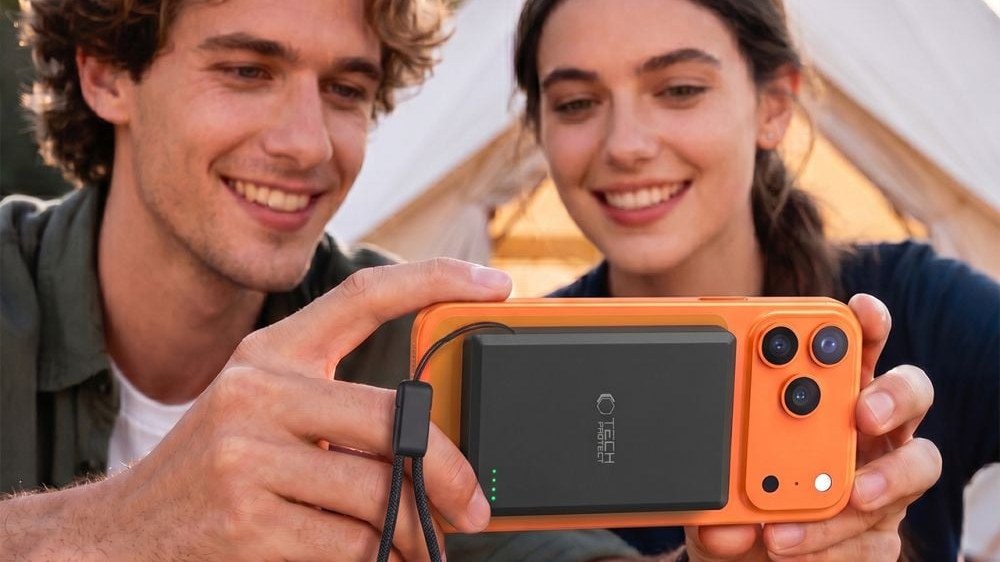
Quick verdict: which MagSafe power bank to choose
- Best overall: Tech-Protect PB40 LifeMag. 25 W Qi2.2 charging (certified, according to the manufacturer), 10,000 mAh and USB-C up to 45 W.
- Qi2 25 W with a built-in cable: UGREEN PB773, with 17 magnets with a combined pull force of 9 N and a charge-level screen.
- Largest capacity: UGREEN PB775 (20,000 mAh, Qi2 25 W, 45 W wired). Cheaper: UGREEN PB567 (20,000 mAh, Qi2 15 W).
- Smallest: PITAKA Aramid Fiber, 5000 mAh, 8.8 mm thick and 118 g.
- With a stand: UGREEN UNO PB764 with a fold-out kickstand, or the Satechi OntheGo, which holds the phone upright and sideways.
- Budget: Tech-Protect PB24 LifeMag (15 W, “Qi2” in the name, but without confirmed certification). Even cheaper are the AWEI P33K or the Tech-Protect PB11 LifeMag, our bestseller, also without Qi2 certification.
You’ll find all the models in the MagSafe power banks category. Current prices are shown in the tiles below the ranking sections. They’re loaded from the shop the moment you open the page.
MagSafe power bank ranking — table
We set the order primarily by wireless charging standard: Qi2 25 W first, then Qi2 15 W, and finally magnetic models without Qi2. Within these groups, we arranged the models in the same order as the sections below, from the best Qi2 25 W models to the budget ones. Only models we have in stock made it into the ranking.
| # | Power bank | Capacity | Energy | Wireless | Wired | Standard³ | Weight | Price bracket |
|---|---|---|---|---|---|---|---|---|
| 1 | Tech-Protect PB40 LifeMag | 10,000 mAh | 38.5 Wh | 25 W | 45 W (USB-C) | Qi2.2, certified per manufacturer⁴ | n/a¹ | mid-range |
| 2 | UGREEN PB773 | 10,000 mAh | 36 Wh | 25 W | 30 W (cable + USB-C) | Qi2.2, certified | n/a¹ | higher |
| 3 | UGREEN PB775 | 20,000 mAh | 74 Wh | 25 W | 45 W (cable + USB-C), n/a¹ (USB-A) | Qi2.2, certified | n/a¹ | higher |
| 4 | UGREEN PB567 | 20,000 mAh | 72 Wh | 15 W | 30 W (cable + USB-C), n/a¹ (USB-A) | Qi2, certified | 368 g | mid-range |
| 5 | PITAKA Aramid Fiber | 5000 mAh | approx. 19 Wh (calculated)² | 15 W | 20 W (USB-C) | Qi2, certified | 118 g | higher |
| 6 | UGREEN UNO PB764 | 10,000 mAh | approx. 37 Wh (calculated)² | 15 W | 20 W (USB-C) | Qi2, certified | n/a¹ | mid-range |
| 7 | Satechi OntheGo | 5000 / 10,000 mAh | approx. 19 / 37 Wh (calculated)² | 15 W | n/a¹ | Qi2, certified | n/a¹ | higher |
| 8 | Tech-Protect PB24 LifeMag | 10,000 mAh | approx. 37 Wh (calculated)² | 15 W | approx. 20 W (USB-C), 22.5 W (USB-A) | no confirmed Qi2⁴ | n/a¹ | low |
| 9 | Tech-Protect PB11 LifeMag | 10,000 mAh | approx. 37 Wh (calculated)² | 15 W | approx. 20 W (USB-C) | no Qi2 | n/a¹ | low |
| 10 | AWEI P33K | 10,000 mAh | approx. 37 Wh (calculated)² | 15 W | 20 W (USB-C), 22.5 W (USB-A) | no Qi2 | 184.5 g | low |
¹ The manufacturer doesn’t state this value in the product description.
² Value calculated by us from the capacity in mAh and a voltage of 3.7 V (the typical voltage of a lithium-ion cell), because the manufacturer doesn’t state Wh in the product description. The value printed on the housing may differ slightly, e.g. with 3.85 V cells. The other Wh values come from the product descriptions.
³ Qi2.2 is another name for Qi2 25 W, the version of the Qi2 standard with up to 25 W of power (more in the next section). “No Qi2” means a magnetic model without Qi2 certification.
⁴ We checked the certifications on 22 October 2026 in the public WPC product database. It lists the UGREEN PB773, PB775, PB567 and UNO PB764, the PITAKA Aramid Fiber and the Satechi OntheGo (both capacities). Tech-Protect declares Qi2.2 certification for the PB40, but we didn’t find this model in the WPC database. The PB24 has “Qi2” only in its name: the manufacturer doesn’t state any certification and it isn’t in the WPC database, so in line with the rule described in the next section, we treat it as a magnetic model.
Qi2, Qi2 25 W or “magnetic”? What the labels on the box mean
All the power banks in the ranking attach magnetically to an iPhone with MagSafe. What sets them apart is what happens next.
- Qi2 (15 W) is a Wireless Power Consortium (WPC) standard with magnetic coil alignment. The power bank positions itself in the right spot on the back of the phone. According to Apple, this alignment makes MagSafe charging faster and more efficient.
- Qi2 25 W is a newer variant of the standard. According to the WPC, a Qi2 25 W certified device is listed in the consortium’s database with version 2.2.1 and the MPP25 power profile. That’s why manufacturers also call this variant “Qi2.2”.
- “Magnetic”, “MagSafe compatible” means a power bank with a ring of magnets and a Qi coil, but without Qi2 certification. It attaches the same way, but only its manufacturer vouches for the power. These models are usually cheaper, too.
The WPC explicitly warns against the phrases “Qi2 compatible” and “Qi2 enabled”. A certified device carries the words “Qi2 Certified” on the product or packaging and appears in the public WPC database. If the description only talks about “Qi2 compatibility”, treat the power bank as a magnetic model.
The best MagSafe power banks with Qi2 25 W
If you have an iPhone 17, iPhone 18 Pro or iPhone Duo, you’ll notice 25 W in practice. These phones accept up to 25 W wirelessly, and Apple states that the iPhone 18 Pro charges to 50% in 30 minutes on a MagSafe charger (with an adapter of at least 35 W). With a Qi2 15 W power bank, charging will take longer.
1. Tech-Protect PB40 LifeMag: best overall
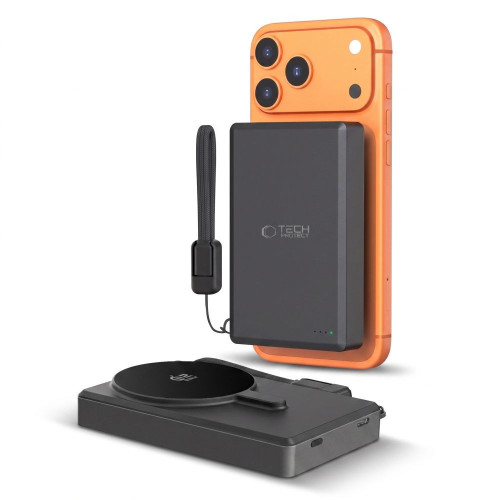
Our overall pick
According to Tech-Protect, the PB40 has certified Qi2.2 wireless charging at up to 25 W, the highest that iPhones currently accept. However, we didn’t find this model in the public WPC database (as of 22.10.2026). The USB-C port works both ways. By cable it delivers up to 45 W, which according to the manufacturer is also enough for a tablet and laptop. The power bank itself recharges at up to 30 W.
The battery has 10,000 mAh (38.5 Wh) and, according to the manufacturer, semi-solid-state cells. Tech-Protect says this is 1.5–2 full charges of most smartphones. The ABS plastic and aluminium alloy housing measures 104.2 × 66.2 × 22.3 mm, and LEDs show the charge level. A short USB-C cable (15 cm) is included. Note when using it for the first time: you need to press the power button twice, because a transport lock is active.
The PB40 also comes in a white and silver version.
Best for: most owners of iPhones with MagSafe, especially the iPhone 17, 18 Pro and Duo. It’s the cheapest of the three Qi2 25 W power banks in the ranking.
2. UGREEN PB773: Qi2 25 W with a built-in cable
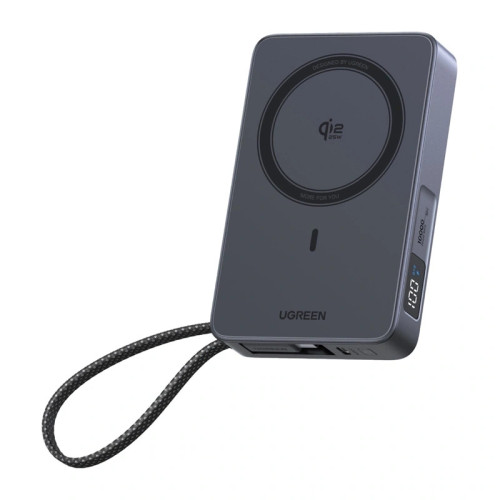
Best with a cable and screen
The PB773 charges wirelessly using the Qi2 standard at up to 25 W. UGREEN says this charges an iPhone 17 Pro Max to 50% in around 38 minutes. The power bank stays on the phone thanks to 17 magnets with a combined pull force of 9 N, so it won’t slide off in your pocket or while walking.
Wired, it charges at up to 30 W and supports the PD 3.0, QC 4.0 and PPS fast charging standards. It has a built-in USB-C cable that has passed a test of more than 10,000 bends. It can charge three devices at once: two via the USB-C connectors and one wirelessly. The screen shows the charge percentage and operating mode, and the ThermalGuard system measures the temperature up to 200 times per second.
The capacity is 10,000 mAh and 36 Wh. According to the manufacturer, that’s around 1.8 full charges of an iPhone 17 Pro Max.
Best for: if you always forget your cable and want to see the exact charge percentage, not just LEDs.
Largest capacity: 20,000 mAh MagSafe power banks
Twice the capacity also means more weight. 20,000 mAh on the back of your phone is handy for a trip of a few days, but for everyday use 10,000 mAh is more comfortable.
3. UGREEN PB775: 20,000 mAh and Qi2 25 W
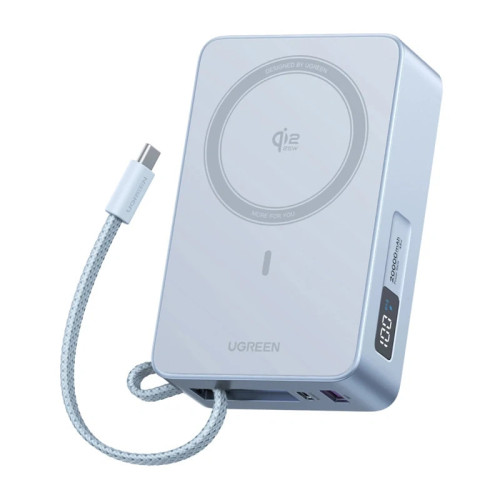
The largest capacity with 25 W
The PB775 combines 20,000 mAh (74 Wh) with Qi2 wireless charging at up to 25 W. The power adjusts automatically to the phone, so it charges older models at up to 15 W.
Wired, it delivers up to 45 W, both through the built-in USB-C cable (approx. 22 cm, tested for more than 10,000 bends) and through a separate USB-C port. There’s also a USB-A port. It has a charge-level display, ThermalGuard and pass-through charging: plug it into a charger and it will charge your phone at the same time.
Best for: long trips, when one power bank needs to charge the phone wirelessly and a tablet or earbuds by cable.
4. UGREEN PB567: 20,000 mAh for less
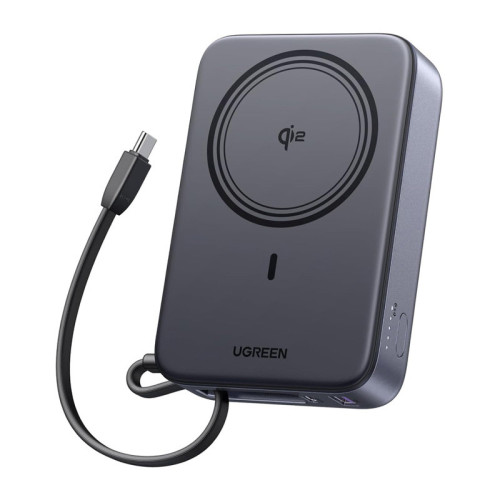
High capacity for sensible money
The PB567 has the same 20,000 mAh capacity (72 Wh), but Qi2 wireless charging at up to 15 W. Wired, it charges at up to 30 W in both directions, through the USB-C port and the built-in cable, which also doubles as a lanyard. There’s an extra USB-A port, and it can handle up to four devices at once.
The manufacturer lists dimensions of 106 × 72 × 33 mm and a weight of approx. 368 g, so this is a power bank for a bag rather than a trouser pocket. NTC temperature sensors and a metal heat sink protect it from overheating.
An even cheaper 20,000 mAh option is the Tech-Protect PB12 LifeMag. It charges magnetically at up to 15 W, but without Qi2 certification.
Best for: if you have an iPhone 17e or an iPhone 12–15, which will accept no more than 15 W anyway, and spare energy is what matters.
The smallest MagSafe power bank
A small 5000 mAh power bank is a top-up during the day, not a full charge for a large phone. In return, you barely feel it in your pocket and it doesn’t get in the way when you hold the phone in your hand.
5. PITAKA Aramid Fiber: the slimmest and lightest
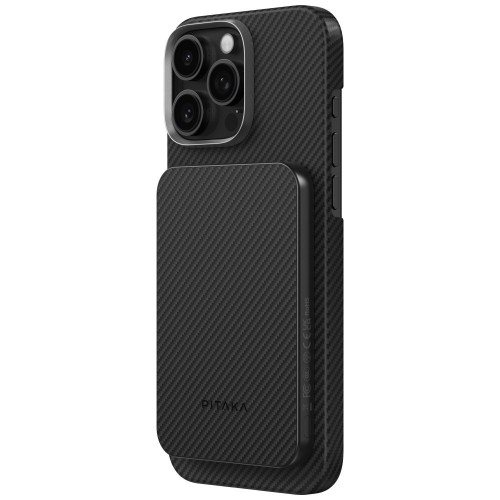
The smallest in the ranking
The PITAKA is approx. 8.8 mm thick and weighs approx. 118 g. It’s the lightest power bank in the line-up. Wireless charging is Qi2 certified with up to 15 W, and the USB-C port charges by cable at up to 20 W and is also used to recharge the power bank itself.
The housing combines aramid fibre with aluminium, and indicators show the charge level. The capacity is 5000 mAh. There are three finishes: black and grey, sunset and moonrise.
A similar alternative is the ZENS Slim Qi2 Aluminium 5000 mAh: aluminium, Qi2 15 W certification, 140 g. It also charges AirPods cases with MagSafe.
Best for: if you want a power bank attached to your phone all day long that barely weighs your pocket down.
The best MagSafe power banks with a stand
A stand turns the power bank into a tabletop holder: you watch a film or make a video call while the phone charges.
6. UGREEN UNO PB764: stand, screen and Qi2
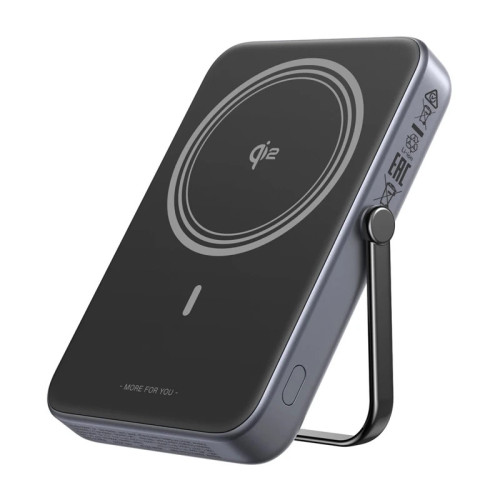
Best with a stand
The PB764 has a folding stand and a TFT screen that shows the power bank’s status with emoticons (the manufacturer has prepared more than 15 of them). It charges wirelessly using the Qi2 standard at 15 W, and via USB-C at 20 W in both directions.
UGREEN says the 10,000 mAh is enough for 1.8 full charges of an iPhone 16, and wirelessly the power bank charges it to 25% in 30 minutes. The silicone finish is pleasant to the touch, and 13 types of protection guard against overheating and overvoltage, among other things.
The UGREEN UNO PB572, one of the two magnetic power banks our customers buy most often, also has an emoticon screen and a stand. However, the PB572 charges wirelessly at 7.5 W, while the PB764 charges at 15 W using the Qi2 standard.
Best for: if you watch a lot on your phone on the go or take video calls at your desk.
7. Satechi OntheGo: a stand for portrait and landscape
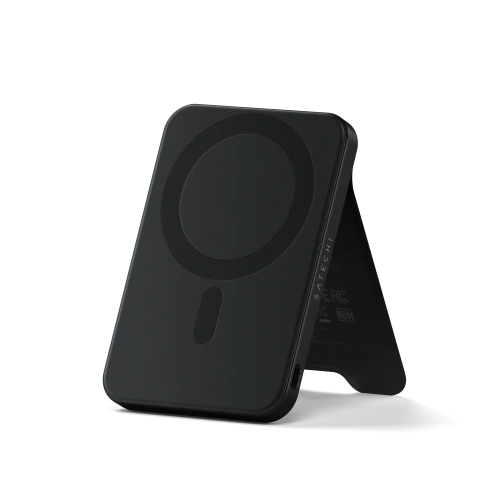
The best stand
The Satechi’s built-in stand holds the phone both upright and sideways, so it’s handy for films, video calls and reading recipes in the kitchen. It charges wirelessly using the Qi2 standard at 15 W. The manufacturer points out that this is twice as much as standard 7.5 W wireless charging.
It supports pass-through charging: when plugged into power, the power bank can charge a phone standing on the stand, so it also works as a desk station. It comes in two capacities: 5000 mAh and 10,000 mAh.
Best for: if the stand needs to work in both orientations and the power bank should also replace the charger on your desk.
[hs_products ids=”141166,142610,149344,137798,140045,141291″ cols=”3″ title=”Best MagSafe power banks: positions 1–6″]
The best budget MagSafe power banks
A cheaper magnetic power bank doesn’t have to be worse in everyday use. Most often, you save on Qi2 certification, wired power and extras such as a screen or built-in cable.
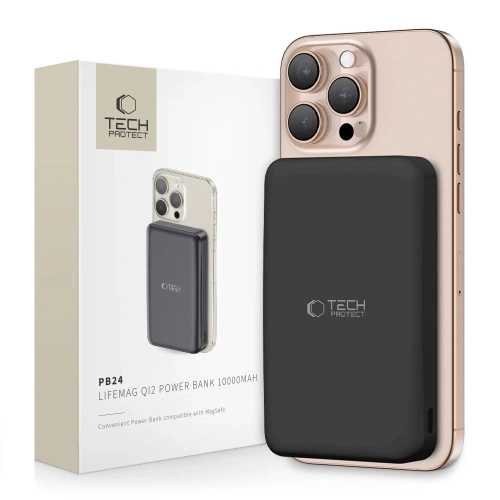
8. Tech-Protect PB24 LifeMag: best budget
Best budget
The PB24 has 10,000 mAh and magnetic wireless charging at up to 15 W. Tech-Protect has “Qi2” in the model name, but doesn’t state any certification, and we didn’t find it in the WPC database, so we treat the PB24 as a magnetic model. Thanks to its USB-C and USB-A ports, you can charge several devices at once. According to the specifications, the USB-C port delivers up to 9 V/2.22 A, i.e. approx. 20 W, and the USB-A up to 5 V/4.5 A, i.e. 22.5 W.
LEDs show the charge level, and protections guard against overcharging, overvoltage and overheating. It comes in black and white.
Best for: if you’re looking for a cheap 10,000 mAh power bank with two ports and don’t need 25 W or Qi2 certification.
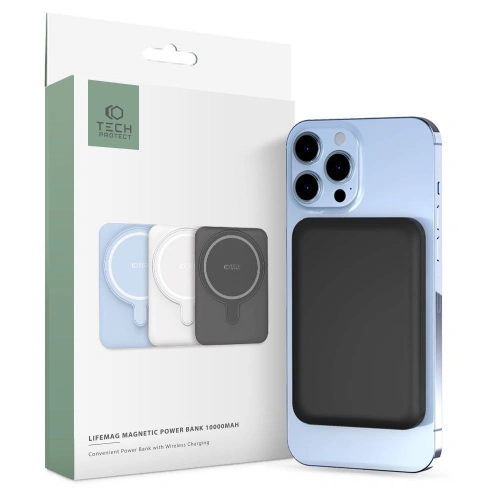
9. Tech-Protect PB11 LifeMag: the shop’s bestseller
The most popular
Together with the UGREEN UNO PB572, the PB11 has been the most frequently bought magnetic power bank in our shop over the last six months. It has 10,000 mAh, magnetic wireless charging at up to 15 W and a single USB-C port, used both for charging by cable and for recharging the power bank.
It’s a magnetic model without Qi2 certification. The ABS and polycarbonate housing is simple and minimalist, and LEDs show the charge level. It comes in several colours, including black, blue, pink and white.
Best for: if you’re looking for a 10,000 mAh power bank that other customers have already put to the test and you don’t care about certification.
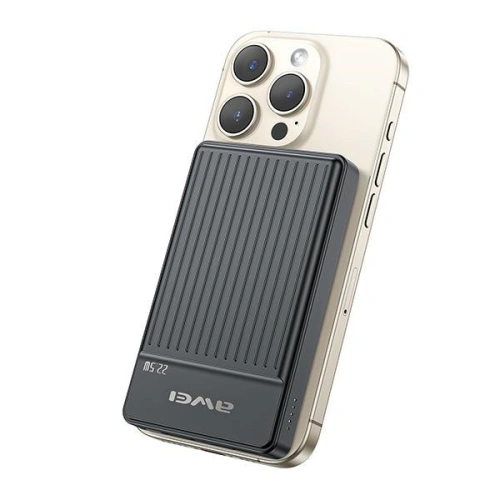
10. AWEI P33K: the cheapest in the ranking
The best price in the ranking
The AWEI is the cheapest 10,000 mAh magnetic power bank in the line-up. It charges wirelessly at up to 15 W, via USB-C at up to 20 W and via USB-A at up to 22.5 W. It weighs 184.5 g and measures 109 × 67 × 15.4 mm.
The manufacturer honestly states two capacities: 10,000 mAh is the cell capacity, and 5200 mAh is the rated output capacity. The latter figure better reflects how much energy actually reaches the phone. More on this in the section on real-world capacity.
Best for: a spare power bank for the car or backpack, when price matters.
[hs_products ids=”111947,88189,42599,77792,113868,87672″ cols=”3″ title=”MagSafe power banks: positions 7–10 and alternatives”]
Which iPhone charges at 25 W? Model compatibility
The power bank will attach magnetically to any iPhone with MagSafe. Apple’s list includes all models from the iPhone 12 to the iPhone 18 Pro Max, except the iPhone 16e. How much power the phone accepts depends on the model. A 25 W power bank won’t speed up charging on an iPhone that accepts 15 W.
| iPhone | MagSafe magnets | Max. wireless charging power according to Apple |
|---|---|---|
| iPhone 18 Pro and 18 Pro Max | ✅ | 25 W² |
| iPhone Duo | ✅ | 25 W² |
| iPhone 17 | ✅ | 25 W² |
| iPhone 17 Pro and 17 Pro Max | ✅ | 25 W¹ |
| iPhone Air | ✅ | 20 W² |
| iPhone 17e | ✅ | 15 W² |
| iPhone 16 Plus and 16 Pro Max | ✅ | 25 W¹ |
| iPhone 16 and 16 Pro | ✅ | 22.5 W¹ |
| iPhone 16e | ❌ | n/a³ |
| iPhone 12, 13, 14 and 15 | ✅ | 15 W¹ (12 mini and 13 mini: 12 W) |
¹ Values given by Apple for the MagSafe charger.
² Apple gives this power for both MagSafe and Qi2 charging.
³ According to Apple’s specifications, the iPhone 16e works with Qi chargers, but no power figure is given. This model has no MagSafe magnets, so a power bank will only attach to it via a case with a magnet or a stick-on ring.
The data comes from the model pages for the iPhone 18 Pro, iPhone Duo, iPhone 17, iPhone Air and iPhone 17e, and from Apple’s article on the MagSafe charger.
What this means in practice:
- iPhone 18 Pro, Duo and iPhone 17: choose Qi2 25 W (positions 1–3). According to the WPC, the iPhone 16 series with iOS 26 also benefits from Qi2 25 W.
- iPhone Air: it accepts up to 20 W, so it will charge faster with a 25 W power bank than with a 15 W model. Note: Apple’s original MagSafe Battery for the iPhone Air works only with the iPhone Air. The power banks in the ranking work with all iPhones with MagSafe.
- iPhone 17e and iPhone 12–15: the maximum is 15 W, so Qi2 15 W (positions 4–7) is perfectly sufficient.
The power bank holds through a case only if the case has MagSafe magnets. You’ll find cases like this for the iPhone 18 Pro in our ranking of iPhone 18 Pro cases and in the iPhone 18 Pro accessories category, and for the foldable model in iPhone Duo accessories. Apple also recommends removing a MagSafe wallet before attaching a MagSafe battery.
MagSafe power banks for Android: Pixel and Galaxy with Qi2
Qi2 is a WPC standard, not an Apple exclusive, so the power banks in the ranking also work with Android phones. However, the phone must have magnets in its body or in its case.
- The Google Pixel 10 and 10 Pro have built-in Pixelsnap magnets and Qi2 certification, and charge wirelessly at up to 15 W. The Pixel 10 Pro XL accepts up to 25 W (Google Store).
- The Google Pixel 11, 11 Pro and 11 Pro XL have Qi2.2 certification and Pixelsnap charging at up to 25 W (Google Store). You’ll find accessories for them in the Pixel 11 category.
- The Samsung Galaxy S25 and S26, according to the WPC, have no built-in magnets and need a “Qi2 Ready” case to use magnetic charging. For the S26 series, Samsung sells a Magnet Case with a built-in magnetic ring. We’ve compared cases with a magnet for the top model in our ranking of MagSafe cases for the Galaxy S26 Ultra.
Have a phone without magnets and don’t want to change your case? A stick-on magnetic ring will help. The power bank will attach, but the charging power still depends on the phone.
How many times will it charge your phone? A power bank’s real-world capacity
The mAh capacity on the box is the capacity of the cells at their voltage, usually 3.7–3.85 V. The phone charges at a higher voltage, so the power bank has to step up the cell voltage. Some of the energy is lost as heat in the process. That’s why a 10,000 mAh power bank won’t charge a phone with a 5000 mAh battery twice.
A better measure of energy is watt-hours (Wh). IATA calculates them as the capacity in ampere-hours multiplied by the nominal voltage. An example from the ranking: the Tech-Protect PB40 has 10,000 mAh and 38.5 Wh, and the UGREEN PB775 20,000 mAh and 74 Wh. The AWEI P33K states plainly that from 10,000 mAh of cells, 5200 mAh of rated capacity remains at the output.
Wireless charging increases losses. In its article on the MagSafe charger, Apple notes that in the EU, the iPhone displays a message the first time you use a wireless charger: wireless charging may use more energy than wired charging. When every percent counts, connect the phone with a cable. The PB40, PB773 and PB775 have powerful USB-C ports for this.
For comparison, the manufacturers’ claims from the ranking:
- Tech-Protect PB40 (10,000 mAh): 1.5–2 full charges of most smartphones.
- UGREEN PB773 (10,000 mAh): approx. 1.8 full charges of an iPhone 17 Pro Max.
- UGREEN UNO PB764 (10,000 mAh): 1.8 full charges of an iPhone 16.
For everyday use, 5000 mAh is enough for a top-up, or 10,000 mAh for one full charge with some to spare. 20,000 mAh makes sense for several days without a socket.
Can you take a MagSafe power bank on a plane?
Yes, but only in hand luggage, and additional restrictions apply from 2026. An amendment by ICAO (the UN agency for civil aviation) to the technical instructions for the safe transport of dangerous goods by air came into force on 27 March 2026. The airline association IATA described it in its guidance for passengers dated 31 March 2026:
- A maximum of two power banks per person, each up to 100 Wh.
- Hand luggage only. A power bank must not be put in checked luggage. If your cabin bag is taken to the hold at the gate, take the power bank out of it first.
- Don’t charge the power bank from a socket on the plane.
- Don’t keep it in the overhead locker; keep it on you.
- Don’t use it to power devices during taxiing, take-off and landing.
There’s also a tip specifically about wireless power banks. IATA recommends switching them off for the flight and not keeping them close to the phone, because a power bank switched on by accident will start charging it. With a MagSafe power bank, this simply means: detach it from the phone and store it separately.
The ICAO amendment allows power banks of 100 to 160 Wh with the airline’s approval. However, in its guidance for operators, IATA announces that from 1 January 2027 (the 68th edition of the IATA Dangerous Goods Regulations, DGR) this option will no longer exist, and in its table for passengers it already marks such power banks as forbidden. This threshold doesn’t affect the power banks in the ranking. The largest in the ranking have 72–74 Wh, and the 10,000 mAh models around 36–38.5 Wh.
Airlines may have stricter rules, so check your carrier’s terms before flying. IATA also points out that an airline may refuse to carry a battery whose watt-hour rating can’t be verified on the housing or in the documentation. You’ll find power banks within the limit in the power banks for flying category.
How to choose a MagSafe power bank: 5 questions before you buy
- What phone do you have? iPhone 17, 18 Pro, Duo, Air and the iPhone 16 series with iOS 26, and among Android phones the Pixel 10 Pro XL and the Pixel 11 models: choose Qi2 25 W. iPhone 17e, iPhone 12–15 and most Android phones with a magnet: Qi2 15 W is enough.
- Certified or “magnetic”? Qi2 certification guarantees compatibility and the declared power. A “magnetic” model can be noticeably cheaper and will also do the job for topping up during the day.
- How much energy do you need? 5000 mAh is a top-up, 10,000 mAh is a full charge with some to spare, 20,000 mAh is several days, but also considerable weight (the UGREEN PB567 weighs approx. 368 g).
- Will a cable come in handy? By cable you’ll charge your phone faster and with lower losses. A built-in cable (UGREEN PB773, PB775, PB567) means you don’t have to remember a separate one.
- What will you charge it with? The PB40 accepts up to 30 W, so it’s worth having a USB-C wall charger of at least 30 W. We’ve compared powerful models in our GaN charger ranking.
One caveat concerns the iPhone 18 Pro. Apple quotes the fastest wired charging, up to 50% in around 15 minutes, for power adapters of 60 W and above with adjustable voltage (AVS). None of the MagSafe power banks in the ranking has that much power, so on the go the iPhone 18 Pro will charge more slowly than from a good wall charger. We’ve compared chargers for the latest iPhones in our guides on the charger for the iPhone Duo and the charger for the iPhone 17.
Summary
- The best MagSafe power bank is the Tech-Protect PB40 LifeMag: 25 W Qi2.2 charging (certified, according to the manufacturer), 10,000 mAh and 45 W USB-C.
- Qi2 25 W makes sense with the iPhone 17, 18 Pro, Duo, Air, the iPhone 16 series with iOS 26, the Pixel 10 Pro XL and the Pixel 11 models. The iPhone 17e and iPhones 12–15 will accept no more than 15 W anyway.
- Largest capacity: UGREEN PB775 (20,000 mAh, Qi2 25 W), cheaper: UGREEN PB567 (20,000 mAh, Qi2 15 W).
- Smallest: PITAKA Aramid Fiber (8.8 mm, 118 g). With a stand: UGREEN UNO PB764 or Satechi OntheGo.
- Budget: Tech-Protect PB24 LifeMag, AWEI P33K and Tech-Protect PB11, all without confirmed Qi2 certification.
- On a plane: a maximum of two power banks up to 100 Wh, in hand luggage only, without charging the power bank on board.
You’ll find all the models in the MagSafe power banks category, and magnetic chargers, mounts and wallets in MagSafe accessories. Need a power bank without a magnet and with more power for a laptop? Check out our 2026 power bank ranking and the power banks category.
[hs_products category=”1901″ limit=”6″ sort=”sales” title=”Best-selling MagSafe power banks”]
FAQ — frequently asked questions
Which MagSafe power bank is best for an iPhone?
For the iPhone 17, 18 Pro and Duo, the best choice is a power bank with Qi2 25 W, e.g. the Tech-Protect PB40 LifeMag with Qi2.2 certification (according to the manufacturer). For the iPhone 17e and the 12–15 models, Qi2 15 W is enough, because these phones accept no more than 15 W. In this group, the UGREEN UNO PB764 does well, and a cheaper option is the Tech-Protect PB24 LifeMag (15 W, but without confirmed Qi2 certification).
What’s the difference between Qi2 and Qi2 25 W (Qi2.2)?
Qi2 charges at up to 15 W, while Qi2 25 W, also called Qi2.2, charges at up to 25 W. According to the WPC, a certified Qi2 25 W product is listed in the consortium’s public database with version 2.2.1 and the MPP25 power profile. Both versions have magnetic coil alignment, and a Qi2 25 W power bank will also charge an older phone, just at lower power.
Is a “magnetic” power bank the same as MagSafe?
Not always. A “magnetic” or “MagSafe compatible” power bank has magnets and will attach to an iPhone, but it doesn’t have Qi2 certification, so only the manufacturer vouches for its power and compatibility. A certified power bank carries the “Qi2 Certified” label and appears in the WPC database.
Will a MagSafe power bank work with Android?
Yes, if the phone has magnets in its body or in its case. The Pixel 10, 10 Pro and 10 Pro XL, as well as the Pixel 11, 11 Pro and 11 Pro XL, have built-in Pixelsnap magnets and Qi2 certification. The Pixel 10 Pro XL and the three Pixel 11 models charge at up to 25 W. The Galaxy S26 needs a case with a magnetic ring, e.g. the Samsung Magnet Case.
Can you take a MagSafe power bank on a plane?
Yes, but only in hand luggage and no more than two per person, each up to 100 Wh. Since 27 March 2026, you’re not allowed to charge a power bank from a socket on the plane. IATA also recommends not keeping it in the overhead locker and not using it to power devices during taxiing, take-off and landing. The power banks in our ranking range from approx. 19 Wh (a value calculated from mAh, because the manufacturer doesn’t state it) to 74 Wh, so they’re within the limit.
How many mAh should a MagSafe power bank have?
For everyday use, 10,000 mAh is best: that’s one full phone charge with some to spare at a sensible weight. A 5000 mAh power bank is enough for a top-up during the day and you barely feel it in your pocket. 20,000 mAh is the choice for trips of several days, but a power bank like that is noticeably heavier (the UGREEN PB567 weighs approx. 368 g).
Does charging with a MagSafe power bank harm the iPhone’s battery?
Apple states that the iPhone and MagSafe charger may get slightly warm while charging, as with any wireless charger. If the battery gets too warm, the software may limit charging above 80% to extend its lifespan. Choose power banks with overheating protection. In the ranking, UGREEN (the ThermalGuard system), Tech-Protect and PITAKA, among others, declare it.
Why won’t my MagSafe power bank stay on the phone?
Most often because of a case without magnets. The power bank only holds directly on the back of an iPhone with MagSafe or on a case with a built-in magnetic ring. Some manufacturers also state a maximum case thickness. ZENS, for example, declares compatibility with magnetic cases up to 3 mm thick.
Leave a Reply