iPhone 18 Pro received 172 points from DxOMark and ranks second in the world, just behind the Huawei Pura 80 Ultra with 175. The iPhone 17 Pro has 168 points and occupies the fifth position. A four-point difference between generations — not much on paper, but three spots in the ranking.
However, the teardown of the new model reveals something that shouldn’t explain this difference: two of the three rear sensors are exactly the same as last year.
Where this data comes from: the component data comes from publications on Weibo.
What’s inside the camera
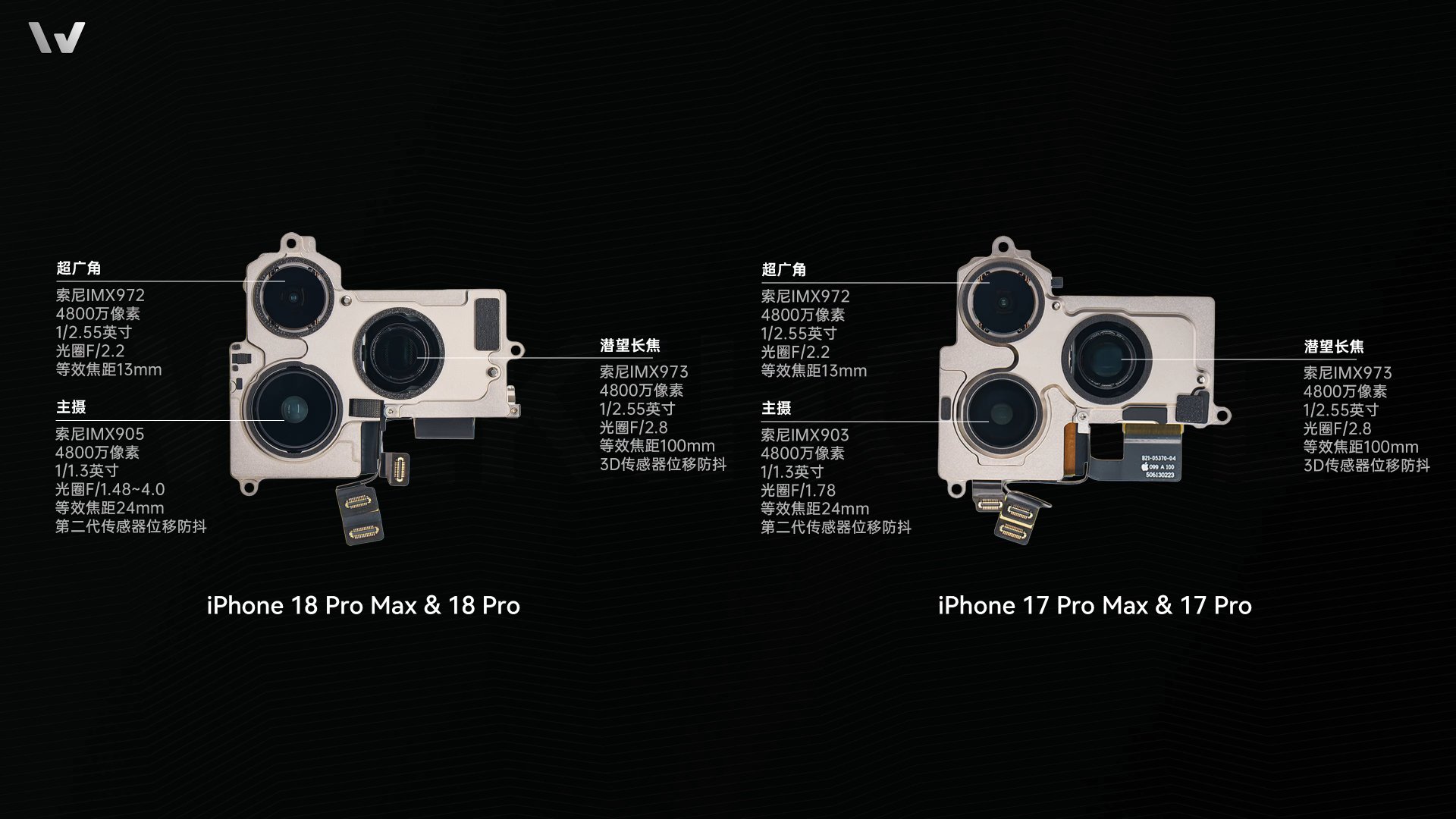
The rear cameras are the same in the iPhone 18 Pro and 18 Pro Max — the teardown author describes them once, for both phones at the same time. Three lenses mounted in a common metal frame, each 48 Mpix:
| Camera | Sensor | Size | Aperture | Focal length equivalent | Stabilization |
|---|---|---|---|---|---|
| Ultrawide | Sony IMX972 | 1/2.55″ | f/2.2 | 13 mm | not specified |
| Main | Sony IMX905 | 1/1.3″ | f/1.48–4.0 | 24 mm | second generation sensor-shift |
| Periscope | Sony IMX973 | 1/2.55″ | f/2.8 | 100 mm | 3D sensor-shift |
For the ultrawide, the teardown does not mention anything about stabilization — which means that it is unknown, not that it does not exist.
Controversy: two of the three cameras are the same as last year
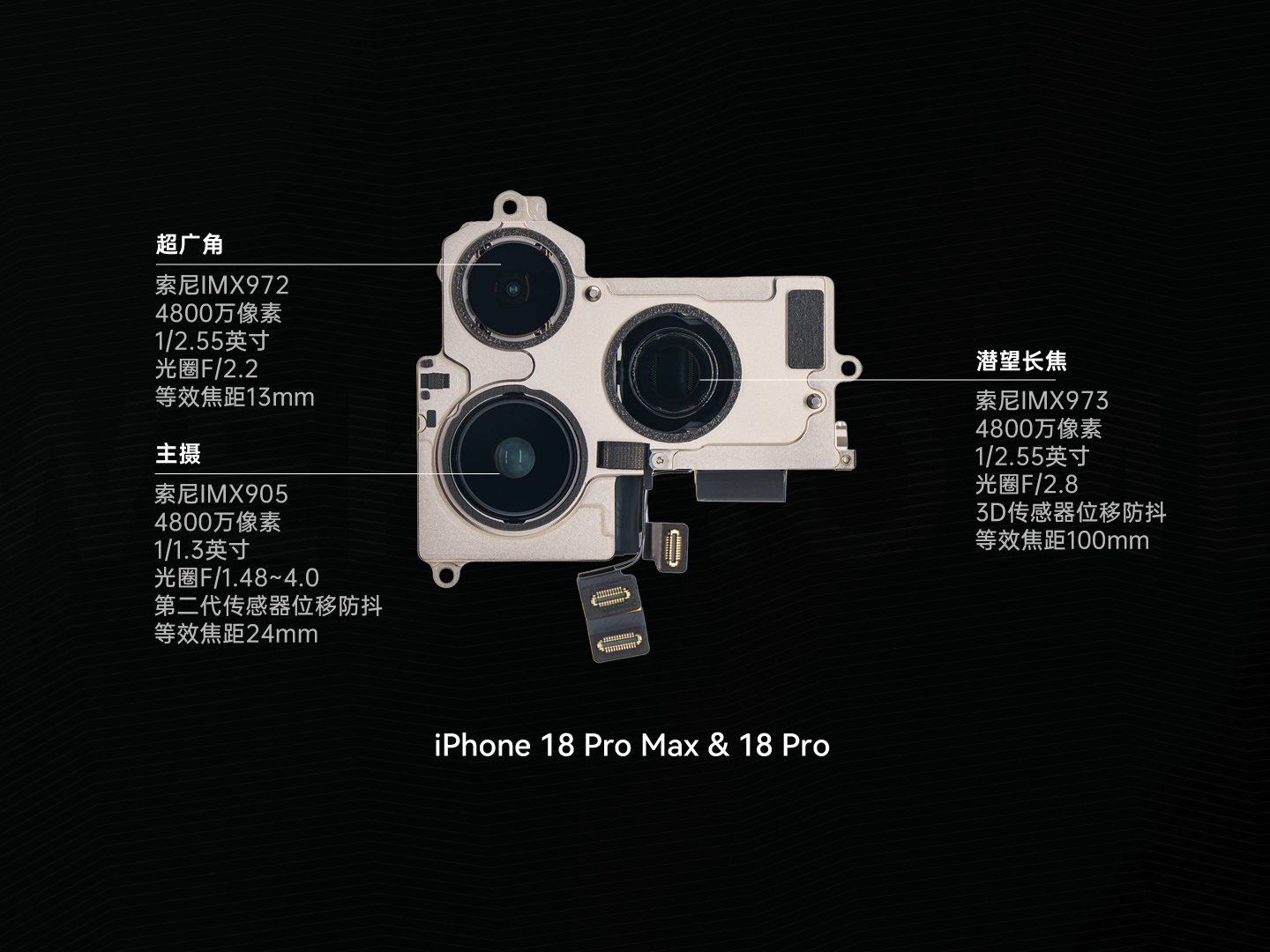
The author placed the cameras from both generations side by side and described them with the same set of data. In pairs, because the Pro and Pro Max from the same year have the same set:
| iPhone 17 Pro and 17 Pro Max | iPhone 18 Pro and 18 Pro Max | |
|---|---|---|
| Ultra-wide | Sony IMX972, 1/2.55″, f/2.2, 13 mm | Sony IMX972, 1/2.55″, f/2.2, 13 mm |
| Periscope | Sony IMX973, 1/2.55″, f/2.8, 100 mm | Sony IMX973, 1/2.55″, f/2.8, 100 mm |
| Main — sensor | Sony IMX903, 1/1.3″, 48 Mpix | Sony IMX905, 1/1.3″, 48 Mpix |
| Main — aperture | fixed f/1.78 | variable f/1.48–4.0 |
Ultra-wide and periscope are literally the same sensors. The same resolution, the same size, the same brightness, and the same focal length equivalent.
The main camera has changed its designation from IMX903 to IMX905, but the teardown indicates the same sensor size for both, 1/1.3 inches, and the same resolution. Industry sources provide a more precise value of 1/1.28 inches for the seventeen, so there may be a slight difference — the teardown author rounds both the same.
The only real difference is the aperture of the main camera.
Six moving blades
In place of the fixed aperture f/1.78, Apple has introduced a variable aperture with a range of f/1.48–4.0. DxOMark describes it as a true aperture with six moving blades that opens and closes like in a camera — the photos of the mechanism itself are not visible, as the author did not disassemble the lens. There is only a dry label next to the lens: f/1.48–4.0.
This is not a software trick, but a real mechanism that allows less or more light to pass through. DxOMark attributes the improvement in score to this aperture.
What the range provides:
- f/1.48 at night — an opening wider than f/1.78 in its predecessor lets in more light; the score in low light increased from 143 to 150 points
- f/4.0 during the day — stopping down increases depth of field, meaning it allows for maintaining sharpness over a larger portion of the frame
- range instead of a single value for everything — although it is unclear whether the aperture closes smoothly or in steps
DxOMark Results: Where the Difference is Visible
| Category | iPhone 17 Pro | iPhone 18 Pro |
|---|---|---|
| Overall | 168 | 172 |
| Video | — | 176 — the highest video score in the entire DxOMark database |
| Low Light | 143 | 150 |
| Portraits | 151 | 157 |
| Zoom | 135 | 138 |
The most significant gains were in low light photos (+7) and portraits (+6), while zoom saw the least improvement (+3), and this is the only camera whose aperture change does not apply at all. DxOMark does not specify where each of these changes came from, so formally it is a coincidence. However, it is exceptionally consistent.
What DxOMark Did Not Praise
DxOMark pointed out four issues: color inaccuracies and white balance jumps, weaker zoom at long distances, flares in certain conditions, and brightness differences between photo previews and video. The second point is not surprising, as the periscope remained the same.
How Much Do These Points Really Matter
Before you consider 172 versus 168 as a decisive factor, it’s worth knowing where that number comes from and what it does not show.
DxOMark makes money from the manufacturers it tests. It sells them the DxO Analyzer software and provides consulting for camera tuning, and then evaluates the finished phones. In the industry, this is referred to as the “pay to win” problem: those who use DxO’s paid tools perform better in the rankings than those who do not. No one claims that results are bought. However, it’s hard to maintain independence when the same company first advises and then evaluates.
Each subsequent generation receives a higher score. This has been evident in the rankings for years, and it’s hard not to ask whether the points measure real progress or if they grow along with the methodology. Therefore, results from different years cannot be directly compared.
One number hides all compromises. The overall score is derived from several sub-scores of varying weights, and the media only quotes this score. This is exemplified in our case: the eighteen wins in low-light photography and portraits, while in zoom it practically stands still. If you mainly shoot with a telephoto lens, this difference does not concern you.
A loud dispute over independence also occurred. When Xiaomi did not send a 12S Ultra model for testing, DxOMark purchased a unit on its own and published a review despite the lack of cooperation from the manufacturer.
The practical conclusion is this: DxOMark points serve as a guideline for the direction of changes, and here they align with what is seen in the teardown. However, they do not answer the question of whether it is worth replacing the phone. That will only be answered by photos taken in the conditions in which you photograph daily.
Face ID and LiDAR received more than the camera
The most changes occurred not in the cameras, but next to them.
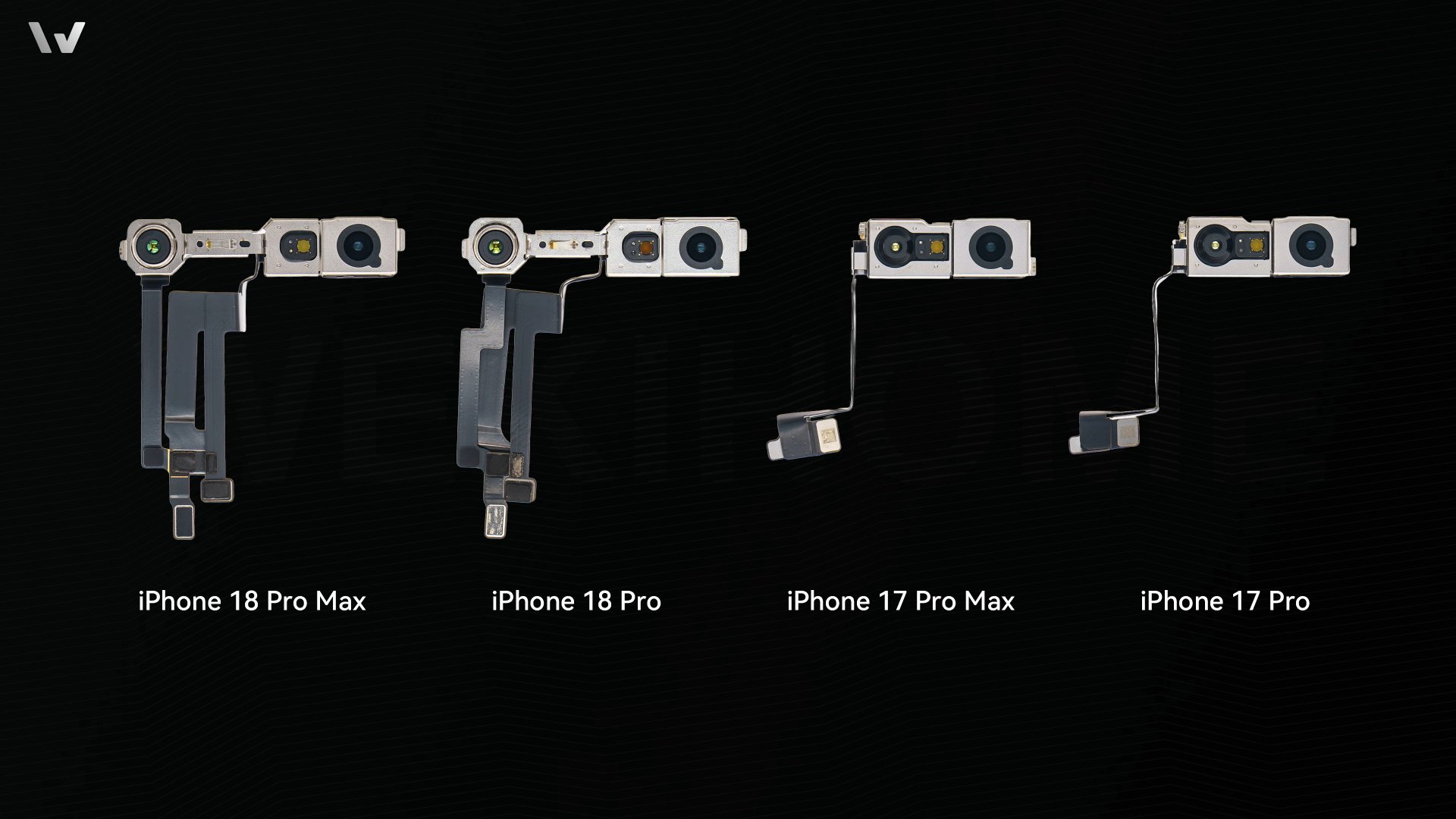
The entire Face ID setup in the eighteenth model is clearly longer — a wide ribbon with a metal reinforcing plate has been added. In the seventeenth model, everything was tightly packed next to each other; here, the sensor has been moved a considerable distance away from the camera.
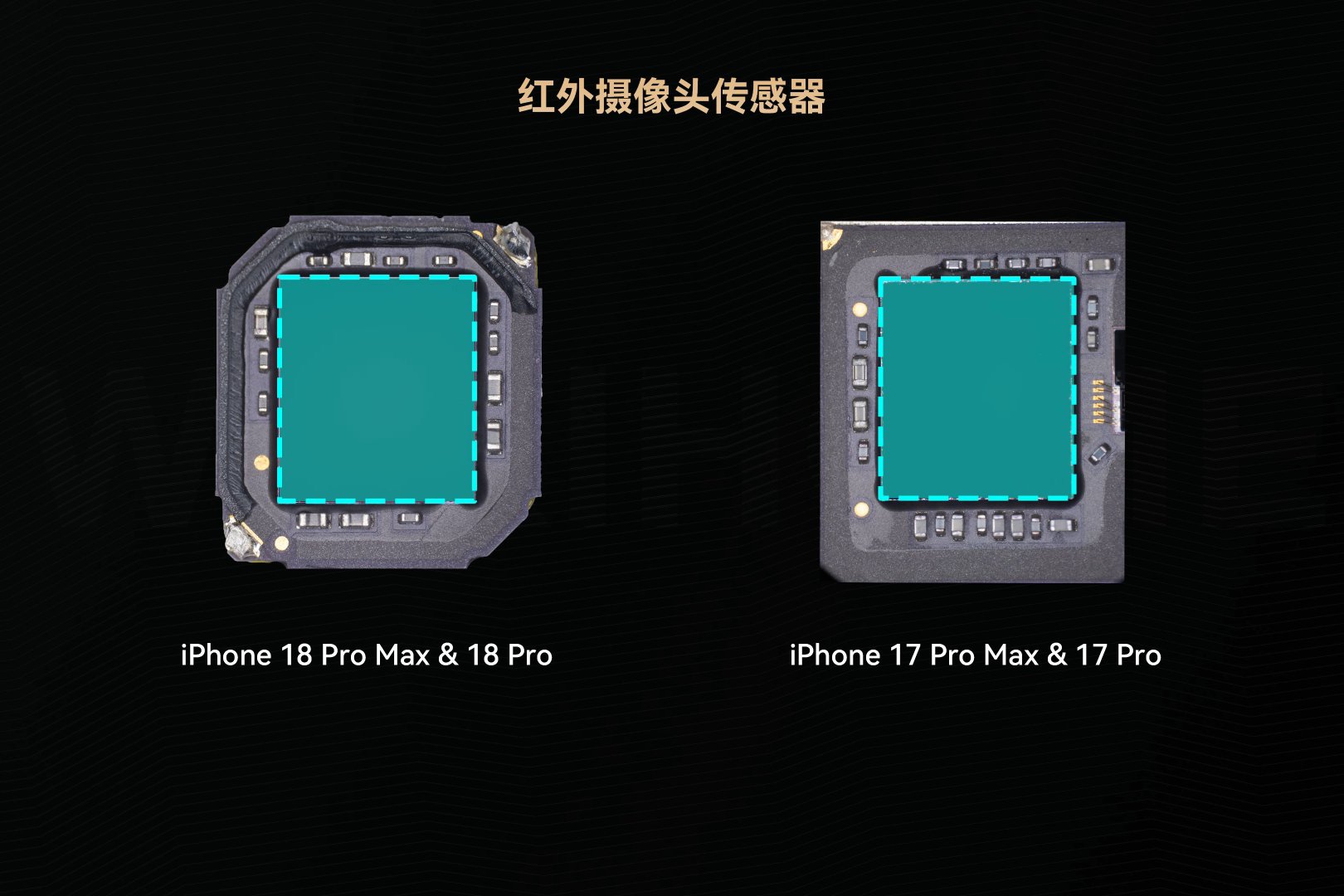
The infrared camera sensor is larger. The author outlined in the photo that part of both sensors that actually collects light — in the eighteenth model, it is larger and more square.
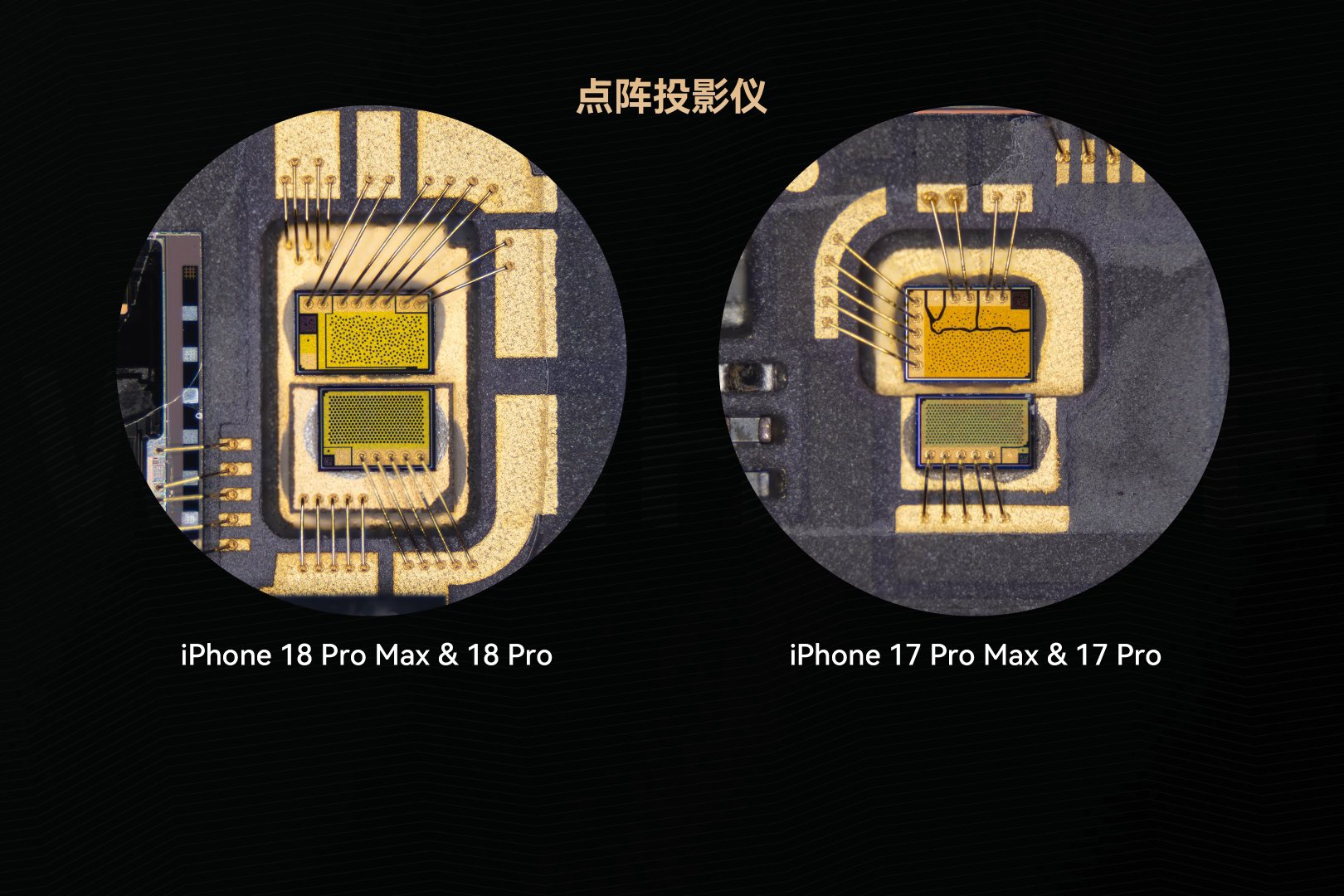
The author removed the casing from the dot projector and photographed the bare circuits in magnification. Here too, the redesign is visible: both circuits — the control one and the emitting one — are larger, there are more thin wires connecting them, and they come from two sides instead of one, while the light points are more densely packed.
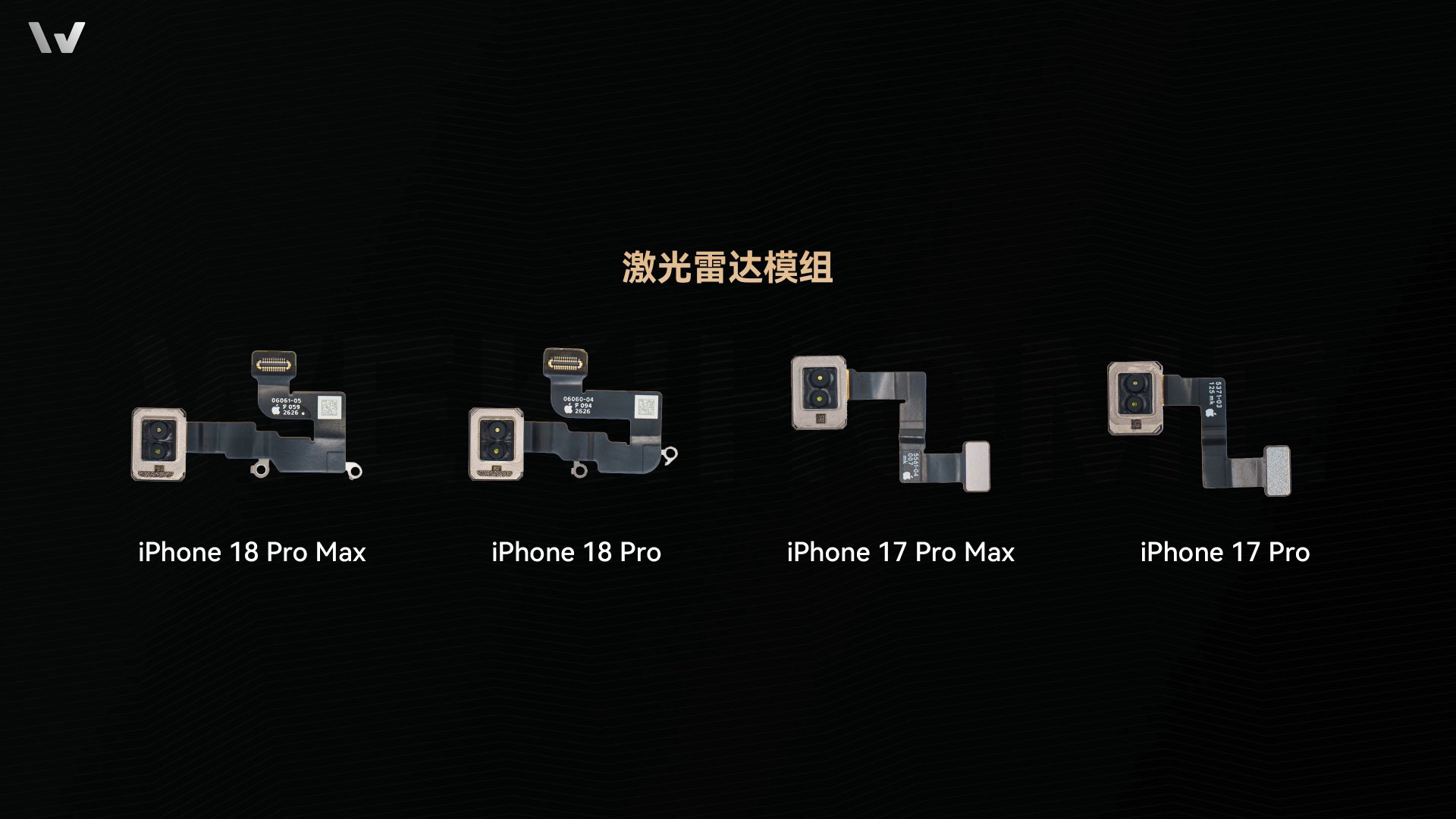
LiDAR has also increased in size. In the iPhone 18, it is simply larger, and its transmitter has a larger surface area. The tape markings are 06061-05 in the 18 Pro Max and 06060-04 in the 18 Pro, compared to 5561-04 and 5371-03 the previous year.
None of these changes are measured by DxOMark, as they evaluate cameras for photos, not facial recognition. How the redesign of the dot projector translates into the speed and effectiveness of Face ID remains unresolved by the teardown.
Front camera without revolution
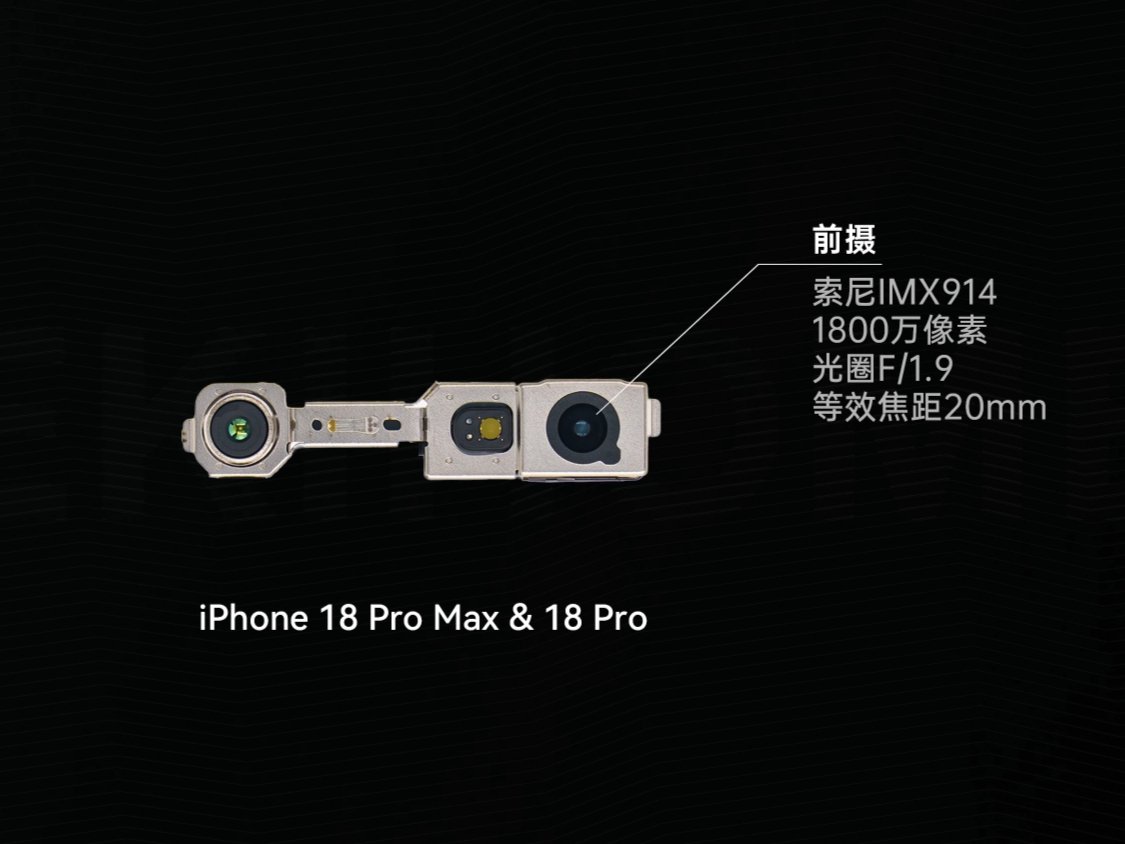
The selfie is taken by Sony IMX914, 18 MP, f/1.9, equivalent to 20 mm — the same specifications for the 18 Pro and 18 Pro Max. The same sensor is attributed to the iPhone 17 by industry services. The comparative photo from the teardown is not labeled, it only shows that both sensors have similarly sized light-collecting parts and differ in the shape of the casing.
What it means when buying protection
The camera island on the eighteen stretches across the entire width of the back. It houses three lenses arranged in a triangle, a flash, a microphone, and a sensor window.
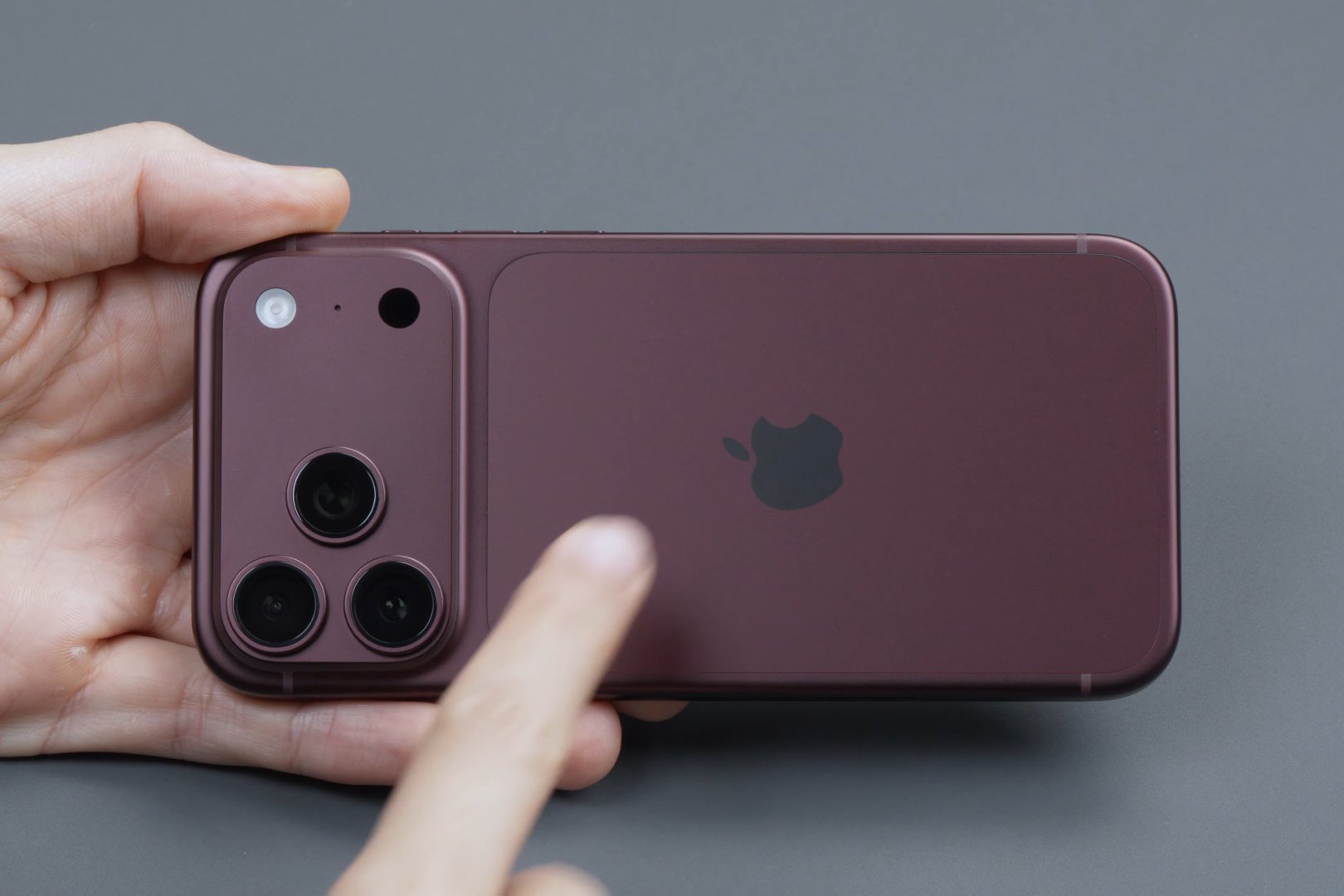
In the photos of the cases of both generations, it can be seen that the rings around the lenses on the eighteen are wider and differently arranged than on the seventeen. Someone took the effort to measure it with calipers — on the Pro Max models:
| Measurement Location | iPhone 17 Pro Max | iPhone 18 Pro Max |
|---|---|---|
| On the lenses | 13.20 mm | 13.68 mm |
| On the island itself | 11.36 mm | 11.58 mm |
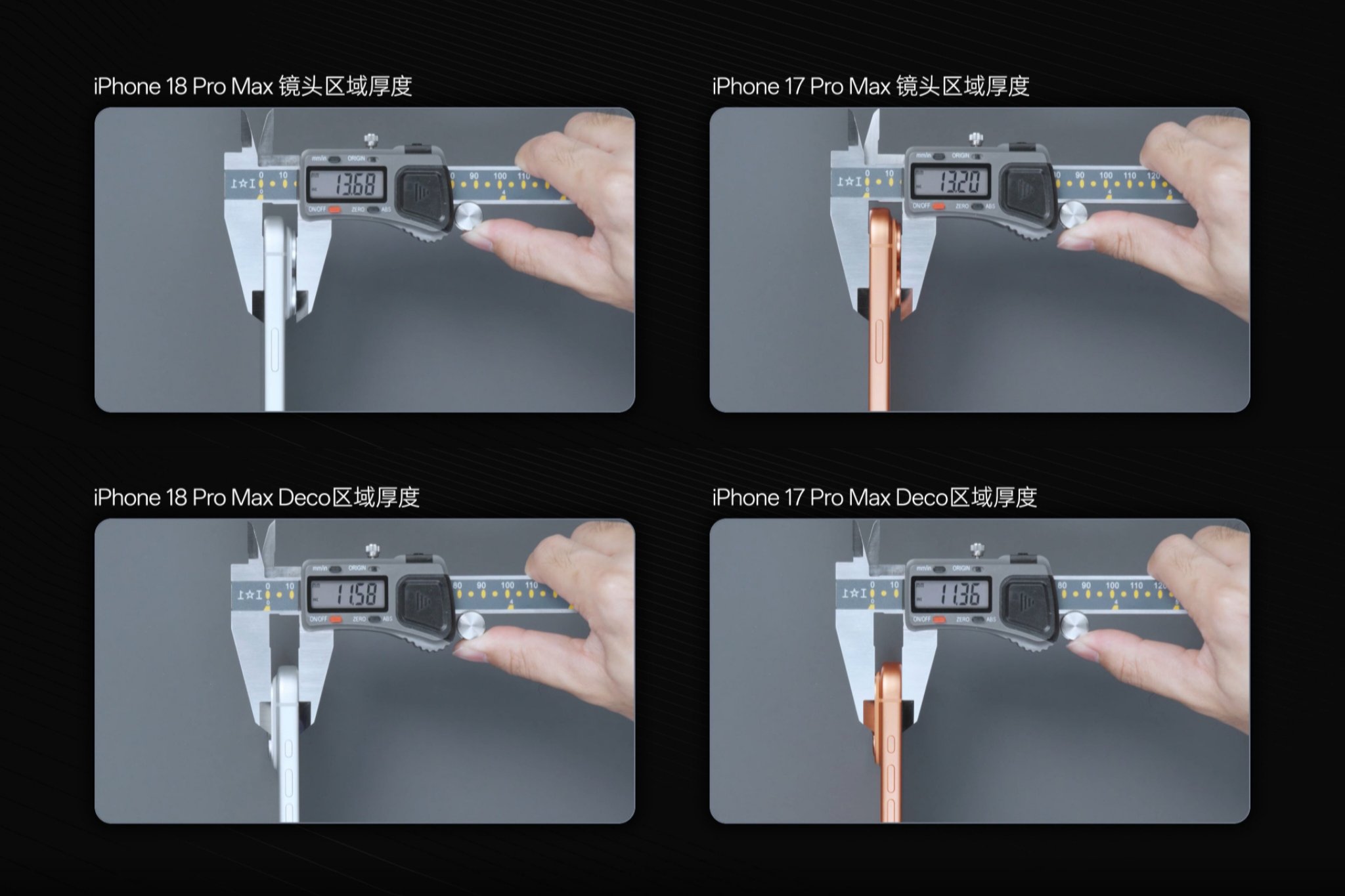
The island has grown by 0.22 mm, and together with the protruding lenses by almost half a millimeter. The measurement was taken on larger models, but the back construction is the same in both variants. It sounds like nothing, but the camera cover is a precisely fitted element — half a millimeter is the difference between a cover that sits evenly and one that wobbles on the edge or doesn’t fit at all. In our store, the covers for both generations are separate products, and that’s why.
A small tip when choosing, which is universal: covers that hold onto the ring around the lens are easier to remove than those that stick directly to the glass — there’s less risk of scratching something.
And one caveat: the flares mentioned by DxOMark are a feature of the camera itself, tested without any additions. The laboratory did not check the covers and does not comment on how they affect the photos.
If you have the seventeen, the proper categories are camera glass for iPhone 17 Pro and iPhone 17 Pro Max — these are separate shelves. For the eighteen, the suitable ones are camera covers for iPhone 18 Pro and iPhone 18 Pro Max.
You can find the full selection of accessories in the categories iPhone 17 Pro and iPhone 18 Pro.
Summary
In the iPhone 18 Pro better results do not come from changing sensors. The ultra-wide and periscope remain the same, the main camera has changed its designation with the same size and resolution, and the only real change is the aperture f/1.48–4.0. The new model debuts in second place in the ranking, while its predecessor is currently in fifth.
However, the most changes have occurred where DxOMark does not look at all: in Face ID and LiDAR.
And the points themselves should be taken with a grain of salt. They indicate the direction of changes, but they cannot replace viewing photos from the phone you actually use.
FAQ — frequently asked questions
What camera does the iPhone 18 Pro have?
Three sensors of 48 Mpix: ultra-wide Sony IMX972 (f/2.2, equivalent 13 mm), main Sony IMX905 (1/1.3″, variable aperture f/1.48–4.0, equivalent 24 mm) and periscope Sony IMX973 (f/2.8, equivalent 100 mm). The front one is Sony IMX914 18 Mpix f/1.9. The same set goes to the 18 Pro Max.
How many DxOMark points does the iPhone 18 Pro have?
172 points and second place in the global ranking, behind the Huawei Pura 80 Ultra with 175. The iPhone 17 Pro has 168 points and occupies fifth place. It is worth remembering that DxOMark sells tools and consulting to manufacturers for tuning cameras, so the ranking is sometimes criticized for lack of independence.
What is the difference between the iPhone 18 Pro camera and the 17 Pro?
Actually one: the main camera has a variable aperture of f/1.48–4.0 instead of a fixed f/1.78. The main sensor has changed its designation (IMX903 → IMX905) while maintaining the same size and resolution, and the ultra-wide and periscope sensors are the same as in the previous generation.
What is a variable aperture in the iPhone 18 Pro?
A mechanism that changes the size of the lens opening from f/1.48 to f/4.0 — DxOMark describes it as a physical aperture made of six movable blades, like in a camera. A wider opening lets in more light after dark, while a smaller one provides greater depth of field.
Does the camera glass from the iPhone 17 Pro fit the 18 Pro?
No. The camera island on the eighteen is thicker — 11.58 mm compared to 11.36 mm, and counting the protruding lenses 13.68 compared to 13.20 mm. Additionally, the rings around the lenses are wider and differently spaced. A glass dedicated to the new model will be needed.
Can you trust DxOMark results?
With reservations. DxOMark sells software and consulting to manufacturers for tuning cameras, and then evaluates the finished phones — the industry accuses it of lacking independence. Moreover, each subsequent generation receives a higher score, making it difficult to directly compare results from different years, and a single number hides all compromises between categories. Treat the points as a guideline for the direction of changes rather than a verdict.
Does the iPhone 18 Pro have better zoom than the 17 Pro?
Minimally: 138 points versus 135. The periscope uses the same Sony IMX973 sensor with the same f/2.8 aperture, so there has been no hardware change, and the reasons for these three points are not explained by DxOMark. The lab pointed out the weaker zoom at long distances.
Is Face ID in the iPhone 18 Pro better?
Hardware-wise, yes: the infrared camera sensor collects light from a larger area, and the dot projector has been redesigned — its components are larger, and the dots are more densely packed. However, the teardown does not specify how this translates to speed or effectiveness of recognition.
Leave a Reply