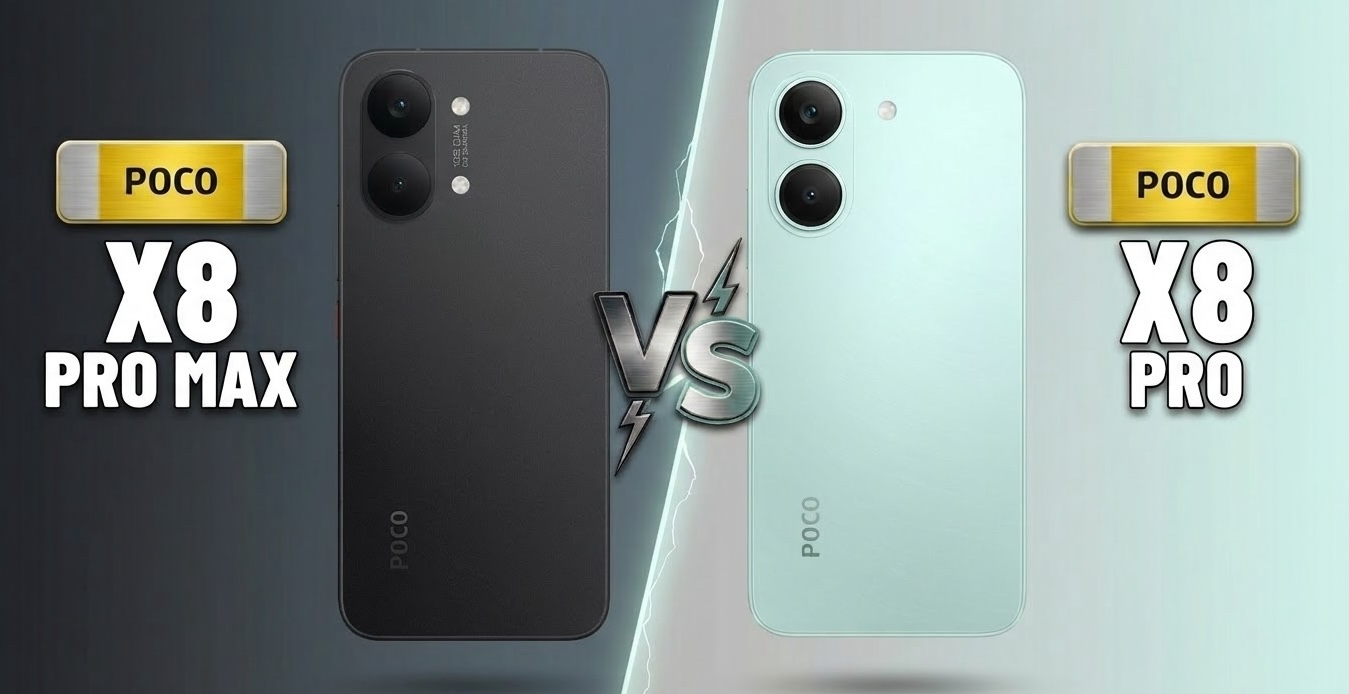
The dilemma of POCO X8 Pro vs POCO X8 Pro Max is one of the hottest smartphone comparisons of 2026. Both models debuted in March and immediately generated enormous interest — they offer AMOLED displays with a brightness of 3,500 nits, IP68/IP69K protection, and 100 W charging. The key difference? Processor, battery, and camera. POCO X8 Pro starts at 1,399 PLN, while POCO X8 Pro Max starts at 1,799 PLN. Below you will find a detailed comparison to help you choose the right model.
Technical specifications — POCO X8 Pro vs POCO X8 Pro Max
Before we move on to a detailed analysis, it’s worth seeing the full specifications of POCO X8 Pro and POCO X8 Pro Max in one place. The table below shows the key differences between both models.
| Parameter | POCO X8 Pro | POCO X8 Pro Max |
|---|---|---|
| Display | 6.59″ AMOLED, 1.5K | 6.83″ AMOLED, 1.5K |
| Brightness | 3,500 nits (peak) | 3,500 nits (peak) |
| Refresh Rate | 120 Hz | 120 Hz |
| Processor | MediaTek Dimensity 8500-Ultra (4 nm) | MediaTek Dimensity 9500s (3 nm) |
| AnTuTu v11 | 2,283,558 | 3,085,998 |
| RAM / Storage | 8/256 GB or 12/512 GB | 12/256 GB or 12/512 GB |
| Main Camera | 50 MP, Sony IMX882, OIS | 50 MP, Light Fusion 600, OIS |
| Battery | 6,500 mAh | 8,500 mAh |
| Charging | 100 W HyperCharge | 100 W HyperCharge |
| System | Android 16, HyperOS 3 | Android 16, HyperOS 3 |
| Resistance | IP68 / IP69K | IP68 / IP69K |
| Weight | 201.5 g | 218 g |
| Fingerprint Reader | Optical (under display) | Ultrasonic (under display) |
| Wi-Fi | Wi-Fi 6 | Wi-Fi 7 |
| eSIM | No | Yes |
| Price from | 1,399 PLN | 1,799 PLN |
Display — bigger doesn’t always mean better
Both the POCO X8 Pro and POCO X8 Pro Max feature 1.5K AMOLED panels with a refresh rate of 120 Hz and a peak brightness of 3,500 nits. They support Dolby Vision and HDR10+, which translates to excellent color reproduction while watching movies.
The main difference is the size — the POCO X8 Pro has a 6.59-inch display, while the POCO X8 Pro Max offers 6.83 inches. Both models are protected by Corning Gorilla Glass 7i and have TÜV Rheinland certifications (Low Blue Light, Flicker Free).
Tip: If you value compactness and one-handed operation, the POCO X8 Pro will be more comfortable. For fans of large displays — the X8 Pro Max with a 6.83-inch panel is a better choice for movies and games.
The touch sampling rate is 480 Hz (Game Turbo) in both models, and the PWM dimming operates at 3,840 Hz — this is important for those sensitive to screen flicker.
Processor and performance — this is where the POCO X8 Pro Max excels
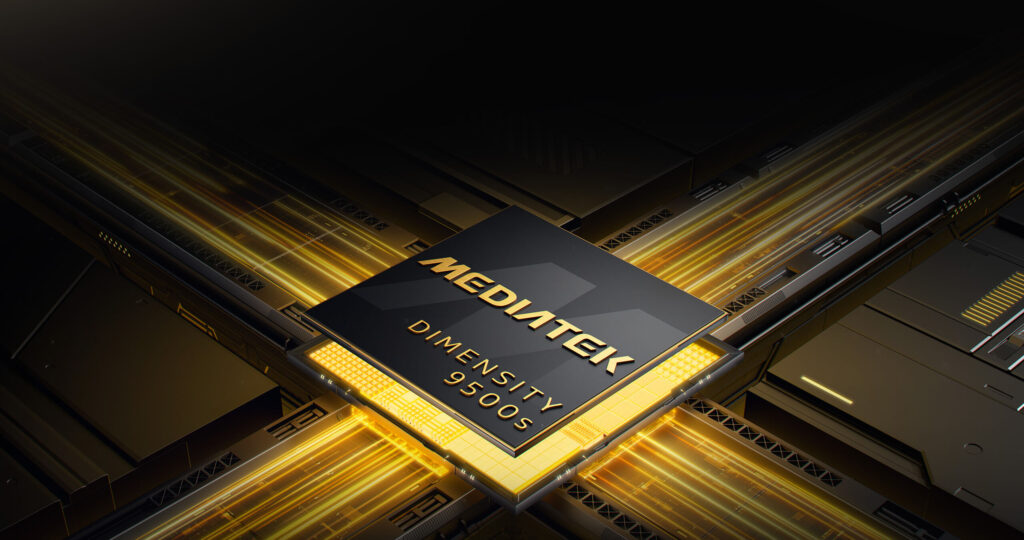
This is one of the biggest differences when comparing POCO X8 Pro vs POCO X8 Pro Max. The Pro model is powered by the MediaTek Dimensity 8500-Ultra in a 4-nanometer process technology, while the Pro Max received the flagship Dimensity 9500s made in a 3 nm process.
The performance difference is clear — the POCO X8 Pro score in AnTuTu v11 is 2,283,558 points, while the POCO X8 Pro Max achieves 3,085,998 in AnTuTu:
| Test | POCO X8 Pro | POCO X8 Pro Max | Difference |
|---|---|---|---|
| AnTuTu v11 | 2,283,558 | 3,085,998 | +35% |
| Process technology | 4 nm (TSMC) | 3 nm | Newer |
| GPU | Mali-G720 MC8 | Immortalis-G925 MC12 | Higher class |
The Dimensity 9500s in the POCO X8 Pro Max is a flagship segment chip — the same processor can be found in phones costing over 3,000 PLN. The Immortalis-G925 MC12 GPU provides smooth gameplay even in the most demanding mobile games, such as Genshin Impact or Honkai: Star Rail at the highest settings.
POCO X8 Pro with Dimensity 8500-Ultra also performs very well in everyday use — multitasking, social media, and gaming on medium settings are not a problem. However, in benchmarks and intensive games, the 35% difference in favor of the Max model is noticeable.
Both smartphones feature the POCO 3D IceLoop cooling system with a surface area of 5,300 mm², which effectively dissipates heat during longer gaming sessions.
It is worth adding that both models support 5G network (SA/NSA) — this is the standard in 2026, but still an important parameter when choosing a new smartphone. The RAM in both cases is LPDDR5X, and the internal storage is UFS 4.1 — the fastest available standards in the mid-premium segment.
Camera — Light Fusion 600 vs Sony IMX882
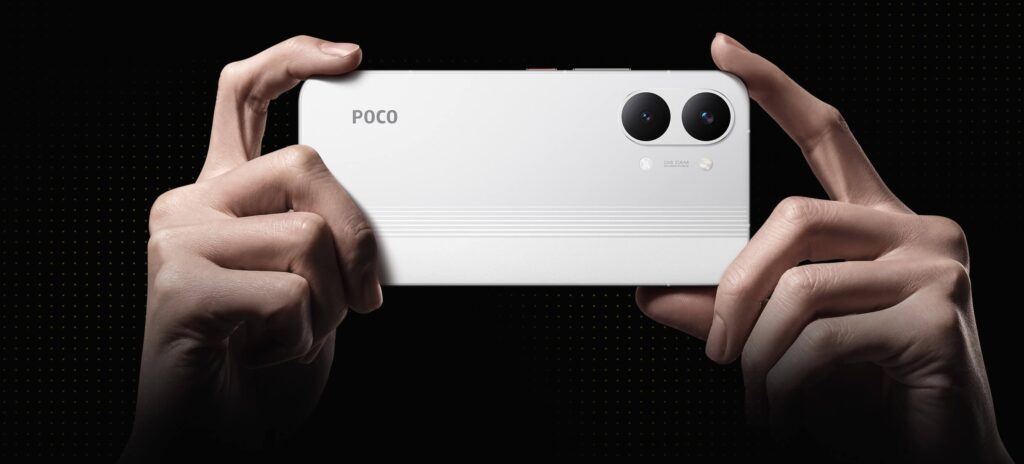
Both models have a 50 MP main camera with optical image stabilization (OIS), but the sensors used differ significantly.
POCO X8 Pro uses the Sony IMX882 — a proven sensor with a size of 1/1.95 inches and 0.8 μm pixels. It is a solid sensor that performs well in daylight and well-lit scenes.
POCO X8 Pro Max received the newer Light Fusion 600 with 1.6 μm pixels — twice as large as those in the X8 Pro. The Dual Native ISO Fusion technology improves dynamic range and significantly enhances photo quality in low light. In practice, this means less noise in night photos and better details in shadows.
The remaining elements of the camera set are identical:
– Ultra-wide angle — 8 MP, f/2.2
– Front — 20 MP, f/2.2
– Video recording — 4K at 30/60 fps, slow motion 960 fps
Tip: If you often take photos in the evening or in poorly lit interiors, the POCO X8 Pro Max with the Light Fusion 600 sensor will be a noticeably better choice.
Battery and charging — 6,500 vs 8,500 mAh
This is another category where the POCO X8 Pro Max clearly dominates. The 8,500 mAh battery (silicon-carbon technology) is 30% more than the 6,500 mAh in the Pro model.
| Parameter | POCO X8 Pro | POCO X8 Pro Max |
|---|---|---|
| Capacity | 6,500 mAh | 8,500 mAh |
| Wired charging | 100 W HyperCharge | 100 W HyperCharge |
| Reverse charging | 27 W | 27 W |
| Wireless charging | No | No |
| Battery life | ≥80% after 1,600 cycles | ≥80% after 1,600 cycles |
In practice, the POCO X8 Pro Max easily lasts two full days of moderate use, and with light usage, even three days. The POCO X8 Pro comfortably provides a full day even with intensive use.
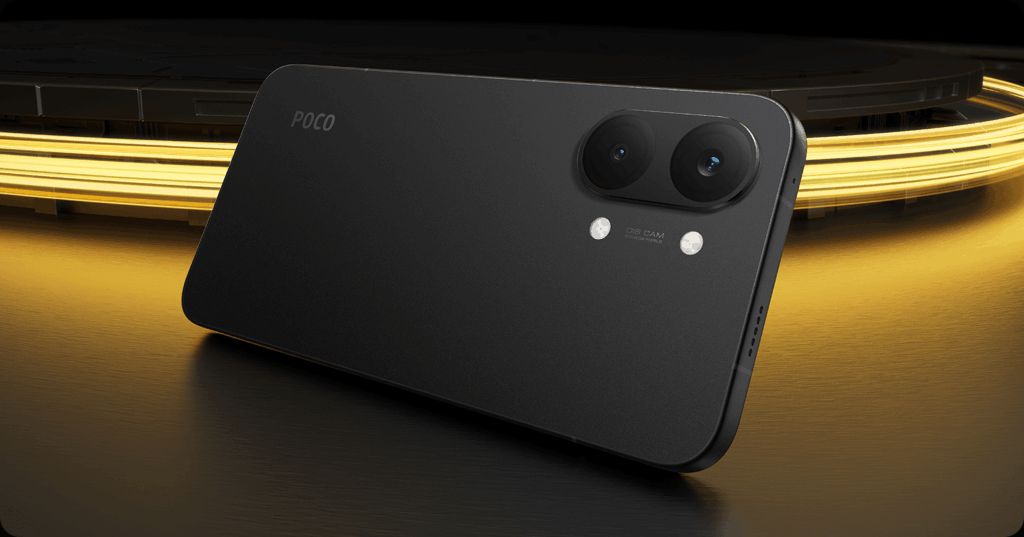
Both models charge with a power of 100 W — the POCO X8 Pro Max recovers 50% of energy in about 24 minutes, and a full charge takes just over 50 minutes. Neither model supports wireless charging.
If you are looking for a fast wall charger that supports 100 W, it’s worth choosing a model with USB Power Delivery (fast charging standard) or a dedicated Xiaomi charger. A compact power bank with the appropriate output power will also be useful for daily top-ups while traveling.
Build and design — aluminum, glass, and IP69K
Both smartphones have aluminum frames, Gorilla Glass 7i protection on the front, and an IP68/IP69K certification — they can withstand immersion in water as well as a stream of hot water under pressure. This is rare in this price range. Despite their durability, it is worth protecting the display — screen protectors will provide additional protection against scratches in everyday use.
| Parameter | POCO X8 Pro | POCO X8 Pro Max |
|---|---|---|
| Dimensions | 157.5 × 75.2 × 8.4 mm | 162.9 × 77.9 × 8.2 mm |
| Weight | 201.5 g | 218 g |
| Back cover | Glass | Fiberglass |
| SIM | Dual nano-SIM | Dual nano-SIM + eSIM |
| RGB backlight | 8 colors | 8 colors |
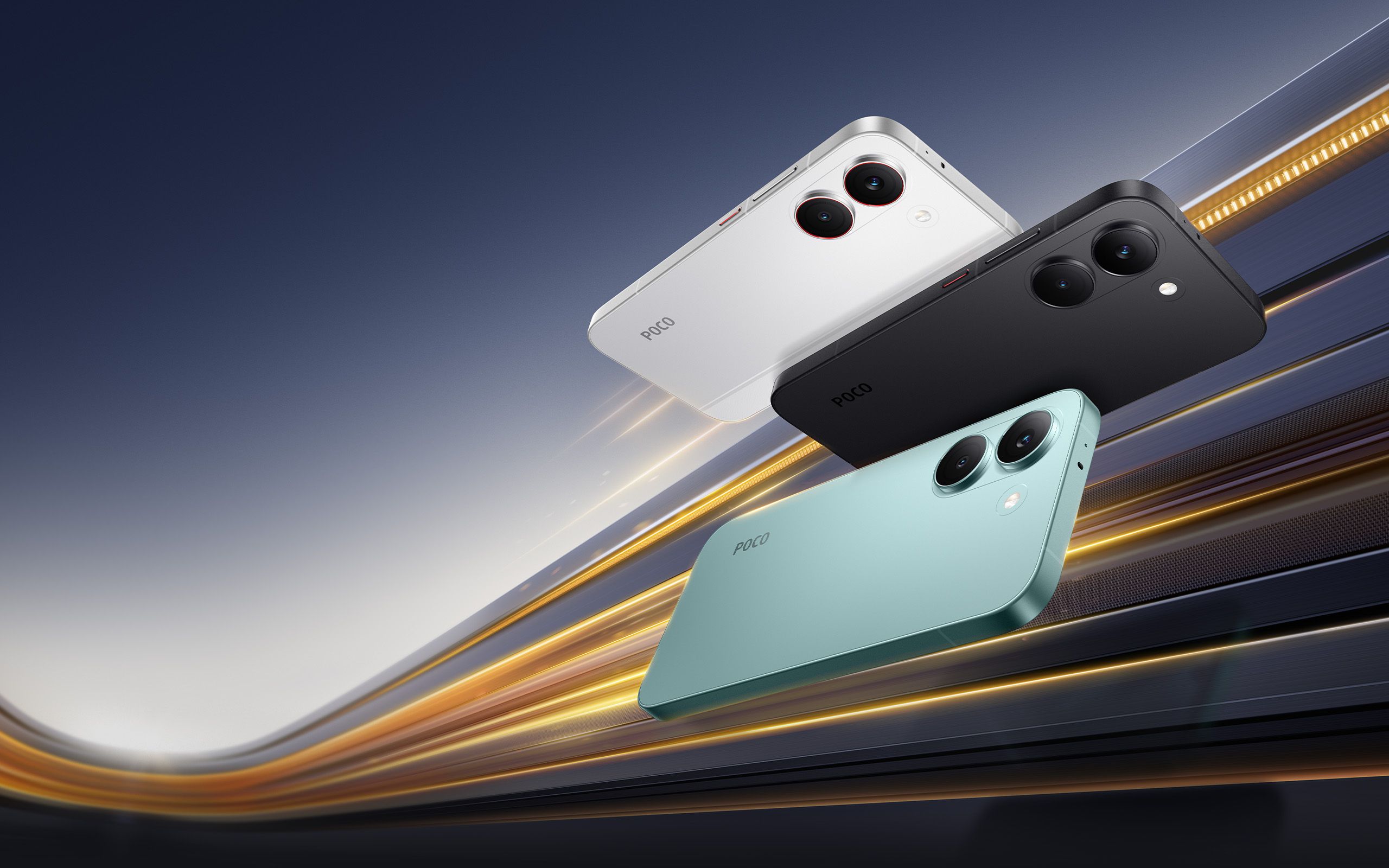
| Colors | Black, White, Mint Green | Black, White, Blue |
POCO X8 Pro is lighter by 16.5 g and slightly narrower — it fits better in the hand and in narrower pockets. The Max model is slimmer (8.2 vs 8.4 mm) but larger and heavier due to the bigger battery and display.
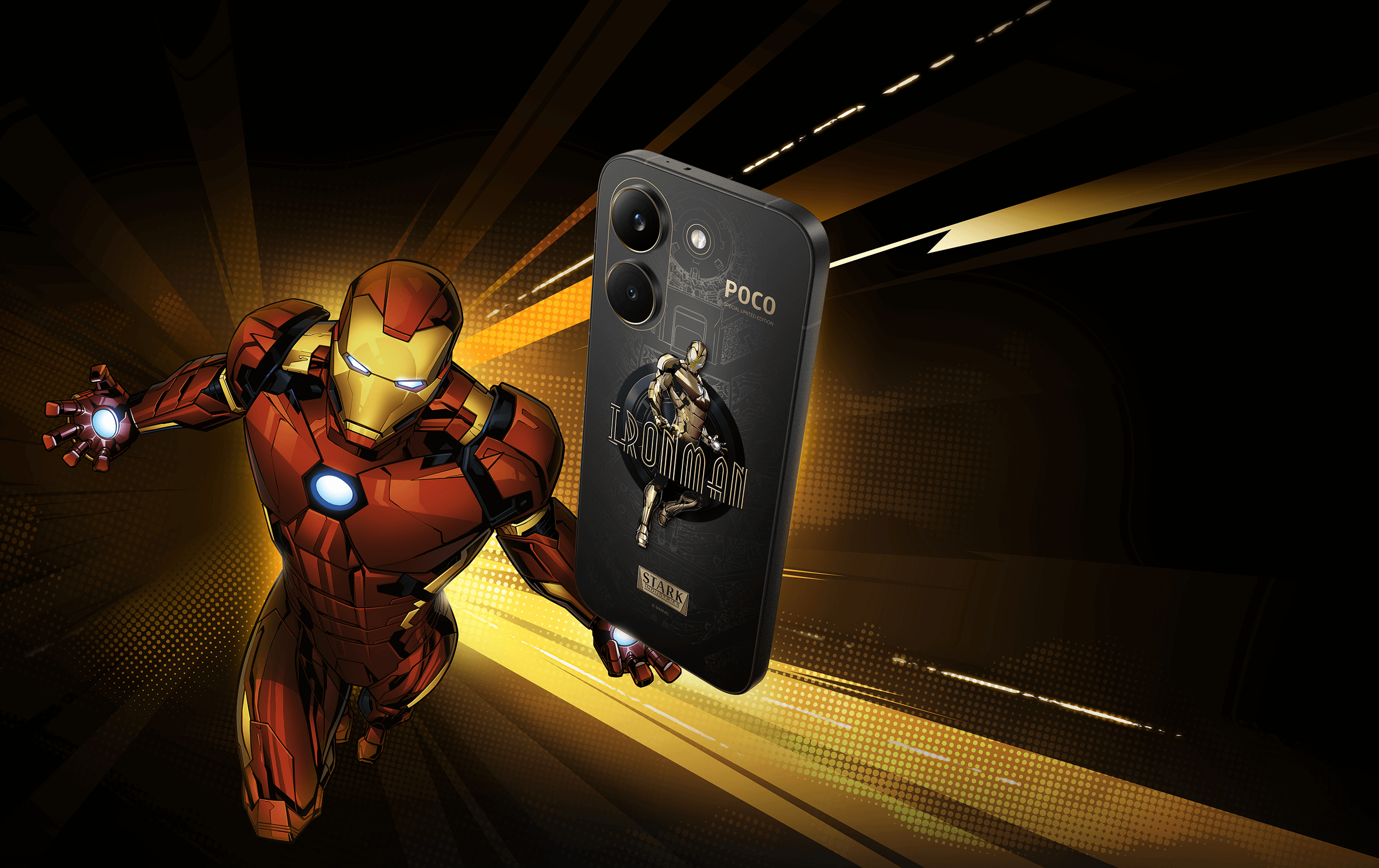
It is worth mentioning that the POCO X8 Pro is also available in a limited Iron Man edition (12/512 GB) for 1,749 PLN on promotion — this variant is for Marvel fans.
Regardless of the chosen model, it is good to invest in a suitable POCO smartphone case that will protect the aluminum frame and glass or fiberglass back from mechanical damage.
Connectivity — Wi-Fi 7 and eSIM only in the Max model
In terms of connectivity, the POCO X8 Pro Max offers several significant improvements:
- Wi-Fi 7 (802.11be) instead of Wi-Fi 6 — faster transfer and lower latency
- eSIM — a convenient solution while traveling, without the need to swap a physical SIM card
- Bluetooth 5.4 with Auracast — wireless audio sharing to multiple headphones simultaneously
- Symmetrical stereo speakers — better sound than the standard stereo speakers in the X8 Pro
The POCO X8 Pro 5G and POCO X8 Pro Max 5G support both SA and NSA modes. Other common connectivity features include NFC, infrared port (IR blaster), USB-C 2.0, GPS L1+L5, and Dolby Atmos with Hi-Res Audio (24-bit/192 kHz). Neither model has a 3.5 mm headphone jack — if you prefer wireless audio, check out Bluetooth headphones compatible with both smartphones.
Security and Software
Both smartphones run on Android 16 with HyperOS 3 and will receive 4 years of system updates and 6 years of security patches. They also have access to Google Gemini, Circle to Search, and AI tools (AI Writing, AI Speech).
The key difference concerns the fingerprint reader:
- POCO X8 Pro — optical reader under the screen
- POCO X8 Pro Max — ultrasonic reader under the screen
The ultrasonic reader works faster, is more precise, and recognizes the finger even when wet — this is a clear advantage of the Max model.
POCO X8 Pro Max also offers the Xiaomi Offline Communication feature with a range of up to 500 m — it allows communication with other Xiaomi devices without internet access or cellular network.
Price of POCO X8 Pro and POCO X8 Pro Max in Poland
How much do these smartphones cost? The price of POCO X8 Pro starts at 1,399 PLN, and the price of POCO X8 Pro Max starts at 1,799 PLN in the promotional launch (until March 31, 2026):
| Variant | POCO X8 Pro | POCO X8 Pro Max |
|---|---|---|
| 8/256 GB | 1,399 PLN (only mi.com) | — |
| 12/256 GB | — | 1,799 PLN (only mi.com) |
| 12/512 GB | 1,599 PLN | 1,999 PLN |
| Iron Man 12/512 GB | 1,749 PLN | — |
Regular prices (after the promotion):
| Variant | POCO X8 Pro | POCO X8 Pro Max |
|---|---|---|
| 8/256 GB | 1,699 PLN | — |
| 12/256 GB | — | 2,099 PLN |
| 12/512 GB | 1,899 PLN | 2,299 PLN |
| Iron Man 12/512 GB | 1,999 PLN | — |
The difference of 400 PLN between comparable variants (12/512 GB) is a reasonable surcharge for the flagship processor, larger battery, better camera, and Wi-Fi 7. You can find current prices and availability on the official POCO website.
Gaming performance — how do they perform in practice?
Simply comparing AnTuTu scores does not provide the full picture. In everyday use, both smartphones perform excellently — apps open instantly, multitasking works smoothly, and scrolling through the interface is fluid at 120 Hz.
The difference becomes apparent in demanding mobile games. The POCO X8 Pro Max with the Immortalis-G925 MC12 GPU maintains a stable 60 fps in Genshin Impact at the highest graphics settings, while the POCO X8 Pro with the Mali-G720 MC8 requires lowering some options to medium to maintain smoothness. In less demanding titles — PUBG Mobile, Call of Duty Mobile, or Honkai: Star Rail — both models run without issues at high settings.
The POCO 3D IceLoop cooling system works effectively in both cases. After a 30-minute session of Genshin Impact, the casing temperatures remain within a comfortable range. The POCO X8 Pro Max has a slight advantage here due to its larger casing, which dissipates heat better.
For casual gamers, the POCO X8 Pro will be more than sufficient. However, if you regularly play the most demanding titles and care about maximum graphics settings, the Dimensity 9500s in the Max model is a safer choice for the coming years.
POCO X8 Pro Max vs competition — how does it compare to rivals?
It’s worth looking at both POCO models in the context of the market. In the price range of 1,400–2,300 PLN, the competition is significant:
- Samsung Galaxy A56 5G (~1,699 PLN) — better Samsung ecosystem, longer support (7 years of updates), but noticeably weaker Exynos 1580 processor and smaller 5,000 mAh battery. The POCO X8 Pro offers more performance for a similar price.
- Redmi Note 14 Pro+ 5G (~1,599 PLN) — a close relative from the Xiaomi family. Similar specifications to the POCO X8 Pro, but slightly weaker Dimensity 8400-Ultra and smaller 6,200 mAh battery. POCO stands out with an IP69K certification.
- Nothing Phone (3a) (~1,799 PLN) — distinguished by its Glyph lighting design, pure Android, but weaker processor and smaller battery. A choice for those who prioritize aesthetics.
- Motorola Edge 60 (~1,899 PLN) — a competitor with wireless charging, which is lacking in POCO. However, it falls short in performance compared to the POCO X8 Pro Max.
POCO X8 Pro Max priced at 1,999 PLN (12/512 GB) offers performance comparable to smartphones costing over 3,000 PLN — Samsung Galaxy S25, OnePlus 13, or Xiaomi 15. This is its biggest competitive advantage.

Summary of differences — who wins in each category?
| Category | Winner | Why? |
|---|---|---|
| Display | POCO X8 Pro Max | Larger 6.83″ panel |
| Performance | POCO X8 Pro Max | Dimensity 9500s, +35% in AnTuTu |
| Camera | POCO X8 Pro Max | Light Fusion 600, better night photos |
| Battery | POCO X8 Pro Max | 8,500 vs 6,500 mAh |
| Compactness | POCO X8 Pro | Lighter (201.5 g), narrower |
| Price | POCO X8 Pro | From 1,399 PLN |
| Connectivity | POCO X8 Pro Max | Wi-Fi 7, eSIM, Auracast |
| Biometrics | POCO X8 Pro Max | Ultrasonic reader |
POCO X8 Pro Max wins in six out of eight categories — but POCO X8 Pro holds its ground with its price and compact dimensions.
POCO X8 Pro vs POCO X8 Pro Max — which model to choose in 2026?
The choice between POCO X8 Pro and POCO X8 Pro Max depends on your priorities and budget.
Choose POCO X8 Pro if:
– You are looking for the best value for money under 1,700 PLN
– You prefer a compact and lighter smartphone (201.5 g vs 218 g)
– You don’t need flagship performance — Dimensity 8500-Ultra is more than sufficient for everyday tasks
– You are interested in the limited Iron Man edition
Choose POCO X8 Pro Max if:
– You want the flagship Dimensity 9500s processor with performance comparable to phones costing over 3,000 PLN
– You care about the longest battery life — 8,500 mAh lasts 2–3 days without charging
– You take a lot of photos in low light — Light Fusion 600 makes a noticeable difference
– You need eSIM or Wi-Fi 7
– You value a faster and more accurate ultrasonic fingerprint reader
Our verdict: For an additional 400 PLN, POCO X8 Pro Max offers significantly more — a flagship processor, a huge battery, and a better camera. It is one of the best smartphones in terms of price to performance ratio in 2026. However, if compactness and a lower price are priorities, POCO X8 Pro remains an excellent choice.
In summary, comparing POCO X8 Pro vs POCO X8 Pro Max — both smartphones offer excellent value, but the Max model targets users who want flagship performance without the flagship price.
Are you looking for accessories for your new POCO smartphone? Check out cases and tempered glass for POCO phones at Home Screen — you’ll find protection tailored to your model.
Frequently Asked Questions (FAQ)
POCO X8 Pro vs POCO X8 Pro Max — what are the differences?
The main differences are the processor (Dimensity 8500-Ultra vs flagship Dimensity 9500s), battery (6,500 vs 8,500 mAh), camera sensor (Sony IMX882 vs Light Fusion 600 with larger pixels), fingerprint reader (optical vs ultrasonic), and connectivity (Wi-Fi 6 vs Wi-Fi 7, no eSIM vs eSIM).
Is the POCO X8 Pro Max worth the additional 400 PLN?
Yes — for an additional 400 PLN, you get a flagship processor with 35% higher performance, a battery that’s 2,000 mAh larger, a better camera for night photos, Wi-Fi 7, and eSIM. It’s one of the better upgrades on the smartphone market.
What is the price of the POCO X8 Pro in Poland?
The POCO X8 Pro costs from 1,399 PLN (8/256 GB, promotional price) to 1,899 PLN (12/512 GB, regular price). There is also a limited Iron Man edition available for 1,749–1,999 PLN.
Are the POCO X8 Pro and X8 Pro Max waterproof?
Yes — both models have an IP68 and IP69K certification, which means they are resistant to immersion in water (up to 1.5 m for 30 minutes) and to a stream of hot water under pressure.
How long does the battery last in the POCO X8 Pro Max?
The 8,500 mAh battery in the POCO X8 Pro Max lasts for 2–3 days of moderate use. The 100 W HyperCharge charging allows you to recover 50% of the energy in about 24 minutes.
Does the POCO X8 Pro have eSIM?
No — eSIM is available only in the POCO X8 Pro Max. The Pro model supports only two physical nano-SIM cards.
Leave a Reply