Blog

  • Xiaomi 18 Pro and 18 Pro Max — screen on the back, Leica optics, and premiere on September 23

    Xiaomi 18 Pro and 18 Pro Max — screen on the back, Leica optics, and premiere on September 23

    Xiaomi will showcase the 18 Pro series on Wednesday, September 23, 2026, at 7:00 PM Chinese time — which is 1:00 PM in Poland. The date appears on the poster for the autumn conference that has surfaced online, and the entire campaign revolves around one thing: a touch screen built into the camera island.

    The campaign’s slogan is “one more side, thousands of possibilities.”

    Note: this article was created before the presentation. It is based on promotional materials that leaked online before the premiere — they appear to be prepared by Xiaomi, but the manufacturer has not officially published them. Treat all numbers as highly probable, unconfirmed. Certainty will come on September 23.

    Screen on the back, so what’s really going on here

    The camera island is a wide, horizontal rectangle with rounded corners. On the left side sit two large lenses stacked one above the other, while the entire right side is occupied by a colorful, touch display. Below the island, already outside of it, there is also an elongated module with a third eye and a flash LED.

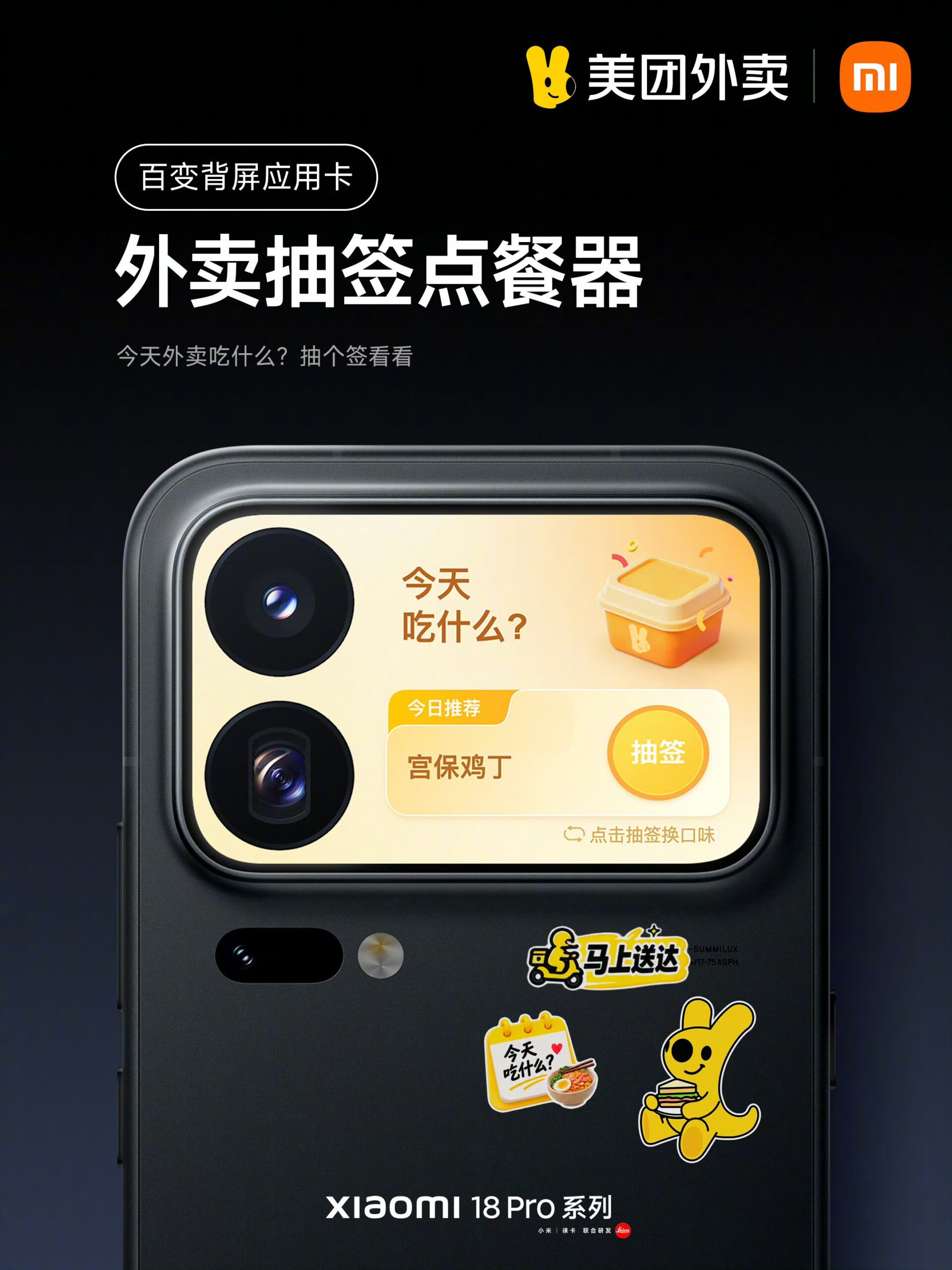
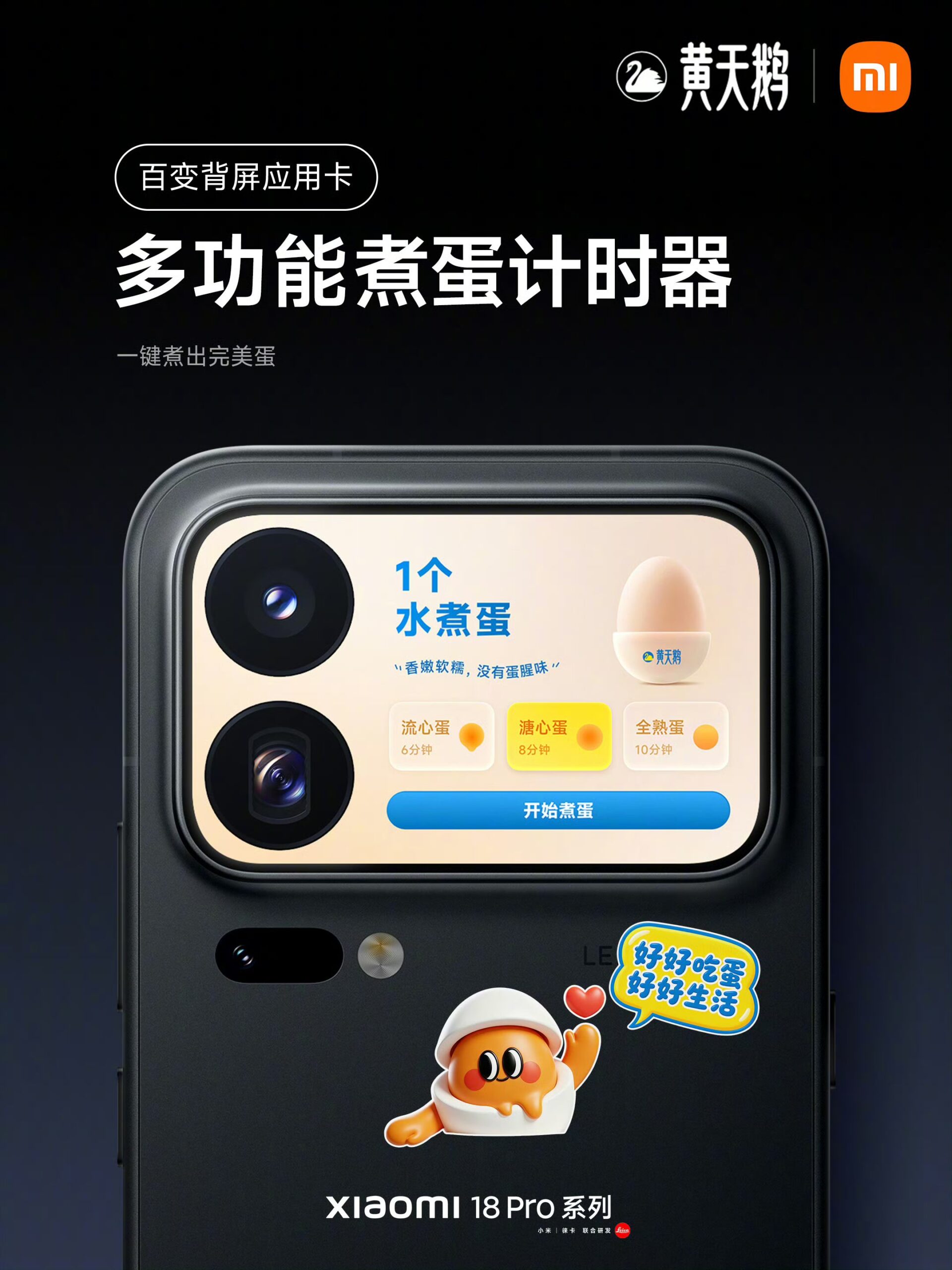
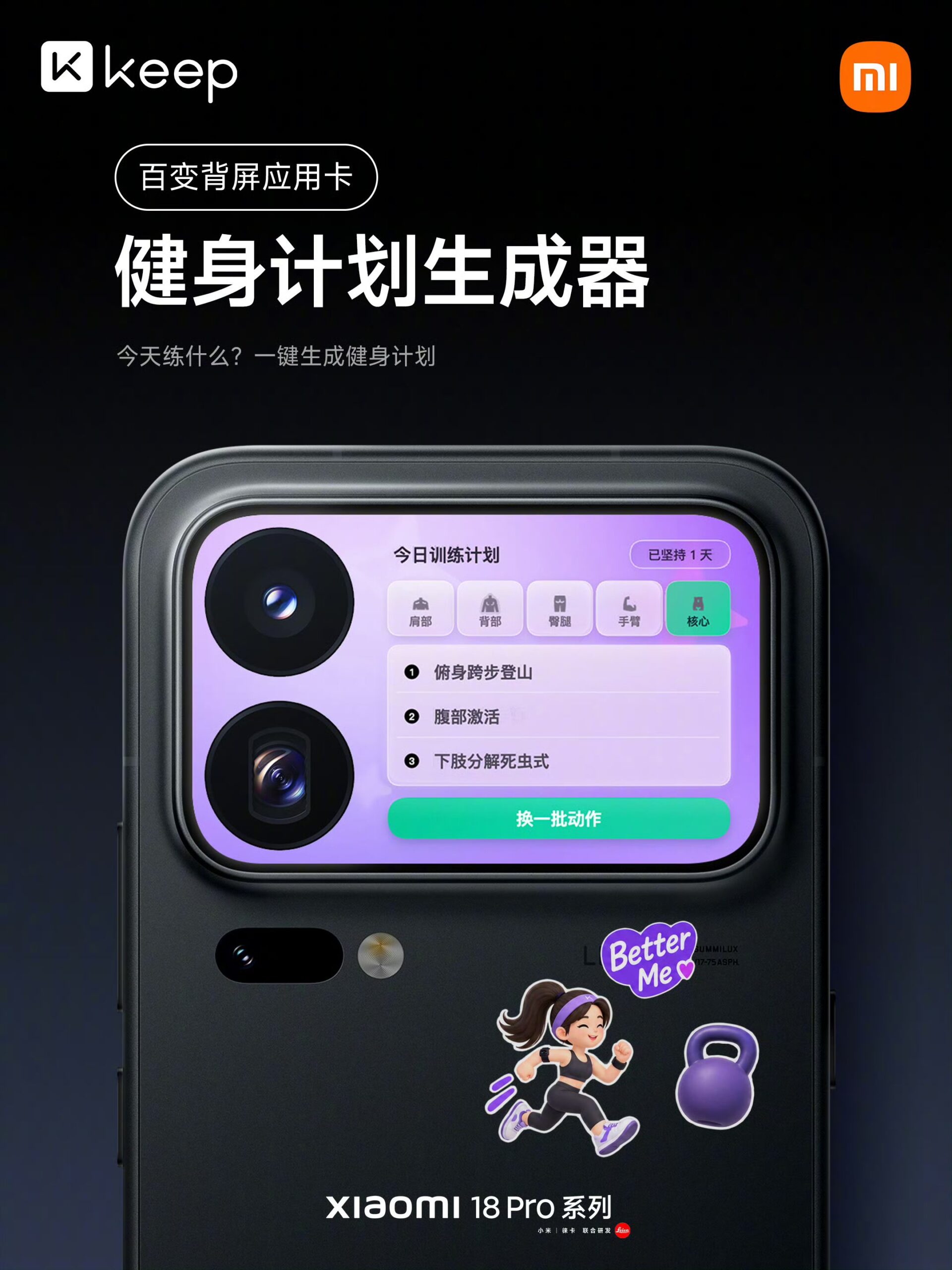
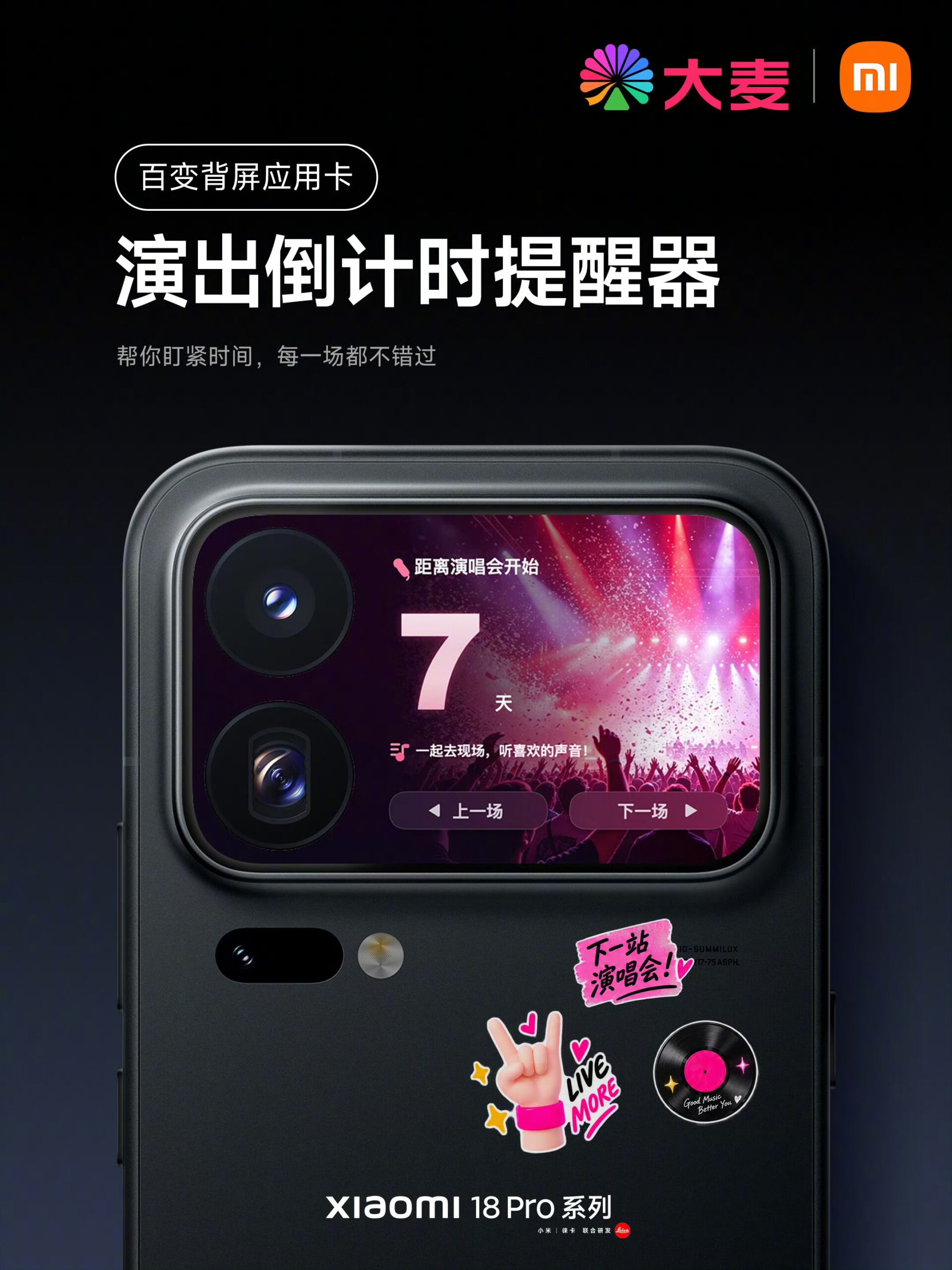
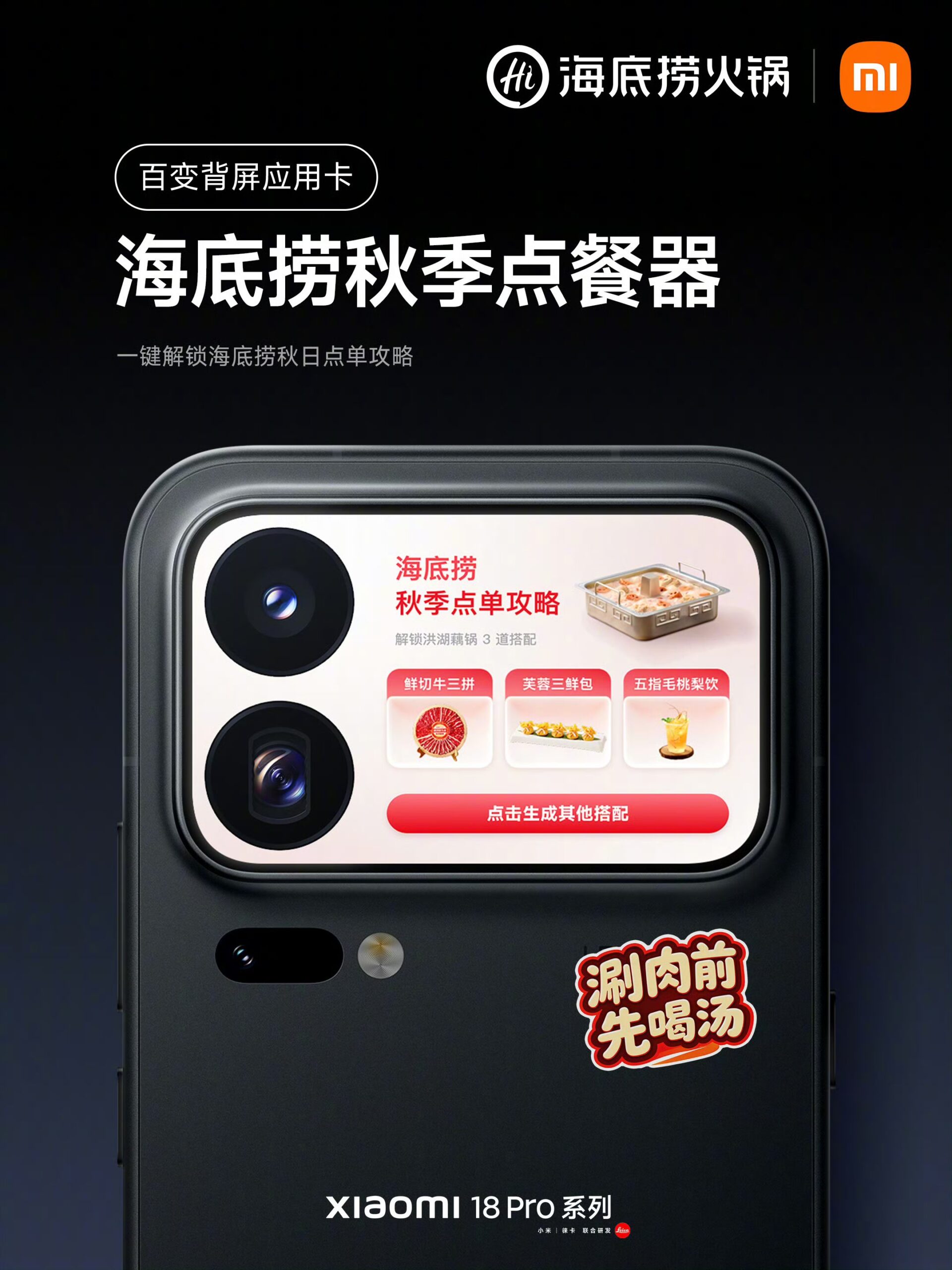
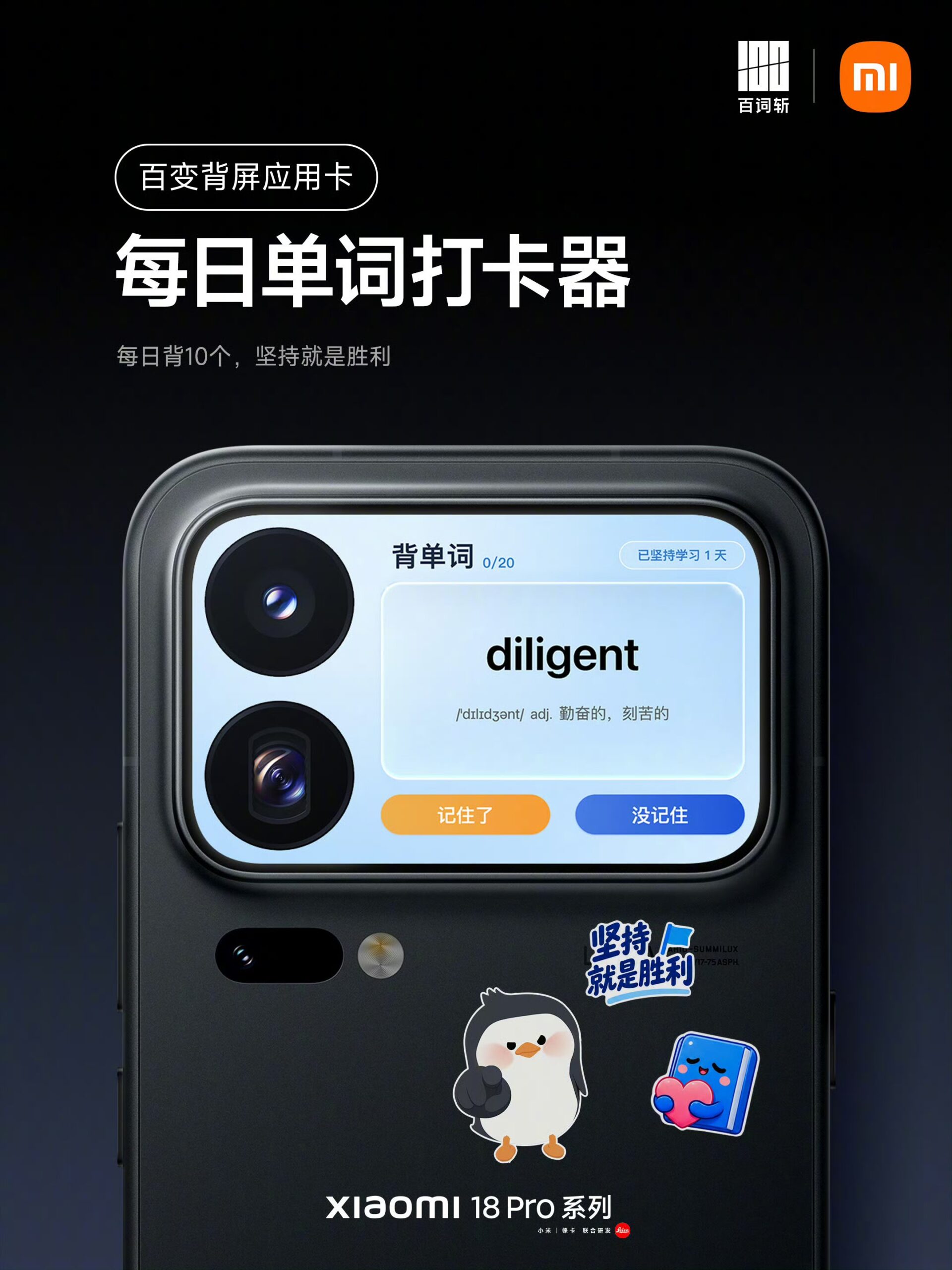
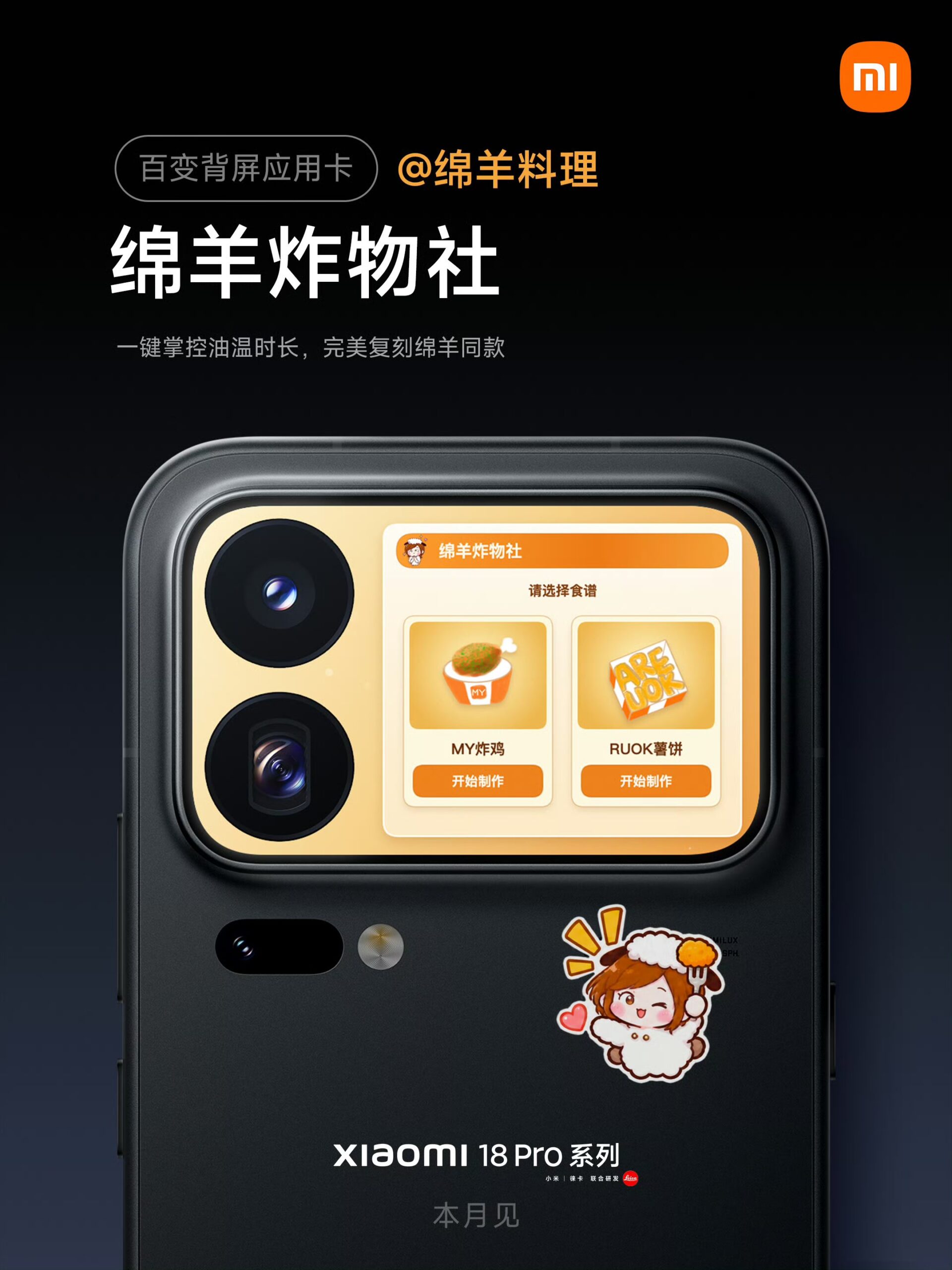
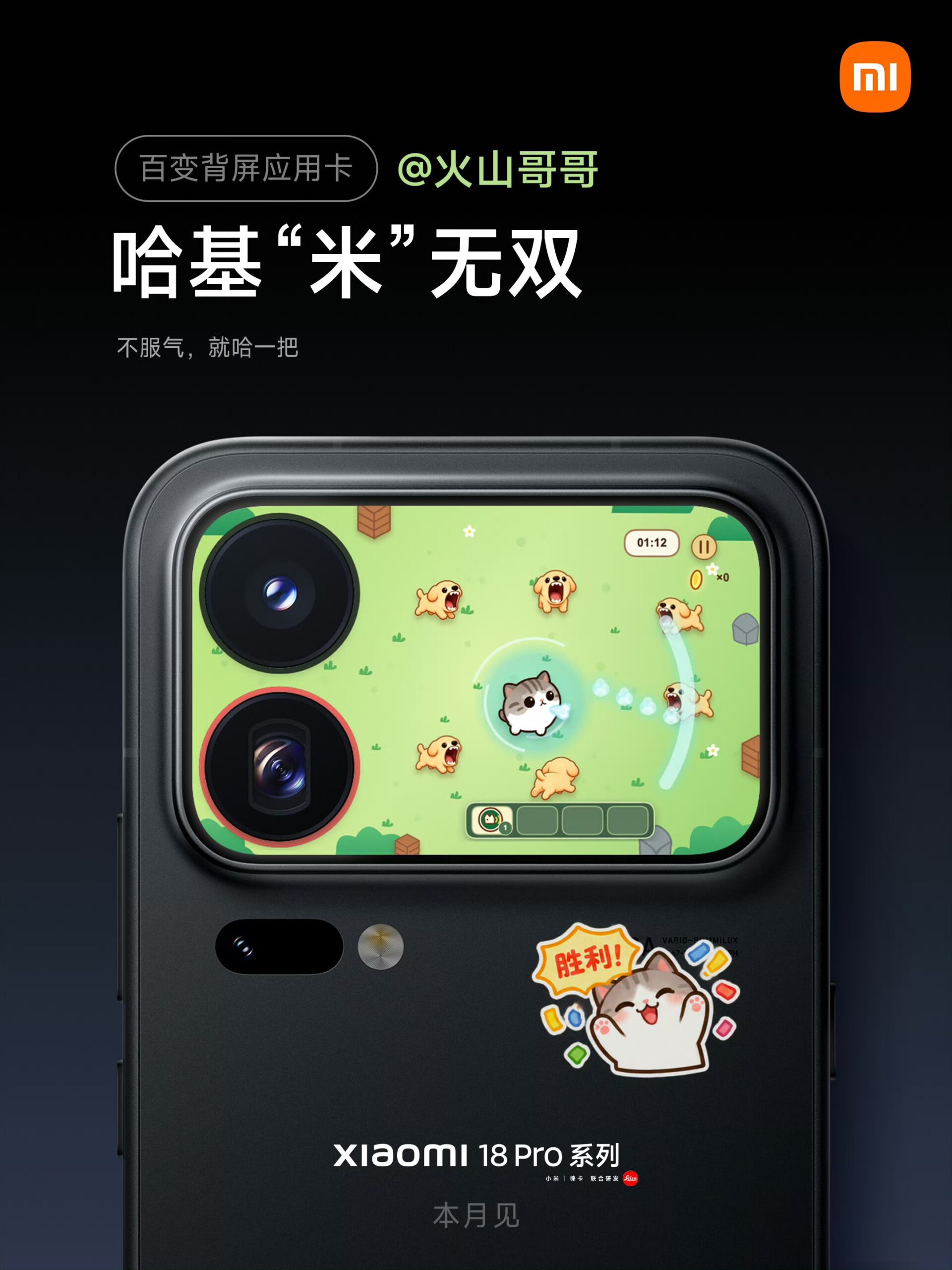
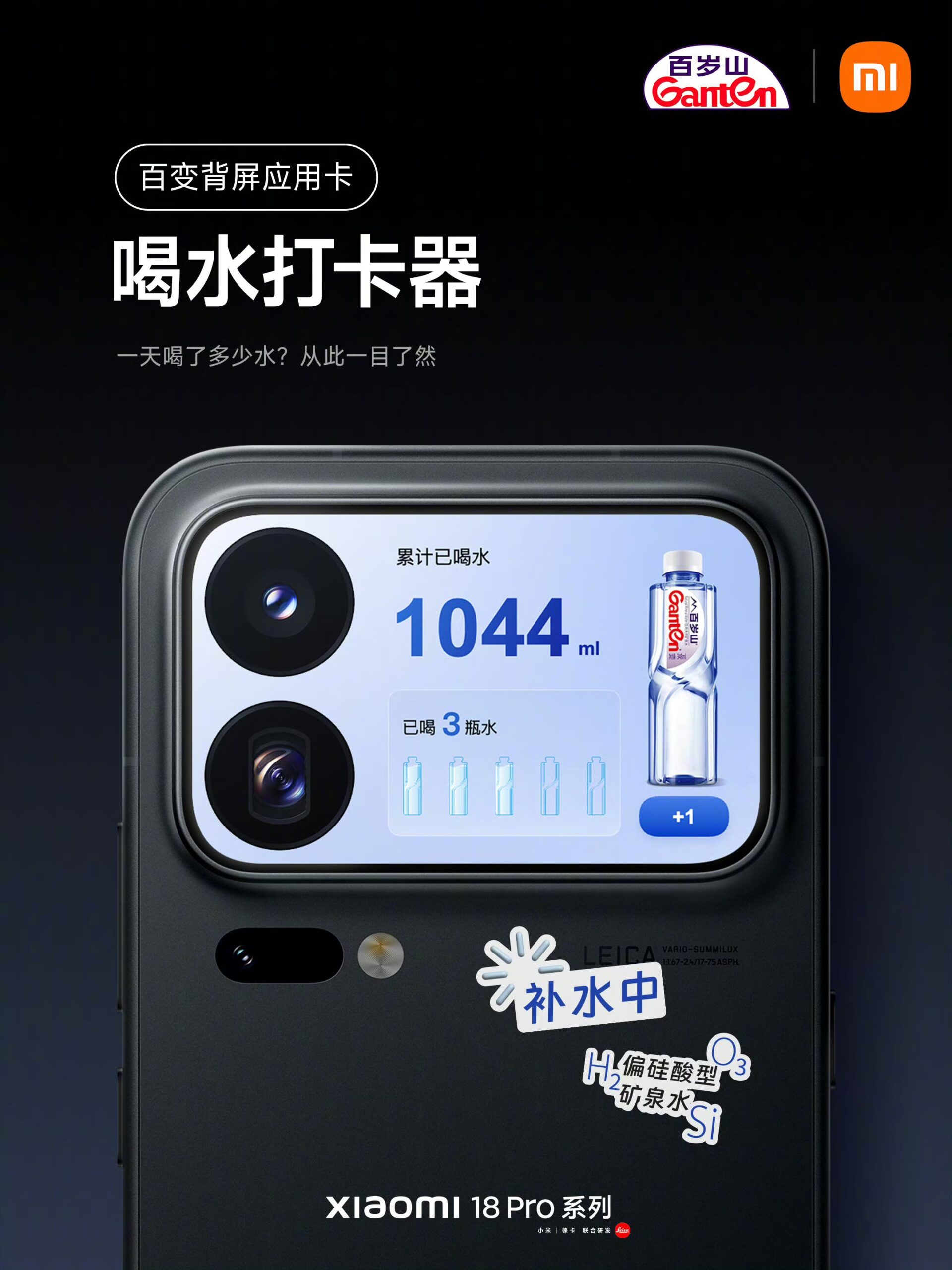
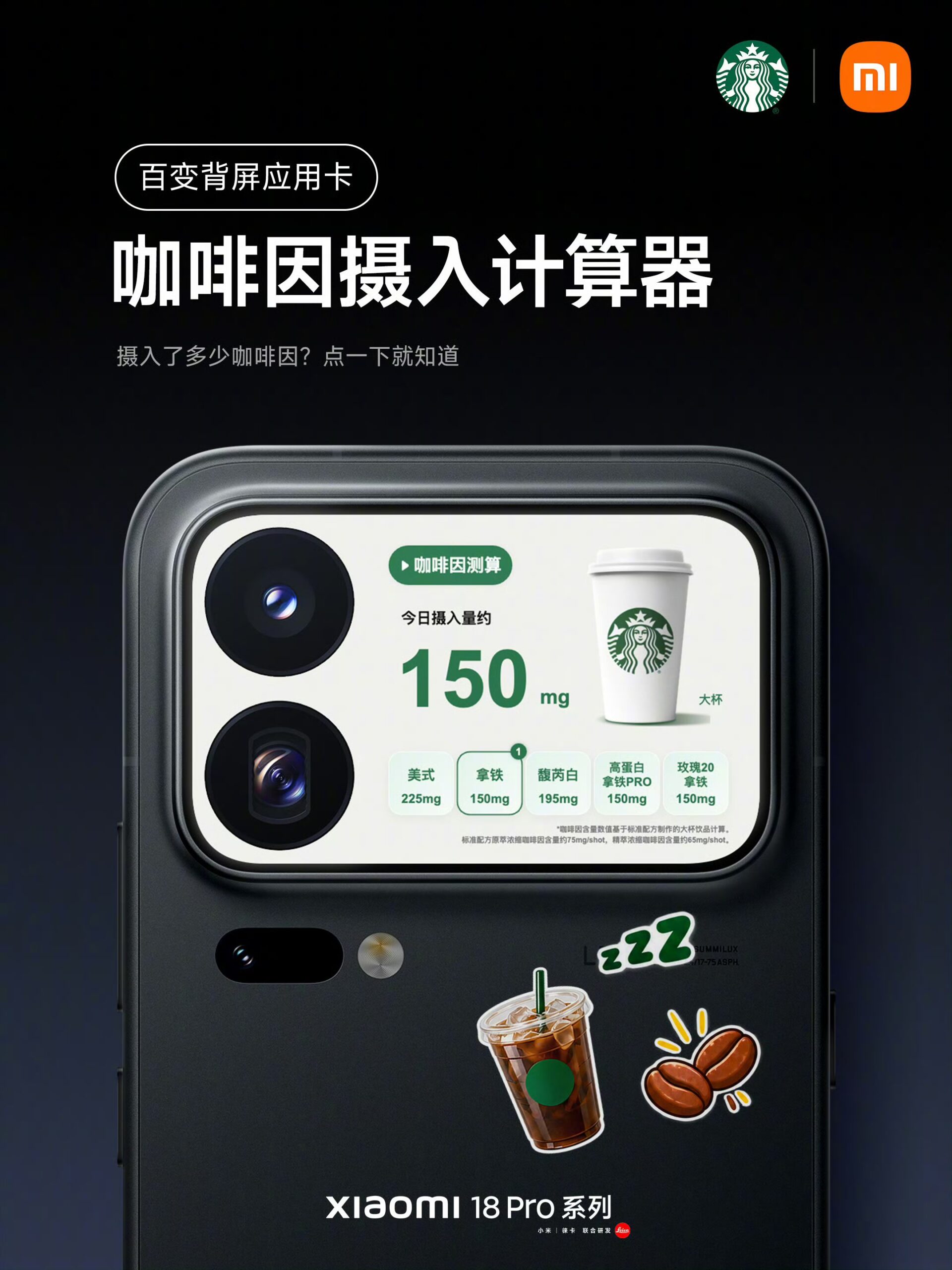
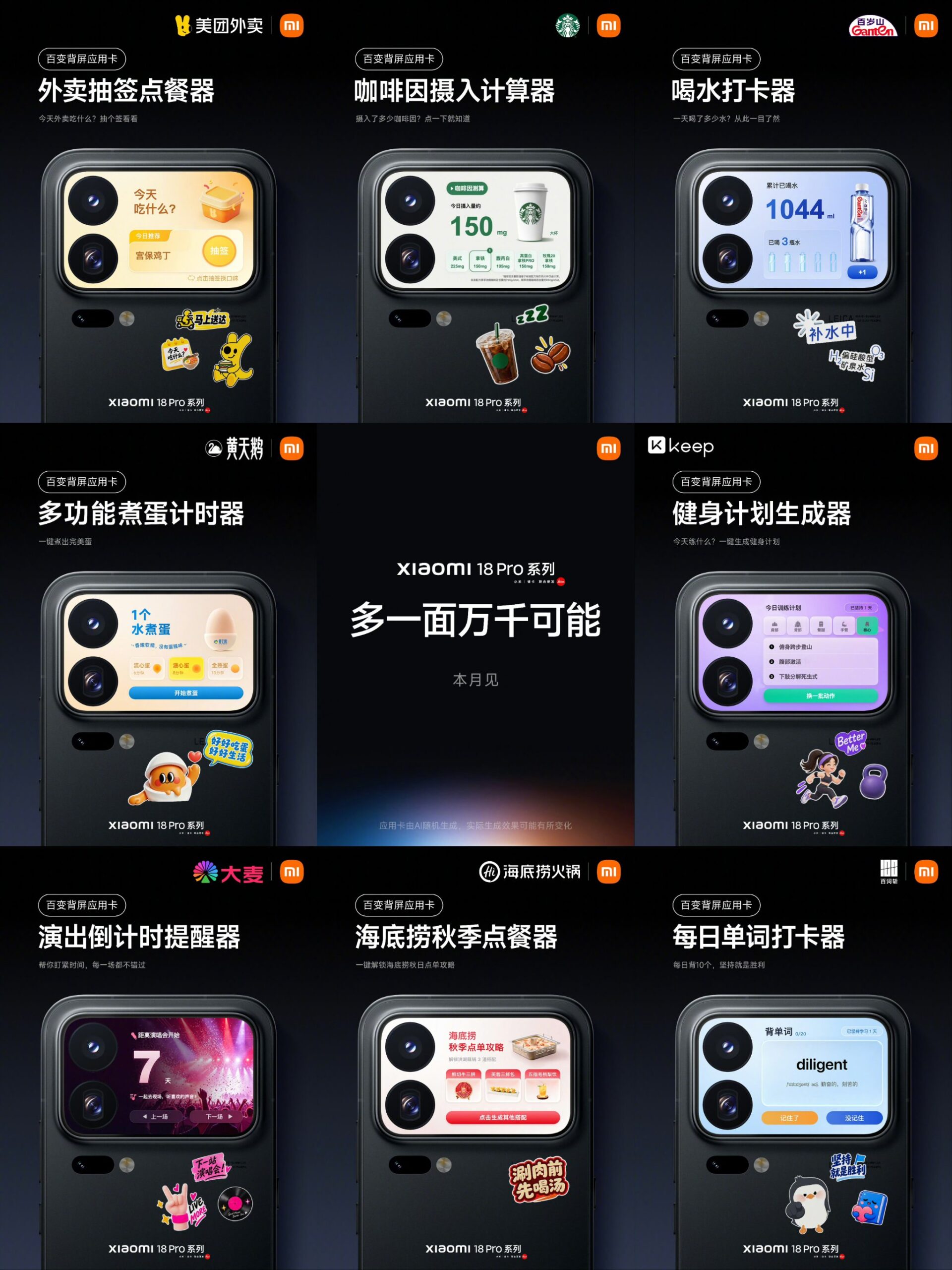
    Xiaomi calls this feature application cards on the rear screen. It is not just a decorative element showing the time — although Xiaomi itself notes in fine print that the content of the cards in the promotional graphics is generated by AI, and the images are for illustration purposes. In the shown graphics, the screen supports among others:

    • water intake counter with a “+1 glass” button,
    • egg timer with three modes: 6 minutes for runny yolk, 8 for medium, 10 for hard,
    • caffeine calculator — Americano 225 mg, Flat White 195 mg, Latte 150 mg,
    • pomodoro timer with a 25-minute session, with a pause controlled directly from the back of the phone,
    • countdown to the concert, food order card, and exercise set lottery.
    Teaser of the Xiaomi 18 Pro series: the wallpaper on the back screen changes like a carousel.

    The platform is open to external partners: the materials show eight cards, including Starbucks, Haidilao, Meituan, Keep, and Damai, as well as cards prepared by internet creators.

    The second application is simpler and probably more important in everyday life: the screen acts as a preview for selfies taken with the main camera, with video, photo, and portrait modes. Xiaomi notes in fine print that the figure in the demo selfie and the content of the water counter card were generated by AI, and the graphics are for illustration purposes.
    Everything can appear on the rear screen

    A separate branch of the campaign — under the slogan “everything can appear on the rear screen” — showcases the screen as a place for an animated mascot. The set of licenses makes an impression in China: characters from “Battle Through the Heavens,” exhibits from the Chinese television program “National Treasures” (a figure of an officer from the Qin dynasty, a bronze mask from Sanxingdui, ceramic figurines from the Northern Wei period), and from Western classics Van Gogh and “Girl with a Pearl Earring.”

    You can also upload a photo of your pet — the system recognizes its features and builds an animated character from them.
    3D animated figures on the back screen — from Xiao Yan to “Girl with a Pearl Earring”.
    The uploaded photo of the pet turns into an animated plush toy on the back of the phone.
    Application cards on the back screen of Xiaomi 18 Pro — comparison

    AI attaches someone to the photo who wasn’t with you

    The second feature that has its own teaser is AI group photo. The slogan is “take a group photo with everything you dream of”. In the video, a photo of a person and a character from a game merge into one shot, where both pose side by side.

    Teaser of the AI shared photo feature — two separate frames merged into one.

    A screen that your neighbor in the subway won’t read

    The day after the specification poster, Xiaomi showcased another feature of the series: privacy screen. It doesn’t work like privacy films that darken the entire display. Here, selected rectangles turn black, while the rest of the screen remains bright and readable.

    The video demonstrates this in five situations. In the subway, a notification comes in, and a black rectangle appears in its place, while the clock, widgets, and wallpaper remain visible. In a café, the coffee ordering app is fully readable, while the chat window hovering above it is black. In the office, with a split screen, one half is darkened, while the other, with notes, is completely normal. On the lock screen, one notification from the list disappears under a black bar, while the neighboring ones remain.

    Privacy screen in the Xiaomi 18 Pro series: individual fragments turn black, not the entire display.

    Protection is set separately for each application, and it can be activated in two ways. On the left edge of the phone, there is an orange AI button that can be assigned to turn on protection with a single click. The second way is a voice command to the Xiao AI assistant, and it’s not a one-time command, but conditional: “when arriving at the office, turn on protection in messengers,” “when returning home, turn off all protection.” The fine print states that such rules are configured in the expert mode of the assistant.

    Xiaomi also described how it works, and it is neither an overlay nor a software mode. In the panel, there are two types of pixels — privacy and regular — arranged alternately in a 1:1 ratio. They differ in the angle at which they emit light: the regular one spreads it in a wide cone to the sides, while the privacy one emits it in a narrow column straight ahead. On a daily basis, all of them light up, and when protection is activated — only the privacy ones.
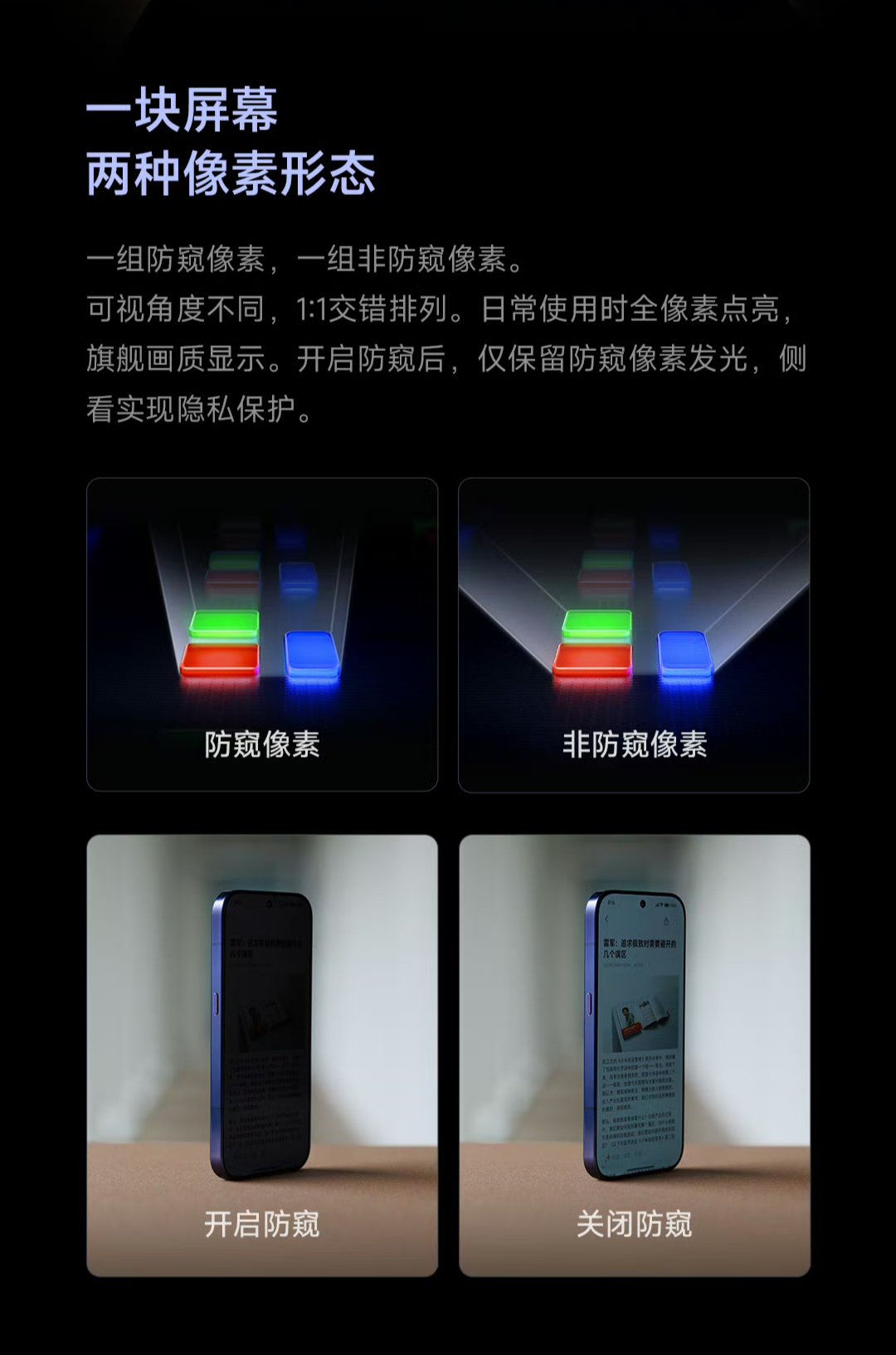
    Two types of pixels in the Xiaomi 18 Pro screen — privacy and regular, arranged alternately 1:1
    Two types of pixels in the Xiaomi 18 Pro screen — privacy and regular, arranged alternately 1:1

    Xiaomi also mentions privacy films: they work like micro-blinds, thus reducing brightness, distorting the image, and straining the eyes. The manufacturer claims that with them, quality does not drop because each pixel retains a complete set of RGB subpixels regardless of the mode. It sounds reasonable, but it is still a manufacturer’s declaration, not a measurement.

    The same principle is applied by Galaxy S26 Ultra. Samsung calls it Flex Magic Pixel and also divides pixels into two types, narrow and wide. The difference lies in what each manufacturer has published: Samsung provided measured angles — at 45 degrees, side brightness drops to 3.5 percent, at 60 below one. Xiaomi did not provide a single degree, only showing images of the screen viewed from the side.

    Specifications from the leaked poster

    A poster titled “upgrade in every field” is circulating online, attributed to Xiaomi. Each point is accompanied by the note “both sizes” — the parameters refer to both models, which the poster names. “both sizes”: Xiaomi has been talking about two models from the beginning and names them on the same poster.

    ParameterXiaomi 18 ProXiaomi 18 Pro Max
    Battery7000 mAh8500 mAh
    CellXiaomi “Jinshajiang”, 32% siliconXiaomi “Jinshajiang”, 32% silicon
    ProcessorSnapdragon 8 Elite Gen 6 (2 nm)Snapdragon 8 Elite Extreme Gen 6 (2 nm)
    Main camera200 Mpix, large sensor200 Mpix, large sensor
    Telephoto lensperiscope 200 Mpix, large sensorperiscope 200 Mpix, large sensor
    Screen“super pixel”, emission M11“super pixel”, emission M11
    Screen frame0.99 mm0.99 mm

    The poster calls this set of cameras the most powerful Leica system in the numerical series of Xiaomi, and the batteries — the longest-lasting in this series. Regarding the display, it mentions the new M11 emission system and a new green emission material: higher brightness with lower energy consumption.

    A separate graphic adds the screen parameters. The peak brightness is said to reach 4000 nits, and the new green emission material is expected to increase the brightness efficiency by 20 percent compared to the previous generation. Additionally, there is the BT.2020 color gamut and a pixel arrangement where each pixel has a complete set of RGB subpixels — Xiaomi compares it to the classic Pentile and claims that the sharpness matches 2K displays while consuming less power than 1.5K. The manufacturer does not specify the resolution in pixels.
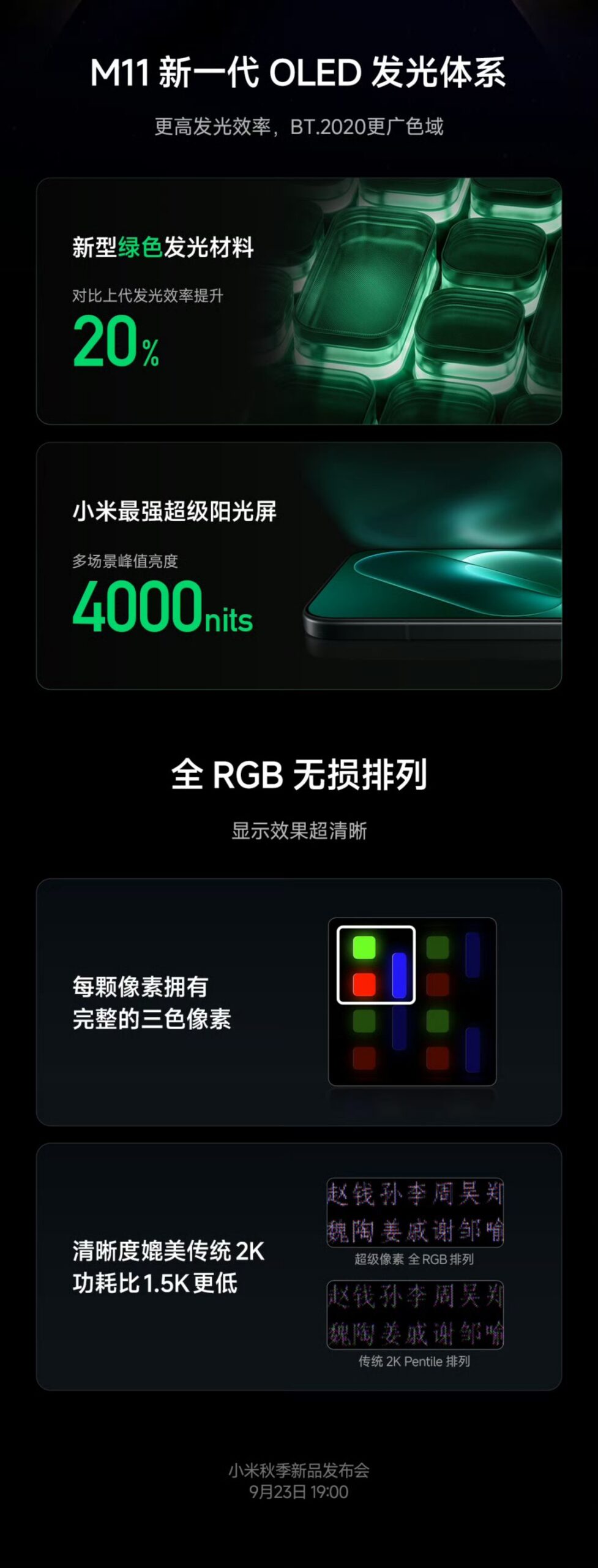
    Screen parameters of the Xiaomi 18 Pro series — 4000 nits peak brightness and full RGB arrangement
    Screen parameters of the Xiaomi 18 Pro series — 4000 nits peak brightness and full RGB arrangement

    A separate graphic clarifies a matter that the specification poster was silent about: each model gets a different layout. The Xiaomi 18 Pro features the Snapdragon 8 Elite Gen 6. The Xiaomi 18 Pro Max — a stronger Snapdragon 8 Elite Extreme Gen 6 (SM8975). It’s worth knowing this, as earlier leaks referred to this chip as “Gen 6 Pro” — that was a placeholder name that Qualcomm ultimately replaced with the Extreme designation. An entry in the Geekbench database from September 16 showed a unit with 16 GB of memory, two cores clocked up to 5.01 GHz, and HyperOS 4 on Android 17.
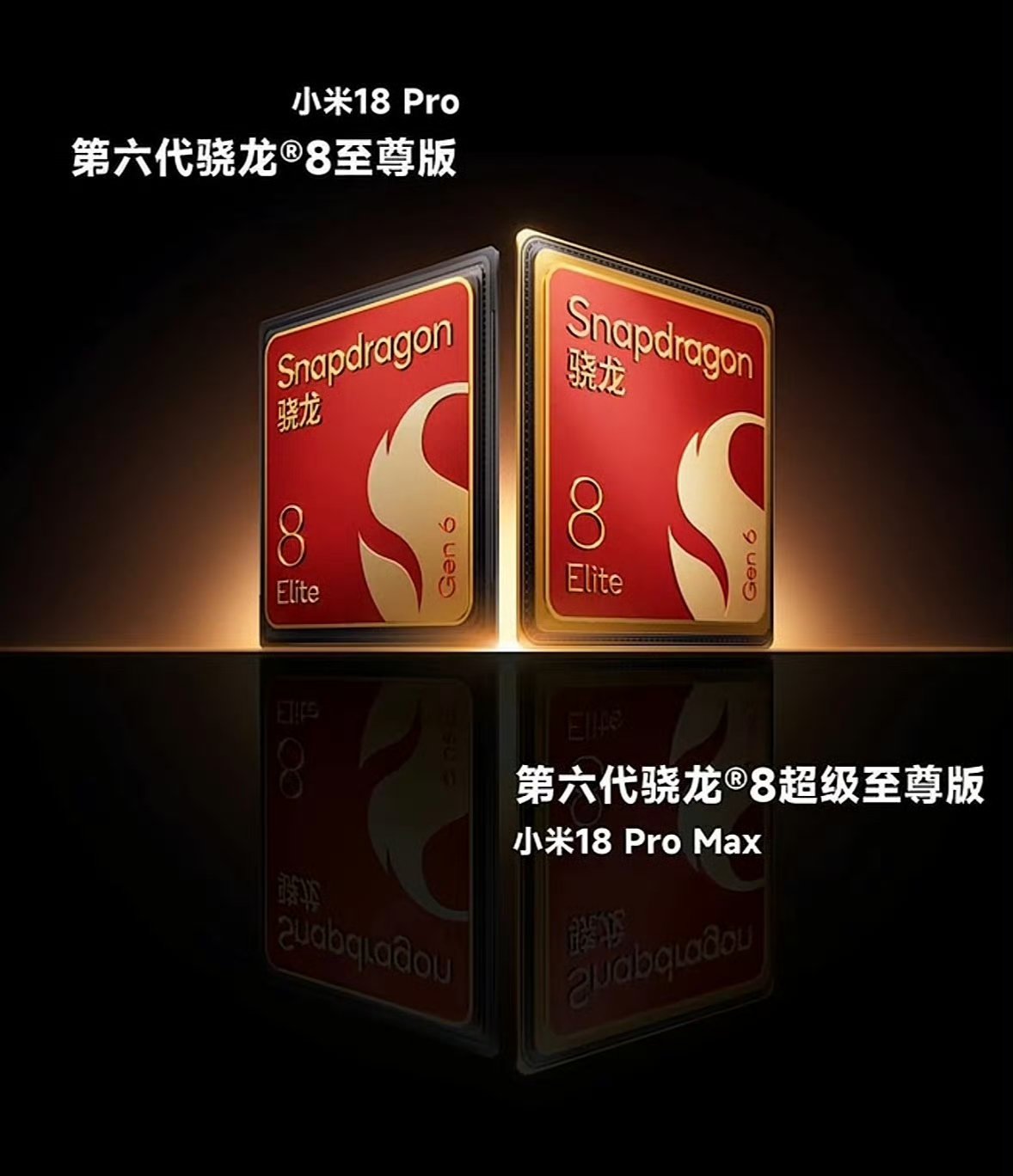
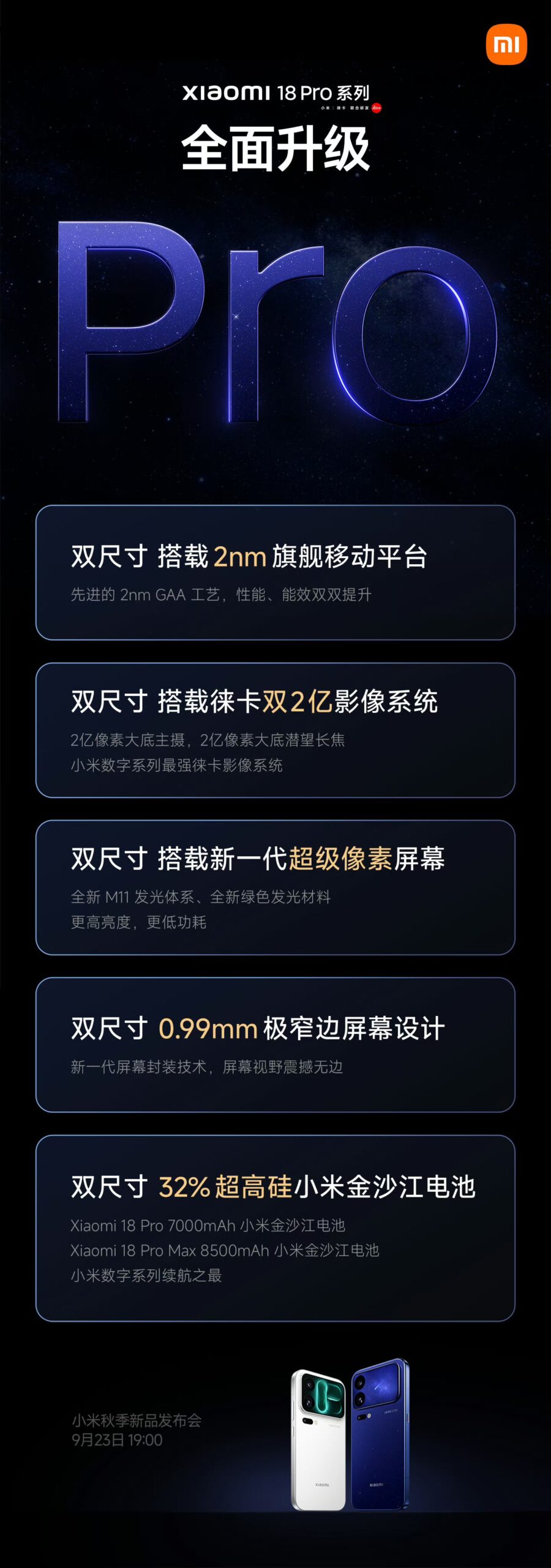
    Processors of the Xiaomi 18 Pro series — Snapdragon 8 Elite Gen 6 in Pro and Elite Extreme Gen 6 in Pro Max
    Processors of the Xiaomi 18 Pro series — Snapdragon 8 Elite Gen 6 in Pro and Elite Extreme Gen 6 in Pro Max
    Leaked infographic with the specifications of the Xiaomi 18 Pro series

    Frame narrower by 0.19 mm

    One of the materials shows the front and provides a detail that can be compared to its predecessor: the frame around the screen has slimmed down from 1.18 mm in the Xiaomi 17 series to 0.99 mm — and this applies to the entire series, not just the larger model. The radius of the screen corners has also increased.
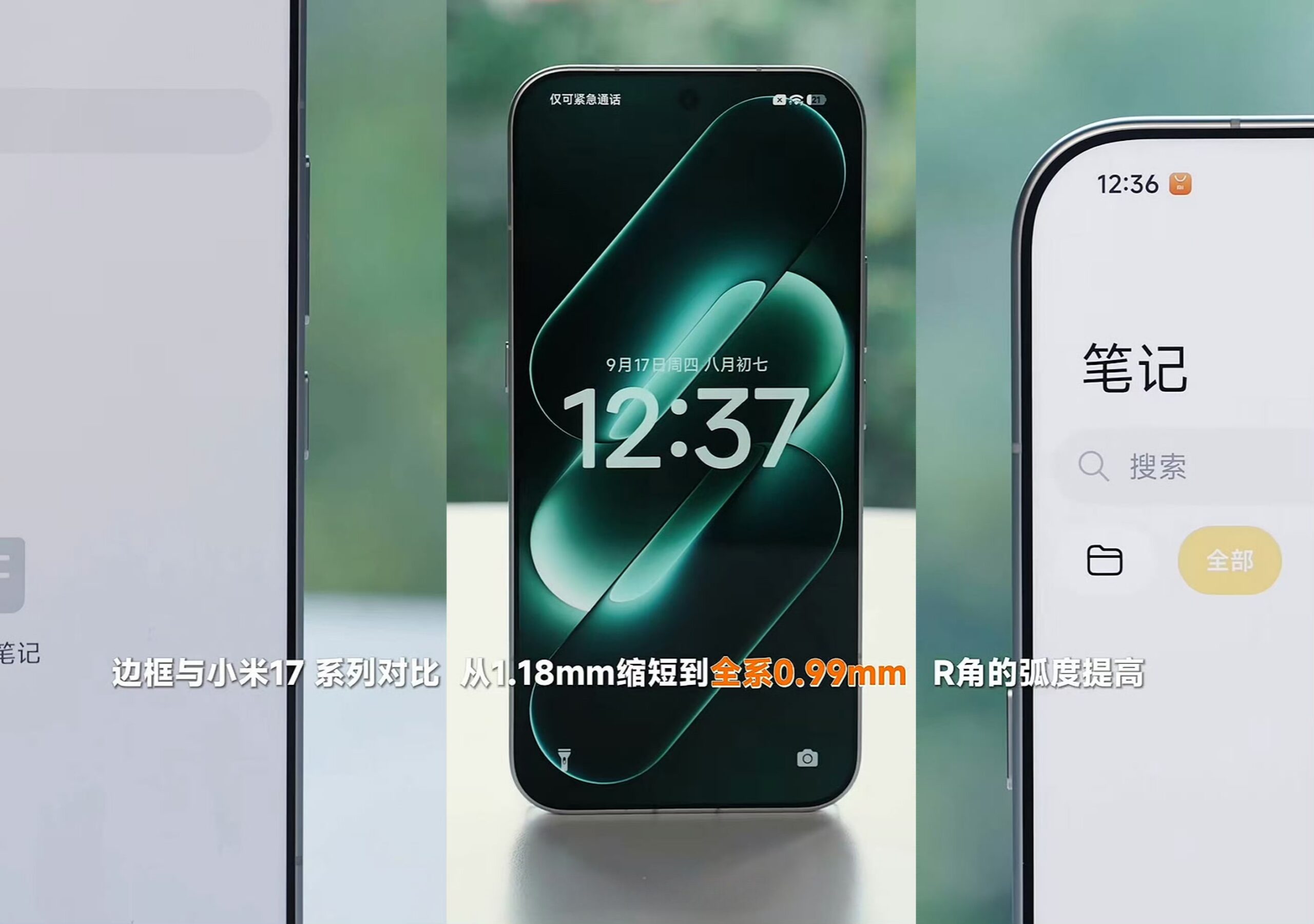
    Front Xiaomi 18 Pro — frame narrowed from 1.18 mm in the Xiaomi 17 series to 0.99 mm
    Front Xiaomi 18 Pro — frame narrowed from 1.18 mm in the Xiaomi 17 series to 0.99 mm

    Camera: Leica and a range of 17–75 mm

    The body features the engraving LEICA VARIO-SUMMILUX 1:1.67-2.4/17-75 ASPH. We read it from the full-resolution render, and it is confirmed by four independent materials. This indicates an aperture of f/1.67–2.4 and a focal length range of 17–75 mm.

    Here arises a discrepancy worth noting. The specification poster lists two cameras — the main and periscope, both 200 Mpix. Meanwhile, on the back, three lenses are visible: two in the island and one in the module below it. Xiaomi has not yet described this third one, and the range starting from 17 mm suggests that there is also a wide-angle lens included. Until Wednesday, this remains an open question.

    Four colors

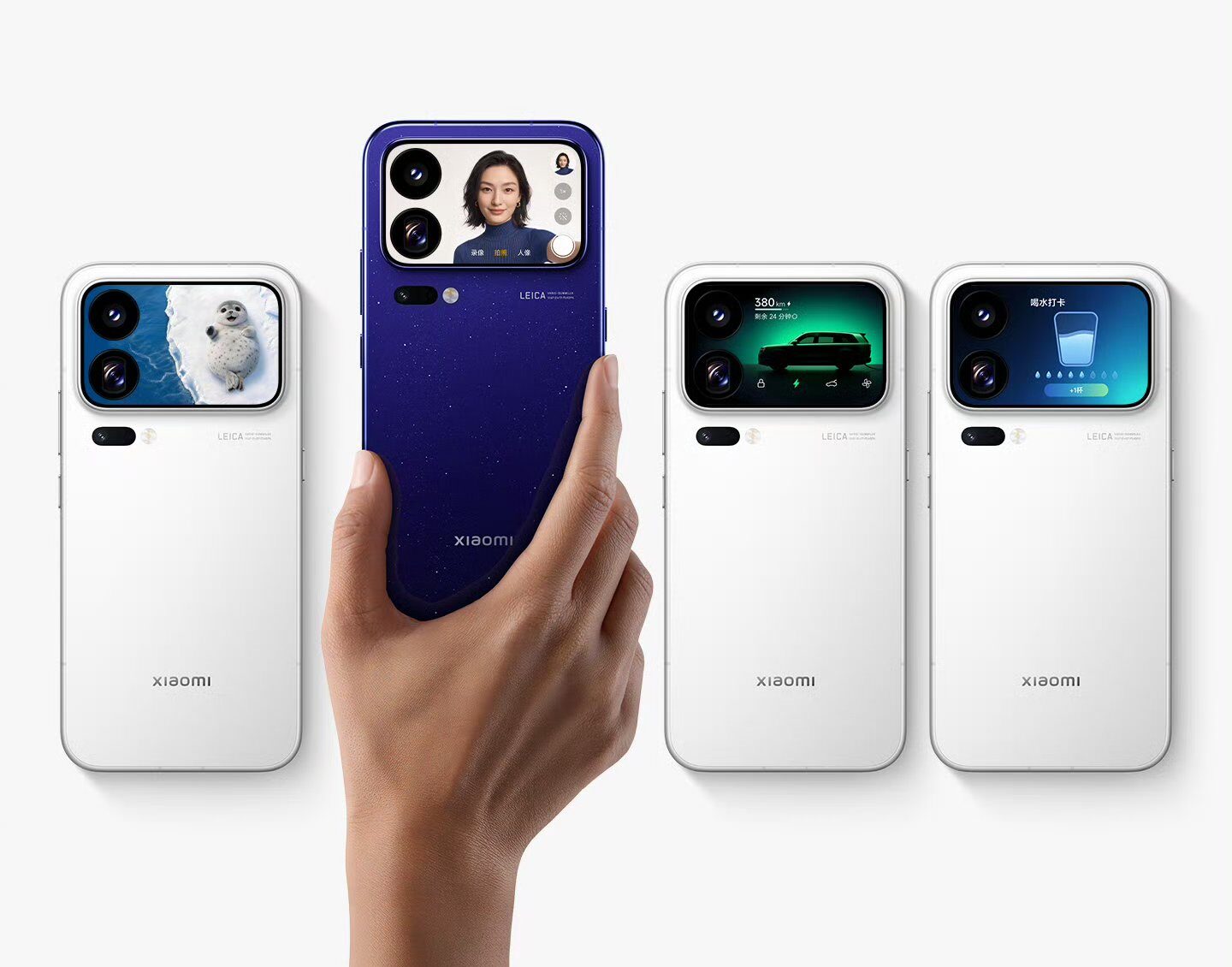
    The series comes in four finishes: navy blue, white, graphite, and pink. Pink is the most unexpected here — it did not appear in earlier materials.
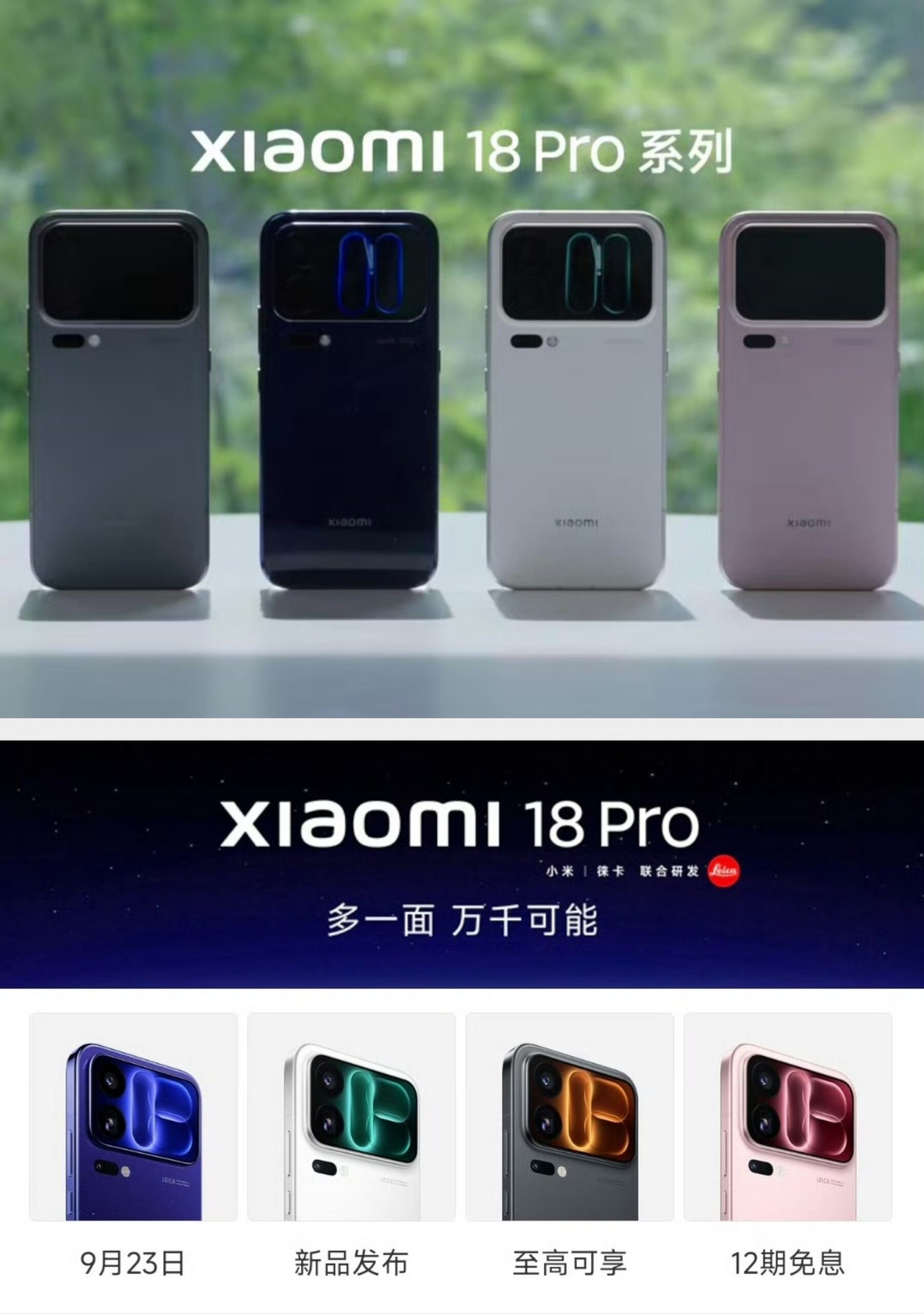
    Xiaomi 18 Pro in four colors — navy, white, graphite, and pink, each with a matching wallpaper for the rear screen
    Xiaomi 18 Pro in four colors — navy, white, graphite, and pink, each with a matching wallpaper for the rear screen

    The prettiest detail: the wallpaper on the rear screen is matched to the color of the casing — blue with navy, green with white, orange with graphite, and pink with pink. In some renders, it looks like a static print, but it’s the same screen in wallpaper mode, not a cheaper version without a display.

    One of the circulating materials refers to the navy variant by the English name Starry River Blue, with a glittering star dust effect — but its origin cannot be confirmed. Official Chinese color names for Xiaomi have not yet been provided.

    What is missing from any of the materials

    The materials do not include diagonal screens or pixel resolutions. We also do not know the refresh rate, dimming method, or parameters of the rear display itself: its size, resolution, and brightness. There is a lack of charging power, dimensions, weight, IP resistance class, memory variants, and any price.

    Leaks fill some of these gaps, but these are no longer Xiaomi’s words. GSMArena reported in April 6.3 inches for the 18 Pro and 6.9 inches for the 18 Pro Max with a flat LTPO OLED panel, and a July post from tipster Digital Chat Station mentioned 100 W wired charging and support for wireless charging. Treat these numbers as hints, not specifications.

    It is still unknown if and when the series will reach Europe. The entire campaign is Chinese, and the partners on the back screen — Meituan, Haidilao, Starbucks CN — are brands from that market. The Chinese poster, however, mentions purchasing in 12 installments without interest.

    What it means for accessories

    One thing is clear in every render: the cutout in the case must cover the entire island along with the screen, not just two holes for the lenses. A case that covers the display with plastic takes away its purpose. The same goes for the camera glass — a sensible cover only shields the optics and leaves the area above the screen free.

    Xiaomi has not yet provided the dimensions of the case, so any compatibility with accessories from the previous generation can only be discussed conditionally. What is certain is what can be seen: the layout of the back is different from the Xiaomi 17 series, and the previous generation does not have an additional screen at all. We will provide specifics about compatibility after September 23.

    Everything that fits the new series is collected in one place — accessories for the Xiaomi 18 series — with separate shelves for accessories for the Xiaomi 18 Pro and accessories for the Xiaomi 18 Pro Max. Xiaomi talks about two sizes, so the cases will most likely not be interchangeable between them — we will confirm this when we know the dimensions.

    Summary

    The Xiaomi 18 Pro and 18 Pro Max are the first Xiaomi phones where the second screen is not a novelty glued to the case, but an integrated platform within the camera island with its own applications. Additionally, there are dual 200 Mpix with Leica, optics with a range of 17–75 mm, and batteries of 7000 and 8500 mAh — all of this is still pre-release material, not a manufacturer announcement.

    The conference is on Wednesday, September 23 at 1:00 PM Polish time. Then we will learn the prices, diagonals, and whether the series will even leave China.

    FAQ — frequently asked questions

    When is the Xiaomi 18 Pro premiere?

    September 23, 2026, at 7:00 PM Chinese time, which is 1:00 PM in Poland. The date comes from a poster for Xiaomi’s autumn conference that leaked before the premiere.

    What is the difference between the Xiaomi 18 Pro and 18 Pro Max?

    The size of the casing, battery (7000 vs. 8500 mAh), and processor — the Pro gets the Snapdragon 8 Elite Gen 6, while the Pro Max has the more powerful Elite Extreme Gen 6. The cameras, screen, and bezel width are listed as common for both sizes.

    What is the screen on the back of the Xiaomi 18 Pro?

    A touch-sensitive, color display built into the camera island, next to the lenses. It supports app cards — from a water meter to a stopwatch and pomodoro timer — displays animated mascots, and serves as a preview for selfies taken with the main camera.

    What processor does the Xiaomi 18 Pro have?

    Different in both models. The Xiaomi 18 Pro gets the Snapdragon 8 Elite Gen 6, while the Xiaomi 18 Pro Max has the more powerful Snapdragon 8 Elite Extreme Gen 6. Both are built on a 2 nm process.

    How much does the Xiaomi 18 Pro cost?

    The price has not been provided in any material — neither in yuan nor in euros. We will know it on September 23.

    Does the case from the Xiaomi 17 Pro fit the Xiaomi 18 Pro?

    Xiaomi has not yet provided the dimensions of the casing, so there is no certain answer today. However, the layout of the back is clearly different, and the previous generation does not have an additional screen in the island — after the premiere, we will update the shelves of both models with accessories that have confirmed compatibility.

    Will the Xiaomi 18 Pro come to Poland?

    There is currently no information about this. All materials concern the Chinese premiere.

  • How to Reduce Photo Size on iPhone? Proven Methods

    How to Reduce Photo Size on iPhone? Proven Methods

    One photo rarely causes a problem with memory space. A few thousand — that’s another story.

    Large files can also be troublesome in everyday situations: the submission form accepts attachments no larger than 2 MB, sending messages takes too long, or the site rejects the photo in HEIC format. In each of these cases, the request to “reduce the photo” means something slightly different.

    This guide shows how to reduce the size of a photo on an iPhone in five practical ways. The choice depends on whether you need a smaller file for uploading, photos of the same width in pixels, or more free space in your library.

    How to check the size of a photo and understand the given values

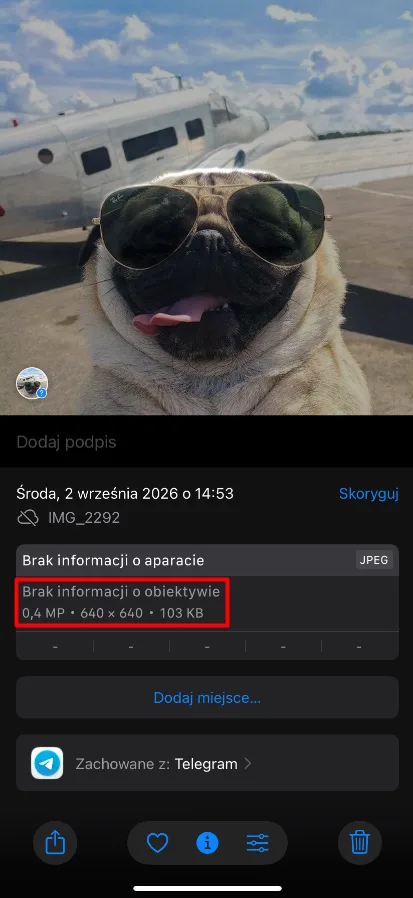
    Open the image in the Photos app, then swipe up or tap the info button. In the details panel, you will see the photo format, its dimensions in pixels, and the file size.

    The info panel in the Photos app shows the format, dimensions, and file size.
    The info panel in the Photos app shows the format, dimensions, and file size.

    In this screenshot, JPEG indicates the format, 640 × 640 are the dimensions in pixels, and 103 KB is the file size. Compare the attachment or uploaded file limit with the value expressed in KB or MB.

    Dimensions define the width and height of the image. Reducing them removes some pixels, which usually allows for a smaller file size. However, there are fewer details left that can be used for later cropping or printing the photo.

    The file size also depends on the format and compression. Two images with identical dimensions can take up different amounts of space. Changing the format from HEIC to JPEG may improve compatibility with an app or website, but it doesn’t necessarily reduce the file size.

    The space occupied in memory is another issue: it refers to the total space used by the photo library. Creating a smaller copy makes it easier to upload the image, but keeping both versions takes up more space on the phone.

    If the photo is in the Files app, tap and hold it, then select Get Info. Also, pay attention to the extension. Even a small HEIC file may require a JPEG copy if the destination does not support HEIC.

    How to reduce photo size on iPhone: five methods

    Method 1: Use a compression app

    If you prefer to compress a photo on your iPhone using an app, one option is the Clever Cleaner app for iPhone. It helps manage your library: it finds duplicates, removes unnecessary files, and compresses photos and videos that you want to keep.

    The available compression of multiple images at once allows you to select several images, choose the compression level, and check the expected size reduction before starting. This way, you don’t have to process each image individually.

    1. Open Clever Cleaner or install the app if you don’t have it yet. Allow access to the photos you want to compress.
    2. Tap Compress to open the multimedia compression screen.
    3. Select Photos and check several images you want to process together.
    4. Open the compression settings for the selected images.
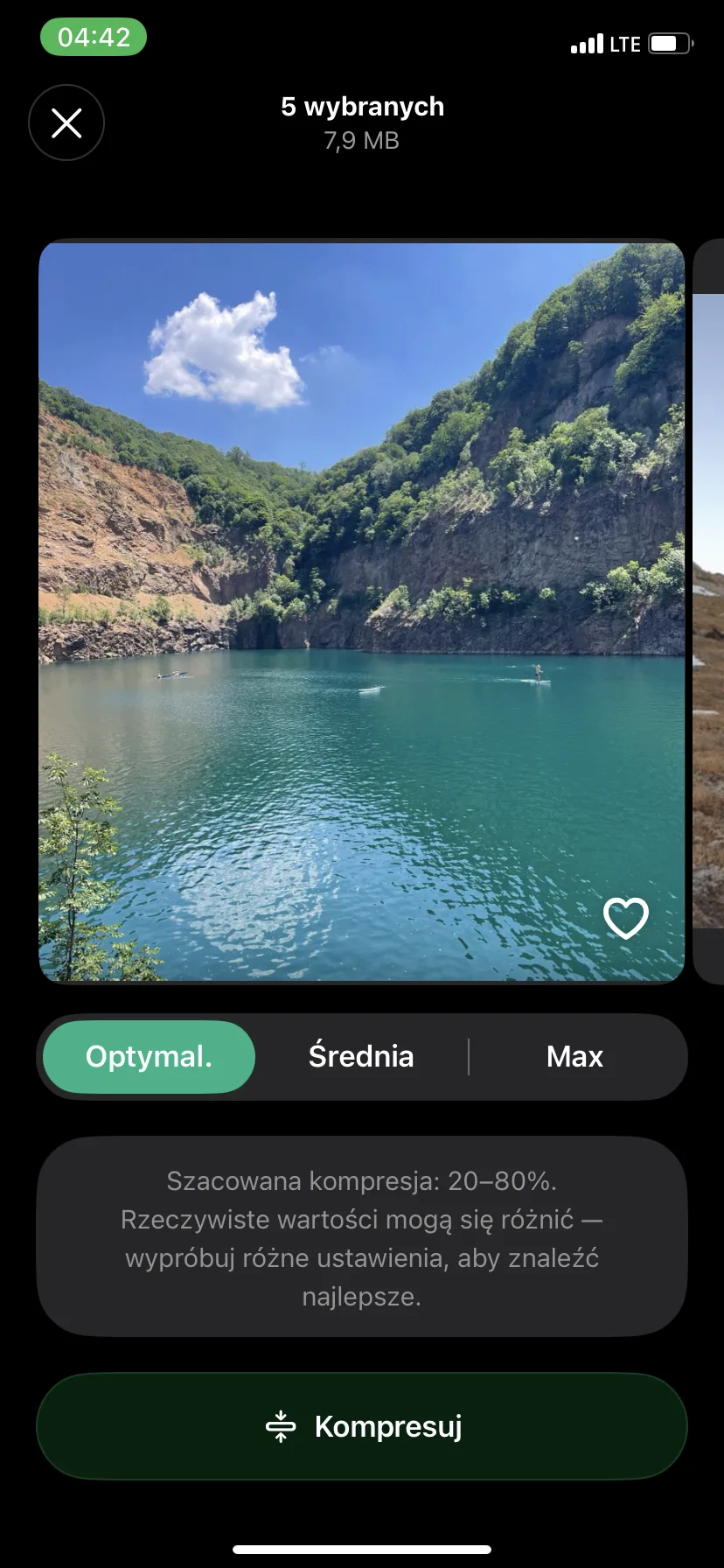
    5. Start with the Optimal setting. Medium and Max are also available. Before applying stronger compression to a large group of images, test it on a small sample.
    6. Check the expected size reduction visible under the compression options.
    Compression settings for five selected images in Clever Cleaner.
    Compression settings for five selected images in Clever Cleaner.
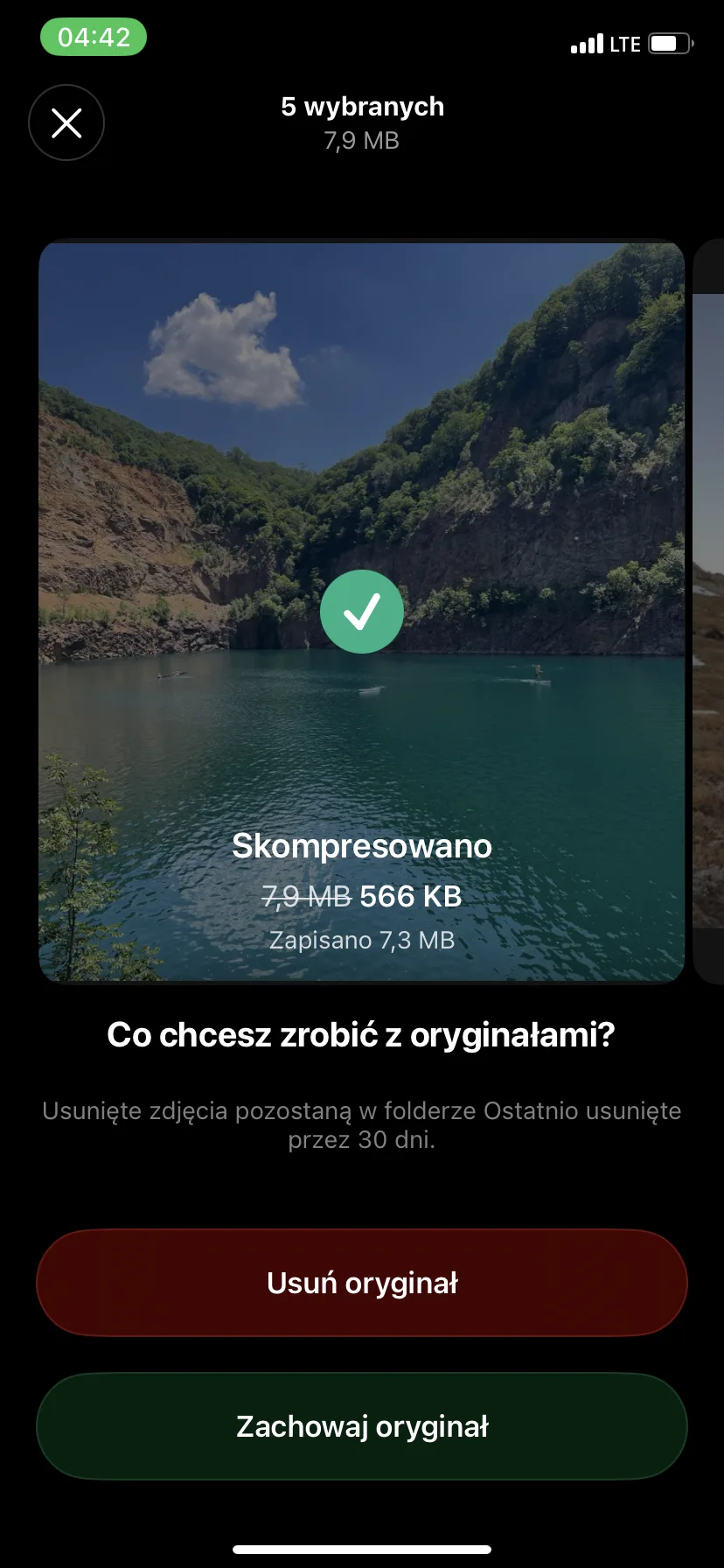
    1. Tap Compress and wait for the processing to finish.
    Clever Cleaner shows the file sizes after compression and the amount of space saved.
    Clever Cleaner shows the file sizes after compression and the amount of space saved.
    1. On the first attempt, choose Keep Original to retain the original. Open the compressed copies in the Photos app and compare them to the originals before deciding to delete anything. Keeping both versions initially takes up extra space. Deleted originals remain in the Recently Deleted album for up to 30 days.

    For photos intended for sending or viewing on a phone, try Medium compression. If you plan to edit or print them, start with Optimized and check if the details are still clear.

    Method 2: Use an online photo compression tool

    If you don’t want to install an app, you can use an online photo compression tool. One option is TinyPNG: it reduces image files and can also convert them to another format.

    You upload the photos, wait for the service to compress them, and then download the smaller copies. This is a convenient solution for occasional file uploads, as long as you don’t mind sending your images to an online service.

    1. Open TinyPNG in Safari and tap the file upload area.
    2. Select a photo from the Photos or Files app. Wait for the compression to finish.
    3. If you need a different format, enable Convert my images automatically and choose a format supported by the destination. Otherwise, leave conversion off. The exception is uploaded HEIC files: TinyPNG converts them to JPEG.
    4. Download the result, find it in the Files app, and check its size before sharing it further.
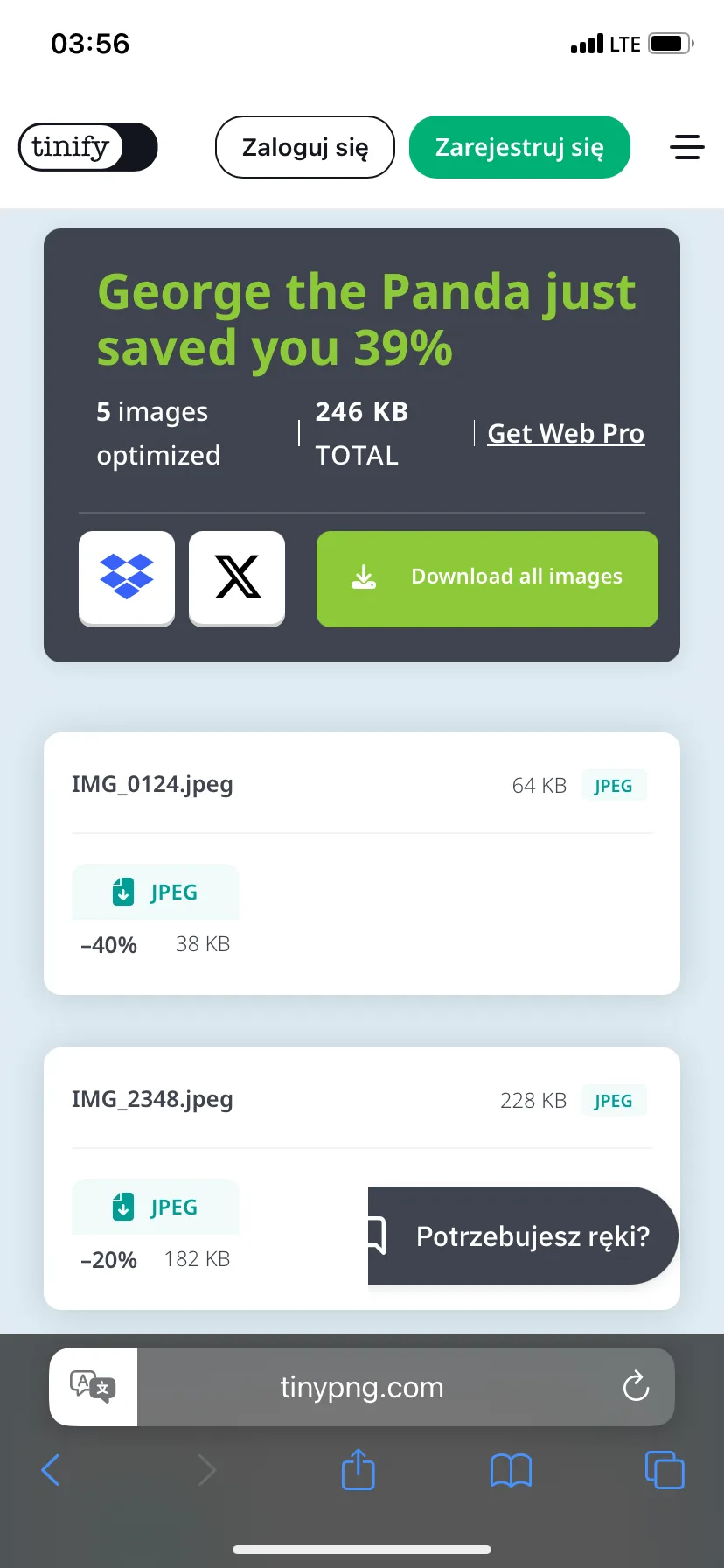
    TinyPNG shows compressed images and the degree of reduction in their file sizes.
    TinyPNG shows compressed images and the degree of reduction in their file sizes.

    TinyPNG processes uploaded images on its servers. For private documents or photos that you prefer to keep on your phone, use Clever Cleaner, the Files app, or Shortcuts instead.

    Method 3: Change the format and size of a photo in the Files app

    To get a smaller photo without installing another app and uploading it to a website, try the built-in Files app on your iPhone. Its Convert Image feature creates a separate copy of the image and allows you to choose a smaller size.

    You can keep the current photo format or change it if necessary — for example, to JPEG for a site that does not accept HEIC. The original remains unchanged.

    1. In the Photos app, select the image and tap the share button — Share.
    2. Select Save to Files to save it in the Files app, and specify a folder.
    3. Open Files, locate the saved image, then tap and hold it.
    4. Select Quick Actions > Convert Image from the quick actions menu.
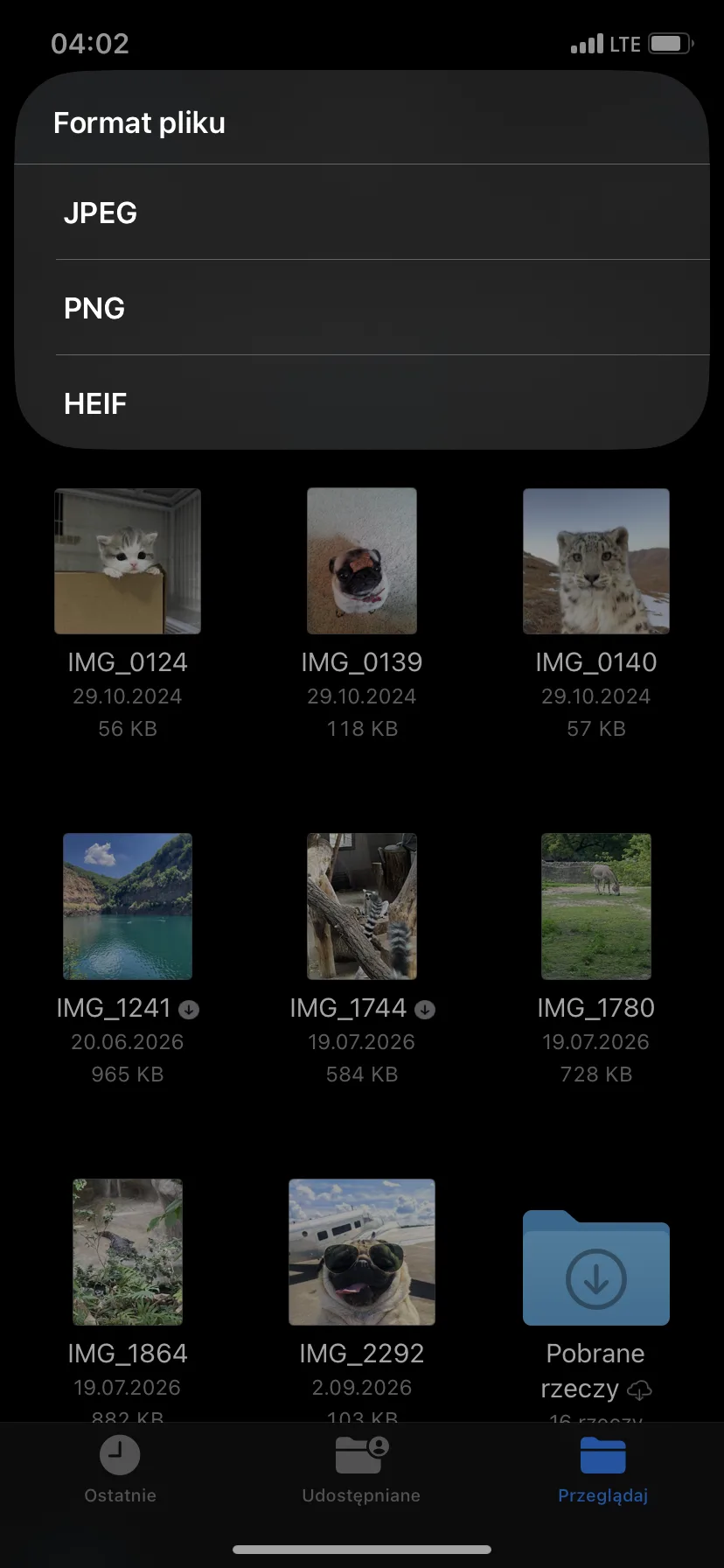
    5. Select JPEG, PNG, or HEIF. You can stick with the current format: for example, for a JPEG photo, select JPEG again.
    The Files app allows you to convert a photo to JPEG, PNG, or HEIF.
    The Files app allows you to convert a photo to JPEG, PNG, or HEIF.
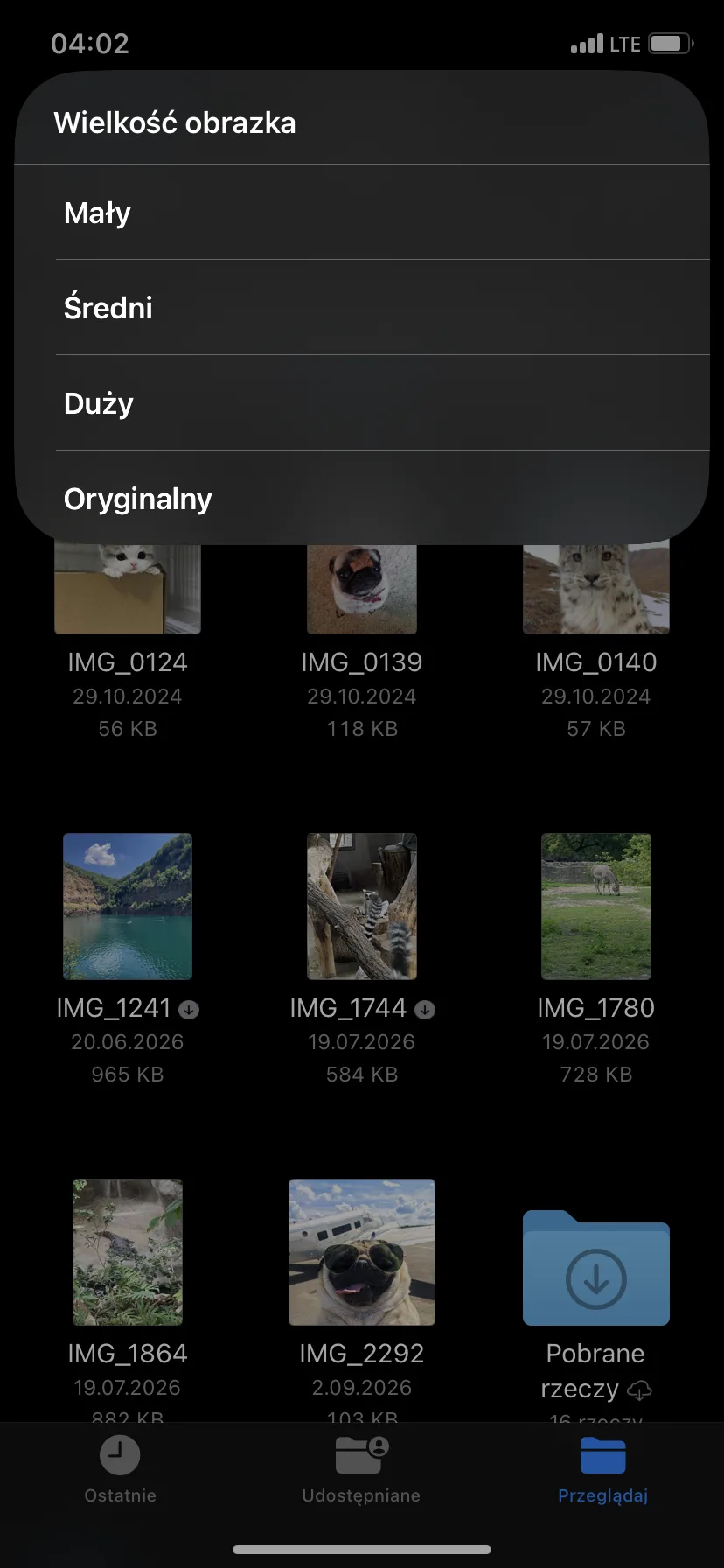
    1. In the Image Size menu, select Small, Medium, or Large. The Original option retains the original dimensions, so if you want to reduce the photo, choose one of the smaller available sizes.
    The Files app provides four output sizes for the converted image.
    The Files app provides four output sizes for the converted image.
    1. Open a new file and check its size using Get Info. If it still exceeds the upload limit, go back to the original and choose a smaller size.

    Which format to choose? For JPEG images, it is a safe choice when compatibility with various devices and services matters. HEIF usually takes up less space at similar image quality, but an older app or website may not open it. PNG works well for interface graphics and images requiring transparency. However, it is rarely the smallest format for a camera photo.

    Method 4: How to resize an image using a reusable shortcut

    If you often need images of the same width, the Shortcuts app can save you time. Just prepare a resizing shortcut once and run it again when preparing images for a blog, announcement, or upload form.

    You choose the width in pixels, and the height adjusts automatically to maintain the image’s proportions. Reducing the dimensions of the image usually also reduces the file size.

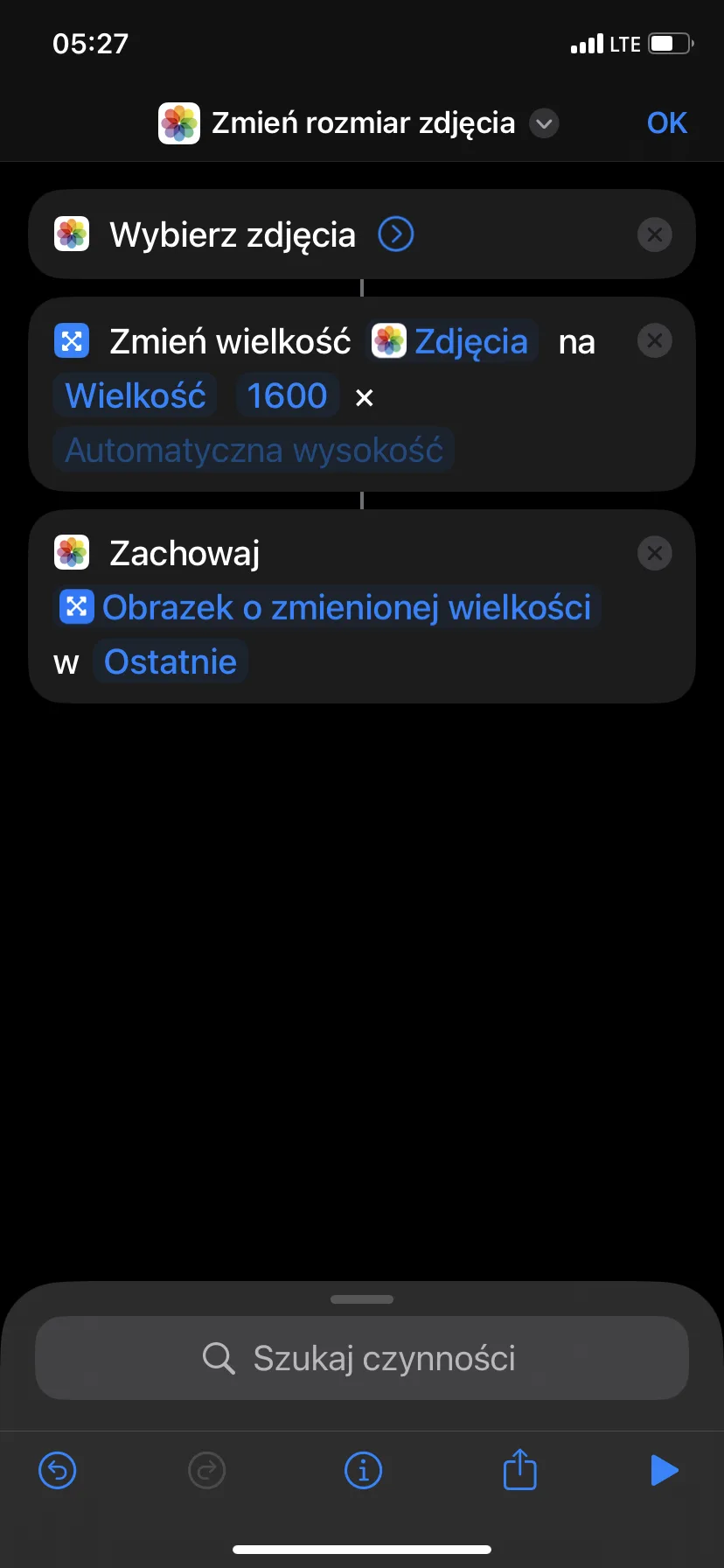
    1. Open the Shortcuts app and tap the plus button.
    2. Add the Select Photos action to choose photos. Enable Select Multiple if you sometimes want to process several photos at once.
    3. Add Resize and enter the required width. Leave the height set to automatic to maintain the photo’s proportions.
    4. Add Save to Photo Album or Save File — depending on where you want to save the result.
    5. Give the shortcut a descriptive name, such as “Resize Photos for Upload.”
    6. Run it once on a test photo.
    Reusable shortcut changes the width of selected photos to 1600 pixels.
    Reusable shortcut changes the width of selected photos to 1600 pixels.

    Saving in the Files app is convenient when the page opens a file selection window. Saving in Photos places the result in the library along with other images. In both cases, make sure the shortcut creates a new copy before you use it on important photos.

    What width to choose? For many screen applications, a reasonable starting point is 1600–2000 pixels, but this is not a fixed rule. If the destination specifies required dimensions, follow those.

    The Resize Image action does not require a separate format change step. Add Convert Image only if the destination requires a specific format, such as JPEG. If the file is still too large after resizing, go back to the original and try a smaller width.

    Method 5: Send a smaller copy via Email

    If you only need to send a smaller picture via email, the Email app can prepare a reduced attachment while leaving the original unchanged in the Photos app.

    1. Open the Photos app and select the image.
    2. Tap Share, which is the sharing button, and then select Mail.
    3. Add the recipient and tap Send to send the message.
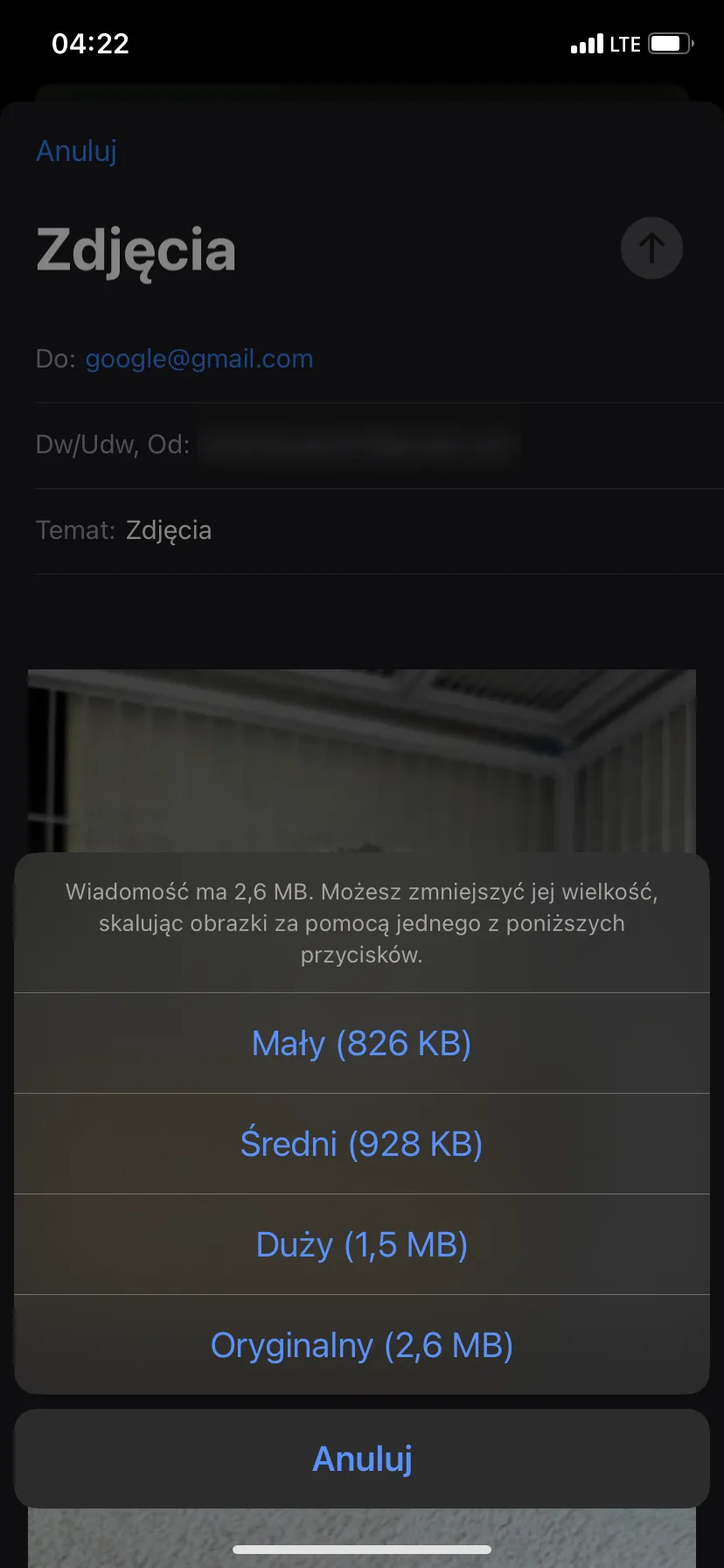
    4. If Mail displays a size menu, compare the expected values next to the options Small, Medium, Large, and Original.
    5. Tap the smaller size in which you want to send the picture.
    Mail offers smaller attachment sizes before sending the picture.
    Mail offers smaller attachment sizes before sending the picture.

    Medium is a reasonable first choice for regular viewing on screen. Large retains more detail, while Small is suitable for a preview image when quality is less important. If the image contains fine text or may be printed, send a sample to yourself before choosing the smallest version.

    How to make new photos on iPhone take up less space

    You can limit the space taken up by future photos: open Settings > Camera > Formats and select High Efficiency. Supported photos will then be saved in HEIF, usually with the .heic extension, instead of JPEG. With comparable image quality, this format generally requires less space.

    The Most Compatible option saves JPEG photos and is useful when other software cannot open HEIC. However, you don’t need to use it for every photo: leave High Efficiency and convert individual images when the form requires JPEG. This setting applies to new photos, not images already saved in the library.

    On models that support Apple ProRAW, keep RAW saving turned off unless you need more flexibility during editing. Live Photos is a separate feature in the Camera app. Turn it off there before taking a photo if you don’t need motion and sound.

    Which method to choose?

    • Clever Cleaner is a practical starting point when you have several photos to reduce: you can select the entire group and compare compression settings in one place.
    • If you don’t want to install an app and don’t mind uploading photos to an online service, another option is an online compressor like TinyPNG.
    • To get a smaller copy without a new app and online service, use the Files app.
    • Select Shortcuts when the destination requires a specific width in pixels or you want to regularly repeat the same resizing.
    • Email is useful when you only want to send a smaller attachment and keep the original unchanged.

    Regardless of the method chosen, check if the saved file fits within the limit applicable to the destination. The level of compression or width in pixels does not guarantee a specific number of megabytes.

    Frequently Asked Questions

    How to reduce file size on iPhone to fit a photo within a specified MB limit?

    Check the initial size, then choose a smaller variant in the Files app, reduce the width using Shortcuts, or try an online compressor. Check the saved result: if it’s still too large, go back to the original and choose a smaller size.

    No single dimensions guarantee a file size of 1 MB or 2 MB. Minor details and image noise can increase file size even with the same dimensions. Make one or two reasonable changes instead of repeatedly compressing the same copy.

    How to reduce a photo on iPhone without installing an app?

    You can do this in the Files app by creating a smaller copy, or in Shortcuts by setting a repeatable width in pixels. Mail is another option when you only need a smaller attachment for an email.

    You can also open an online compressor in Safari, such as TinyPNG. Before using it for private photos, check the upload limits and how the service processes your images.

    Does reducing the size of a photo lower its quality?

    Generally yes, although the change may be unnoticeable during regular viewing. Reducing dimensions removes pixels, and stronger JPEG or HEIF compression discards more information. Enlarging the image, heavy cropping, and large prints make it easier to notice this loss.

    “Good quality” depends on the purpose of the photo. A copy may be perfectly suitable for an email, while being too small for a photo book. Keep the original until you are sure the reduced version meets its purpose.

    Does the Optimize iPhone Storage feature reduce the actual size of the photo?

    No. When iCloud Photos and the Optimize iPhone Storage option are enabled, Apple stores the originals in full resolution in iCloud, while keeping smaller copies on the iPhone to save space. This frees up local storage on the device but does not create a permanently compressed original and does not reduce the space occupied in iCloud.

    Use memory optimization when your phone starts running out of space. If you really need a smaller file to send or upload to the site, choose one of the methods described above.

  • The best glass for iPhone 18 Pro Max: ranking 2026

    The best glass for iPhone 18 Pro Max: ranking 2026

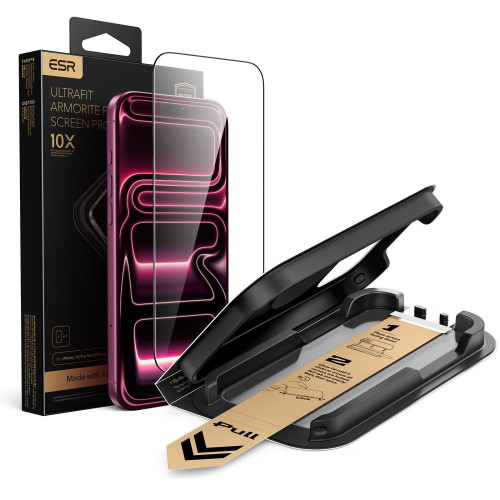
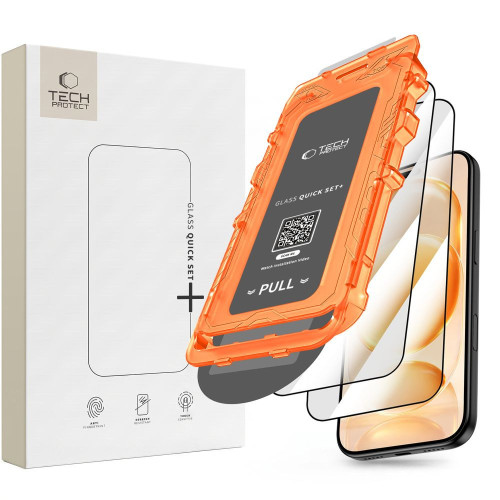
    The best glass for iPhone 18 Pro Max is ESR UltraFit Armorite Pro: Corning tempered glass with a hardness of 9H, which covers the screen edge to edge and is installed in a mounting tray. The easiest to install is the Tech-Protect Quick Set+ two-pack with a positioning frame, and if reflections bother you, choose the matte UNIQ Optix Covex Matte DX2.

    Summary ranking:

    • Best overall: ESR UltraFit Armorite Pro, Corning glass with UltraFit Tray
    • Easy installation: Tech-Protect Quick Set+, two pieces and positioning frame
    • Best matte: UNIQ Optix Covex Matte DX2, less glare and drops up to 1.8 m
    • Best privacy: UNIQ Optix Covex Privacy DX2, screen unreadable from the side
    • For backup: Bizon Glass Edge Duo, two pieces with a black border

    There is one detail that accessory stores rarely mention. The iPhone 18 Pro Max has a factory anti-reflective coating, and regular tempered glass covers it. We explain what this means in practice, whether the glass from the seventeenth model fits the new one, and which camera covers are worth choosing to complete the set.

    Does the glass from iPhone 17 Pro Max fit 18 Pro Max?

    Yes, the glass fits the screen, but buy new camera covers. According to Apple’s official specifications, both models have identical dimensions and the same screen. They differ in weight (231 g vs 249 g), but this does not affect the fitting of the glass.

    ParameteriPhone 17 Pro MaxiPhone 18 Pro Max
    Dimensions163.4 × 78.0 × 8.75 mm163.4 × 78.0 × 8.75 mm
    Screen6.9″, OLED6.9″, OLED
    Resolution2868 × 1320 px2868 × 1320 px
    Ceramic Shield 2 on the front✅✅
    Anti-reflective coating✅✅

    Data: specification of iPhone 18 Pro Max and iPhone 17 Pro Max on Apple’s pages

    Some glasses, including ESR, Tech-Protect Quick Set+, and Bizon Glass Edge Duo, are described by manufacturers as common for both the iPhone 17 Pro Max and 18 Pro Max. If you have spare glass from the seventeen, you can usually use it. It’s best when the manufacturer explicitly states compatibility with the 18 Pro Max.

    Camera covers are different. In our catalog, all are described as “for iPhone 18 Pro / 18 Pro Max” or just “for iPhone 18 Pro Max,” and none are marked as compatible with the seventeen. Why you can transfer the case to the new phone, but not the camera covers, is explained in the guide whether the case from iPhone 17 Pro fits 18 Pro.

    All glasses described as compatible with the new model can be found in the category tempered glass for iPhone 18 Pro Max.

    Anti-reflective coating of the iPhone 18 Pro Max and tempered glass

    Yes, regular tempered glass disables the anti-reflective coating of the iPhone 18 Pro Max. The coating reduces reflections only when it is in direct contact with air, and glass without its own anti-reflective layer covers it. In sunlight, you will see more reflections than on a bare screen.

    Apple lists this coating in the screen specifications, and it has already appeared in the iPhone 17. According to tests described by MacRumors, it reduces light reflections by about half compared to the iPhone 16. The tests were conducted by Astropad, which itself sells glasses with such a coating, so treat this number as a guideline.

    There are glasses for the screen with their own anti-reflective layer, but none of the glasses in our ranking claim to have it. The glass does not damage the screen itself: after its removal, the coating works as it did before. You have three reasonable options:

    • Transparent tempered glass: the best protection against cracks and scratches, but more glare in sunlight.
    • Frosted glass: diffuses light, reducing glare, although the image may be slightly less sharp.
    • No glass: you retain the full effect of the coating. At the launch of the iPhone 17 Pro, Apple stated that Ceramic Shield 2 has a new coating that provides 3x better scratch resistance, but even it does not guarantee that the screen won’t crack upon falling.

    Tip: if your phone often lands on hard surfaces, choose glass. Replacing the screen on the Pro Max costs many times more than even the best protection, and a cracked tempered glass can simply be removed and replaced with a new one.

    What to pay attention to when choosing screen glass

    9H hardness does not distinguish products. It is the highest grade on the pencil hardness scale and is claimed by practically every tempered glass. Other factors matter: material, coatings, and how well the glass withstands drops.

    Installation with a frame, tray, or applicator. A 6.9-inch screen is difficult to align perfectly by hand. A positioning frame, tray, or applicator ensures that the glass lands in place on the first try, without shifting relative to the edges.

    Compatibility with cases. Edge-to-edge glass protects the most surface area, but a high-rim case can lift it. Look for the “case friendly” designation or check if the manufacturer provides the dimensions of the glass.

    Oleophobic coating. Reduces fingerprints and makes your finger glide smoothly across the screen. The bare iPhone has it factory-installed, so you’ll notice immediately if the glass lacks such a coating.

    The type of glass depends on how you use your phone:

    TypeAdvantagesDisadvantagesFor whom
    Clearfull brightness and clarity of imagemore glare in sunlightfor most people
    Matteless glare and fingerprintsimage may be slightly less sharpfor people often outdoors
    Privacyscreen unreadable from the sidedarker imagefor public transport and office use
    Hybridflexible, harder to breakusually less scratch-resistant than temperedfor people who break every glass

    The differences between types of protection are described in more detail in the guide tempered glass, hybrid glass or film.

    Ranking: the best tempered glasses for iPhone 18 Pro Max

    The first place is taken by transparent glass, about which the manufacturer provides the most specifics: material, scratch resistance, and installation method. Matte and privacy glasses are ranked lower not because they offer less protection, but because each of them detracts something from the image. The Bison closes the ranking, as it is the only one without a frame or mounting tray in the set.

    1. ESR UltraFit Armorite Pro: best overall

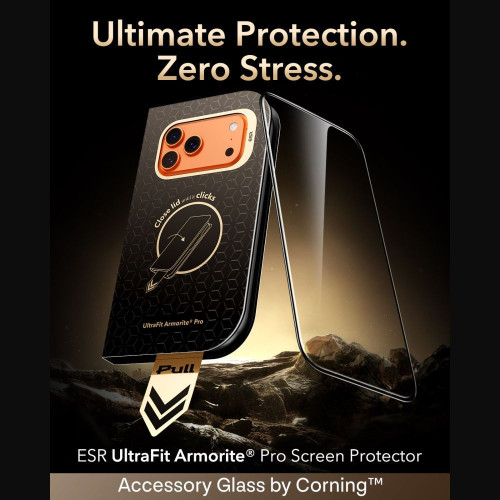
    ESR UltraFit Armorite Pro is made of Corning Accessory Glass with a hardness of 9H. Corning has been supplying glass to smartphone manufacturers for years, and Accessory Glass is its line designed for screen protection.

    According to ESR, the glass is even twice as resistant to scratches as regular tempered glasses, and any scratches are up to 25% less visible. It covers the screen edge to edge and has an oleophobic coating. The UltraFit Tray positioning tray sets the glass on the screen, so installation takes two steps.

    It will work for most people who want one well-crafted glass.

    Minus: there is one piece in the package. If you prefer a spare, ESR also sells a two-pack of UltraFit Armorite, in which the manufacturer does not specify Corning glass.

    2. Tech-Protect Quick Set+ [2 PACK]: the easiest installation

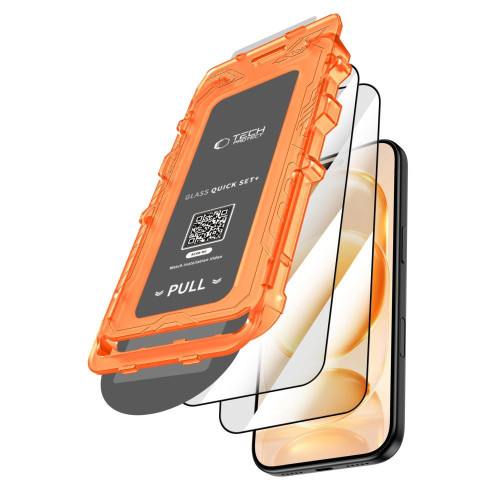
    Tech-Protect Quick Set+ is two pieces of 9H glass with a positioning frame. The frame is placed on the phone and guides the glass precisely onto the screen, making it difficult to apply it crooked even on the first installation.

    The glass has an oleophobic coating and according to the manufacturer, it does not affect touch sensitivity. The second piece will come in handy if the first one breaks or if the installation fails. It’s a good choice if you’re applying glass for the first time.

    Cons: Tech-Protect does not provide the type of glass or scratch resistance data, making it harder to compare with ESR, which reveals both.

    3. UNIQ Optix Covex Matte DX2: best matte

    UNIQ Optix Covex Matte DX2 is a sensible compromise if you miss the factory anti-reflective coating after applying the glass. The matte surface diffuses reflections, making the screen clearer in sunlight than under clear glass, and fingerprints are less visible.

    UNIQ uses Fusion Glass with lithium additives, chemically strengthened twice (hence the DX2 designation). According to the manufacturer, it is twice as durable as regular tempered glass and protects the screen from drops from heights of up to 1.8 m. The package includes a mounting frame, and the glass is marked as case-friendly.

    Cons: the matte surface may slightly soften the image, which can be noticeable when viewing photos and videos.

    [hs_products ids=”143081,143223,146666″ cols=”3″ title=”Top three in the ranking”]

    4. UNIQ Optix Covex Privacy DX2: best privacy glass

    UNIQ Optix Covex Privacy DX2 is a privacy glass, also referred to as tinted, with a filter that limits the visibility of the screen from the side. You see the content directly, albeit a bit darker, while a person sitting next to you on the tram will see a dark surface.

    The glass uses the same DX2 technology as the matte version, and UNIQ claims protection against drops from a height of up to 2 m. The package also includes a mounting frame. It will come in handy if you check your work email on public transport or work on your phone in an open office.

    Cons: the privacy filter darkens the image, so you’ll often need to increase the brightness. We explain how such glasses work in the text what privacy glasses are.

    5. Bizon Glass Edge Duo [2 PACK]: for backup

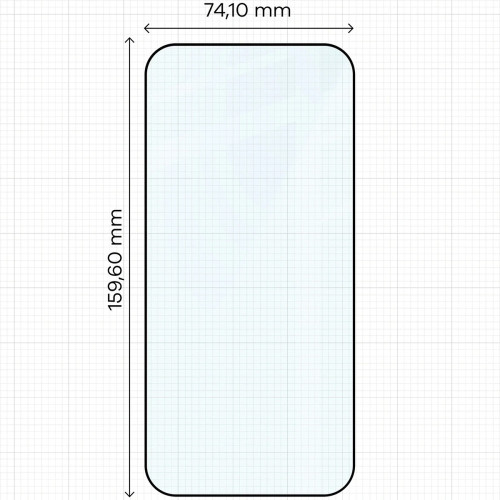
    Bizon Glass Edge Duo consists of two pieces of 9H glass with a thickness of 0.33 mm, featuring a black border on the edges and an oleophobic coating. The edges have a 4D rounding.

    Bizon provides the dimensions of the glass and honestly notes that it overlaps with the screen frames, which may not fit every case. It’s a good choice if you frequently change the glass and want to have a second piece on hand.

    Cons: the set does not include a mounting frame, only positioning stickers, so you align the glass manually. With a case that has a high edge, it may lift up.

    Comparison of glasses in the table

    GlassTypeMaterial (according to the manufacturer)Drop protection (according to the manufacturer)InstallationNumber of pieces
    ESR UltraFit Armorite ProtransparentCorning Accessory Glassno height (Military Grade)UltraFit Tray1
    Tech-Protect Quick Set+transparentno datano dataframe2
    UNIQ Optix Covex Matte DX2matteFusion Glass DX2up to 1.8 mframe1
    UNIQ Optix Covex Privacy DX2privacyFusion Glass DX2up to 2 mframe1
    Bizon Glass Edge Duotransparent, black borderno datano datapositioning stickers2

    It’s also worth considering

    If none of the five glasses meet your needs, check out these alternatives:

    • Matte from 3mk: 3mk HardGlass Matt Max is a matte 9H glass with a thickness of 0.33 mm that covers the entire screen along with the rounded edges. The package includes a card for squeezing out bubbles.
    • Ceramic glass: UNIQ Optix Xenon Nanoceram has a thickness of 0.33 mm and according to the manufacturer, it survived a drop test of a 250 g metal ball from a height of 2 m.
    • Second privacy glass: Bizon Glass Clear Shadow has a thickness of 0.30 mm and a viewing angle of 30°.
    • Screen and lens set: Tech-Protect Easy Set+ includes two glasses for the screen and a glass for the lens with a mounting frame.

    Camera glass for iPhone 18 Pro Max

    The camera island on the Pro Max protrudes above the back and it is the first to touch the surface when you lay the phone down. The lens cover costs a fraction of the camera repair.

    If you take a lot of photos against the light, choose the ESR Armorite Camera Protector with an anti-reflective coating. If you want to maintain the look of the camera island, opt for single lens covers: Tech-Protect Camring Fit+ or UNIQ Optix Aluguard DX2.

    ESR Armorite Camera Protector

    ESR Armorite Camera Protector is tempered glass with an anti-reflective coating, which the manufacturer claims reduces glare and does not degrade photo quality. The raised edges create an additional barrier when placing the phone down, and the cover is easy to remove and reapply.

    It is the only cover in the comparison whose manufacturer claims to have an anti-reflective coating.

    Tech-Protect Camring Fit+

    Tech-Protect Camring Fit+ protects each lens separately: the aluminum ring surrounds the lens, and the tempered glass covers it. This way, the camera island retains its appearance.

    The set includes a mounting frame that guides each piece of glass into the correct position. This is important because a misaligned cover can overlap the lens.

    UNIQ Optix Aluguard DX2

    UNIQ Optix Aluguard DX2 combines a 360° aluminum frame around each lens with Fusion Glass DX2 glass with a hardness of 9H. The included applicator aligns the covers evenly, and several color variants allow you to match them to the color of the phone.

    CoverConstructionAnti-reflective coatingInstallation
    ESR Armorite Camera Protectortempered glass with raised edges✅no data
    Tech-Protect Camring Fit+aluminum and glass for each lensno declarationmounting frame
    UNIQ Optix Aluguard DX2360° aluminum and Fusion Glass DX2no declarationapplicator

    [hs_products ids=”143085,142581,146670″ cols=”3″ title=”Camera covers for iPhone 18 Pro Max”]

    You can find the full selection of covers in the category camera glass for iPhone 18 Pro Max.

    How to apply glass to iPhone 18 Pro Max without bubbles

    Most manufacturer instructions from our catalog come down to similar steps:

    1. Prepare a dust-free area. ESR and Tech-Protect recommend installation in the bathroom right after a shower, as steam binds dust from the air.
    2. Clean and degrease the screen, then polish it with a dry cloth. Collect any remaining particles with a dust removal sticker if included in the set.
    3. Align the glass using a frame, tray, or positioning stickers, depending on the set.
    4. Press the glass and push air bubbles towards the edges.

    You can find more tips in the guide on how to apply tempered glass without air bubbles.

    Which glass to choose for the iPhone 18 Pro Max?

    • Want one proven glass? Choose ESR UltraFit Armorite Pro.
    • Worried about crooked installation? Choose Tech-Protect Quick Set+ with a frame and a second piece included in the set.
    • Annoyed by reflections? Choose matte UNIQ Optix Covex Matte DX2. It won’t replace the factory coating, but it will significantly reduce glare.
    • Do you care about privacy? Choose UNIQ Optix Covex Privacy DX2.
    • Do you use a case with a high edge? Avoid glasses that overlap the screen frames. Cases that work well with the glass can be found in our ranking of cases for iPhone 18 Pro Max.

    For every screen glass, it’s worth choosing a camera cover, as the camera island often collects scratches when placing the phone down.

    Summary

    The best glass for iPhone 18 Pro Max is ESR UltraFit Armorite Pro. From the entire ranking, remember four things:

    1. Screen glass from 17 Pro Max usually fits. Apple provides identical dimensions and screens for both models.
    2. Regular glass disables the anti-reflective coating effect. If reflections are bothersome, choose matte glass for iPhone 18 Pro Max instead of clear.
    3. Hardness 9H is a standard, not a distinguishing feature. Look at the material, installation, and compatibility with cases.
    4. Buy camera covers marked for 18 Pro Max, as none in our catalog are described as compatible with the seventeenth.

    If you’re looking for protection for an older model, check our ranking of glasses for iPhone 17 Pro Max.

    FAQ: glass for iPhone 18 Pro Max

    Which tempered glass is the best for iPhone 18 Pro Max?

    The best overall is the ESR UltraFit Armorite Pro made of Corning 9H glass with a mounting tray. If reflections bother you, a better choice would be the matte UNIQ Optix Covex Matte DX2.

    Does tempered glass ruin the anti-reflective coating of the iPhone?

    It doesn’t damage it, but covers it, so the effect disappears. The coating works only in contact with air and returns to function after removing the glass.

    Which tempered glass is better: 7H or 9H?

    9H is better, but the difference matters less than the packaging suggests. On the pencil hardness scale, 9H is the end of the scale, so almost every tempered glass claims it, and when choosing, the material, coatings, and installation method are more important.

    What is better for iPhone: film or glass?

    Tempered glass offers better protection against cracks and scratches, while film, including hydrogel, is thinner and more flexible. On the flat screen of the Pro Max, glass will be the better choice.

    What is better: hybrid glass or hydrogel film?

    Hybrid glass is stiffer and better withstands scratches, while hydrogel film is soft and adapts even to curved screens. For the flat screen of the iPhone 18 Pro Max, hybrid glass will be better, although tempered glass provides the best protection against cracking.

    Should you put tempered glass on the iPhone 18 Pro Max since it has Ceramic Shield 2?

    Yes, if you tend to drop your phone. Ceramic Shield 2 withstands scratches well, but it does not guarantee that the screen won’t crack, and the protective glass absorbs the impact, allowing you to replace it instead of the screen.

    Which privacy glass to choose for the iPhone 18 Pro Max?

    The best is the UNIQ Optix Covex Privacy DX2 with a mounting frame and according to the manufacturer, protection against falls from heights of up to 2 m. An alternative is the tinted Bizon Glass Clear Shadow with a viewing angle of 30°. Every privacy filter darkens the image, so you will often need to increase the screen brightness.

    Sources: iPhone 18 Pro Max specifications, iPhone 17 Pro Max specifications, Apple on Ceramic Shield 2 at the iPhone 17 Pro launch, MacRumors on anti-reflective coating and protective glasses

  • Honor Magic 9 and Magic 9 Pro Max — premiere on September 28, two 200 MP cameras

    Honor Magic 9 and Magic 9 Pro Max — premiere on September 28, two 200 MP cameras

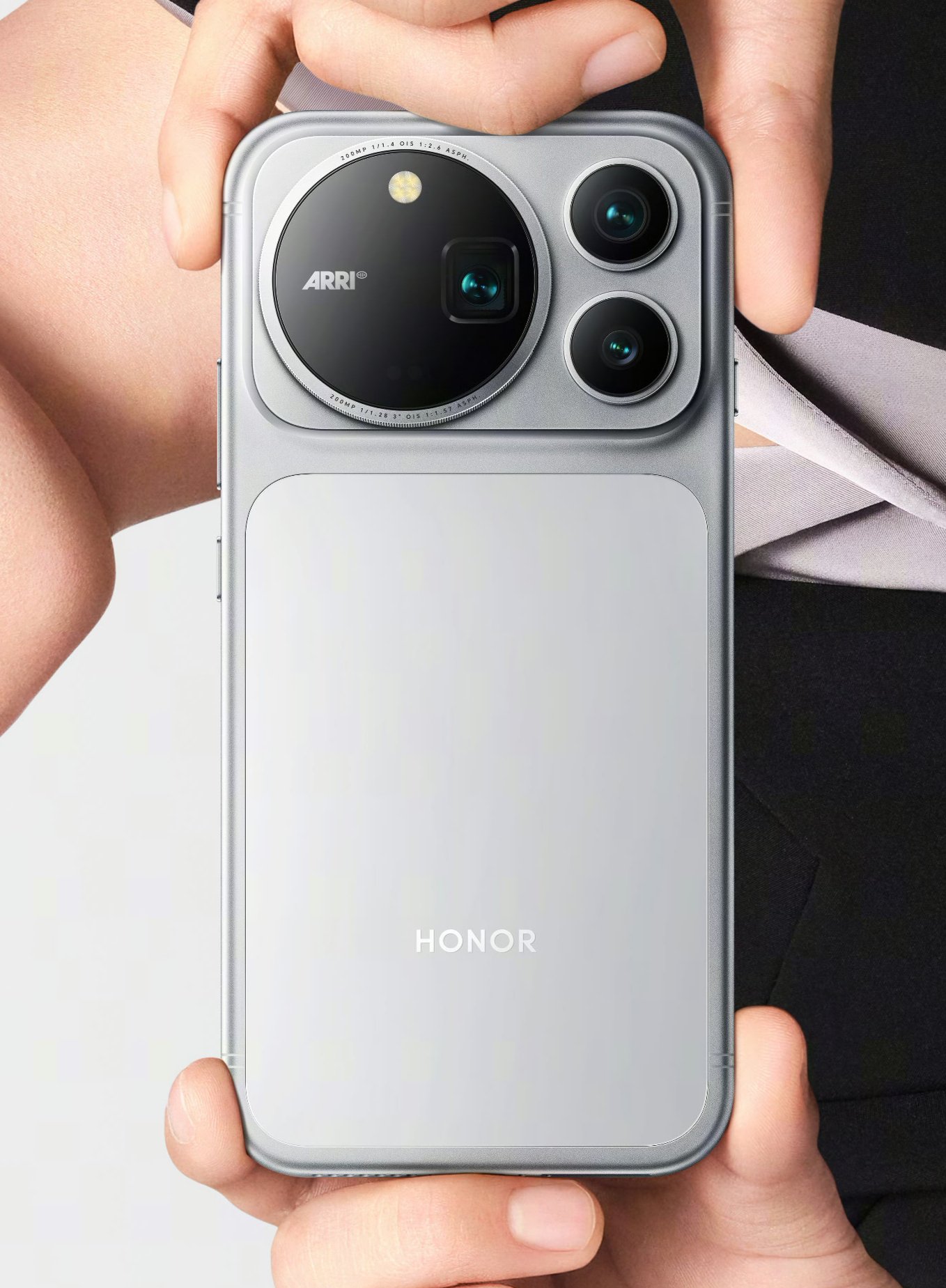
    Honor will showcase the Magic 9 series in Beijing on September 28, 2026. The date was confirmed by the brand’s president Li Jian, and reservations in China have already begun. The strongest argument for the new series is the set of two 200-megapixel sensors and imaging developed in collaboration with ARRI — the German film camera company known to anyone who has watched the credits of a major production.

    Note: this article was created before the official presentation. The release date, collaboration with ARRI, Snapdragon configuration, and set of photography accessories come from Honor’s materials; the screen diagonals, battery capacities, and distribution of configurations between models are still leaks from Chinese services. Everything will be confirmed on September 28.

    Honor Magic 9 Pro Max in Silver Salt color with ARRI ring

    Photos reveal more than announcements

    In the official renders, it’s worth taking a closer look at the ring around the camera module — Honor has engraved the full specifications of both sensors on it. It can be read that the main camera is 200 MP on a 1/1.28 inch sensor with an f/1.57 aperture and three-axis stabilization, while the periscope is 200 MP on a 1/1.4 inch sensor with an f/2.6 aperture. This is the same set described by Chinese services, but here it is provided by the manufacturer itself, in fine print on the casing.

    The ARRI logo sits on the module, next to the lens. The brand doesn’t make phones — it makes cameras used to shoot feature films — so its involvement pertains to color grading and video mode, not the optics themselves.

    Five colors of the entire series

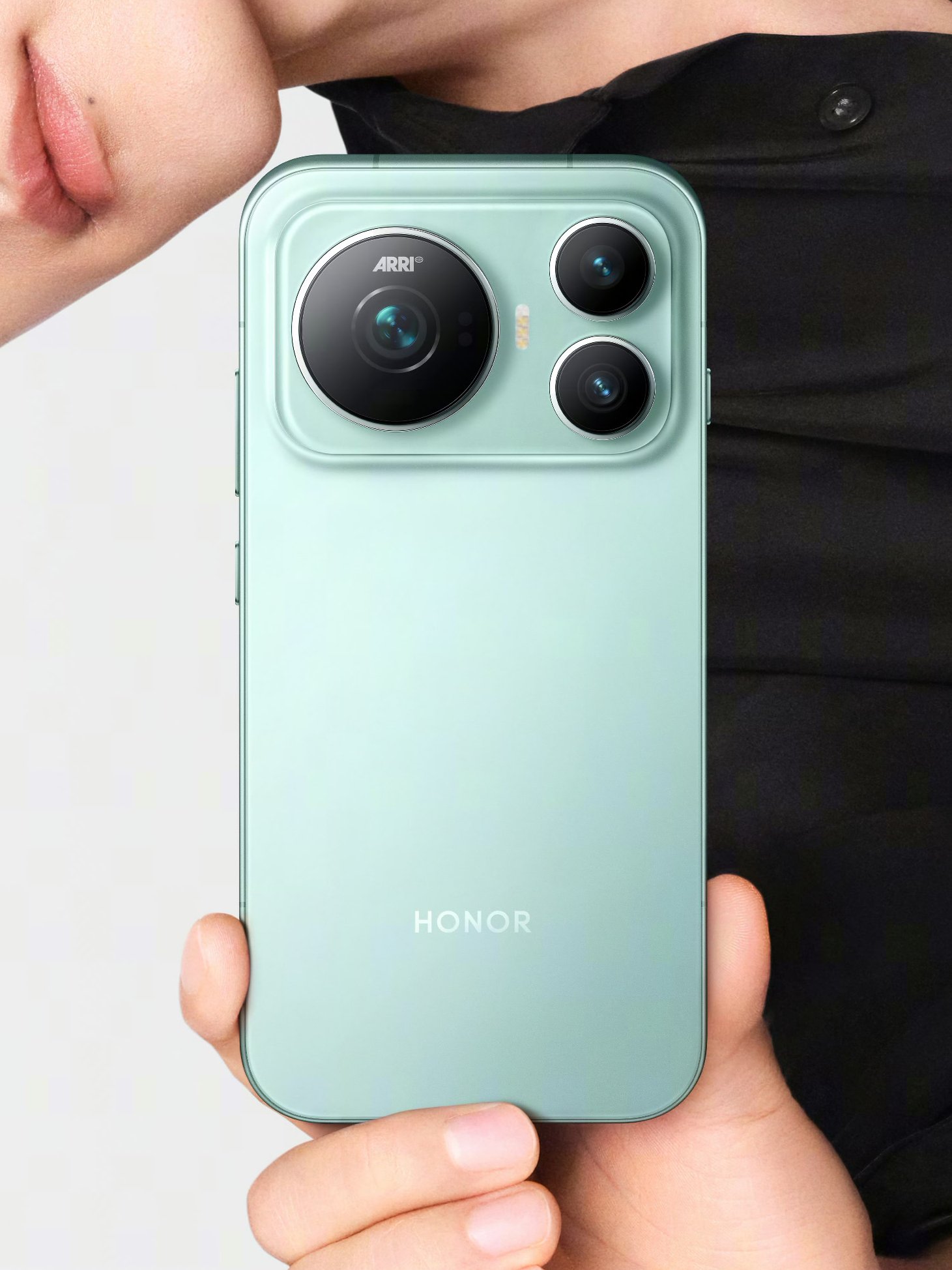
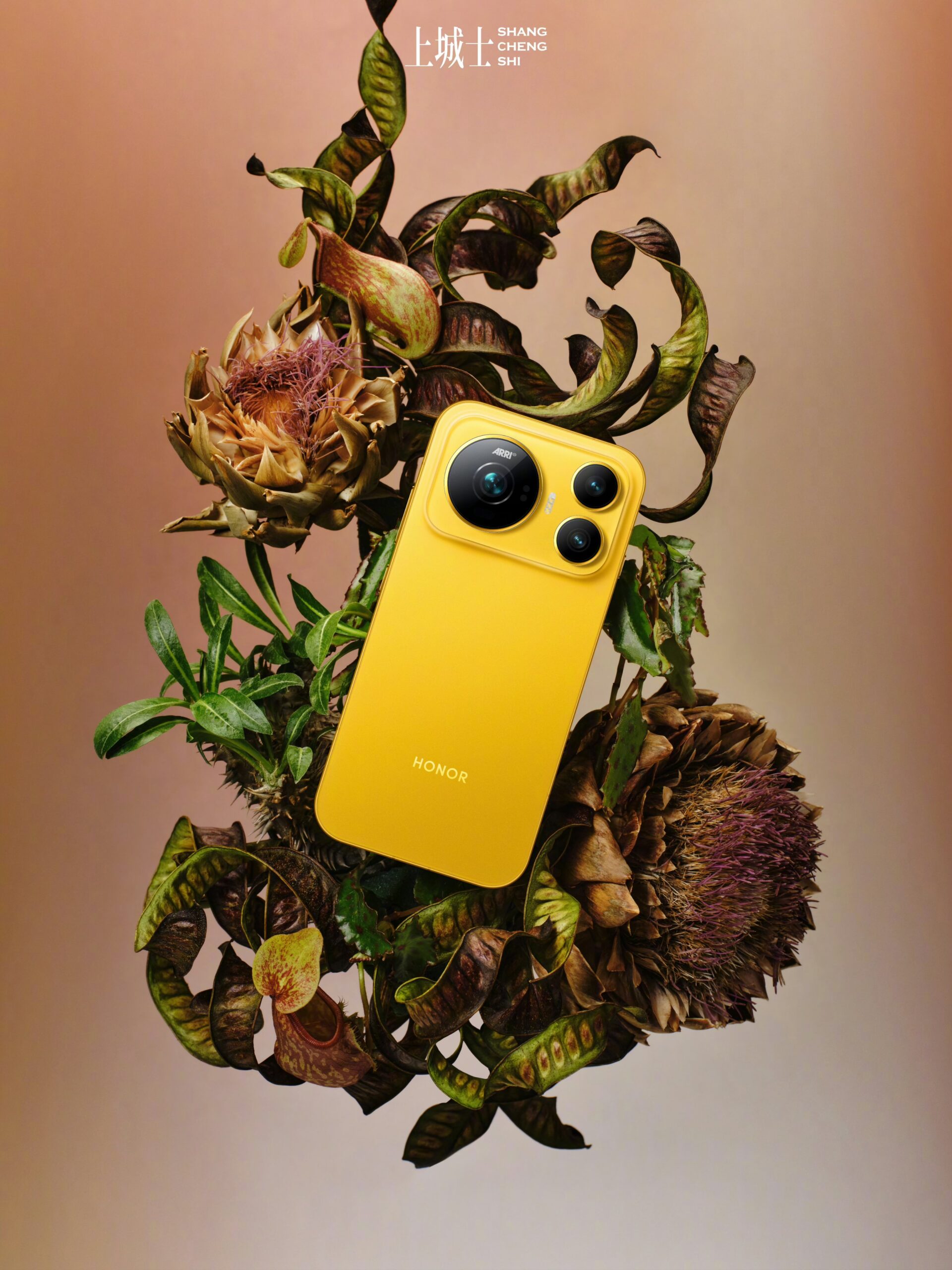
    Honor showcased the series in five variants. The names are cinematic and that’s no coincidence: Curtain Black refers to the curtain, Opening White to the opening credits, and Silver Salt alludes to silver salt, which is part of traditional photography chemistry.

    The full palette includes Curtain Black, Opening White, Olive Green, Silver Salt, and Popcorn Yellow. Yellow and olive are matte, solid backs without gloss — this finish gets dirty less easily, but shows scratches more prominently, so with these two colors, a case is not a matter of taste.

    Attachable telephoto lenses instead of digital zoom

    The most interesting element of the premiere is not part of the phone. Honor has prepared a Master Camera Kit — a set with two attachable lenses: a compact 200 mm (81 mm in length, 88 grams) for everyday carry and a 500 mm for situations where digital zoom falls short: birds, animals, sports from the stands.

    Honor Magic 9 with the attachable telephoto lens from the Master Camera Kit

    For the buyer of accessories, there is one practical conclusion. Such a lens is mounted on a dedicated case with a ring, not on any case — this is a rule we have already seen with OPPO and vivo photography kits. Whoever reaches for this set will practically use two cases: a photography one for sessions and a regular, thinner one for the rest of the day.

    Specifications: Magic 9 and Magic 9 Pro Max

    Parameter Magic 9 Magic 9 Pro Max
    Screen approx. 6.36–6.37″ 1.5K 120 Hz, flat OLED approx. 6.8″ 1.5K 120 Hz LTPO, flat OLED
    Processor Snapdragon 8 Elite (disputed version — see below) Snapdragon 8 Elite Gen 6, 2 nm
    Main camera 200 MP, 1/1.4″, OIS 200 MP, 1/1.28″, f/1.57, OIS 3°
    Ultra-wide 50 MP 50 MP
    Telephoto 200 MP, 1/1.56″, periscope 3.5× 200 MP, 1/1.4″, periscope 85 mm, f/2.6
    Front 55 MP, square matrix 55 MP, square matrix
    Imaging ARRI ARRI
    Battery approx. 8000 mAh 8800–10,000 mAh (discrepant sources)
    Charging 80 W + 50 W wireless 100 W + 50 W wireless
    Additionally — 3D face recognition

    Where sources disagree

    Two things should be taken with caution, as reports are conflicting.

    Base version processor. Some leaks attribute the Magic 9 to the previous Snapdragon 8 Elite Gen 5 chip in a 3 nm process, while Gen 6 is reserved for the Pro Max. Chinese outlets, however, state that the entire series belongs to the first wave with Gen 6 in 2 nm. The premiere will clarify.

    Battery capacity in the Pro Max. You will encounter both 8800 mAh and reports of a peak version reaching 10,000 mAh. The latter number would be a record for a phone of this size, so it’s even more worth waiting for official data.

    There is also context that explains the timing. Qualcomm is showcasing Snapdragon 8 Elite Gen 6 at the Snapdragon Summit on September 22–24, and Honor is entering four days later. This is the shortest possible gap — the brand wants to be the first with the new chipset before the competition does.

    What it means if you have Magic 7 or Magic 8

    If photography is your top priority, the leap is real: two 200 MP sensors instead of one and color science developed with ARRI is a different league than previous generations. If you mainly use your phone as a phone, feel free to wait for the European premiere and the first tests — Honor usually brings the Magic series to our market with a few weeks delay and in a narrower lineup.

    Accessories from the previous generation will not fit. The camera module changes shape and size, so cases from Magic 8 or Magic 8 Pro are out of the question. Protection for earlier models can be found in the categories of Honor Magic 7, and all brand accessories are collected in the Honor category.

    Summary

    Magic 9 is a premiere built around two things: a pair of 200 MP sensors and the name ARRI on the camera module. Additionally, it features a 2-nanometer Snapdragon, a large battery, and a set of attachable telephoto lenses that no one else has in this form today.

    The caveat is the same as with any Chinese premiere: on September 28, we will learn about the Chinese version of events. The European lineup, prices, and release dates may vary.

    FAQ — frequently asked questions

    When is the Honor Magic 9 premiere?

    September 28, 2026, in Beijing. The date has been confirmed by the Honor CEO, and reservations in China have already begun.

    Does the Magic 9 really have two 200 MP cameras?

    Yes. The specifications of both sensors are engraved by Honor on the ring around the module: 200 MP 1/1.28″ f/1.57 for the main one and 200 MP 1/1.4″ f/2.6 for the periscope.

    What is ARRI in the Honor camera?

    ARRI is a German manufacturer of film cameras. The collaboration concerns color reproduction and video modes, not the optics themselves — similar to Hasselblad with OPPO or Zeiss with vivo.

    What colors does the Honor Magic 9 come in?

    Five: Curtain Black, Opening White, Olive Green, Silver Salt, and Popcorn Yellow. The names reference cinema and traditional photography.

    What is the Master Camera Kit?

    Set with two interchangeable telephoto lenses: 200 mm for everyday carry and 500 mm for long-distance photography. They are mounted on a dedicated case with a ring.

    Will the case for Honor Magic 8 fit Magic 9?

    No. The camera module changes shape and dimensions, so a case dedicated to the new series will be needed.


    External sources: Gizmochina — premiere on September 28 and 2 nm chip, Nokiamob — Master Camera Kit and 500 mm extender, IT Home — official announcement of the date, Chinaz — first wave of Snapdragon in 2 nm

  • vivo X500, X500 Pro and Pro Max — specifications, colors and release date

    vivo X500, X500 Pro and Pro Max — specifications, colors and release date

    The vivo X500 series will be showcased on September 21, 2026, at 7:00 PM Chinese time. The manufacturer has already confirmed the date, four colors of both main models, and the key selling point: a periscope telephoto lens 200 MP on a 1/1.4 inch sensor in the Pro Max version.

    The photographic ambassador of the brand is Jay Chou, who unboxed the Pro Max before the premiere — and in the process revealed an accessory that vivo had not mentioned a word about.

    Note: this article was created before the official presentation. It is based on official materials from vivo and leaks from Chinese services and Weibo. Full specifications and prices will be confirmed on September 21.

    vivo X500 Pro Max in the Glow of the Aurora color

    Three models instead of two

    vivo is splitting the series into three variants and for the first time is using the name Pro Max.

    Parameter vivo X500 X500 Pro X500 Pro Max
    Screen 6.59″ 1.5K flat OLED approx. 6.36″ 1.5K, 144 Hz 6.83–6.85″ 2K LTPO, 144 Hz
    Panel — — BOE Q11
    Processor Dimensity 9600M (3 nm) Dimensity 9600 Pro (2 nm) Dimensity 9600 Pro (2 nm)
    Battery 7500 mAh approx. 6400 mAh approx. 8000 mAh
    Charging 90 W + 40 W wireless no data 90 W
    Main camera 50 MP Sony LYT-828, 1/1.28″ Phantom 900 50 MP Phantom 900, 3-axis gimbal
    Telephoto 64 MP Sony LYT-610 64 MP LYT-610, 85 mm 200 MP Samsung HP0, 1/1.4″
    Ultrawide 50 MP 50 MP 50 MP
    Stabilization CIPA 5.5 CIPA 7.0 CIPA 7.0
    System OriginOS 7 OriginOS 7 OriginOS 7

    The base version is by no means a poor relative. Screenshots from the „About Phone” section of the Chinese demo show Dimensity 9600M clocked at 4.21 GHz, 12 GB RAM with 24 GB of extended memory, 512 GB of storage, an additional 50 GB from compression, and a separate image processor BlueImage V3+.

    vivo X500 — screen About Phone with Dimensity 9600M and 7500 mAh battery

    Periscope 200 MP — the strongest argument for Pro Max

    The heart of the X500 Pro Max is the periscope telephoto lens 200 MP on a Samsung HP0 sensor with a format of 1/1.4 inches. This is an unusual approach: most manufacturers give the largest sensor to the main camera, treating the telephoto as an addition. vivo reverses this order.

    Additionally, it features 30× zoom, stabilization CIPA 7.0, and support for a detachable 400 mm teleconverter. The main camera is 50 MP with a three-axis gimbal and a dynamic range claimed at 17 EV.

    The video specs are impressive on paper: 4K 240 fps, 8K in RAW, slow motion 4K 960 fps, and 4K 120 fps in 10-bit Log. All of this is produced as part of a long-standing collaboration with Zeiss.

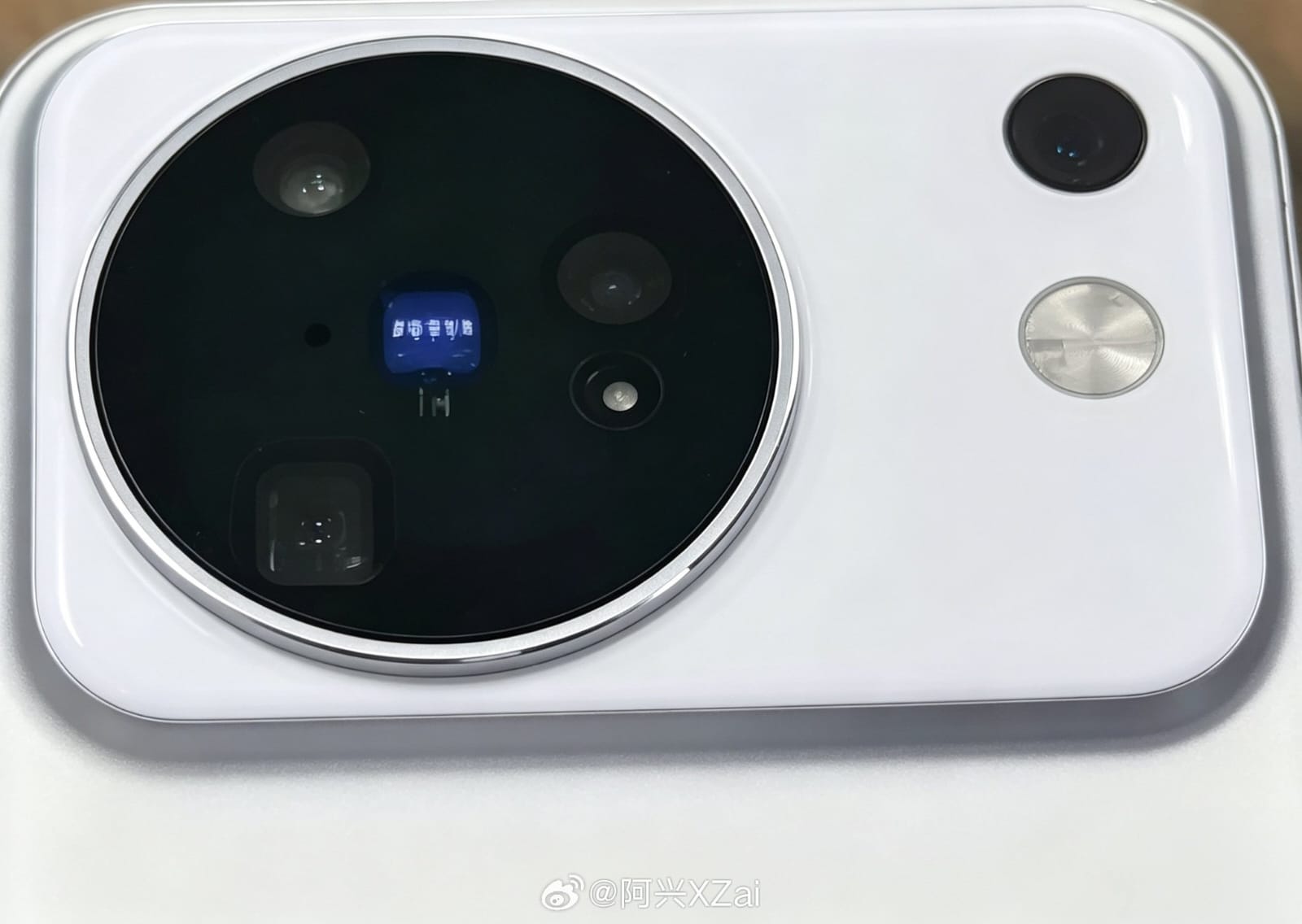
    Camera module of vivo X500 Pro Max in a photo from Weibo

    The base model receives a Sony LYT-828 1/1.28″ sensor known from the X300 Pro, a periscope 64 MP LYT-610, and support for a 200 mm teleconverter. Stabilization at the level of CIPA 5.5.

    Creator’s kit and the mysterious square screen

    The most interesting element of the launch is not the phone. In Jay Chou’s unboxing, a small square display flashed, which vivo had not announced. The manufacturer confirmed that it is an external preview monitor.

    The idea is simple: you connect it to your phone and record yourself with the main camera instead of the front one, seeing the frame on a separate screen. For someone who shoots vlogs, beauty content, or unboxings from a tripod, this is the difference between a selfie lens and a full-featured rear camera.

    The monitor is part of the creator kit for the X500 Pro Max, which also includes: a dedicated case, two teleconverters, a grip with a remote, and a strap. vivo has been building an ecosystem of photographic accessories around the X series for several generations, but this is the first time a separate display has landed in the box.

    Colors of vivo X500 Pro Max

    vivo showcased four variants, all with a two-tone back and — in some color options — flecks that illuminate at an angle.

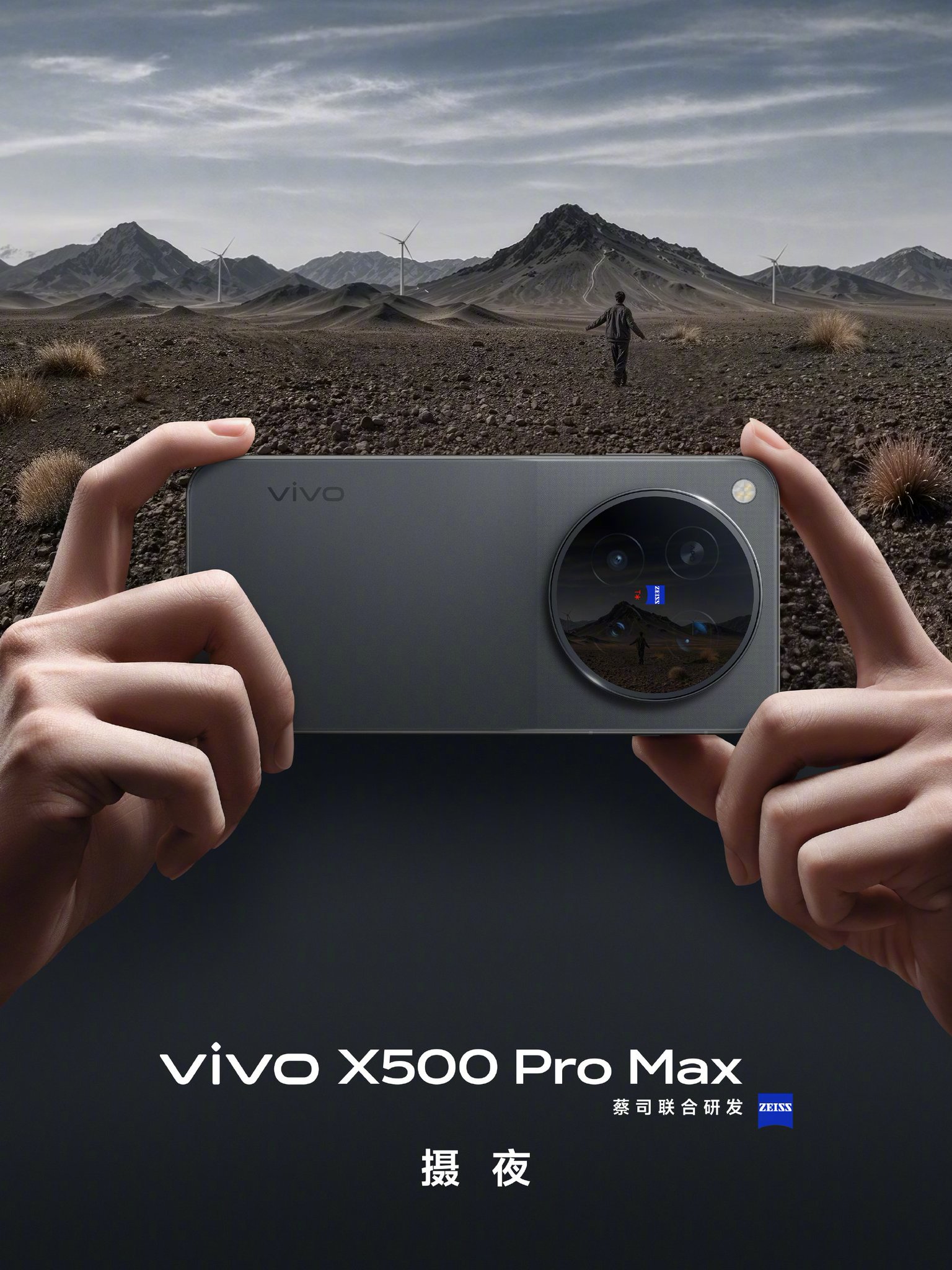
    „Capture the Night” — a dark, muted version.

    vivo X500 Pro Max in the Capture the Night color

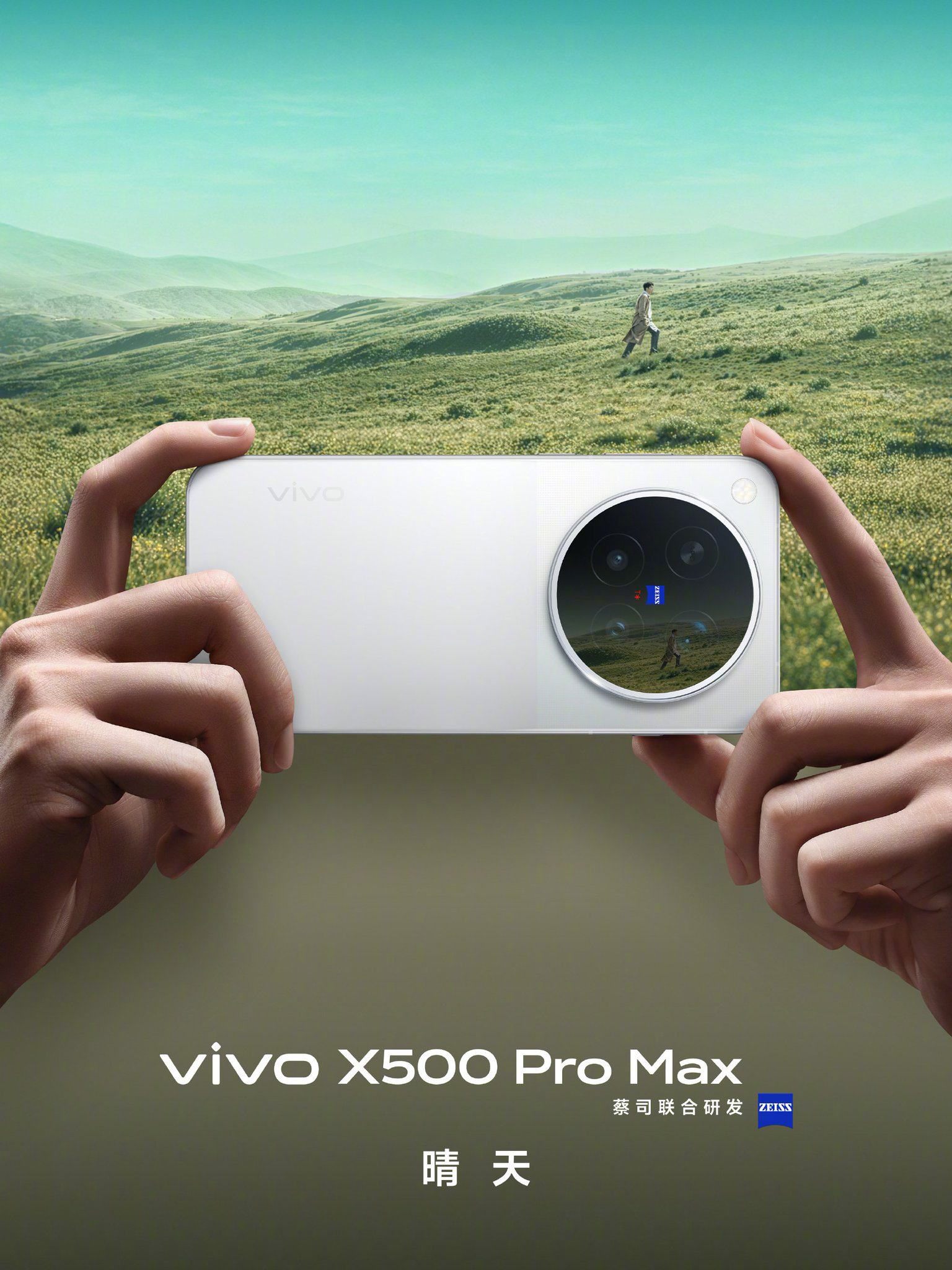
    „Sunny Day” — a white described by vivo as „scattering clouds”.

    vivo X500 Pro Max in the Sunny Day color

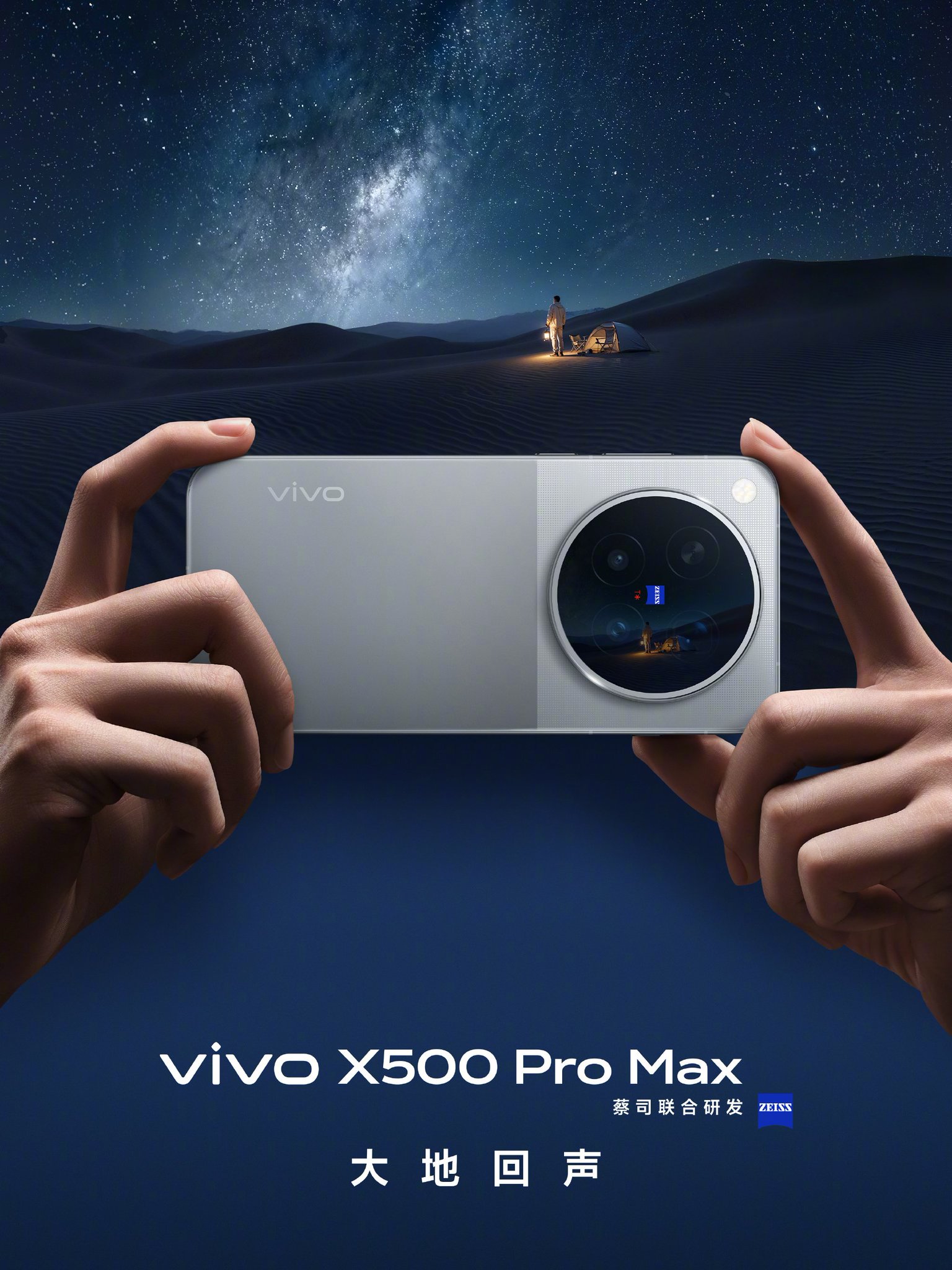
    „Echo of the Earth” — a silvery variant with flecks resembling the Milky Way.

    vivo X500 Pro Max in the Echo of the Earth color

    The fourth is “Glow of the Aurora” — a warm orange visible in the opening photo of the article.

    The base model receives three of the same colors — Sunny Day, Capture the Night, and Echo of the Earth — and instead of Glow of the Aurora it features “Dawn”.

    When is the premiere and what about Europe

    The Chinese presentation will take place on September 21, 2026, at 7:00 PM. For India, leaks suggest October or November, following the V70 series.

    There is no European date. vivo has been bringing the X series to our market in a trimmed version and with delays measured in months for several years, so there’s no immediate hope for the X500 Pro Max in Polish distribution — if it appears at all.

    Is it worth waiting if you have the X300?

    If you are using vivo X300 Pro, you have the same main camera — the LYT-828 returns in the base X500. The upgrade mainly concerns the telephoto lens, and that is the reason for the exchange, not the rest of the specifications.

    However, if long focal length photography is your main scenario, the 200 MP periscope on a 1/1.4 inch sensor is simply in a different class than anything vivo has offered before.

    Accessories from the X300 series will not fit — the camera module changes radically, from a rectangle to a large circle in the middle of the housing. Cases and glass for the new series will usually appear with us within a few days of the debut; all accessories for vivo phones can be found in one category.

    Summary

    vivo X500 Pro Max is a phone built around a telephoto lens, not around the main camera — and that is the most interesting thing about it. Additionally, it features a 2-nanometer Dimensity 9600 Pro, a battery around 8000 mAh, and an ecosystem of accessories that has grown this generation with an external preview monitor.

    The base model looks more reasonable than base versions usually do: 7500 mAh, 90 W, flat 1.5K screen, and a main sensor from last year’s Pro.

    FAQ — Frequently Asked Questions

    When is the vivo X500 premiere?

    September 21, 2026, at 7:00 PM Chinese time. The premiere in India is expected in October or November, the European date has not been announced.

    What is the difference between vivo X500 Pro Max and X500 Pro?

    Primarily the screen and telephoto lens. Pro Max has a 6.83–6.85 inch screen and a 200 MP periscope on a 1/1.4″ sensor, while Pro is compact — about 6.36 inches — and gets a 64 MP telephoto with an 85 mm focal length. Pro Max also has a larger battery.

    What processor does the vivo X500 have?

    The base version gets the Dimensity 9600M built on a 3 nm process, clocked at 4.21 GHz. Both Pro models use the more powerful Dimensity 9600 Pro made in 2 nm.

    What is that square screen included with the X500 Pro Max?

    It is an external preview monitor. It allows you to record yourself with the main rear camera instead of the front one, seeing the frame on a separate display. It comes as part of the creator kit along with a case, two teleconverters, a grip, and a strap.

    What colors does the vivo X500 Pro Max come in?

    Four: „Capture the Night”, „Sunny Day”, „Echo of the Earth” and „Glow of the Aurora”. Instead of Glow of the Aurora, the base model gets „Dawn”.

    Does the case from the vivo X300 fit the X500?

    No. The camera module changes shape from rectangular to a large circle placed in the middle of the casing, so a case dedicated to the new series will be needed.


    External sources: Gizmochina — overview of X500 series specifications, IT Home — official colors, Notebookcheck — confirmed launch date, iXBT — Pro Max specifications

  • OPPO Find X10 Pro Max — specifications, price in Europe and Poland, release in 2026

    OPPO Find X10 Pro Max — specifications, price in Europe and Poland, release in 2026

    OPPO Find X10 Pro Max has officially launched in Europe and Poland on October 21, 2026. In the OPPO store, it costs 6999 PLN, while in Germany and France it is priced at €1799 — in both cases for the only European version of 12/512 GB. It is the first smartphone with three 200 MP cameras: a main, ultra-wide, and periscope telephoto lens.

    In China, the phone debuted on September 22, 2026, and costs from 6799 yuan. The European version differs from the Chinese one in one important aspect: it has a battery 7150 mAh instead of 8000 mAh.

    Update 21.10.2026: the first version of this article was created before the Chinese premiere and was partially based on leaks. After the global premiere, we replaced them with official OPPO data. What did not hold true, we have gathered below in the section “Post-premiere: what has changed compared to the leaks”.

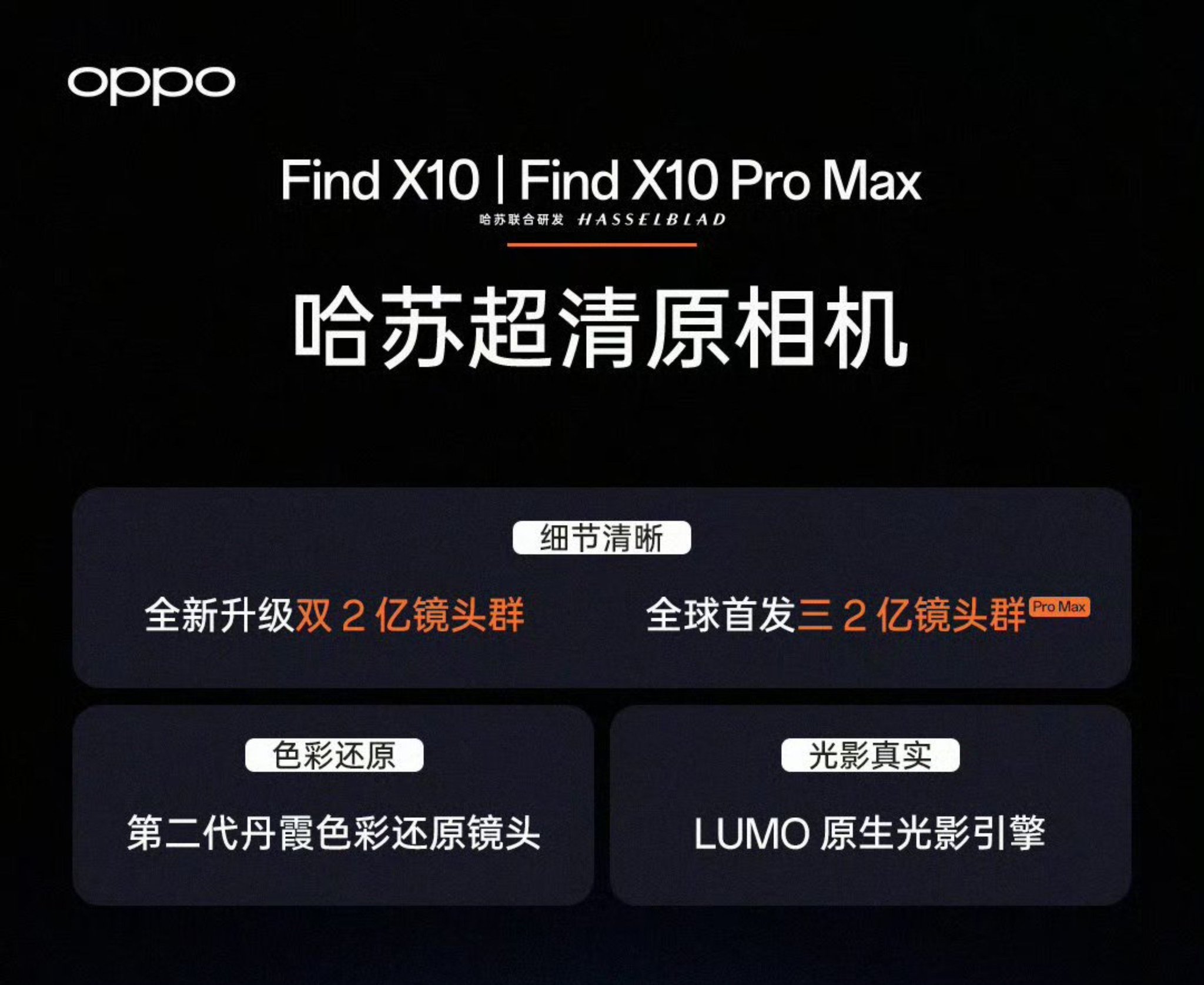
    Hasselblad camera teaser in the OPPO Find X10 series

    This OPPO poster was shown even before the premiere and summarizes the entire series well. The Find X10 received two 200 MP cameras, while the Find X10 Pro Max — as the first phone on the market — has three 200 MP cameras. The module was developed in collaboration with Hasselblad, and the colors and light are handled by the second generation Danxia color lens and the LUMO image engine.

    When is the OPPO Find X10 Pro Max premiere?

    The series had two premieres:

    • China: September 22, 2026, at 7:00 PM Chinese time. This date was provided by OPPO itself in an advertisement on Weibo and confirmed by the conference. Sales in China began on September 24.
    • Europe and Poland: October 21, 2026. On this day, OPPO stores in Poland, Germany, France, and the United Kingdom started selling the Find X10 and Find X10 Pro Max.

    In September, Western media also circulated the date of September 17. This referred to a separate conference for the ColorOS 17 system, not the phone launch.

    How much does the OPPO Find X10 Pro Max cost? Prices in Poland, Europe, and China

    In Europe, the Pro Max is available only in one configuration: 12 GB RAM and 512 GB storage. Versions with 16 GB RAM and 1 TB are available only in China.

    Market Find X10 Pro Max Find X10
    Poland (OPPO store) 6999 zł (12/512 GB) 5499 zł (12/256 GB), 6399 zł (12/512 GB)
    Germany, France (OPPO store) 1799 € (12/512 GB) 1499 € (12/512 GB); 256 GB version approx. 1300 €
    United Kingdom (OPPO store) £1499 (12/512 GB) from approx. £1100
    China from 6799 ¥ (12/256 GB), 7499 ¥ (12/512), 7999 ¥ (16/512), 8999 ¥ (16 GB/1 TB) —

    Prices are provided according to OPPO stores on the launch date (October 21, 2026), without initial promotions. For the Pro Max, OPPO sells separately the Hasselblad Teleconverter Kit — in Poland for 1499 zł.

    A pricing curiosity concerns the older Ultra. In euros, the Find X10 Pro Max is €100 more expensive than the Find X9 Ultra, but in the Polish price list from OPPO, it’s the opposite: the Pro Max costs 6999 PLN, while the X9 Ultra costs 7399 PLN. Which one suits your photography style better, we outlined in the comparison OPPO Find X10 Pro Max vs X9 Ultra.

    After the premiere: what has changed compared to the leaks

    Some pre-release information turned out to be accurate, but several important parameters look different. The comparison below contrasts what we wrote in September with the official specifications.

    Before the premiere (leaks, September 2026) Officially (October 2026)
    LPDDR6 and UFS 5.0 memory LPDDR5X and UFS 4.1
    6.78–6.82″ display with 2K resolution 6.78″, 2772 × 1272 (1.5K), 450 ppi
    8000 mAh battery in both models 8000 mAh only in China, in Europe 7150 mAh (also applies to Find X10)
    Four colors: white, orange, blue, titanium Pro Max: three colors in China (without blue), two in Europe — Luna White and Titanium Grey
    Price approx. 7499 ¥ or 8200 HKD from 6799 ¥ in China, 1799 € in Europe, 6999 zł in Poland
    IP68/IP69 resistance confirmed: IP66, IP68 and IP69
    80 W charging and 50 W wireless confirmed
    f/1.5, f/2.2, f/2.1 apertures and CIPA 7.5 stabilization apertures confirmed; CIPA 7.5 applies to the telephoto lens
    Premiere September 22, 19:00 confirmed

    The most noticeable change concerns the battery. Chinese materials, including a poster with the “glacier battery,” mentioned 8000 mAh, but the European Pro Max has 7150 mAh typical capacity (6960 mAh nominal). This is 100 mAh more than in the Find X9 Ultra, but less than 7500 mAh in the Find X9 Pro.

    The second difference is the display. Instead of 2K, there is a 1.5K panel, which is a lower resolution than in the Find X9 Ultra (QHD+). In return, the display covers 95% of the BT.2020 color space and has PWM dimming at 3840 Hz.

    Three 200 MP cameras — official specifications

    OPPO confirmed the setup known from the announcements: the 200 MP sensor has been given to each of the three main cameras. You can take full-resolution 200 MP photos at focal lengths of 13, 24, and 70 mm, while the phone defaults to saving 26 MP photos to avoid taking up too much space.

    Camera Resolution Sensor Aperture Focal Length Notes
    Main 200 MP 1/1.3″, DeepPix f/1.5 24 mm OIS, HDR up to 17 EV in video
    Ultrawide 200 MP 1/1.56″ f/2.2 13 mm, 124° autofocus, macro from 4 cm
    Periscope Telephoto 3× 200 MP 1/1.56″ f/2.1 70 mm OIS, telemacro from 10 cm, lossless zoom 6× (140 mm)
    True Color Camera 3.2 MP — f/2.4 — 24 spectral channels
    Front 50 MP 1/2.75″ f/2.0 18 mm autofocus, 4K video

    OPPO does not disclose the manufacturers of the sensors. According to reviews from Digital Camera World and HardwareZone, the main camera features a new Samsung ISOCELL HPC, developed in collaboration with OPPO, while the ultrawide and telephoto lenses use ISOCELL HP5 sensors.

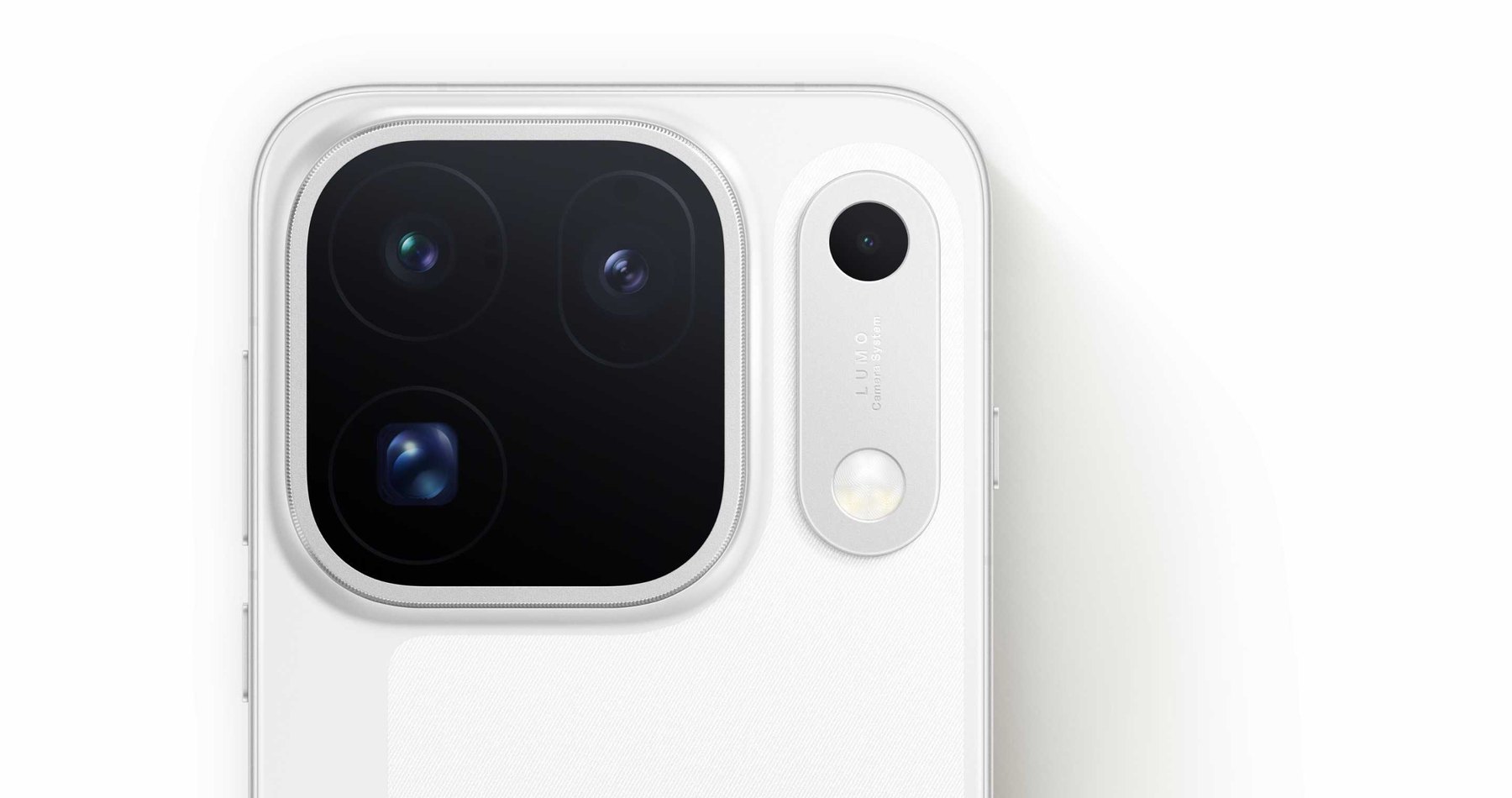
    OPPO Find X10 Pro Max camera module: three 200 MP lenses and LUMO color sensor

    The video benefits the most. Pro Max records 8K at 30 fps and 4K at 120 fps with Dolby Vision on all three rear cameras. Additionally, there is the Open Gate mode (full sensor in 4:3 aspect ratio), O-Log2 recording, and horizon leveling. The dynamic range of 17 EV, which OPPO mentioned before the launch, works in standard video mode on the main camera at a 1× zoom.

    The photographic processing is powered by LUMO True Image Engine with 18 color styles and the LUMO Framing feature, which suggests the frame. Unlike the Find X9 Ultra, the Pro Max model does not have a physical camera button, and a separately purchased Hasselblad 3.28× teleconverter is used for further zooming. The one from the Find X9 Ultra does not fit the new model.

    For accessory buyers, the shape of the camera island is important. The rectangular module with a ribbed frame determines the cutout in the case, and the frame can easily get scratched when placing the phone on its back, so it’s worth using a case with a raised edge around the camera from the start.

    Battery: 8000 mAh in China, 7150 mAh in Europe

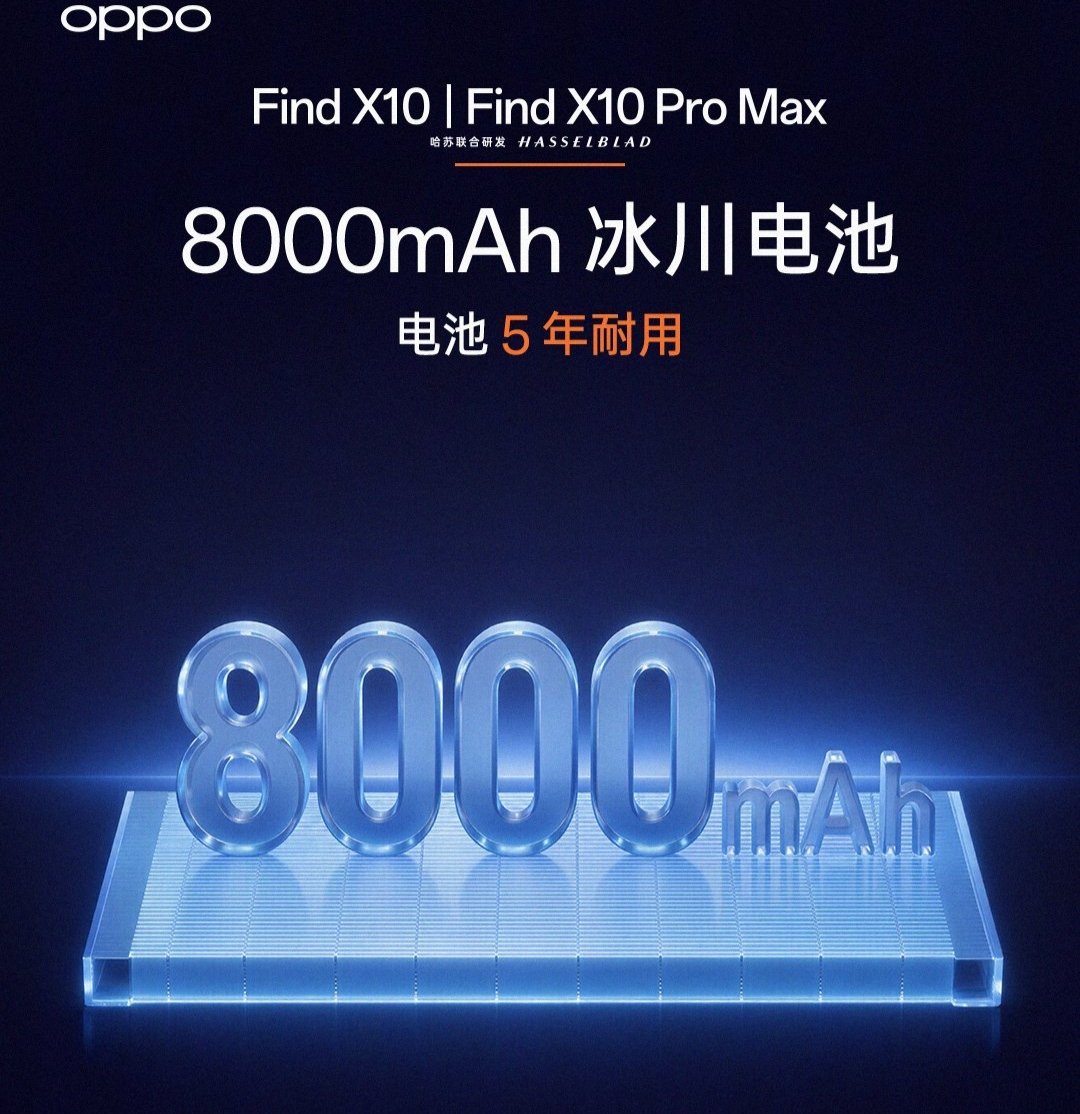
    OPPO Find X10 — battery 8000 mAh

    This pre-release poster from OPPO pertains to the Chinese version. Both versions have a silicon-carbon cell, for which OPPO announced a five-year lifespan, but in Europe, the Find X10 and Find X10 Pro Max received 7150 mAh instead of 8000 mAh.

    The charging has been fully confirmed: 80 W wired (SUPERVOOC and UFCS) and 50 W wireless (AIRVOOC). With chargers from other brands, the phone charges at up to 55 W via PPS, and only 13.5 W via standard USB Power Delivery. The charger is not included in the box.

    In practice, this means that when purchasing a new charger, it is worth looking for a model with PPS (programmable power supply) support of at least 60 W. You can choose it from smartphone wall chargers. The Pro Max does not have built-in Qi2 magnets, so it will only work with magnetic wireless chargers when in a case with a magnetic ring.

    Specifications of OPPO Find X10 and Find X10 Pro Max (European versions)

    Parameter Find X10 Find X10 Pro Max
    Screen 6.59″ OLED 1.5K, LTPO up to 144 Hz 6.78″ OLED 2772 × 1272 (1.5K), 1–120 Hz, 144 Hz in games
    Brightness HBM 2000 nits HBM 2000 nits (peak up to 3600 nits according to press materials)
    Processor MediaTek Dimensity 9600M (3 nm) MediaTek Dimensity 9600 Pro (2 nm)
    Memory 12 GB + 256 or 512 GB, LPDDR5X, UFS 4.1 12 GB + 512 GB, LPDDR5X, UFS 4.1
    Rear Cameras two 200 MP cameras (main and periscope), 50 MP ultra-wide, 3.2 MP color camera three 200 MP cameras (13, 24, and 70 mm), 3.2 MP color camera
    Front Camera 50 MP with AF 50 MP with AF
    Battery (EU) 7150 mAh 7150 mAh (in China 8000 mAh)
    Charging 80 W, 50 W wireless 80 W, 50 W wireless
    System ColorOS 17 (Android 17) ColorOS 17 (Android 17)
    Resistance IP66, IP68, IP69 IP66, IP68, IP69
    Connectivity Wi-Fi 7, Bluetooth 6.2, NFC, eSIM, infrared Wi-Fi 7, Bluetooth 6.2, NFC, eSIM, infrared
    Dimensions and Weight 8.35 mm, approx. 216 g 161.32 × 76.57 × 8.40 mm, 226 g (white) / 228 g (titanium)
    Colors (EU) Glacier Blue, Mist Grey, Glow Coral Luna White, Titanium Grey

    Data for Find X10 Pro Max comes from the specifications on oppo.com/pl. For Find X10, we use OPPO’s launch materials and comparisons from the launch date.

    One note about resistance. In the European Union, the label only shows IP68, as required by the EU regulation regarding smartphone labeling. However, OPPO declares a complete set: IP66, IP68, and IP69.

    Colors and availability of OPPO Find X10 Pro Max

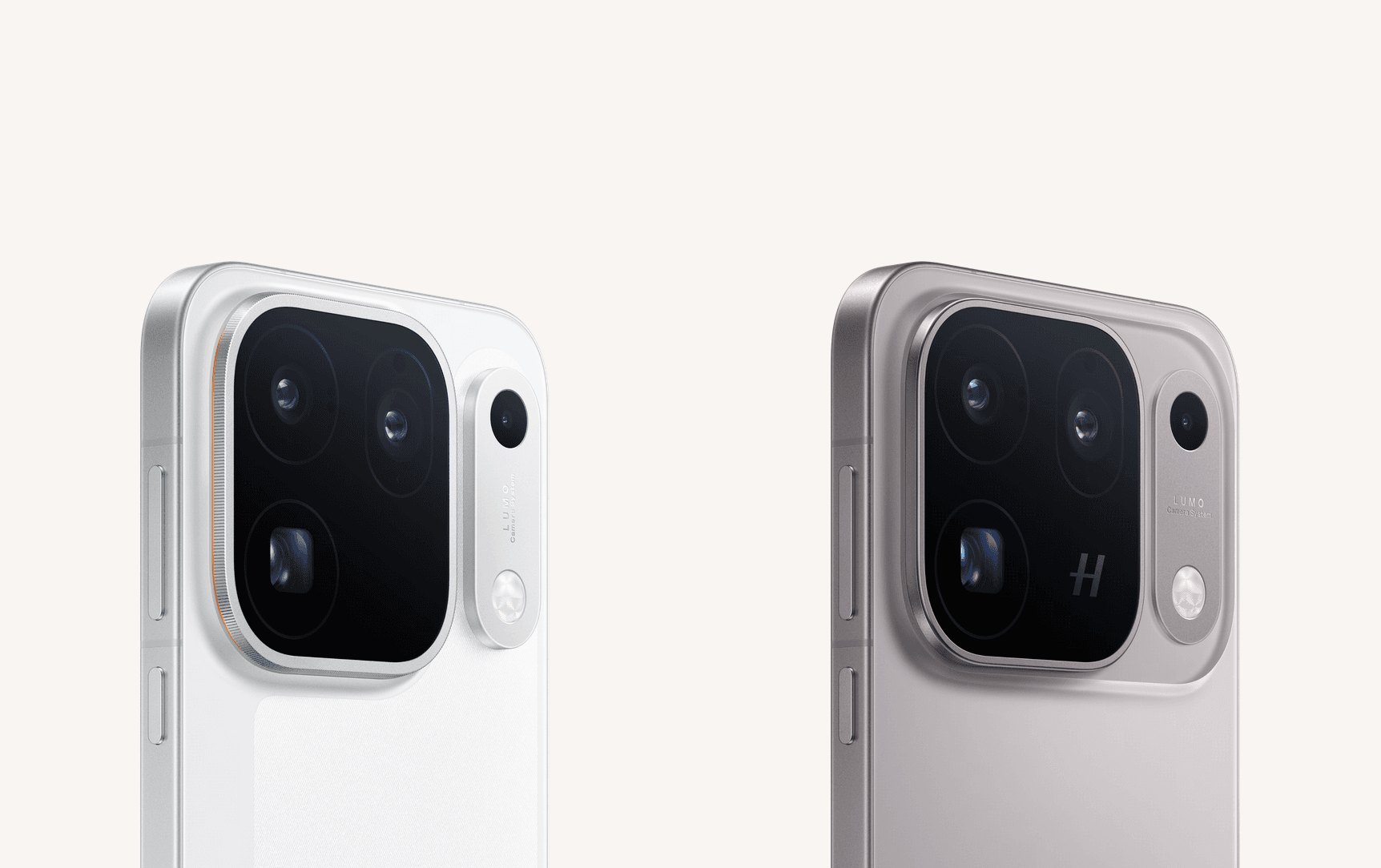
    OPPO Find X10 Pro Max in Luna White and Titanium Grey colors

    In Europe and Poland, the Pro Max is available in two colors: Luna White and Titanium Grey. The white version combines a silver camera island with an orange Hasselblad ring. In China, there is also a third color, warm orange. The icy blue from the pre-release advertisements was only available for the basic Find X10.

    The Find X10 in Europe comes in three colors: Glacier Blue, Mist Grey, and Glow Coral (in the Polish store: blue, grey, and coral).

    Series composition: no Pro, and Find X10 E only in China

    In this generation, OPPO has eliminated the intermediate Pro model, which we mentioned before the premiere. The Find X10 E, whose name appeared on the Chinese reservation page, debuted in China along with the rest of the series, but did not make it to Europe.
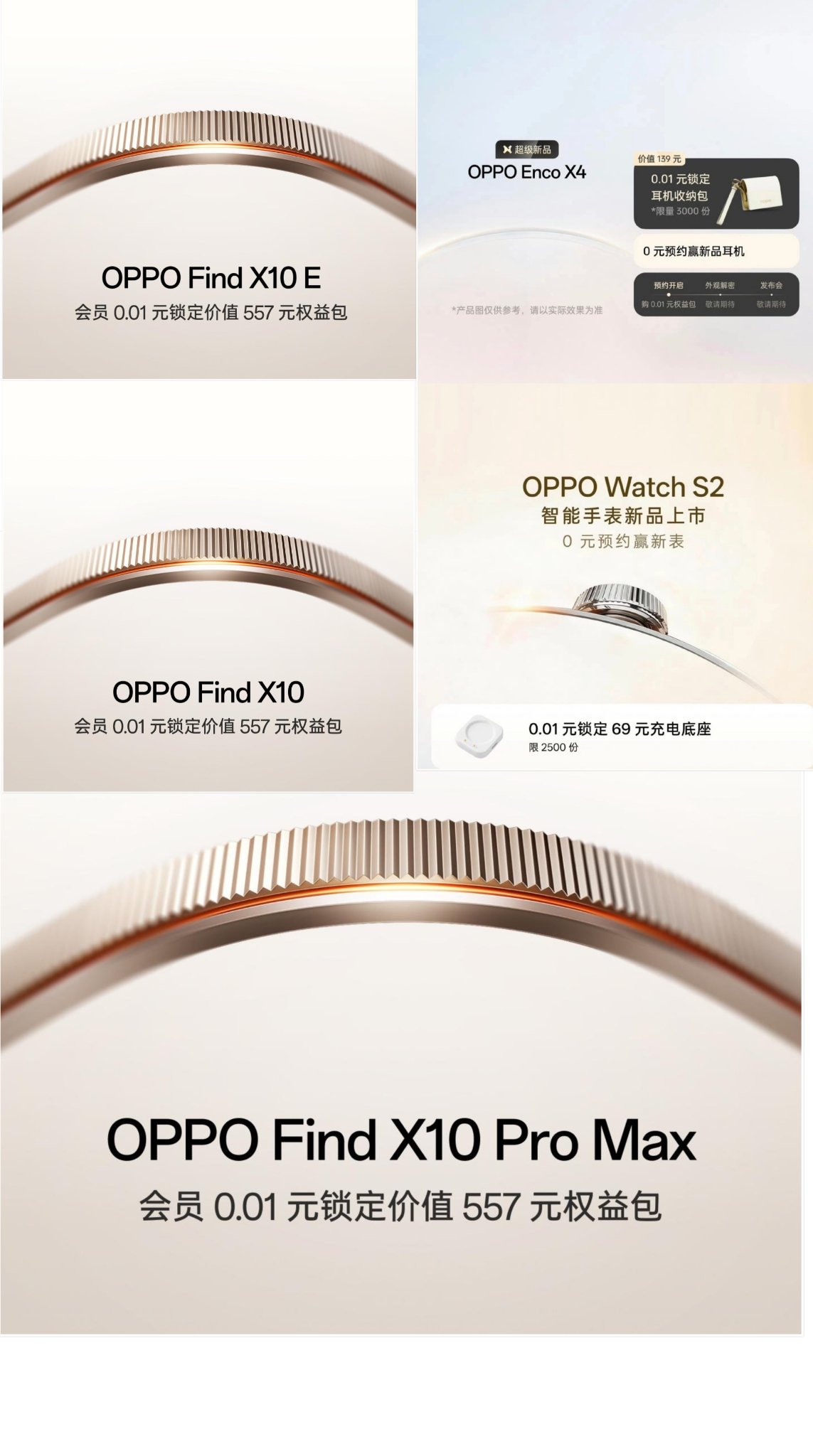
    Reservation page for the OPPO Find X10 series along with Enco X4 and Watch S2
    Model China Europe and Poland
    Find X10 E launch on 22.09.2026 not available
    Find X10 launch on 22.09.2026 from 21.10.2026
    Find X10 Pro not available in this generation not available in this generation
    Find X10 Pro Max launch on 22.09.2026 from 21.10.2026
    Find X10 Ultra no official announcement no official announcement

    Is it worth upgrading from Find X9 to Find X10 Pro Max?

    If photos and videos are your top priority, the jump is significant. The 200 MP ultra-wide camera, 8K and 4K 120 fps on all lenses, and telemacro from 10 cm is a real difference compared to the previous generation.

    If you mainly use the Find X9 or Find X9 Pro as a phone rather than a camera, there are fewer reasons to rush. The European Pro Max has a smaller battery than the Find X9 Pro and a lower resolution screen than the Find X9 Ultra.

    Accessories for the Find X9 series do not fit the new models, as the camera module and the dimensions of the casing have changed. Cases and glass for the new generation can be found in the categories OPPO Find X10 and OPPO Find X10 Pro Max.

    Accessories for OPPO Find X10 Pro Max

    With a phone costing 7,000 PLN, protection from day one is a sensible investment. Cases, tempered glass, and films tailored to the camera island can be found in the category accessories for OPPO Find X10 Pro Max, and the entire series is covered by the category OPPO Find X10 Series.

    [hs_products category=”2669″ limit=”6″ sort=”sales” title=”Protection for OPPO Find X10 Pro Max”]

    If you travel a lot, a power bank of 20,000 mAh or more will also come in handy — a smaller one will not fully charge the 7150 mAh battery. Accessories for other phones of the brand can be found in the OPPO category.

    Summary

    OPPO Find X10 Pro Max has fulfilled the most important promise from the announcement: it is the first phone with three 200 MP cameras and 8K and 4K 120 fps video on each of them. Additionally, it features a 2-nanometer Dimensity 9600 Pro, Wi-Fi 7, and ColorOS 17.

    However, the European version has two compromises compared to the leaks: a 7150 mAh battery instead of 8000 mAh and a 1.5K display instead of 2K. For the only configuration of 12/512 GB, you will pay 6999 PLN in Poland and 1799 € in the euro zone.

    FAQ — frequently asked questions

    When was the OPPO Find X10 Pro Max launched in Poland?

    October 21, 2026, along with the global launch of the series. On that day, sales began at the OPPO store in Poland and in other European countries. In China, the phone debuted earlier, on September 22, 2026.

    How much does the OPPO Find X10 Pro Max cost?

    In Poland, 6999 PLN, in Germany and France 1799 €, and in the UK £1499 — everywhere for the only European version of 12/512 GB. In China, prices start from 6799 yuan for the 12/256 GB version.

    What battery does the OPPO Find X10 Pro Max have in Europe?

    Typical capacity of 7150 mAh. The Chinese version has 8000 mAh. The phone charges at 80 W wired and 50 W wireless, and the charger is not included in the box.

    Does the Find X10 Pro Max really have three 200 MP cameras?

    Yes. The 200 MP sensor is in the main camera (24 mm), ultra-wide (13 mm), and periscope telephoto lens 3× (70 mm). This is the first such set in a smartphone.

    In what colors is the Find X10 Pro Max available?

    In Europe and Poland in two: Luna White (white) and Titanium Grey (titanium). In China, an orange color is also available.

    Is OPPO Find X10 E available in Poland?

    No. In Poland and Europe, OPPO sells Find X10 and Find X10 Pro Max. Find X10 E debuted only in China.

    Will the case from Find X9 fit Find X10 Pro Max?

    No. The camera module and the dimensions of the casing have changed, so a case dedicated to the new generation is needed.


    Sources: OPPO — Find X10 Pro Max specifications (PL), GSMArena — global premiere and prices in Europe, IT之家 — Chinese premiere and prices, rootblog — prices in Poland

  • iPhone 18 Pro vs iPhone 17 Pro: what’s changed

    iPhone 18 Pro vs iPhone 17 Pro: what’s changed

    The biggest difference between the iPhone 18 Pro and the 17 Pro is the main camera with a variable aperture, the first such mechanism in iPhone history. In addition, there is the A20 Pro chip with steam cooling and longer battery life: up to 34 hours of video playback instead of 31 in the seventeen.

    The casing has not changed at all. Both phones have identical dimensions, the same screen, the same zoom range, and the same front camera. This comparison is therefore shorter than it might seem, and comes down to three areas: camera, performance, and battery.

    Below is the full specification table, commentary on each real change, a list of things that remain unchanged, and an answer to the question of whether switching from the seventeen makes sense.

    iPhone 18 Pro Max from the back and iPhone 18 Pro from the front, both in Burgundy color
    iPhone 18 Pro and 18 Pro Max in Burgundy color, which replaced Cosmic Orange from the seventeen. Photo: Apple

    iPhone 18 Pro vs iPhone 17 Pro: comparison table

    The data comes from the official Apple specification pages and the manufacturer’s comparison table.

    ParameteriPhone 18 ProiPhone 17 ProChange
    ScreenOLED Super Retina XDR 6.3″, ProMotion up to 120 HzOLED Super Retina XDR 6.3″, ProMotion up to 120 Hzno changes
    ChipA20 Pro with steam coolingA19 Pronew generation
    Neural Enginedual, 16-core16-coredoubled
    Main CameraFusion 48 MP, variable aperture ƒ/1.48 to ƒ/4.0Fusion 48 MP, fixed aperturekey novelty
    UltrawideFusion 48 MP, ƒ/2.2Fusion 48 MPno changes
    TelephotoFusion 48 MP, 100 mm (4x), ƒ/2.8Fusion 48 MP, 4xno changes
    Optical zoom range0.5x, 1x, 2x, 4x, 8x0.5x, 1x, 2x, 4x, 8xno changes
    Front CameraCenter Stage 18 MP, ƒ/1.9Center Stage 18 MPno changes
    Battery (18 Pro)up to 34 hours of video playbackup to 31 hours of video playback+3 hours
    Battery (Max version)up to 43 hours of video playbackup to 37 hours of video playback+6 hours
    Wireless chargingMagSafe up to 25 W, Qi2 up to 25 WMagSafe up to 25 W, Qi2 up to 25 Wno changes
    Memory256 GB, 512 GB, 1 TB, 2 TB256 GB, 512 GB, 1 TB, 2 TBno changes
    Bodyaluminum unibody, Ceramic Shield 2 on the frontaluminum unibody, Ceramic Shield 2 on the frontno changes
    Dimensions150.0 × 71.9 × 8.75 mm150.0 × 71.9 × 8.75 mmno changes
    Weight211 g204 g+7 g
    Dimensions (Max version)163.4 × 78.0 × 8.75 mm, 249 g163.4 × 78.0 × 8.75 mm, 231 g+18 g
    ResistanceIP68 (6 m for 30 min)IP68 (6 m for 30 min)no changes
    Starting price in Poland6,299 PLN5,799 PLN+500 PLN

    Camera: variable aperture and what it really offers

    This is the only change in this comparison that you’ll see in the photos, not in the benchmark. The main 48 MP Fusion camera in the iPhone 18 Pro switches between four aperture values: ƒ/1.48, ƒ/1.8, ƒ/2.8, and ƒ/4.0. The iPhone 17 Pro has a fixed aperture, like every previous iPhone.

    In practice, it works both ways. At ƒ/1.48, more light hits the sensor than in any previous iPhone, which saves photos in low light and indoors. At ƒ/4.0, the depth of field increases, so in a group photo or macro shot, the entire frame remains sharp, not just the foreground. Previously, such background blur or its absence had to be simulated programmatically in portrait mode.

    Black and white portrait of a person with a heavily blurred background, taken with the iPhone 18 Pro
    At ƒ/1.48, the background blurs optically, without portrait mode. Photo taken with the iPhone 18 Pro. Photo: Apple

    Apple has added Pro controls: manual adjustment of aperture, shutter speed, and white balance, as well as a histogram preview. This is a set that previously required a third-party app.

    The rest of the optical layout remains unchanged. The ultra-wide Fusion 48 MP and the Fusion 48 MP telephoto lens with a focal length of 100 mm are the same as in the seventeenth model, as is the entire zoom range: 0.5x, 1x, 2x, 4x, and 8x.

    Performance: A20 Pro and Vapor Cooling

    The iPhone 18 Pro received the A20 Pro chip instead of the A19 Pro. Apple describes it as the most powerful and energy-efficient chip in iPhone history, built for AI computing. A key architectural change is the dual 16-core Neural Engine instead of a single one, along with Neural Accelerator accelerators.

    Graphic of Apple A20 Pro chip: silver plate with Apple logo and A20 Pro inscription
    A20 Pro replaced the A19 Pro from the iPhone 17 Pro. Photo: Apple

    Additionally, there is vapor cooling. This is more important than it sounds, and it’s not just about benchmark results. The vapor chamber dissipates heat from around the chip, allowing the phone to maintain peak performance longer before it starts to throttle. This is noticeable during extended 4K video recording and gaming, which is precisely where iPhones have throttled after several minutes for years.

    Fair warning: Apple does not publish a percentage comparison of the A20 Pro with the A19 Pro. The numbers circulating online refer either to the parameters of the production process itself or to comparisons with much older generations. If you use the phone for browsing, photos, and social media, you won’t notice a difference in everyday use.

    Battery and Charging

    Here, the change is measurable and directly provided by Apple.

    ModelVideo Playback
    iPhone 17 Proup to 31 hours
    iPhone 18 Proup to 34 hours
    iPhone 17 Pro Maxup to 37 hours
    iPhone 18 Pro Maxup to 43 hours

    The Max version gained the most, with as much as six hours. That’s a difference of one additional evening without a charger. Part of this gain is due to the larger battery, which is why the weight has increased: 249 g instead of 231 g in the Pro Max and 211 g instead of 204 g in the Pro version.

    Wired charging is faster: up to 50% in about 15 minutes with a 60 W or higher power adapter with voltage regulation. Wireless charging remains unchanged, at up to 25 W via MagSafe and the same via Qi2. This is good news for your wallet, as chargers do not need to be replaced.

    What Has Not Changed

    This list is longer than the list of changes and is worth reading before deciding to upgrade.

    • Screen. The same 6.3-inch diagonal, the same OLED Super Retina XDR technology, and the same ProMotion up to 120 Hz.
    • Body. Unibody aluminum, Ceramic Shield 2 on the front with three times higher scratch resistance than the iPhone 16 Pro, Ceramic Shield on the back. The same in both generations.
    • Dimensions. Identical to the tenth of a millimeter, more on that shortly.
    • Zoom range. 0.5x, 1x, 2x, 4x, and 8x in both phones.
    • Front camera. Center Stage 18 MP in both generations.
    • Resistance. IP68 up to 6 meters for 30 minutes.
    • Wireless charging. Up to 25 W via MagSafe and Qi2.
    • Memory. The same range from 256 GB to 2 TB, with no 128 GB version in either model.
    • Face ID. Still in Dynamic Island, not under the screen.

    Price: iPhone 18 Pro vs iPhone 17 Pro

    The increase is 500 PLN at entry level and remains at every memory level.

    Model (256 GB)Starting priceChange
    iPhone 17 Pro5,799 PLN–
    iPhone 18 Pro6,299 PLN+500 PLN
    iPhone 17 Pro Max6,299 PLN–
    iPhone 18 Pro Max6,799 PLN+500 PLN

    It is worth noting that the iPhone 18 Pro costs exactly as much as the iPhone 17 Pro Max did a year earlier. For the same amount, you are choosing between a newer phone in a smaller body and an older one with a larger screen.

    The full price list of both models of the eighteen, along with the Max version and the foldable iPhone Duo, is detailed in the text iPhone 18 Pro price in Poland.

    Is it worth switching from the iPhone 17 Pro to the 18 Pro?

    The answer depends on what you use the phone for, but it is quite clear.

    It is worth it if you earn from photos or videos. The variable aperture plus Pro controls are a real tool, not just cosmetics. Additionally, there is steam cooling that maintains performance during longer recordings, and six extra hours of battery life in the Max version.

    It is not worth it if you use the phone normally. The screen is the same, the body is the same, the front camera is the same, the zoom is the same, and the wireless charging is the same. With a jump of one generation, you pay 500 PLN more for a camera feature that you may never consciously use.

    It is worth considering if you are switching from the iPhone 16 Pro or older. Then the difference accumulates over two generations and also includes the unibody aluminum case, Ceramic Shield 2, and Center Stage 18 MP in the front. Our text comparison of the iPhone 16 Pro and 17 Pro will be helpful here.

    Accessories: what you will transfer from the seventeenth

    The casing has not changed, so the case from the iPhone 17 Pro fits, MagSafe accessories do too. The exception is the glass and camera frame — the camera island has grown, and you need to buy the version for the eighteenth. We laid out the entire list of what you will transfer and what you won’t, with dimensions and how to check a specific model, in a separate guide: whether the case from the iPhone 17 Pro fits the iPhone 18 Pro.

    Summary

    1. The variable aperture is the only change you will see in the photos. Four values from ƒ/1.48 to ƒ/4.0 plus manual Pro control.
    2. A20 Pro with steam cooling and dual Neural Engine. Apple does not provide a percentage comparison with A19 Pro, so be cautious with the numbers from the web.
    3. Battery lasts 3 hours longer in Pro and 6 hours longer in Pro Max. At the cost of 7 and 18 grams of weight.
    4. Casing, screen, zoom, front camera, and wireless charging unchanged. The list of unchanged items is longer than the list of new features.
    5. Price increased by 500 PLN. 6,299 PLN instead of 5,799 PLN for the 256 GB version.
    6. When switching, you only need to buy the glass for the camera. You transfer the case and MagSafe accessories without purchases.

    FAQ

    What is the difference between the iPhone 18 Pro and the 17 Pro?

    Three things: a main camera with a variable aperture of ƒ/1.48 to ƒ/4.0, an A20 Pro chip with vapor cooling and a dual Neural Engine, and longer battery life, up to 34 hours of video playback instead of 31. The screen, casing, zoom, and front camera are the same.

    Does the iPhone 18 Pro have a larger screen than the 17 Pro?

    No. Both models have 6.3 inches, and the Max versions have 6.9 inches. The same OLED Super Retina XDR technology and the same ProMotion up to 120 Hz.

    What is a variable aperture in a camera?

    It is a mechanism that changes the size of the opening through which light enters the sensor. A wide-open aperture (ƒ/1.48) lets in more light and blurs the background, while a closed aperture (ƒ/4.0) provides greater depth of field, meaning the entire frame is sharp. The iPhone 18 Pro does this mechanically, while earlier models simulated the effect programmatically.

    How much heavier is the iPhone 18 Pro compared to the 17 Pro?

    By 7 grams: 211 g instead of 204 g. In the Max version, the difference is 18 grams, 249 g instead of 231 g. This is due to the larger battery and vapor chamber, not a change in the shape of the casing.

    Is it worth paying extra for the iPhone 18 Pro?

    If you photograph or record professionally, yes, because the variable aperture and vapor cooling are real tools for work. For regular use, the 500 PLN difference mainly buys you camera functionality, which you may consciously choose not to use.

    Does the iPhone 18 Pro have better zoom than the 17 Pro?

    No. Both phones offer the same optical zoom range: 0.5x, 1x, 2x, 4x, and 8x, with a 48 MP Fusion telephoto lens with a focal length of 100 mm.

    Does the case from the iPhone 17 Pro fit the 18 Pro?

    Yes. The body dimensions are identical: 150.0 × 71.9 × 8.75 mm. Only the camera glass does not fit because the camera island has grown.

    Does the iPhone 18 Pro have Face ID under the screen?

    No. The TrueDepth module still sits in the Dynamic Island, just like in the iPhone 17 Pro. The Dynamic Island has received a new incarnation and can track up to three Live Events simultaneously.

    Sources: official specifications for the iPhone 18 Pro and 18 Pro Max, iPhone comparison table on apple.com/pl (chips, battery, dimensions, weight, zoom range, front camera), iPhone 18 Pro purchase page (prices).

  • iPhone 18 Pro price in Poland: complete pricing and where to buy

    iPhone 18 Pro price in Poland: complete pricing and where to buy

    iPhone 18 Pro costs in Poland from 6,299 PLN, and iPhone 18 Pro Max from 6,799 PLN. These are the prices for the 256 GB version in the official Apple store. The most expensive variant, the Pro Max with 2 TB of memory, is 12,799 PLN. The phones are on sale from September 18, 2026, and pre-orders started on September 12 at 2:00 PM.
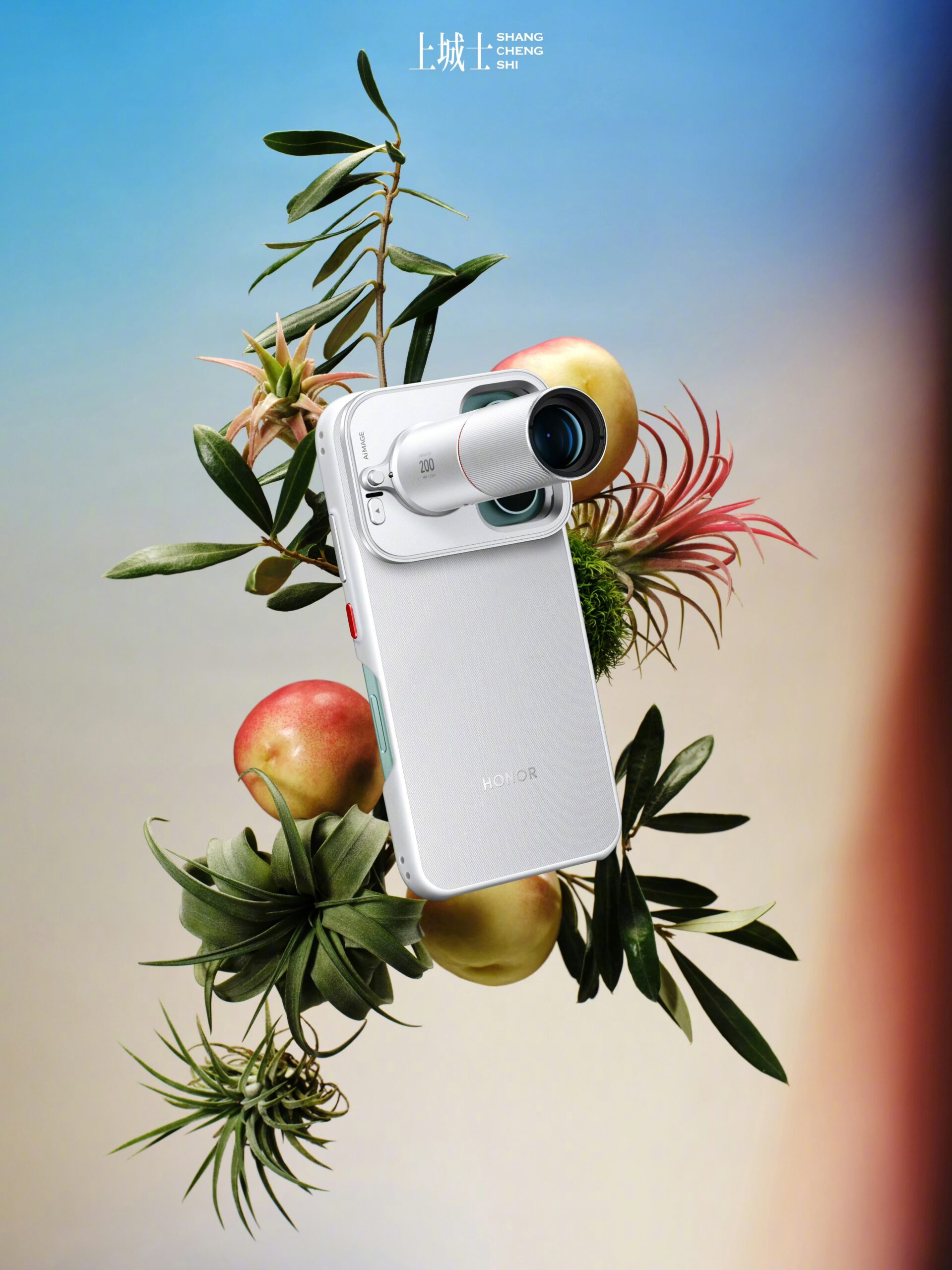
    Below you will find the full price list for each capacity of both models, the prices of the foldable iPhone Duo, a comparison with last year’s seventeen, and information on where to buy the phone and how much to realistically add for protection.

    Note one thing: many Polish services still serve pre-release price forecasts, such as 6,399 PLN, 6,800 PLN, or 7,300 PLN. All of them are outdated. The prices in this text come from the Polish Apple store.
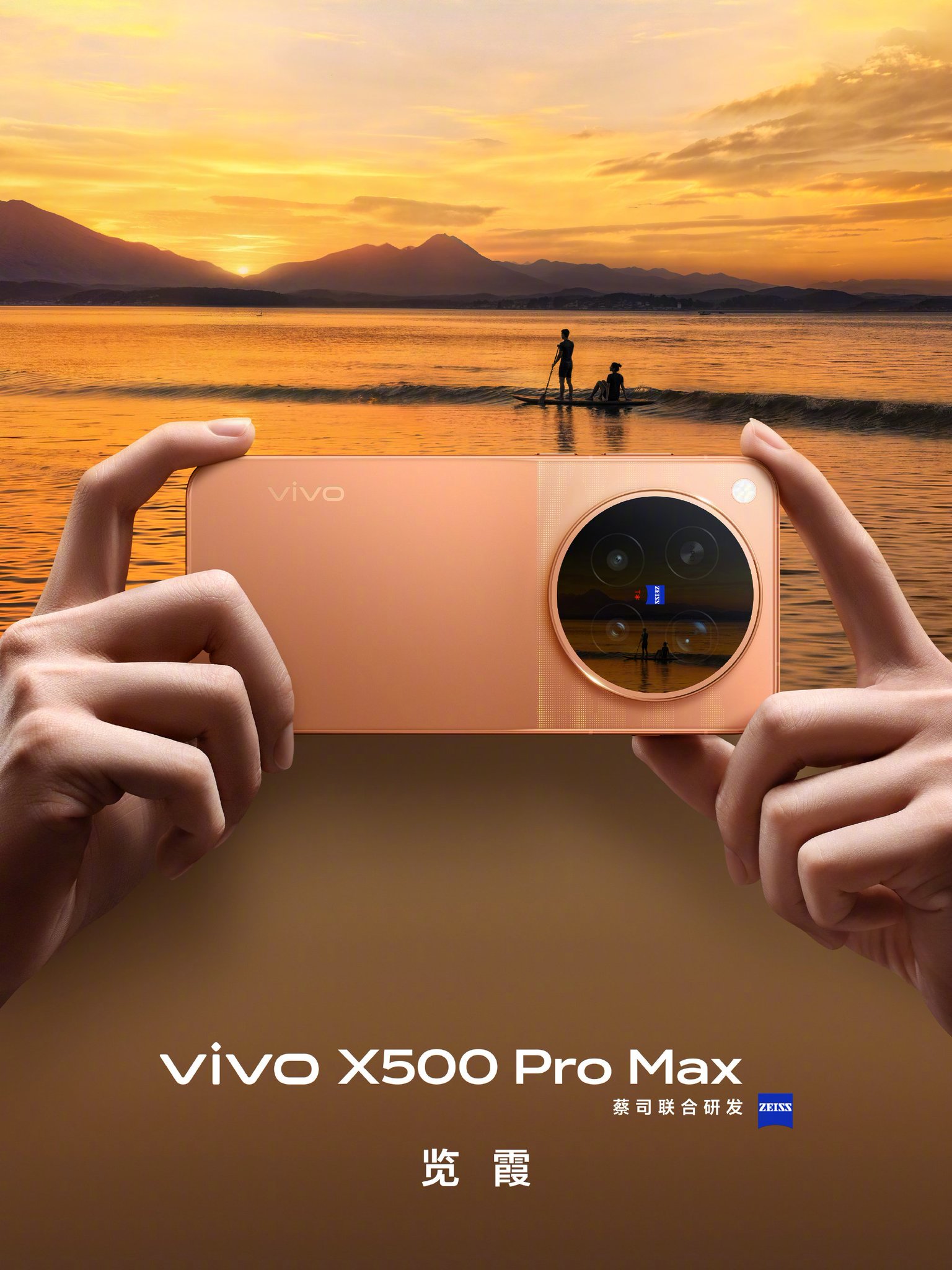
    iPhone 18 Pro Max seen from the back and iPhone 18 Pro from the front, both in Burgundy color
    iPhone 18 Pro and iPhone 18 Pro Max in Burgundy color. Photo. Apple
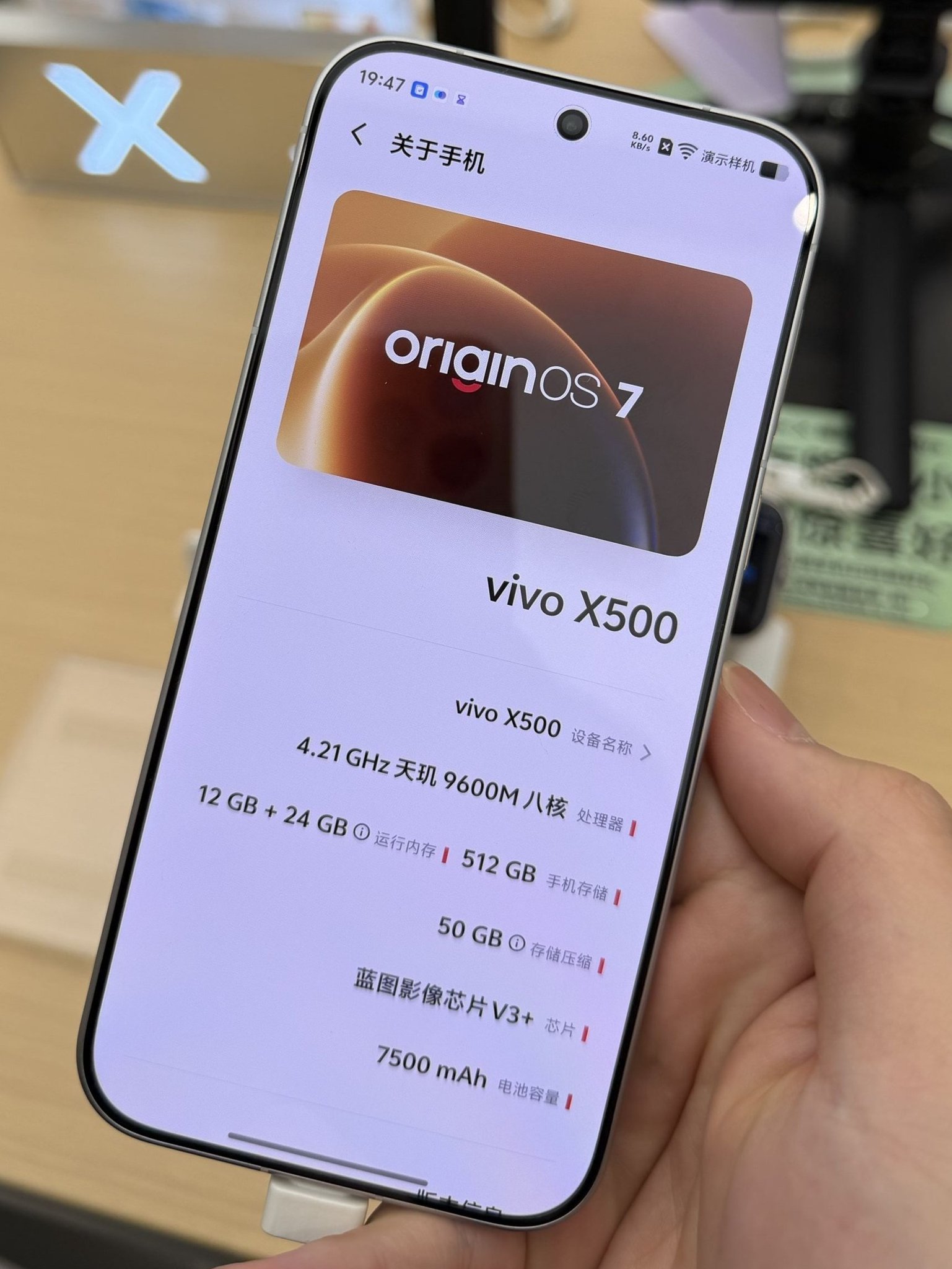
    How much does the iPhone 18 Pro cost in Poland? Full price list

    Both models start from 256 GB. There is no 128 GB version available, so there is no cheaper entry than the amounts listed below. All four colors cost the same.

    CapacityiPhone 18 Pro (6.3″)iPhone 18 Pro Max (6.9″)Difference
    256 GB6,299 PLN6,799 PLN500 PLN
    512 GB7,299 PLN7,799 PLN500 PLN
    1 TB9,299 PLN9,799 PLN500 PLN
    2 TB12,299 PLN12,799 PLN500 PLN

    The surcharge for a larger screen is fixed at 500 PLN at each memory level. However, the jumps between capacities are uneven, and that’s the most important thing in this table. From 256 GB to 512 GB, you pay an additional 1,000 PLN. From 512 GB to 1 TB, it’s already 2,000 PLN. From 1 TB to 2 TB, another 3,000 PLN, which is about the price of a decent mid-range phone.

    Which capacity to choose

    A practical tip instead of generalizations. The iPhone 18 Pro records 4K video at 120 fps in Dolby Vision, and this is one of the most storage-intensive formats you can get from a phone. If you film professionally, 256 GB will fill up faster than you expect, and you cannot expand the memory in the iPhone or insert a card.

    • 256 GB is sufficient if you keep photos in iCloud and record short clips.
    • 512 GB is a reasonable middle ground for someone who shoots a lot of video and doesn’t want to clean their library every month.
    • 1 TB and 2 TB make sense only for professional work with video material. With a surcharge of 3,000 PLN for the last jump, it’s worth calculating whether an external hard drive connected via USB-C might be cheaper.

    When is the iPhone 18 Pro release? Pre-order and sale dates

    Apple showcased both phones on September 9, 2026, during the “Surprise and shine” conference. All dates below are confirmed by the manufacturer.

    ModelPre-orderAvailability
    iPhone 18 ProSeptember 12, 2026, from 2:00 PMSeptember 18, 2026
    iPhone 18 Pro MaxSeptember 12, 2026, from 2:00 PMSeptember 18, 2026
    iPhone DuoOctober 16, 2026, from 2:00 PMOctober 23, 2026

    The pre-order fell unusually on a Saturday instead of a Friday. The reason is simple: September 11 marked the 25th anniversary of the 2001 attacks, and Apple consistently avoids this date for commercial launches. The same maneuver was performed by the company in 2015 with the iPhone 6s.

    Is there a regular iPhone 18 and how much does it cost?

    There is no basic iPhone 18. It is not available in Apple’s offer, and the purchase page for such a model in the manufacturer’s store returns a 404 error. There is also no iPhone 18 Plus.

    Apple has split the annual model into two parts for the first time. In the fall of 2026, only the Pro models and the foldable iPhone Duo debuted. The basic iPhone 18, iPhone 18e, and iPhone Air 2 are expected to appear only in spring 2027, most likely in March or April. If you are looking for a cheaper eighteen, September has given you nothing.

    The real choice for autumn 2026 is the iPhone 18 Pro, iPhone 18 Pro Max, foldable iPhone Duo, or the discounted iPhone 17 from the previous year.

    How much does the iPhone Duo cost? Foldable pricing

    The foldable iPhone appears in the same searches, so for clarity, here is the full pricing. Both colors, Night Sky and Star White, are priced the same.

    CapacityiPhone Duo
    256 GB9,999 PLN
    512 GB10,999 PLN
    1 TB12,999 PLN
    2 TB15,999 PLN
    Two iPhone Duo unfolded at an angle: on the left in Star White, on the right in Night Sky
    iPhone Duo in Star White and Night Sky colors. Photo: Apple

    The Duo in the base version costs 3,200 PLN more than the iPhone 18 Pro Max in the same capacity. It is also worth noting that the phone only supports eSIM, has no SIM card slot, and instead of Face ID, it has Touch ID in the side button.

    Price of the iPhone 18 Pro vs. iPhone 17 Pro: how much more expensive

    There is a price increase, but it is smaller than analysts had predicted. Before the launch, it was said to be an increase of 250 to 300 dollars.

    Model (256 GB)Starting PriceChange
    iPhone 17 Pro5,799 PLN–
    iPhone 18 Pro6,299 PLN+500 PLN
    iPhone 17 Pro Max6,299 PLN–
    iPhone 18 Pro Max6,799 PLN+500 PLN

    A curiosity that changes the way we think about this price list: the iPhone 18 Pro costs exactly as much as the iPhone 17 Pro Max did a year earlier. For the same 6,299 PLN, you can have a newer phone in a smaller body or an older one with a larger screen.

    What you get for this difference is detailed in the text iPhone 18 Pro vs iPhone 17 Pro. In short: a main camera with a variable aperture, A20 Pro chip, and longer battery life.

    What colors does the iPhone 18 Pro come in?

    Four, common to both models and all at the same price:

    • Burgundy, the leading color of this year, which replaced Cosmic Orange from the seventeenth
    • Glacier Blue
    • Silver
    • Black
    Four iPhone 18 Pros set back to back in Black, Silver, Glacier Blue, and Burgundy colors
    Four colors of the iPhone 18 Pro and 18 Pro Max, all at the same price. Photo: Apple

    If you come across the names Dark Cherry, Light Blue, or Dark Gray online, these are code names from pre-release leaks. Apple does not use them.

    Color affects the choice of accessories. Burgundy and Glacier Blue are finishes that are a shame to hide under an opaque case, so it’s worth considering a transparent or semi-transparent cover. The UNIQ LifePro Xtreme in the transparent version or Spigen Ultra Hybrid MagSafe perform well here. Manufacturers have also released cases that match the Burgundy color, such as UNIQ Heldro Air in burgundy.

    Where to buy the iPhone 18 Pro in Poland?

    You can buy the phone directly at the Apple store and from authorized partners: Media Expert, x-kom, Komputronik, Morele. It is also available in the offers of operators Orange, Play, and T-Mobile, although there the price must be calculated together with the subscription, and not compared with the amount from the Apple price list.

    There are two things worth checking before purchasing from a reseller. First, whether the phone has Polish distribution and warranty. Second, whether the price refers to the same capacity, as some comparators match the 256 GB version with the 512 GB version.

    The phone itself is one thing, but you can buy a complete protection set cheaper and faster separately. Here you will find accessories in the categories iPhone 18 Pro and iPhone 18 Pro Max.

    How much to add for accessories for the iPhone 18 Pro?

    A complete set usually consists of three items: a case, screen glass, and camera glass. It will be cheaper than one visit to the service for a display replacement in the Pro model.

    Case

    Here is good news for those switching from the seventeenth model. The body of the iPhone 18 Pro has exactly the same dimensions as the 17 Pro, which are 150.0 × 71.9 × 8.75 mm, so the old case fits. We detailed this in a separate article: whether the case from the iPhone 17 Pro fits the 18 Pro.

    If you’re buying new, look for a case with a built-in magnetic ring so the MagSafe charger holds without an adapter. Verified options include UNIQ Combat, Spigen Ultra Hybrid MagSafe, and the slim PITAKA Edge Case PTK Weaving made of aramid fiber. The full offer is in the category cases for iPhone 18 Pro.

    [hs_products ids=”146623,146505,146577,146632″ cols=”4″ title=”Cases for iPhone 18 Pro”]

    Screen Glass

    Ceramic Shield 2 on the front is, according to Apple, three times more resistant to scratches than the layer on the iPhone 16 Pro, but scratch resistance is not the same as break resistance when dropped on the edge. Tempered glass is a consumable layer: you replace it when it cracks, instead of replacing the display.

    It’s worth aiming for versions with an applicator, as installation without a frame ends up with misalignment or an air bubble. The UNIQ Optix Covex Pure and Tech-Protect Quick Set+ work well in a set of two pieces. The rest of the offer is in the category of tempered glass for iPhone 18 Pro.

    Glass for the camera

    This is the only element that you cannot transfer from the iPhone 17 Pro. The camera island has grown to accommodate the main camera with a variable aperture, so the covers are separate for the eighteen. The module protrudes above the back and is the first to touch the surface when placing the phone down, and replacing the glass costs a fraction of the price of repairing the camera.

    You can choose glass for specific lenses, such as Bizon Glass Lens, and frames for the entire island, like Ringke Camera Frame Protector or UNIQ Optix Aluguard with an applicator. You can find everything in the category camera glass for iPhone 18 Pro.

    [hs_products ids=”146667,143222,146670,146436″ cols=”4″ title=”Screen and camera glass for iPhone 18 Pro”]

    You don’t need to replace MagSafe chargers and power banks. The standard hasn’t changed, the wireless charging power is still up to 25 W, and the magnets are in the same place. You can find an overview in the category MagSafe accessories.

    Summary

    1. iPhone 18 Pro costs from 6,299 PLN, iPhone 18 Pro Max from 6,799 PLN. The surcharge for the larger model is always 500 PLN, regardless of capacity.
    2. Capacity jumps are uneven. For the transition from 1 TB to 2 TB, you pay an additional 3,000 PLN. With such an amount, it’s worth calculating alternatives.
    3. The increase compared to the seventeen is 500 PLN. The iPhone 18 Pro costs exactly as much as the iPhone 17 Pro Max did a year earlier.
    4. There is no regular iPhone 18. The base model, 18e, and Air 2 will debut only in spring 2027.
    5. The case from the seventeen fits, but the camera glass does not. This is the only protective element that needs to be purchased anew.

    FAQ: frequently asked questions about the price of iPhone 18 Pro

    How much does the iPhone 18 Pro cost in Poland?

    6,299 PLN for 256 GB, 7,299 PLN for 512 GB, 9,299 PLN for 1 TB, and 12,299 PLN for 2 TB. All four colors cost the same.

    How much does the iPhone 18 Pro Max cost?

    6,799 PLN for 256 GB, 7,799 PLN for 512 GB, 9,799 PLN for 1 TB, and 12,799 PLN for 2 TB. The Max version is more expensive than the regular Pro by 500 PLN at each memory level.

    When did the sale of the iPhone 18 Pro start?

    Pre-order started on September 12, 2026, at 14:00, and sales began on September 18, 2026. The foldable iPhone Duo has separate dates: pre-order on October 16, and sales on October 23.

    Does the iPhone 18 Pro have a 128 GB version?

    No. The smallest capacity in both Pro models is 256 GB. There are also options for 512 GB, 1 TB, and 2 TB.

    How much more expensive is the iPhone 18 Pro compared to the 17 Pro?

    By 500 PLN at the start. The iPhone 17 Pro started at 5,799 PLN, while the iPhone 18 Pro starts at 6,299 PLN. The same difference applies to the Max version.

    How much does the foldable iPhone Duo cost?

    From 9,999 PLN for 256 GB to 15,999 PLN for 2 TB. This is the most expensive iPhone in history and the only one that supports only eSIM.

    Is it worth waiting for a cheaper iPhone 18?

    The basic iPhone 18 is set to debut only in spring 2027, so waiting means half a year without a new phone. If you don’t care about the camera with a variable aperture, a cheaper option for now is the discounted iPhone 17.

    Do you need to buy new accessories for the iPhone 18 Pro?

    Cases and MagSafe accessories from the iPhone 17 Pro fit, as the body has identical dimensions. You only need to buy a separate lens protector, as the camera island has grown.

    Sources: iPhone 18 Pro purchase page in the Polish Apple store (prices, capacities, colors, dates), iPhone Duo purchase page, official specifications for iPhone 18 Pro and 18 Pro Max, iPhone comparison table.

  • Does the case for iPhone 17 Pro fit iPhone 18 Pro?

    Does the case for iPhone 17 Pro fit iPhone 18 Pro?

    Yes, the case from the iPhone 17 Pro fits the iPhone 18 Pro. Both phones have identical body dimensions, 150.0 × 71.9 × 8.75 mm, to the tenth of a millimeter. The same applies to the larger models: the iPhone 17 Pro Max and 18 Pro Max measure 163.4 × 78.0 × 8.75 mm.

    However, the glass and camera frame do not fit. The camera island has grown to accommodate the new main camera with a variable aperture, so the covers are separate for each generation. This is the only protective element that needs to be purchased anew.

    Below are the exact numbers from Apple, a list of accessories that you can transfer without purchases, and those that you cannot transfer, as well as a way to check in two seconds whether a specific case fits.

    Dimensions of the iPhone 18 Pro and 17 Pro: comparison

    The data comes from Apple’s official comparison chart, not from leaks or statements from case manufacturers.

    ModelHeightWidthThicknessWeight
    iPhone 17 Pro150.0 mm71.9 mm8.75 mm204 g
    iPhone 18 Pro150.0 mm71.9 mm8.75 mm211 g
    iPhone 17 Pro Max163.4 mm78.0 mm8.75 mm231 g
    iPhone 18 Pro Max163.4 mm78.0 mm8.75 mm249 g

    The only difference is the weight: 7 grams in the Pro version and 18 grams in the Pro Max. The weight is distributed across the entire surface of the phone and results from the larger battery and vapor chamber, not from a change in shape. Whether the case snaps into place has no impact.

    The layout of the buttons, the position of the Camera Control button, the cutout for the USB-C port, and the placement of the speakers remain unchanged. Therefore, the case has nothing to catch on.

    What Fits from iPhone 17 Pro to 18 Pro

    A short list of things you don’t need to buy a second time.

    • Cases and covers of all types. Classic backs, TPU hybrids with polycarbonate, armored cases with a stand, flip cases, leather covers. The dimensions are identical, so the type of construction doesn’t matter.
    • MagSafe chargers. The standard hasn’t changed; the wireless charging power is still up to 25 W via MagSafe and up to 25 W via Qi2. The magnets in the phone are in the same place.
    • Magnetic power banks, MagSafe wallets, and car mounts. They work as before because they attach to the magnetic ring, not the edges of the case.
    • Bicycle mounts, gimbals, and video cages mounted on a clamp. Since the width and thickness are the same, the clamp will work identically.
    • USB-C cables and chargers. The connector remains unchanged.

    The same conclusion is evident in product names in stores. Manufacturers did not create separate cases for the eighteen; they simply described the existing ones as common. This was done by UNIQ, Spigen, PITAKA, Tech-Protect, ESR, Benks, 3mk, Bizon, and licensed brands like Guess and BMW. No major manufacturer has released a separate model.

    What You Can’t Transfer: Glass and Camera Frame

    The camera cover from the iPhone 17 Pro does not fit the 18 Pro. The reason is structural: the main Fusion 48 MP camera received a variable aperture mechanism that switches between ƒ/1.48, ƒ/1.8, ƒ/2.8, and ƒ/4.0. This mechanism had to fit somewhere, so the camera island grew.

    Comparison of camera modules: on the left iPhone 17 Pro in orange, on the right iPhone 18 Pro in Burgundy
    The camera island of the iPhone 17 Pro (left) and the iPhone 18 Pro. Apple press images, frames are not to scale.

    To be fair: Apple does not publish the dimensions of the camera island itself, so you won’t find the number from the official specification here. However, you will find indirect evidence that is practically stronger than a leak from the supply chain. Accessory manufacturers left a case common to both generations, and the glass and camera frames were cataloged separately, exclusively for the eighteen. No one bears the cost of a second SKU, injection mold, and separate packaging for an element that would fit unchanged.

    This has practical consequences when purchasing. The glass on the lens is precisely glued to the edge of the lens, and the frame encompasses the plateau of the island. A difference of a few tenths of a millimeter means either glass that does not fit the lens and covers its edge, or a frame that does not fit into place. There is no tolerance here like with a flexible TPU frame in a case.

    And the glass for the screen?

    The diagonals and frames around the display have not changed, so the glass from the seventeenth model should theoretically fit. However, we do not guarantee this for one reason: Dynamic Island has received a new incarnation in the eighteenth model, and glasses with a printed black mask on the upper edge are sometimes cut for a specific model. If you are buying new glass, it is simpler to take one with the 18 Pro designation in the name and not worry about masking.

    How to check if a specific case fits

    You do not need to compare dimensions. Just read the product name.

    1. Search for both models in the name. The formula “for Apple iPhone 18 Pro / 17 Pro” or “for Apple iPhone 17 Pro / 18 Pro” is a manufacturer compliance declaration. The order does not matter; the presence of both names is what counts.
    2. Do not confuse Pro with Pro Max. These are two different sizes, and swapping them will not work here. The case for 18 Pro does not fit 18 Pro Max and vice versa.
    3. When it comes to camera glass, check if the name contains only eighteen. The formula “for Apple iPhone 18 Pro / iPhone 18 Pro Max” is correct because both eighteens have the same module. If the name of the camera glass includes seventeen, it is a product for the older generation.
    4. For MagSafe cases, look for the word “MagSafe” or “Mag” in the name. A case without a built-in magnetic ring disperses the phone’s magnets, and the charger stops centering.

    iPhone 18 Pro Cases Worth Considering

    If you are buying a new case anyway because the old one is worn out or you want to match the color to Burgundy, here are four tried-and-true options. All are described as common for both 17 Pro and 18 Pro.

    Spigen Ultra Hybrid MagSafe is a classic hybrid: a flexible TPU frame plus a rigid, transparent back. The built-in magnetic ring holds the charger without an adapter, and the transparent back does not obscure the color of the case.

    UNIQ Combat aims higher in terms of protection, with reinforced corners and a raised frame around the camera island. This frame matters because the camera module protrudes above the back, and when placing the phone down, it touches the surface first.

    UNIQ Combat case for iPhone 18 Pro in smoky black, with a raised frame around the camera island and a MagSafe ring
    UNIQ Combat: the frame around the camera island is higher than the module itself.

    UNIQ Heldro Air in burgundy is an option for those who chose the iPhone in Burgundy color and want the case to match the phone instead of masking it.

    PITAKA Edge Case PTK Weaving takes a completely different approach: aramid fiber instead of plastic, very thin and lightweight, resistant to abrasion and scratches. It does not absorb impacts like a hybrid with air cushions in the corners, but it hardly changes the silhouette of the phone.

    [hs_products ids=”146505,146623,146632,146577″ cols=”4″ title=”Cases compatible with iPhone 17 Pro and 18 Pro”]

    The full offer is in the categories cases for iPhone 18 Pro and cases for iPhone 17 Pro. These are largely the same products, cataloged under both names.

    Camera glass for iPhone 18 Pro: you need to buy this separately

    Three approaches to protecting the camera island, each with a different philosophy.

    Bizon Glass Lens consists of separate glasses for each lens, with two pieces in the set. They interfere the least with the phone’s appearance and do not change the thickness of the module.

    Ringke Camera Frame Protector is a frame that covers the entire island. It protects the edge of the plateau, which the module most often rubs against when sliding the phone into a pocket.

    UNIQ Optix Aluguard combines a metal frame with glass and adds an applicator that aligns everything evenly on the first try. In an element where a few tenths of a millimeter determine whether the glass obscures the frame, the applicator is not a gadget.

    Three metal frames with glass UNIQ Optix Aluguard for iPhone 18 Pro lenses
    UNIQ Optix Aluguard: separate glasses in metal frames for each lens.

    [hs_products ids=”146436,146415,146670,146676″ cols=”4″ title=”Lenses and frames for the iPhone 18 Pro camera”]

    All options can be found in the category camera glass for iPhone 18 Pro, and for the larger model in camera glass for iPhone 18 Pro Max.

    Summary

    1. The case from the iPhone 17 Pro fits the 18 Pro. The dimensions of the body are identical: 150.0 × 71.9 × 8.75 mm. The only difference is the weight, 211 g compared to 204 g.
    2. The same applies to the Max version. The iPhone 17 Pro Max and 18 Pro Max both measure 163.4 × 78.0 × 8.75 mm, with a weight difference of 249 g versus 231 g.
    3. MagSafe accessories work unchanged. Chargers, power banks, wallets, and mounts can be transferred without any purchases.
    4. The camera glass and frame are the only exception. The camera island has grown due to the variable aperture mechanism and requires a cover dedicated to the eighteen.
    5. You check this in the product name. Cases with the note “18 Pro / 17 Pro” are common. Camera glass with only eighteen in the name is correct.

    FAQ

    Does the case for iPhone 17 Pro fit the iPhone 18 Pro?

    Yes. Both phones have identical body dimensions, 150.0 × 71.9 × 8.75 mm, and the same button layout and cutouts. The difference is only in weight and does not affect the fit of the case.

    Does the case for iPhone 17 Pro Max fit the 18 Pro Max?

    Yes, for the same reason. Both models measure 163.4 × 78.0 × 8.75 mm. You can find more about choosing a case for the larger model in our ranking of cases for iPhone 18 Pro Max.

    Does the camera glass from iPhone 17 Pro fit the 18 Pro?

    No. The camera island has grown to accommodate the main camera with a variable aperture, so the covers are prepared separately for each generation. This is the only protective element that needs to be purchased anew.

    Does the MagSafe charger from iPhone 17 Pro work with 18 Pro?

    Yes. The wireless charging power in both generations is up to 25 W via MagSafe and up to 25 W via Qi2, and the magnets in the phone are arranged the same way. Magnetic power banks, wallets, and car mounts can also be transferred without changes.

    Does the iPhone 18 Pro case fit the 17 Pro?

    Yes, compatibility works both ways. Manufacturers sell one case model under both names, so if you buy a case described as “for iPhone 18 Pro / 17 Pro,” it will work on both phones.

    Does the iPhone 16 Pro case fit the 18 Pro?

    No. The iPhone 16 Pro has different body dimensions and a different camera island layout than the 17 and 18 generations. Compatibility only applies to the 17 Pro and 18 Pro pair.

    Does the iPhone 18 Pro case fit the 18 Pro Max?

    No. These are two different phone sizes: 150.0 × 71.9 mm versus 163.4 × 78.0 mm. Compatibility between generations does not mean compatibility between size variants.

    Sources: official iPhone comparison chart on apple.com/pl (dimensions and weight), iPhone 18 Pro and 18 Pro Max specifications (variable aperture, MagSafe, Qi2) and compatibility statements from case manufacturers provided in product names.

  • iPhone Duo or Galaxy Z Fold 8? A Comparison of Foldables

    iPhone Duo or Galaxy Z Fold 8? A Comparison of Foldables

    iPhone Duo vs Galaxy Z Fold 8 is a choice between two foldable phones in a passport format, with an internal screen of the same diagonal of 7.6 inches. The iPhone wins with its IP68 dust and water resistance and the Apple ecosystem. The Samsung Galaxy Z Fold 8 is 53 g lighter, thinner, cheaper by 1,250 PLN, and has Galaxy AI in Polish.

    The choice will mainly depend on the system you are already using. We compared both phones parameter by parameter based on the official specifications from Apple and Samsung, and at the end of each section, we provide a brief verdict.

    One caveat: the iPhone Duo will be available for sale only on October 23, so this is a comparison of manufacturer data, not a test.

    iPhone Duo vs Galaxy Z Fold 8: key differences in the table

    ParameteriPhone DuoGalaxy Z Fold 8
    Internal display7.6″, 1878 × 2670 px, 430 ppi, matte finish7.6″ (4:3), 2448 × 1848 px, 403 ppi
    External display5.4″, 1398 × 2034 px, 460 ppi5.5″ (16:10), 1972 × 1248 px, 428 ppi
    Peak brightness3000 nits3000 nits
    Dimensions when folded117.8 × 84.1 × 11.3 mm123.9 × 81.9 × 9.7 mm
    Thickness when unfolded5.2 mm4.5 mm
    Weight254 g201 g
    ProcessorApple A20 ProSnapdragon 8 Elite Gen 5 for Galaxy
    Memory256 GB, 512 GB, 1 TB, 2 TB256 GB, 512 GB, 1 TB
    Rear cameras48 MP + 48 MP ultra-wide50 MP + 50 MP ultra-wide
    Telephoto❌❌
    Front cameras12 MP (external) + FaceTime under the display10 MP (external) + 10 MP (internal)
    Batterytwo cells, Apple does not provide mAh4,800 mAh, two cells
    Wired charging50% in about 20 min (60 W charger)63% in about 30 min (45 W charger)
    Wireless chargingMagSafe and Qi2 up to 25 WQi up to 20 W, reverse charging
    BiometricsTouch ID in the side buttonreader in the side button
    SIM cardonly eSIM (two numbers)nano-SIM + eSIM (two lines at once)
    ResistanceIP68IP48
    Stylus✅ Apple Pencil (USB-C), support later in 2026❌ no S Pen support
    SystemiOS 27Android 17, One UI 9
    Updatesmin. 5 years of security patches7 generations of Android, 7 years of patches
    AI in Polish❌✅
    Price in Poland (from)9,999 PLN8,749 PLN

    Data: iPhone Duo specifications, comparison of Galaxy Z Fold 8 and Fold 8 Ultra and Samsung press release

    Appearance and format: two passports, different proportions

    Both phones when folded resemble a passport, rather than a narrow bar like the Galaxy Z Fold 8 Ultra. However, the differences are noticeable in hand. The iPhone Duo is 6 mm shorter and 2 mm wider, but is 11.3 mm thick, while the Fold 8 is only 9.7 mm.

    An even greater difference concerns weight. The Fold 8 weighs 201 g and according to Samsung is the lightest Fold in history. The iPhone Duo weighs 254 g, over a quarter more. When unfolded, the thickness difference decreases, but the Fold 8 is still thinner: 4.5 mm compared to 5.2 mm.

    On the left, the unfolded iPhone Duo, on the right, the Galaxy Z Fold 8. Sources: Apple Newsroom, Samsung Newsroom

    Apple has made the casing from Grade 5 titanium with a mirror polish. Samsung opted for Flex Titanium technology, which is a titanium layer under the screen that is meant to strengthen the panel and over time reduce the visibility of the crease.

    Verdict: Galaxy Z Fold 8. It is lighter by 53 g and thinner when folded by 1.6 mm.

    Screens and the crease

    On paper, it’s a draw. Both internal screens have 7.6 inches, a refresh rate of up to 120 Hz, and brightness of up to 3000 nits. The iPhone has slightly denser pixels (430 vs. 403 ppi), but you won’t see this difference from a normal distance.

    What matters is the finish. The iPhone Duo has a matte nanostructural coating that suppresses reflections and, according to Apple, reduces the visibility of the crease line. Samsung uses a low-reflectance finish and a Vision Booster feature, but does not describe the screen as matte.

    The second difference is the aspect ratio. In the Fold 8, the internal screen has a 4:3 format, close to square, which is comfortable for reading and working on documents. According to Apple, both Duo screens have the same aspect ratio, so when unfolded, the content scales proportionally, and the transition from the small screen to the large one is smooth.

    Note: some Fold 8 owners have noticed that the corners of the inner screen slightly bend under pressure. In response to users in South Korea, Samsung explained that this is a deliberate cushioning zone that protects the display, not a defect. This also applies to the Fold 8 Ultra. Reports SamMobile.

    Verdict: a tie with a slight edge for the iPhone Duo due to its matte finish.

    Performance and system: A20 Pro vs Snapdragon

    The iPhone Duo received the A20 Pro, the same chip as the iPhone 18 Pro, with a vapor chamber directly connected to the processor. Samsung uses the Snapdragon 8 Elite Gen 5 for Galaxy with 12 or 16 GB of RAM. These are flagship chips of this generation, so neither phone will lack power in everyday use. Which one is faster in games will be shown in tests.

    The bigger difference is in the software. iOS 27 on the iPhone Duo introduces Split View for the first time, allowing two apps side by side. Samsung has been developing multitasking for seven generations of Folds: One UI divides the screen into three apps and adds floating windows.

    Galaxy AI in Polish, Apple Intelligence without Polish

    For Polish users, this is one of the most important differences in this comparison. Galaxy AI supports the Polish language: it includes features such as live conversation translation and Writing Assistant.

    Apple Intelligence operates in 16 languages, among which Polish is not included. If AI features are important to you, the Fold 8 clearly offers more today.

    iOS 27 Features That Won’t Be Available in Poland

    iOS 27 launches in the European Union with limitations. Apple announced in June that due to the requirements of the EU Digital Markets Act (DMA), the new Siri AI is being delayed in the EU. Along with it, you won’t receive the new Siri app, enhanced Visual Intelligence, integrated writing tools, or Siri mode in the camera.

    This is important because these features were showcased by Apple as the biggest advantage of the large Duo screen. On the Polish iPhone Duo, you are left with just the foldable screen and Split View.

    Updates: 7 Generations at Samsung, Minimum 5 Years at Apple

    Samsung promises for the Galaxy Z Fold 8 series seven generations of Android updates and seven years of security patches, which starting with Android 17 provides support until Android 24. Apple does not specify how many versions of iOS the iPhone Duo will receive. In documents for the British regulator, it declares a minimum of five years of security patches from the launch for iPhones.

    In practice, iPhones usually receive updates longer than this minimum, but on paper, Samsung’s guarantee is stronger.

    Verdict: performance is a draw until tests, and the software in Poland favors the Fold 8: Galaxy AI in Polish and longer declared support.

    Cameras: 48 MP vs 50 MP, both without telephoto lens

    The sets are almost identical. The iPhone Duo has two 48 MP cameras (main and ultra-wide), while the Fold 8 has two 50 MP cameras. Neither has a telephoto lens, but both offer 2x optical quality zoom, which is a crop from the center of the main sensor.

    On the left, iPhone Duo in starlight white and midnight sky colors, on the right, cameras of Galaxy Z Fold 8. Sources: Apple Newsroom, Samsung Newsroom

    Both manufacturers similarly utilize the second screen. On the iPhone Duo, the Duo Preview feature shows a preview of the shot to the person being photographed. Samsung allows simultaneous recording with the front and rear cameras, with a preview on the external screen.

    With the main camera of the Duo, you can record 4K Dolby Vision video at 120 fps, while the Fold 8 has the My FanCam feature, which automatically tracks a selected person and crops the recording to social media format.

    Who takes better photos will only be revealed by tests. The 10 MP telephoto lens with 3x zoom and the 200 MP camera have been reserved by Samsung for the Fold 8 Ultra, which we show in the comparison of Ultra with Galaxy Z Fold 8.

    Verdict: a tie until tests. The camera setups are almost identical.

    Battery and Charging

    Samsung provides specifics: 4,800 mAh in two cells. Apple does not disclose capacity. It is only known that the Duo also has two cells, one in each half, and according to the manufacturer, it lasts up to 24 hours of typical usage.

    Fast charging according to the manufacturers looks like this:

    • iPhone Duo: 50% in about 20 minutes with a 60 W USB PD charger, 50% in about 30 minutes with MagSafe and a 35 W charger, wirelessly on MagSafe and Qi2 chargers up to 25 W.
    • Galaxy Z Fold 8: 63% in about 30 minutes with a 45 W charger and a 3A cable, wirelessly up to 20 W (Qi), and it also supports reverse charging for other devices.

    Neither of them comes with a charger in the box. For the Duo, choose a USB PD wall charger with a power of at least 60 W, and for the Fold 8, a 45 W charger compatible with Samsung’s fast charging (USB PD with PPS). We described specific models in the guide about chargers for the Galaxy Z Fold 8 Ultra, as both Folds charge at the same power.

    Verdict: undecidable, as Apple does not provide capacity. The Duo charges faster wirelessly (25 W versus 20 W), while the Fold 8 can charge other devices.

    Durability: IP68 vs IP48

    Here the iPhone has a clear advantage. IP68 rating means complete dust resistance, and Apple claims that the Duo is resistant to immersion up to 6 m for 30 minutes.

    The Galaxy Z Fold 8 has IP48. Samsung claims resistance to immersion up to 1.5 m in fresh water for 30 minutes, but it only partially protects against dust, as the standard covers particles larger than 1 mm. The manufacturer itself advises against using it on the beach and by the pool.

    On the front, the iPhone features a Ceramic Shield 2 layer, which according to Apple is 3x more scratch-resistant than the previous generation. By 2026, the Duo will also receive support for Apple Pencil, while Samsung has already abandoned the S Pen stylus with the Galaxy Z Fold 7.

    Verdict: iPhone Duo. IP68 is a real advantage in a phone with a movable hinge.

    Price and availability in Poland

    MemoryiPhone DuoGalaxy Z Fold 8
    256 GB9,999 PLN8,749 PLN
    512 GB10,999 PLN9,599 PLN
    1 TB12,999 PLN11,299 PLN
    2 TB15,999 PLNnot available

    Manufacturer’s list prices as of September 10, 2026. Samsung’s store has ongoing promotions, so the Fold 8 can be cheaper.

    The difference in the base version is 1,250 PLN in favor of Samsung. For the price of the basic Duo, you can buy the Fold 8 with 512 GB and have 400 PLN left. The Fold 8 is already on sale, while the iPhone Duo goes on pre-sale on October 16 at 2:00 PM and hits stores on October 23. Only Apple offers a version with 2 TB.

    Before purchasing, check your SIM card. The iPhone Duo does not have a tray and only supports eSIM. The Galaxy Z Fold 8 has a nano-SIM slot and supports eSIM, with a maximum of two active lines at the same time according to SamMobile. If you are using a physical card, ask your operator for an eSIM before switching to the Duo.

    Verdict: Galaxy Z Fold 8. It is cheaper in every capacity and available immediately.

    Which foldable phone to choose: iPhone Duo or Galaxy Z Fold 8?

    The choice is simpler than the length of the table suggests:

    • Choose the iPhone Duo if you have an iPhone, Mac, or Apple Watch, you care about dust resistance, and you plan to write with a stylus. However, be prepared for a higher price, greater weight, and lack of AI in Polish.
    • Choose the Galaxy Z Fold 8 if you use Android, want a lighter phone, AI in Polish, and richer multitasking. You save 1,250 PLN and can buy it right away, but you have to reckon with weaker dust protection (IP48) and lack of a stylus.
    • Consider another model if you care about zooming from a distance. None of these foldables have a telephoto lens; for example, the iPhone 18 Pro has one (4x) or the Galaxy Z Fold 8 Ultra (3x).

    Switching from iOS to Android (or vice versa) just for a foldable phone is rarely worth it. Apple Watch works exclusively with iPhone, iMessage and FaceTime won’t transfer to Android, and Galaxy Watch doesn’t work with iPhone. You can transfer data using the Move to iOS app or Samsung Smart Switch, but you won’t be able to transfer the accessory ecosystem and subscriptions.

    In the showdown between iPhone Duo and Galaxy Z Fold 8, there is no single winner. The key takeaways:

    1. The screen is a tie. Both have 7.6 inches, and the Duo stands out with its matte finish.
    2. Fold 8 is lighter and thinner. 201 g and 9.7 mm compared to 254 g and 11.3 mm.
    3. Duo is more water-resistant and will get a stylus. IP68 vs IP48, and support for Apple Pencil will arrive in 2026.
    4. Fold 8 has AI in Polish and longer support. Apple Intelligence does not support Polish, and Siri AI does not work in the EU at launch.
    5. Fold 8 is cheaper by 1,250 PLN and available immediately along with a full range of accessories.

    Everything about the iPhone Duo itself, including the full specifications and Polish pricing, can be found in our article about the foldable iPhone Duo.

    Accessories for Galaxy Z Fold 8 and iPhone Duo: what you can buy today

    This is a practical difference that is easy to forget. There are already dozens of products available for the Galaxy Z Fold 8 in our offer: cases, glass, films, and camera covers. The category of iPhone Duo accessories is waiting for the first models that manufacturers will prepare after the official dimensions are published.

    Spigen Airskin Aramid MagSafe

    Spigen Airskin Aramid MagSafe is a thin case made of aramid fiber with a magnetic ring. The Fold 8 does not have built-in magnets, so only with such a case can you attach it to MagSafe chargers and mounts, while the phone retains its greatest advantage, which is its low weight.

    Supcase UB Grip Mag MagSafe

    Supcase UB Grip Mag MagSafe is the choice for those who want stronger protection and a more secure grip. The case will not improve dust resistance, but it will protect the edges and hinge area from drops and scratches.

    Tech-Protect Easy Set Foil & Glass Fit+ 4in1

    Tech-Protect Easy Set Foil & Glass Fit+ 4in1 combines a film for the inner screen with glass for the outer one, which is exactly how a foldable should be protected. We explain why rigid glass is not suitable for the inner screen in our review of glasses for Galaxy Z Fold 8.

    [hs_products ids=”142087,141063,142722″ cols=”3″ title=”Accessories for Galaxy Z Fold 8″]

    FAQ: iPhone Duo vs Galaxy Z Fold 8

    Which is better: iPhone Duo or Samsung Galaxy Z Fold 8?

    Neither wins in everything, and whether the iPhone or Samsung Galaxy turns out to be better mainly depends on the system you are already using. The iPhone Duo is more waterproof (IP68) and will support Apple Pencil by 2026, while the Galaxy Z Fold 8 is lighter by 53 g, cheaper by 1,250 PLN, and has Galaxy AI in Polish.

    How much does Galaxy Z Fold 8 cost, and how much is iPhone Duo?

    The Samsung Galaxy Z Fold 8 costs in Poland from 8,749 PLN, while the iPhone Duo starts at 9,999 PLN, in both cases for the 256 GB version. You can buy the Samsung immediately, while the Duo will hit stores on October 23.

    What does the iPhone Duo have that the Samsung doesn’t?

    Full dust resistance with an IP68 rating, a version with 2 TB of storage, a matte finish on the internal screen, and built-in MagSafe magnets, so it works with magnetic chargers without an additional case. It will also receive support for Apple Pencil by 2026.

    What does the Galaxy Z Fold 8 have that the iPhone Duo doesn’t?

    Galaxy AI in Polish, multitasking with three apps side by side and floating windows, a nano-SIM slot, lower weight (201 g compared to 254 g), and a thinner body. It is also cheaper by 1,250 PLN and already available.

    Does the Galaxy Z Fold 8 support the S Pen?

    No. The Galaxy Z Fold 8 and Fold 8 Ultra do not support the S Pen. Samsung dropped the stylus starting with the Galaxy Z Fold 7 in 2025.

    Does the iPhone Duo have a SIM card?

    No. The iPhone Duo only supports eSIM, with a maximum of two numbers simultaneously. The Galaxy Z Fold 8 has a nano-SIM slot and supports eSIM, so it will work with a traditional card.

    Does a case for the Samsung Fold 8 fit the iPhone Duo?

    No. The phones have different dimensions and differently arranged cameras, so each requires a dedicated case.

    Sources: iPhone Duo specifications, Apple press release, Apple on the suspension of Siri AI in the EU, comparison of Galaxy Z Fold 8 and Fold 8 Ultra on Samsung’s website, Samsung press release on Galaxy Z Fold 8, SamMobile on the screen corners of Fold 8, SamMobile on SIM cards in the Z8 series