Kategori: Newsy

  • iPhone 18 Pro Camera Under the Microscope: Same Sensors, Four Points Better Score

    iPhone 18 Pro Camera Under the Microscope: Same Sensors, Four Points Better Score

    iPhone 18 Pro received 172 points from DxOMark and second place in the world, just behind the Huawei Pura 80 Ultra with 175. The iPhone 17 Pro has 168 points and ranks fifth. A four-point difference between generations — not much on paper, three spots in the ranking.

    However, the teardown of the new model reveals something that shouldn’t explain this difference: two of the three rear sensors are exactly the same as last year.

    Where this data comes from: the component data comes from a publication on Weibo.
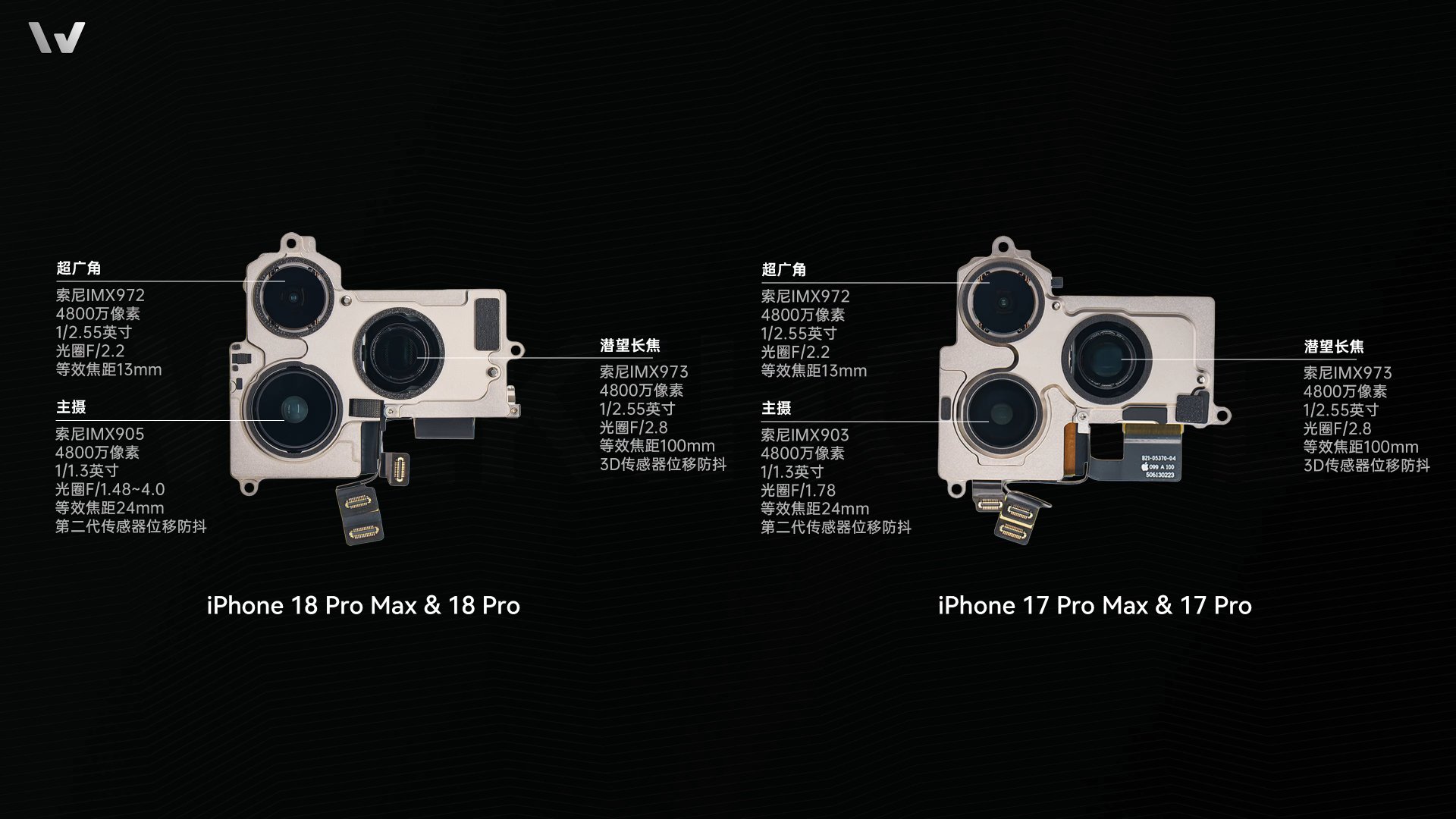
    Comparison of the camera modules of iPhone 18 Pro and iPhone 17 Pro

    What’s inside the camera

    The rear cameras are the same in the iPhone 18 Pro and 18 Pro Max — the teardown author describes them once, for both phones at the same time. Three lenses mounted in a common metal frame, each 48 Mpix:

    CameraSensorSizeApertureFocal length equivalentStabilization
    UltrawideSony IMX9721/2.55″f/2.213 mmnot specified
    MainSony IMX9051/1.3″f/1.48–4.024 mmsecond generation sensor-shift
    PeriscopeSony IMX9731/2.55″f/2.8100 mm3D sensor-shift

    With the ultrawide, nothing is said about stabilization — which means that it is unknown, not that it is absent.
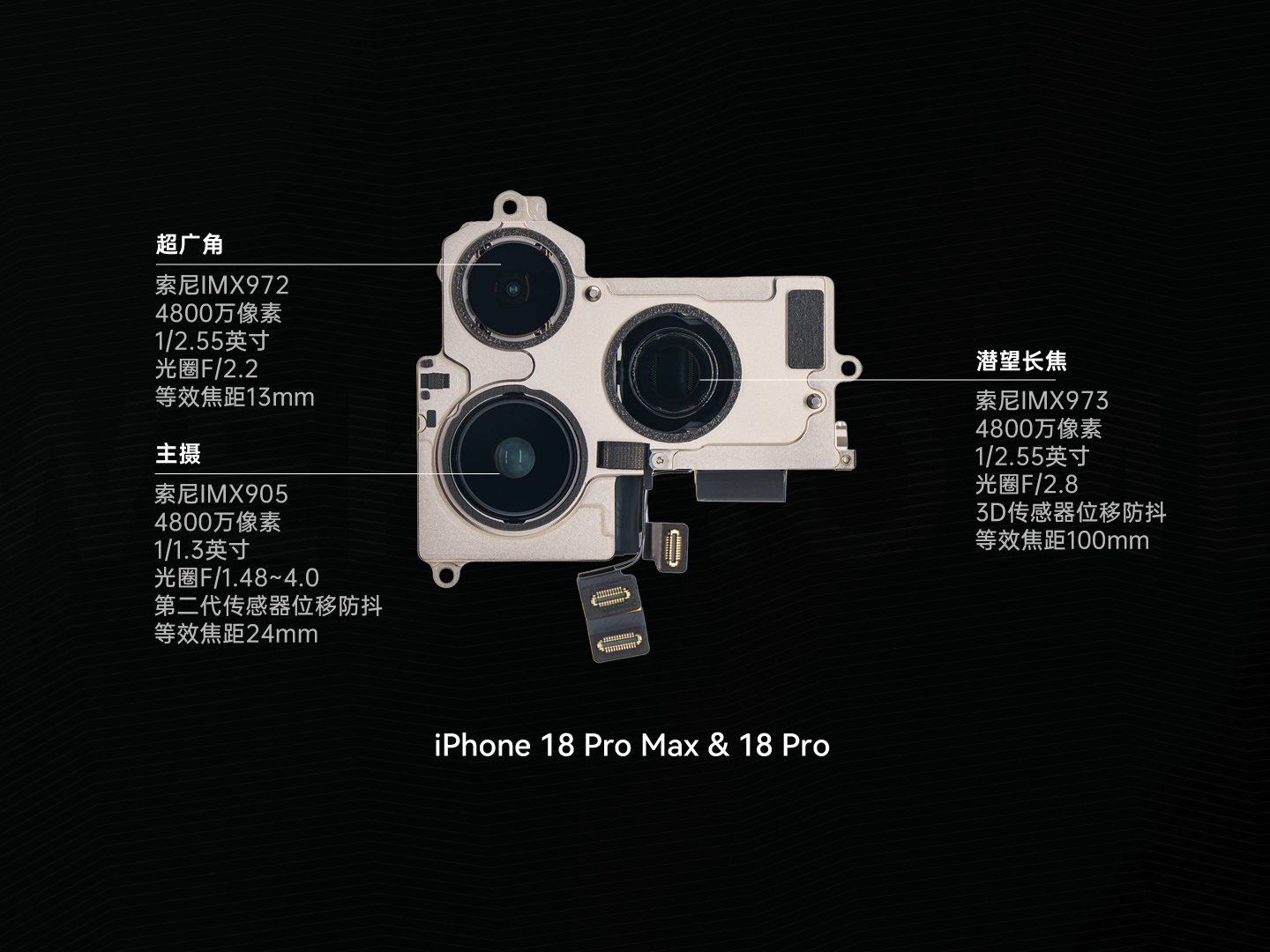
    iPhone 18 Pro rear camera module with sensor descriptions

    Controversy: two of the three cameras are the same as last year

    The author placed the cameras from both generations side by side and described them with the same set of data. In pairs, because the Pro and Pro Max from the given year have the same set:

    iPhone 17 Pro i 17 Pro MaxiPhone 18 Pro i 18 Pro Max
    UltraszerokiSony IMX972, 1/2,55″, f/2,2, 13 mmSony IMX972, 1/2,55″, f/2,2, 13 mm
    PeryskopSony IMX973, 1/2,55″, f/2,8, 100 mmSony IMX973, 1/2,55″, f/2,8, 100 mm
    Główny — matrycaSony IMX903, 1/1,3″, 48 MpixSony IMX905, 1/1,3″, 48 Mpix
    Główny — przysłonastała f/1,78zmienna f/1,48–4,0

    Ultraszeroki i peryskop to dosłownie te same matryce. Ta sama rozdzielczość, ta sama wielkość, ta sama jasność i ten sam ekwiwalent ogniskowej.

    Aparat główny zmienił oznaczenie z IMX903 na IMX905, ale rozbiórka podaje dla obu tę samą wielkość matrycy, 1/1,3 cala, i tę samą rozdzielczość. Serwisy branżowe podają dla siedemnastki dokładniejszą wartość 1/1,28 cala, więc jakaś drobna różnica może istnieć — autor rozbiórki zaokrągla obie tak samo.

    Jedyna prawdziwa różnica to przysłona aparatu głównego.

    Sześć ruchomych listków

    W miejsce stałego otworu f/1,78 Apple włożyło zmienną przysłonę o zakresie f/1,48–4,0. DxOMark opisuje ją jako prawdziwą przysłonę z sześciu ruchomych listków, która otwiera się i zamyka jak w aparacie fotograficznym — na zdjęciach samego mechanizmu nie widać, bo autor nie rozkręcił obiektywu. Przy obiektywie jest tylko suchy podpis: f/1,48–4,0.

    This is not a software trick, but a real mechanism that lets in less or more light. The improvement in the DxOMark score is attributed to this aperture.

    What the range provides:

    • f/1.48 at night — an opening wider than f/1.78 in the predecessor lets in more light; the score in low light went from 143 to 150 points
    • f/4.0 during the day — closing down increases depth of field, allowing for sharpness to be maintained over a larger portion of the frame
    • range instead of a single value for everything — although it is unclear whether the aperture closes smoothly or in steps

    DxOMark Results: Where the Difference is Visible

    CategoryiPhone 17 ProiPhone 18 Pro
    Overall168172
    Video—176 — the highest video score in the entire DxOMark database
    Low Light143150
    Portraits151157
    Zoom135138

    The most significant gains were in low light photos (+7) and portraits (+6), while zoom saw the least improvement (+3), and this is the only camera where the change in aperture does not apply at all. DxOMark does not elaborate on where each of these changes came from, so formally it is a coincidence. However, it is an exceptionally consistent one.

    What DxOMark did not praise

    DxOMark pointed out four issues: color inaccuracies and white balance jumps, weaker zoom at long distances, flares in certain conditions, and brightness differences between photo previews and video. The second point is not surprising, as the periscope remains the same.

    How much do these points really matter

    Before you consider 172 versus 168 as a decisive factor, it’s worth knowing where that number comes from and what it does not show.

    DxOMark makes money from the manufacturers it tests. It sells them the DxO Analyzer software and consulting for camera tuning, and then evaluates the finished phones. In the industry, this is referred to as the «pay to win» problem: those who use DxO’s paid tools perform better in the rankings than those who do not. No one claims that results are purchased. However, it is difficult to maintain independence when the same company first advises and then evaluates.

    Each subsequent generation receives a higher score. This has been visible in the rankings for years, and it is hard not to ask whether the points measure real progress or just grow along with the methodology. Therefore, results from different years cannot be directly compared.

    One number hides all compromises. The overall score is derived from several sub-scores of varying weights, and the media only quotes that. Here, it is exemplified: the eighteen wins in low light photography and portraits, while in zoom it practically stands still. If you mainly shoot with a telephoto lens, this difference does not concern you.

    There was also a loud dispute about independence. When Xiaomi did not send the 12S Ultra model for testing, DxOMark bought a unit on its own and published a review despite the lack of cooperation from the manufacturer.

    The practical conclusion is this: DxOMark points are useful as a hint as to which direction the changes have gone, and here they align with what is seen in the teardown. However, they will not answer the question of whether it is worth replacing the phone. That will only be answered by photos taken in the conditions in which you usually photograph.

    Face ID and LiDAR got more than the camera

    The most changes occurred not in the cameras, but next to them.
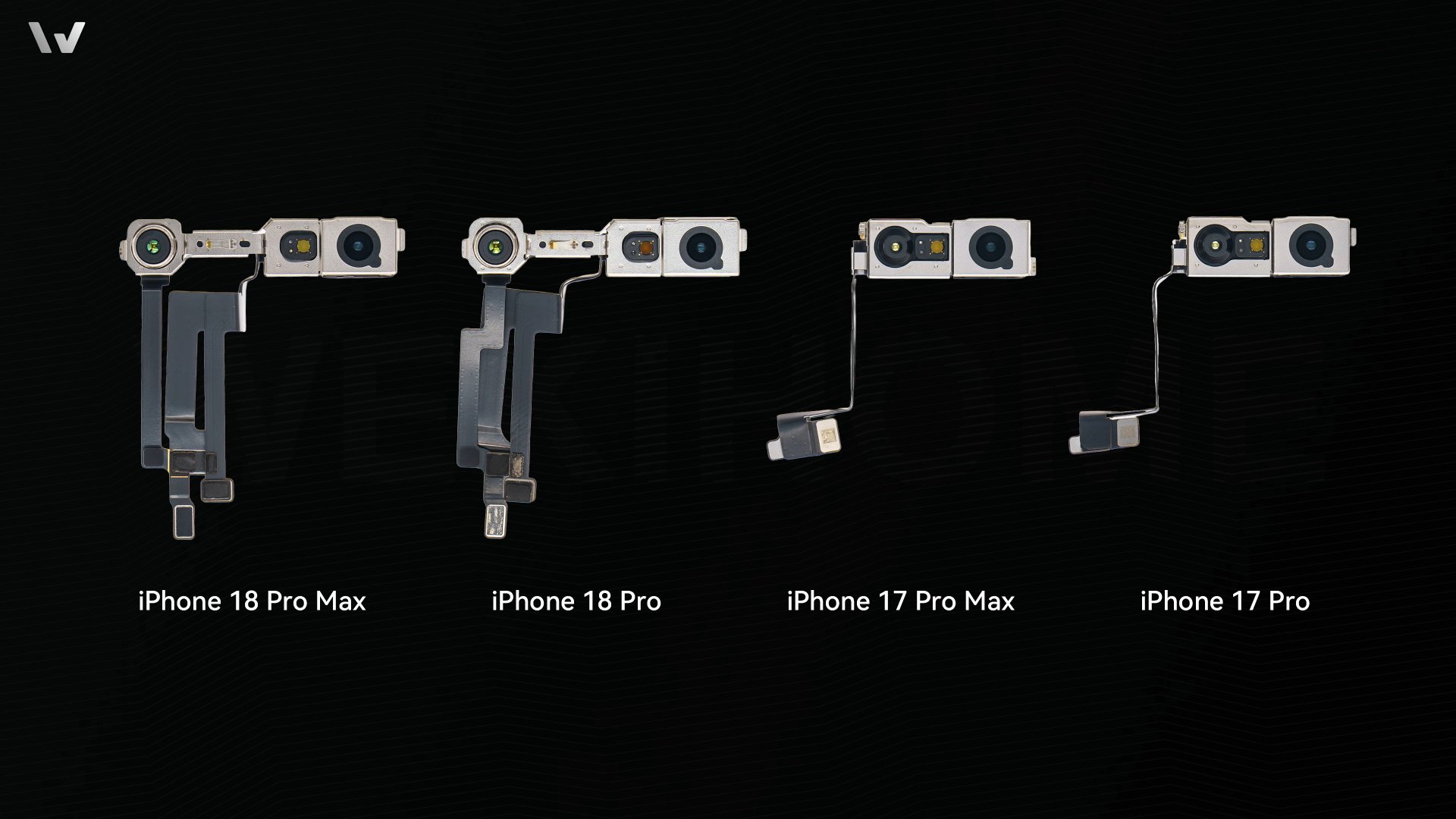
    Face ID modules of four iPhones

    The entire Face ID setup in the eighteen is clearly longer — a wide ribbon with a metal stiffening plate has been added. In the seventeen, everything was tightly packed next to each other; here, the sensor has been moved a considerable distance away from the camera.

    The infrared camera sensor is larger. The author outlined in the photo this part of both sensors that actually collects light — in the eighteen, it is larger and more square.
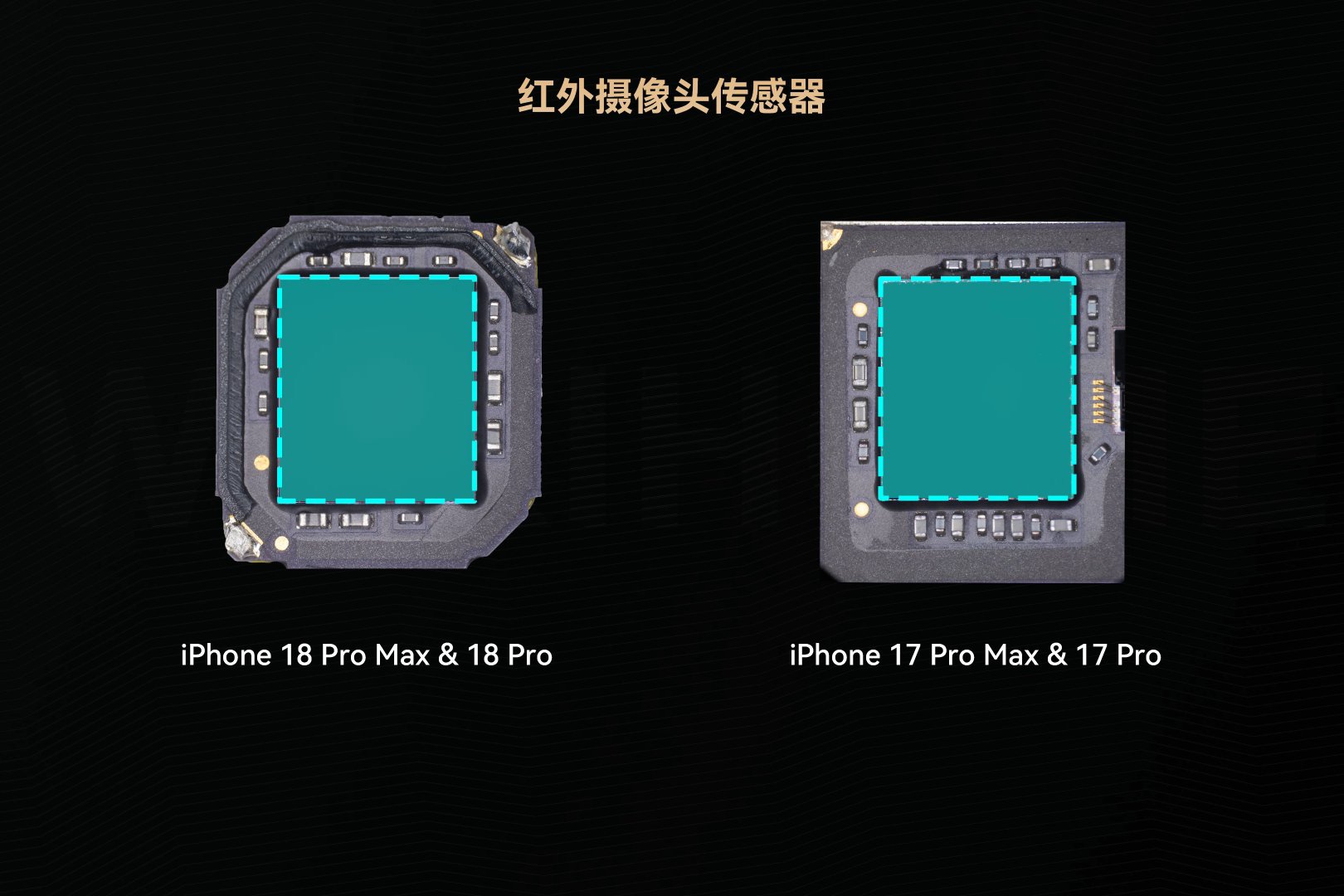
    Comparison of infrared sensors — in the eighteen, the larger part collects light

    The author removed the casings from the dot projector and photographed the bare circuits in magnification. Here, the redesign is also visible: both circuits — the controlling one and the illuminating one — are larger, there are more thin wires connecting them, and they extend from two sides instead of one, with the light points lying more densely.
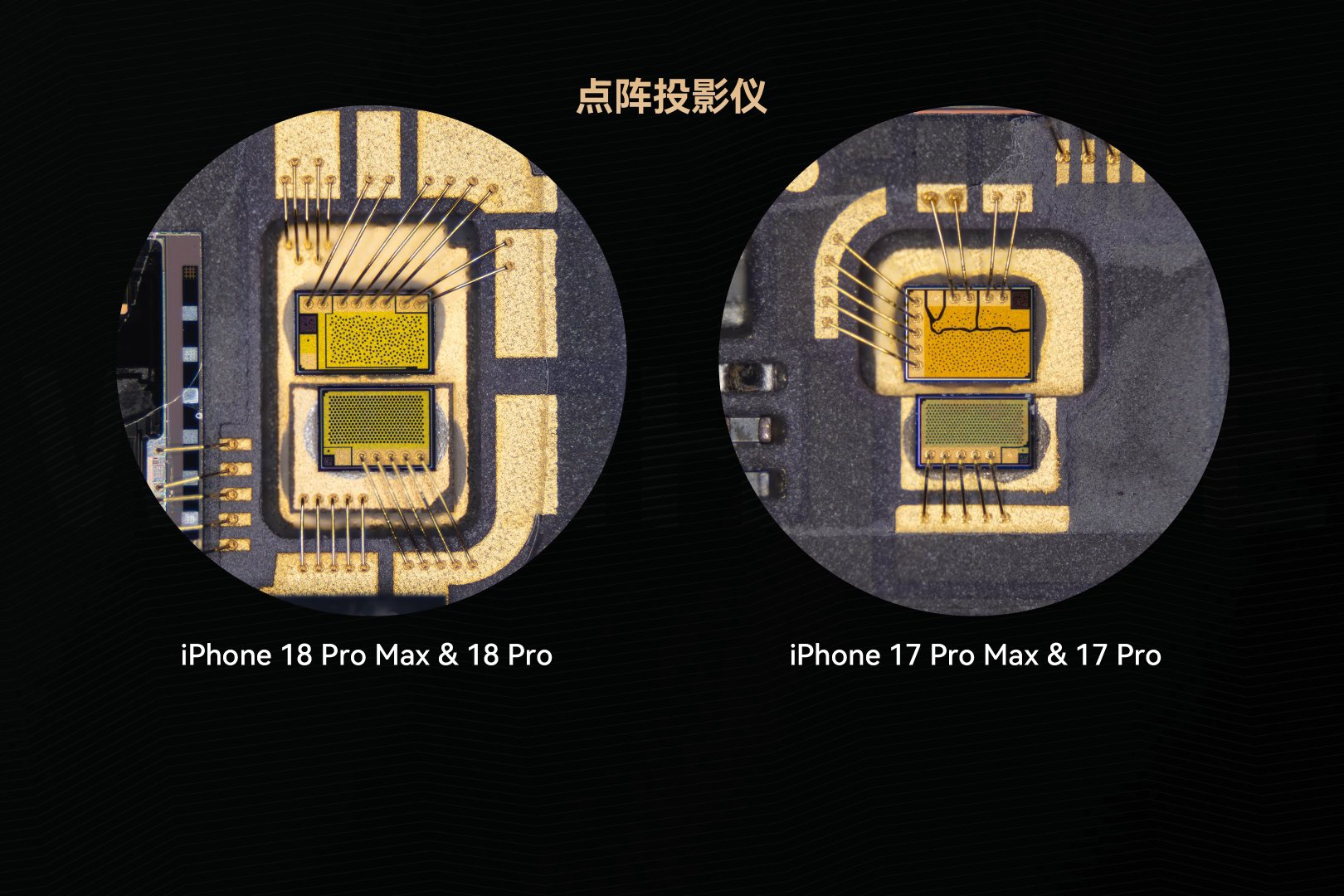
    Dot projector Face ID in magnification

    LiDAR has also increased in size. In the eighteen, it is simply larger, and its transmitter has a larger surface area. The tape markings are 06061-05 in 18 Pro Max and 06060-04 in 18 Pro, compared to 5561-04 and 5371-03 a year earlier.
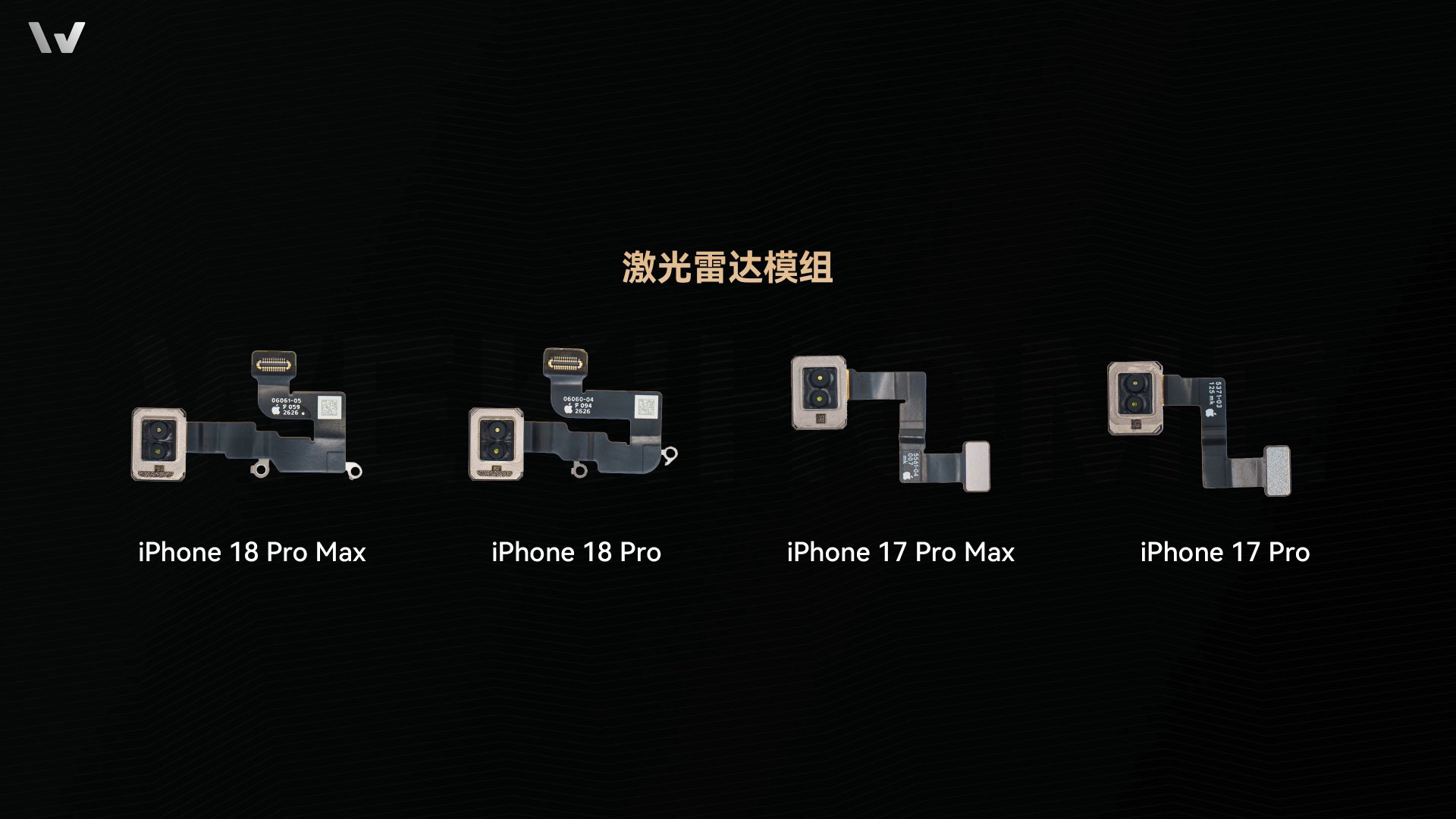
    LiDAR modules of four models

    None of these changes are measured by DxOMark, as they evaluate cameras for photos, not face recognition. How the redesign of the dot projector translates into the speed and effectiveness of Face ID is not determined by the teardown.

    Front camera without revolution

    The selfie is taken by Sony IMX914, 18 Mpix, f/1.9, equivalent to 20 mm — the same data for 18 Pro and 18 Pro Max. The same sensor is attributed to the seventeen by industry services. The comparative photo from the teardown is not labeled; it only shows that both sensors have similarly sized light-collecting parts and differ in casing shape.
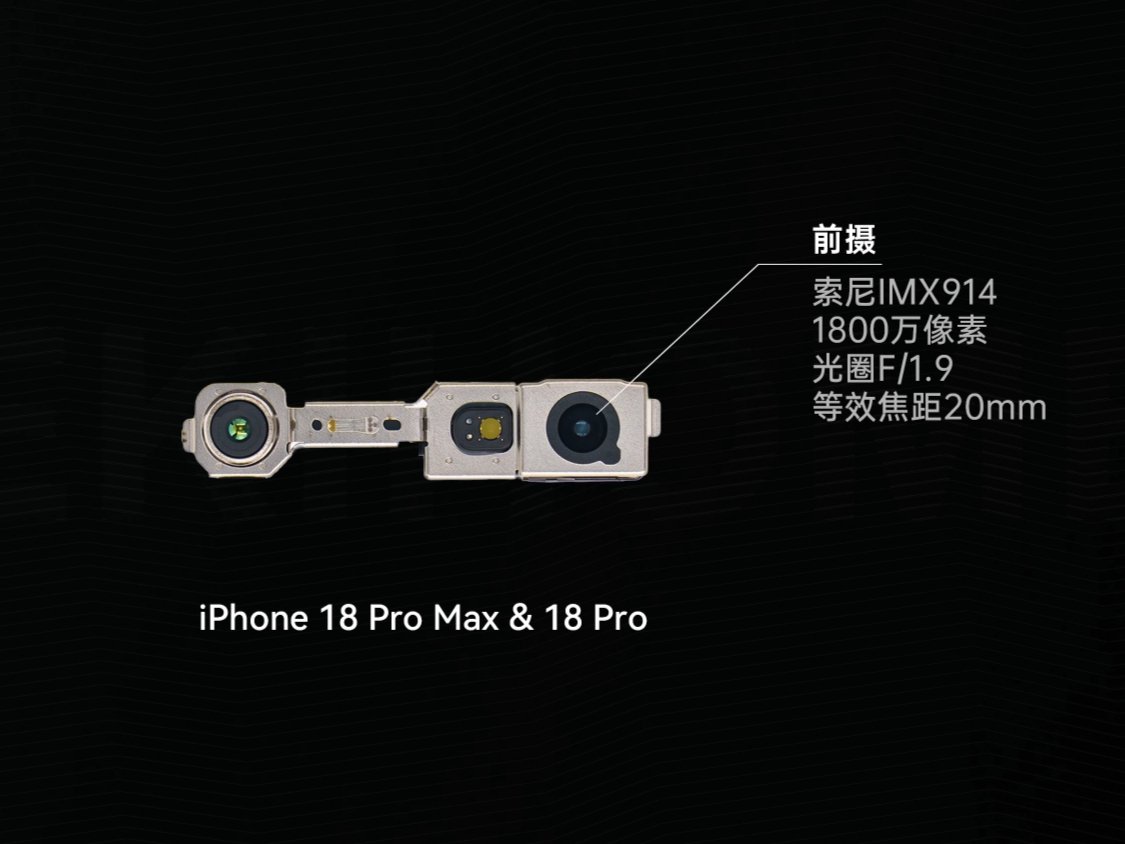
    Moduł aparatu przedniego iPhone 18 Pro

    Co to znaczy przy zakupie ochrony

    Wyspa aparatów w osiemnastce ciągnie się przez całą szerokość pleców. Mieści trzy obiektywy ustawione w trójkąt, lampę błyskową, mikrofon i okienko czujnika.
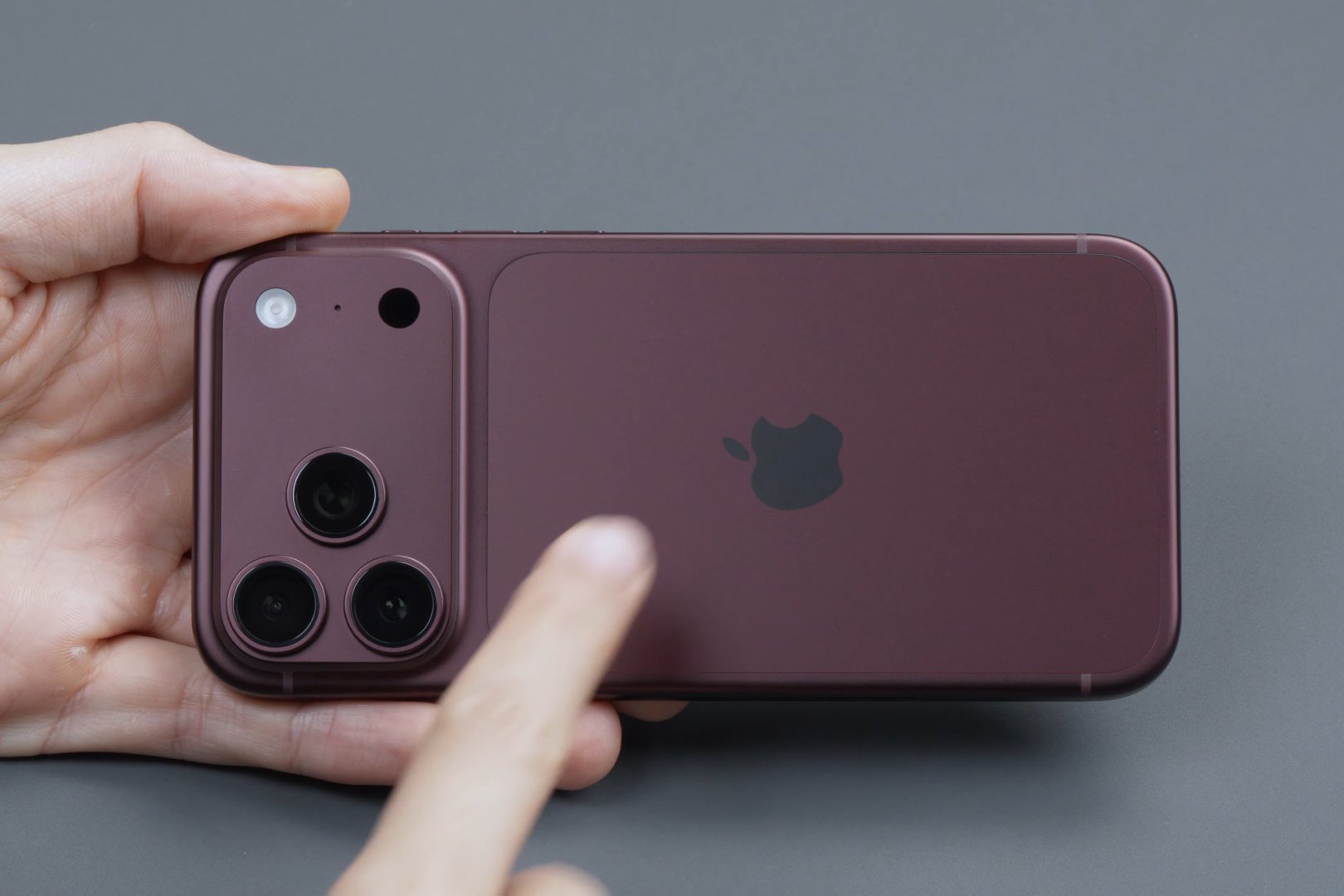
    Plecy iPhone 18 Pro z wyspą aparatów

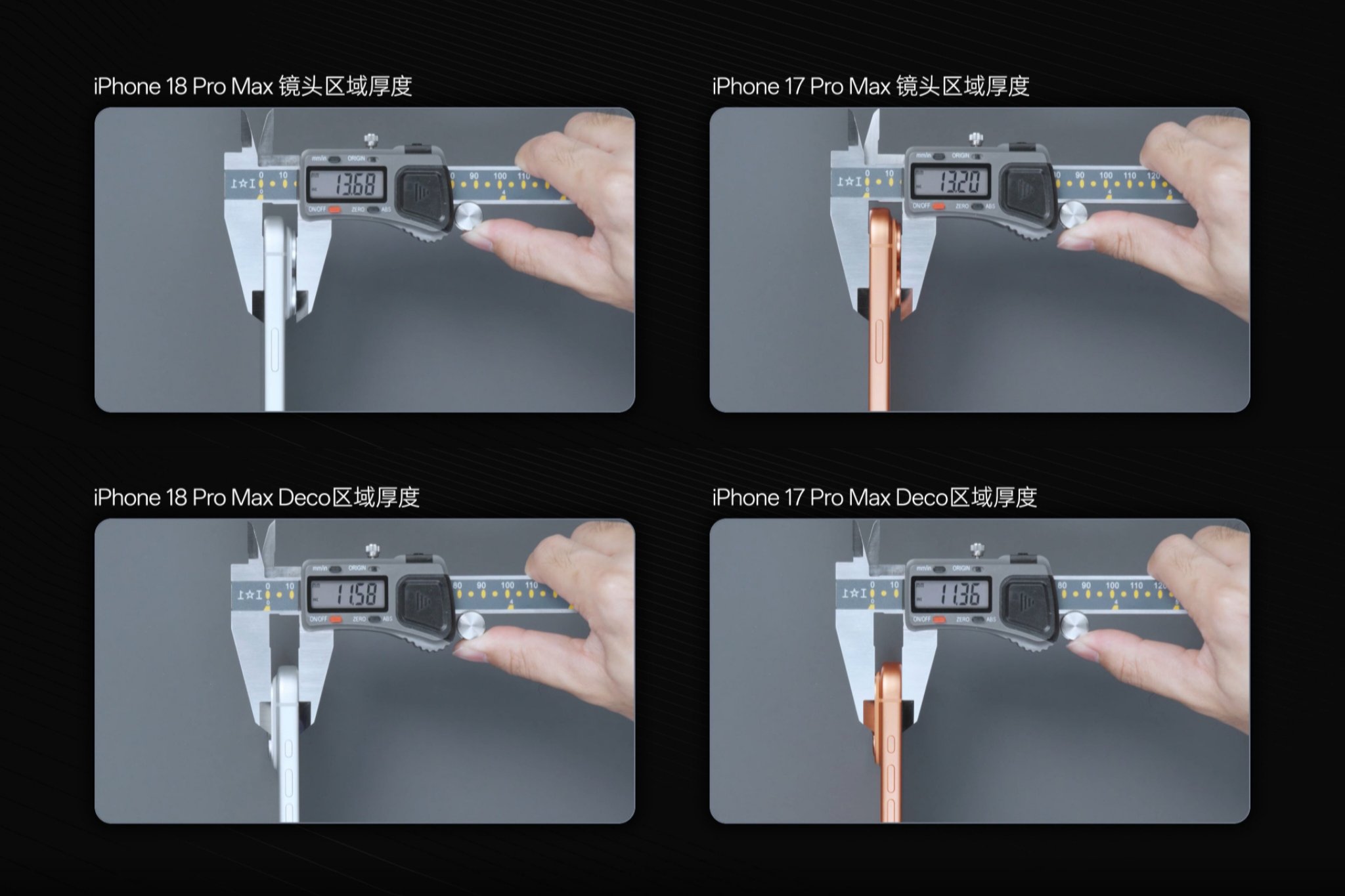
    Na zdjęciach obudów obu generacji widać, że pierścienie wokół obiektywów w osiemnastce są szersze i inaczej rozmieszczone niż w siedemnastce. Ktoś zadał sobie trud i zmierzył to suwmiarką — na egzemplarzach Pro Max:

    Miejsce pomiaruiPhone 17 Pro MaxiPhone 18 Pro Max
    Na obiektywach13,20 mm13,68 mm
    Na samej wyspie11,36 mm11,58 mm
    Pomiar suwmiarką grubości iPhone 18 Pro Max i 17 Pro Max

    The island has grown by 0.22 mm, and together with the protruding lenses by almost half a millimeter. The measurement was taken on larger models, but the back construction is the same in both variants. It sounds like nothing, but the camera cover is a precisely fitted element — half a millimeter is the difference between a cover that sits evenly and one that wobbles on the edge or doesn’t fit at all. In our store, the covers for both generations are separate products, and that’s why.

    A small tip when choosing, by the way universal: covers that hold onto the ring around the lens are easier to remove than those that stick directly to the glass — less risk of scratching something.

    And one caveat: the flares mentioned by DxOMark are a feature of the camera itself, tested without any additions. The laboratory did not check the covers and does not comment on how they affect the photos.

    If you have the seventeenth, the correct categories are camera glass for iPhone 17 Pro and iPhone 17 Pro Max — these are separate shelves. For the eighteenth, the fitting covers are camera covers for iPhone 18 Pro and iPhone 18 Pro Max.

    You can find the full selection of accessories in the categories iPhone 17 Pro and iPhone 18 Pro.

    Summary

    In the iPhone 18 Pro the better result does not come from changing the sensors. The ultra-wide and periscope remain the same, the main camera has changed its designation while maintaining the same size and resolution, and the only real change is the aperture f/1.48–4.0. The new model debuts in second place in the ranking, while its predecessor is currently in fifth.

    However, the most changes have occurred where DxOMark does not look at all: in Face ID and LiDAR.

    And the points themselves should be taken with a grain of salt. They indicate the direction of changes, but they cannot replace viewing photos from the phone that you actually use.

    FAQ — frequently asked questions

    What camera does the iPhone 18 Pro have?

    Three sensors of 48 Mpix: ultra-wide Sony IMX972 (f/2.2, equivalent to 13 mm), main Sony IMX905 (1/1.3″, variable aperture f/1.48–4.0, equivalent to 24 mm) and periscope Sony IMX973 (f/2.8, equivalent to 100 mm). The front camera is Sony IMX914 18 Mpix f/1.9. The same set goes to the 18 Pro Max.

    How many DxOMark points does the iPhone 18 Pro have?

    172 points and second place in the global ranking, behind the Huawei Pura 80 Ultra with 175. The iPhone 17 Pro has 168 points and occupies the fifth position. It is worth remembering that DxOMark sells tools and consulting to manufacturers for tuning cameras, so the ranking is sometimes criticized for a lack of independence.

    What is the difference between the iPhone 18 Pro camera and the 17 Pro?

    Właściwie jedną: aparat główny ma zmienną przysłonę f/1,48–4,0 zamiast stałej f/1,78. Matryca główna zmieniła oznaczenie (IMX903 → IMX905) przy tej samej wielkości i rozdzielczości, a ultraszeroki i peryskopowy to te same matryce, co w poprzedniej generacji.

    Co to jest zmienna przysłona w iPhone 18 Pro?

    Mechanizm zmieniający wielkość otworu obiektywu w zakresie od f/1,48 do f/4,0 — DxOMark opisuje go jako fizyczną przysłonę z sześciu ruchomych listków, jak w aparacie fotograficznym. Szerzej otwarta przepuszcza więcej światła po zmroku, przymknięta daje większą głębię ostrości.

    Czy szkło na aparat z iPhone 17 Pro pasuje do 18 Pro?

    Nie. Wyspa aparatu w osiemnastce jest grubsza — 11,58 mm wobec 11,36 mm, a licząc z wystającymi obiektywami 13,68 wobec 13,20 mm. Do tego pierścienie wokół obiektywów są szersze i inaczej rozmieszczone. Potrzebne będzie szkło dedykowane nowemu modelowi.

    Czy można wierzyć wynikom DxOMark?

    Z zastrzeżeniami. DxOMark sprzedaje producentom oprogramowanie i doradztwo przy strojeniu aparatów, a potem ocenia gotowe telefony — branża zarzuca temu brak niezależności. Do tego każda kolejna generacja dostaje wyższą notę, więc wyniki z różnych lat trudno zestawiać wprost, a jedna liczba ukrywa wszystkie kompromisy między kategoriami. Traktuj punkty jako wskazówkę, w którą stronę poszły zmiany, a nie jako werdykt.

    Does the iPhone 18 Pro have better zoom than the 17 Pro?

    Minimal: 138 points versus 135. The periscope uses the same Sony IMX973 sensor with the same f/2.8 aperture, so there has been no hardware change here, and DxOMark does not explain the reasons for these three points. The lab also pointed out weaker zoom at long distances.

    Is Face ID on the iPhone 18 Pro better?

    Hardware-wise, yes: the infrared camera sensor collects light from a larger area, and the dot projector has been redesigned — its components are larger, and the dots are more densely packed. However, the teardown does not indicate how this translates to speed or effectiveness of recognition.
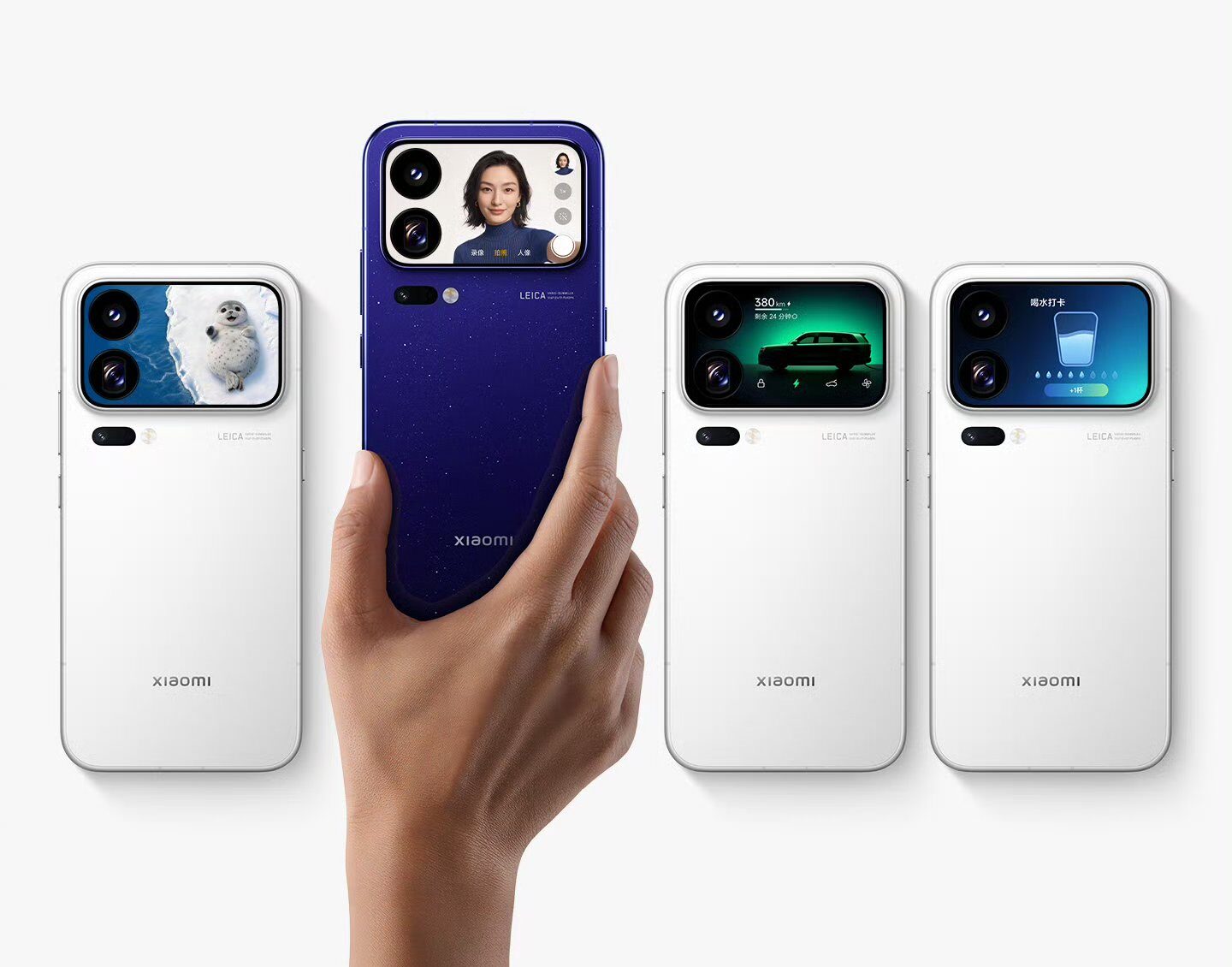
  • Xiaomi 18 Pro and 18 Pro Max — screen on the back, Leica optics, and premiere on September 23

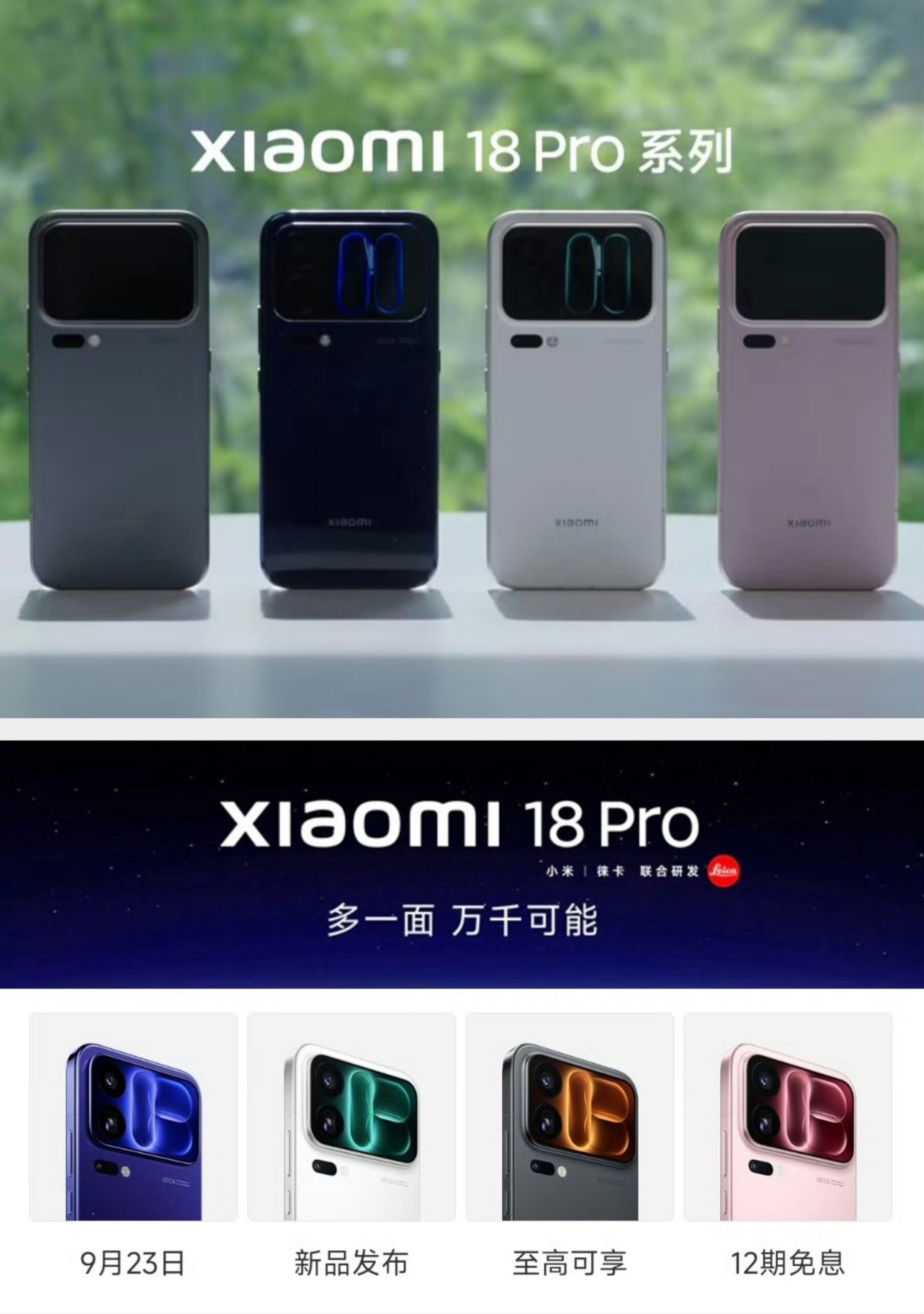
    Xiaomi 18 Pro and 18 Pro Max — screen on the back, Leica optics, and premiere on September 23

    Xiaomi will showcase the 18 Pro series on Wednesday, September 23, 2026, at 7:00 PM Chinese time — which is 1:00 PM in Poland. The date appears on the poster for the autumn conference that has surfaced online, and the entire campaign revolves around one thing: a touch screen built into the camera island.

    The slogan of the campaign is «one more side, thousands of possibilities.»

    Note: the article was created before the presentation. It is based on promotional materials that leaked online before the premiere — they appear to have been prepared by Xiaomi, but the manufacturer has not officially published them. Treat all numbers as highly probable, unconfirmed. Certainty will come on September 23.

    Screen on the back, so what’s really going on here

    The camera island is a wide, horizontal rectangle with rounded corners. On the left side sit two large lenses stacked one above the other, while the entire right side is occupied by a colorful, touch display. Below the island, already outside of it, there is an elongated module with a third eye and a flash LED.

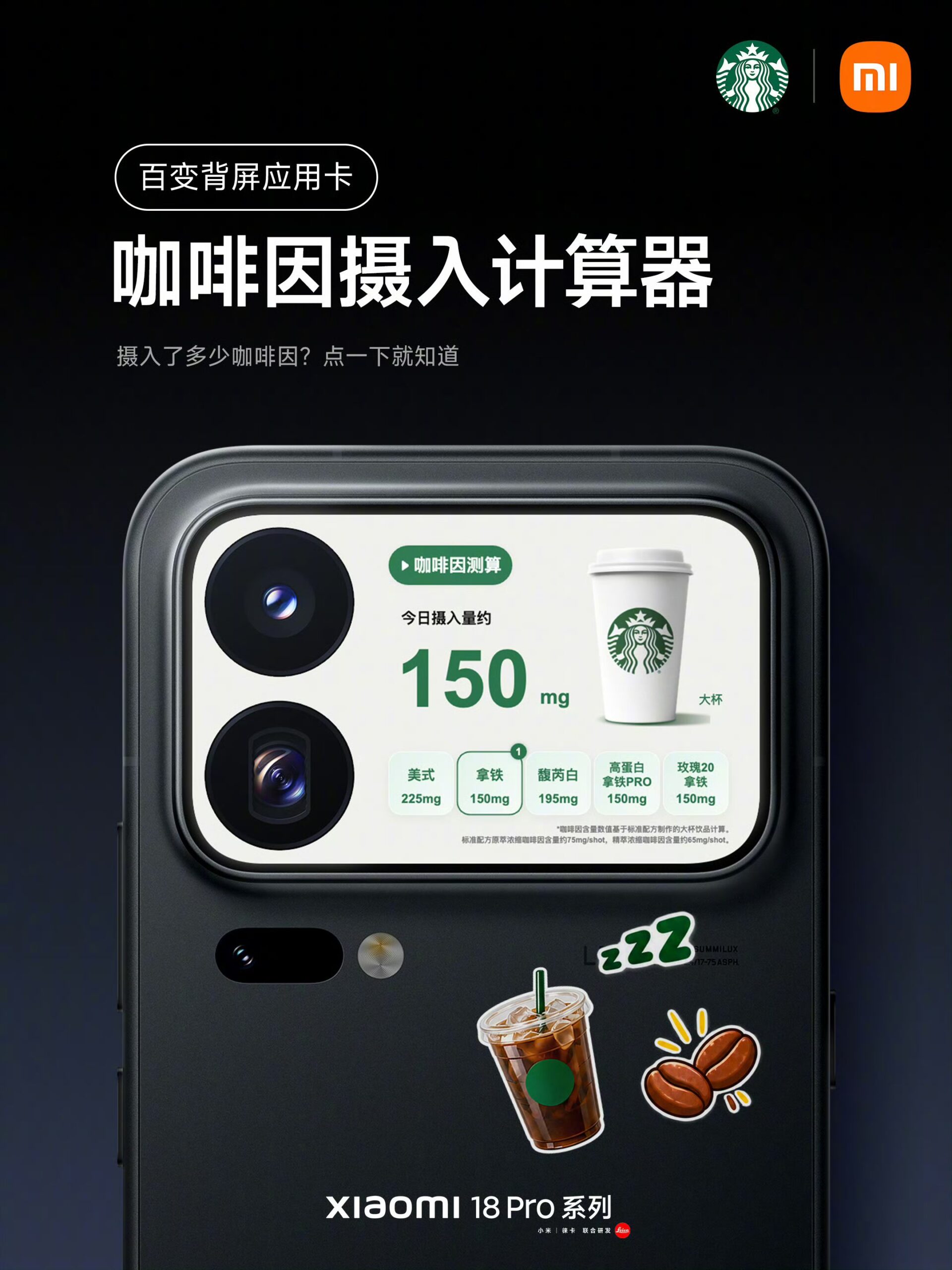
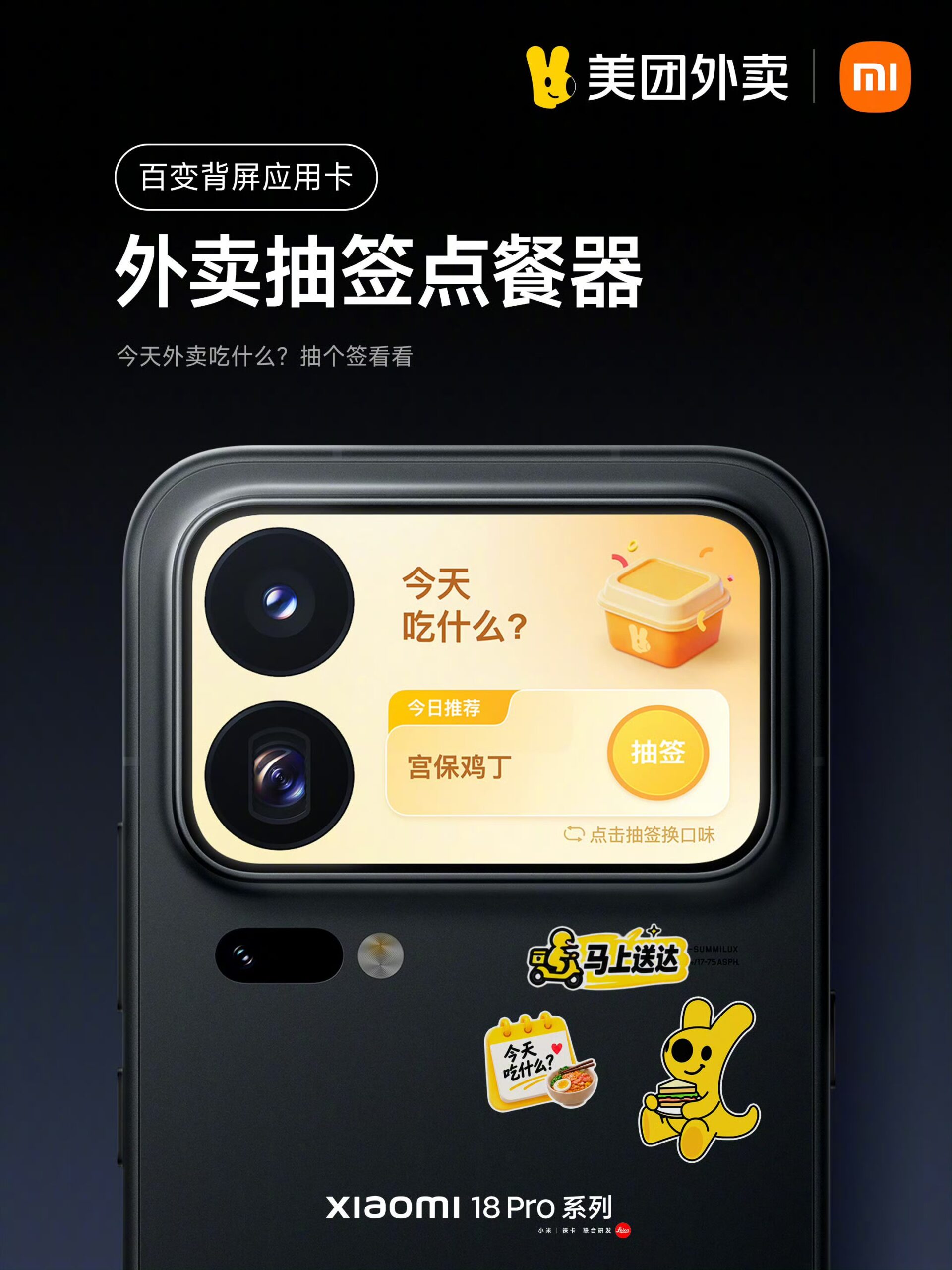
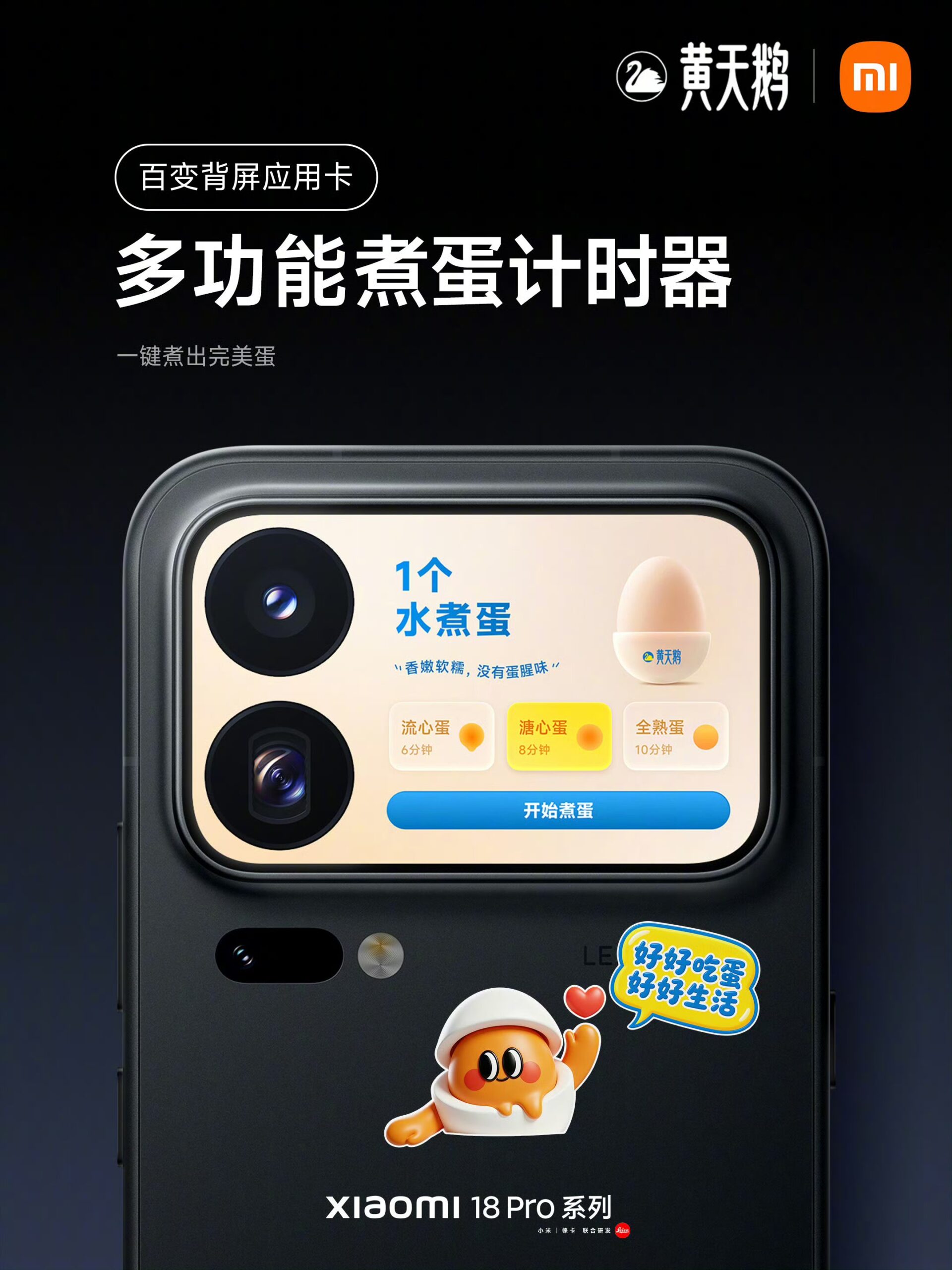
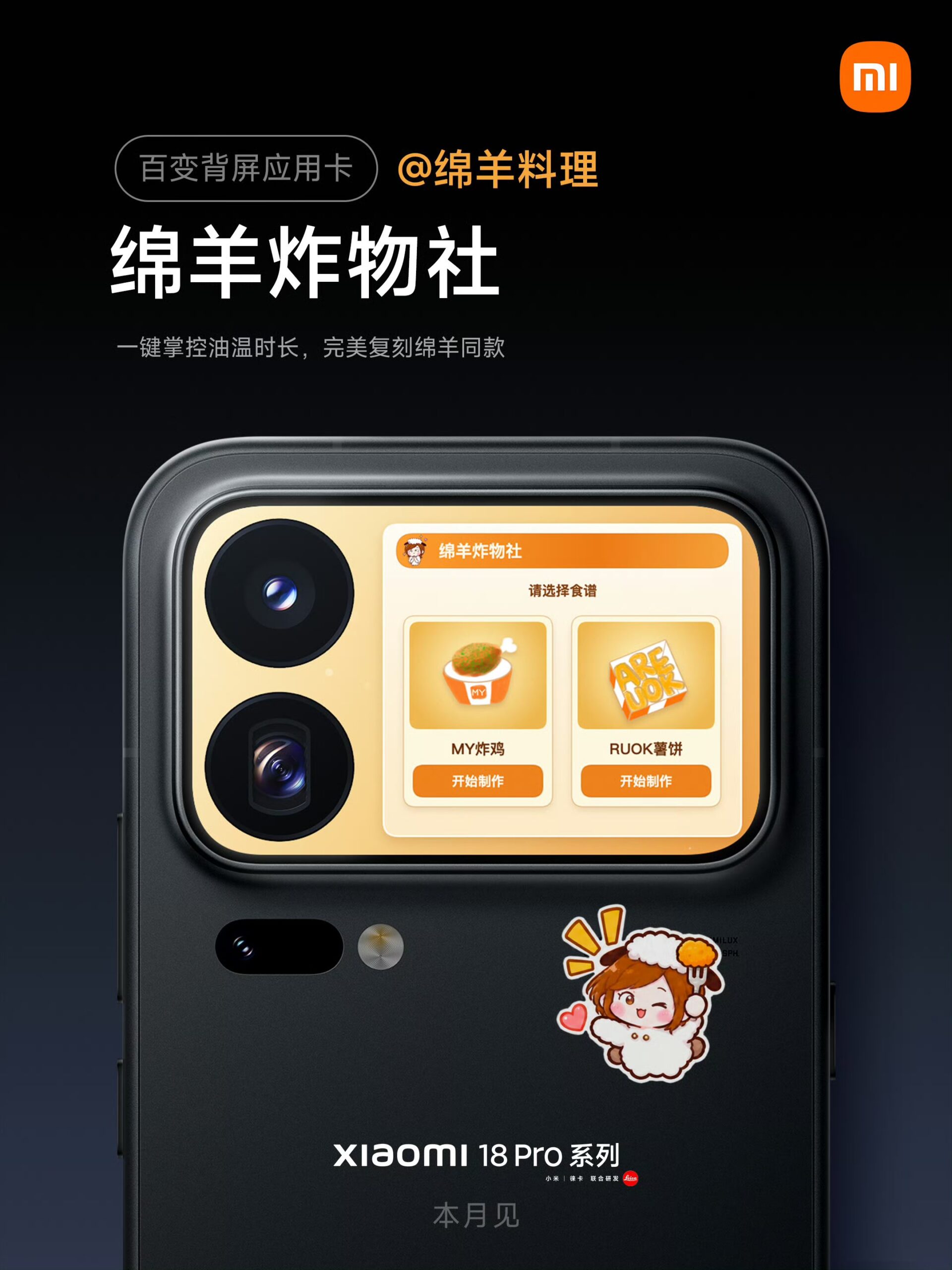
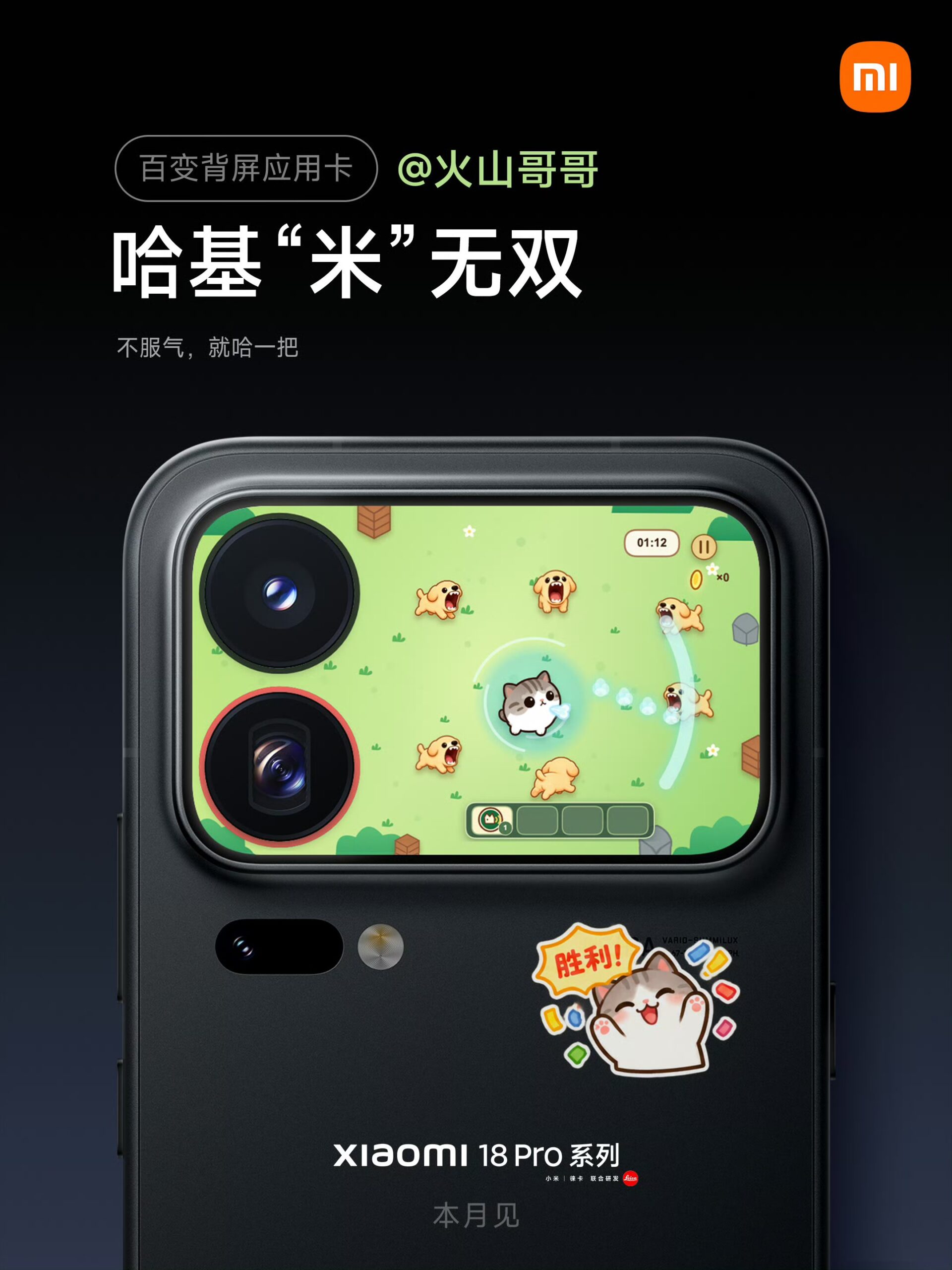
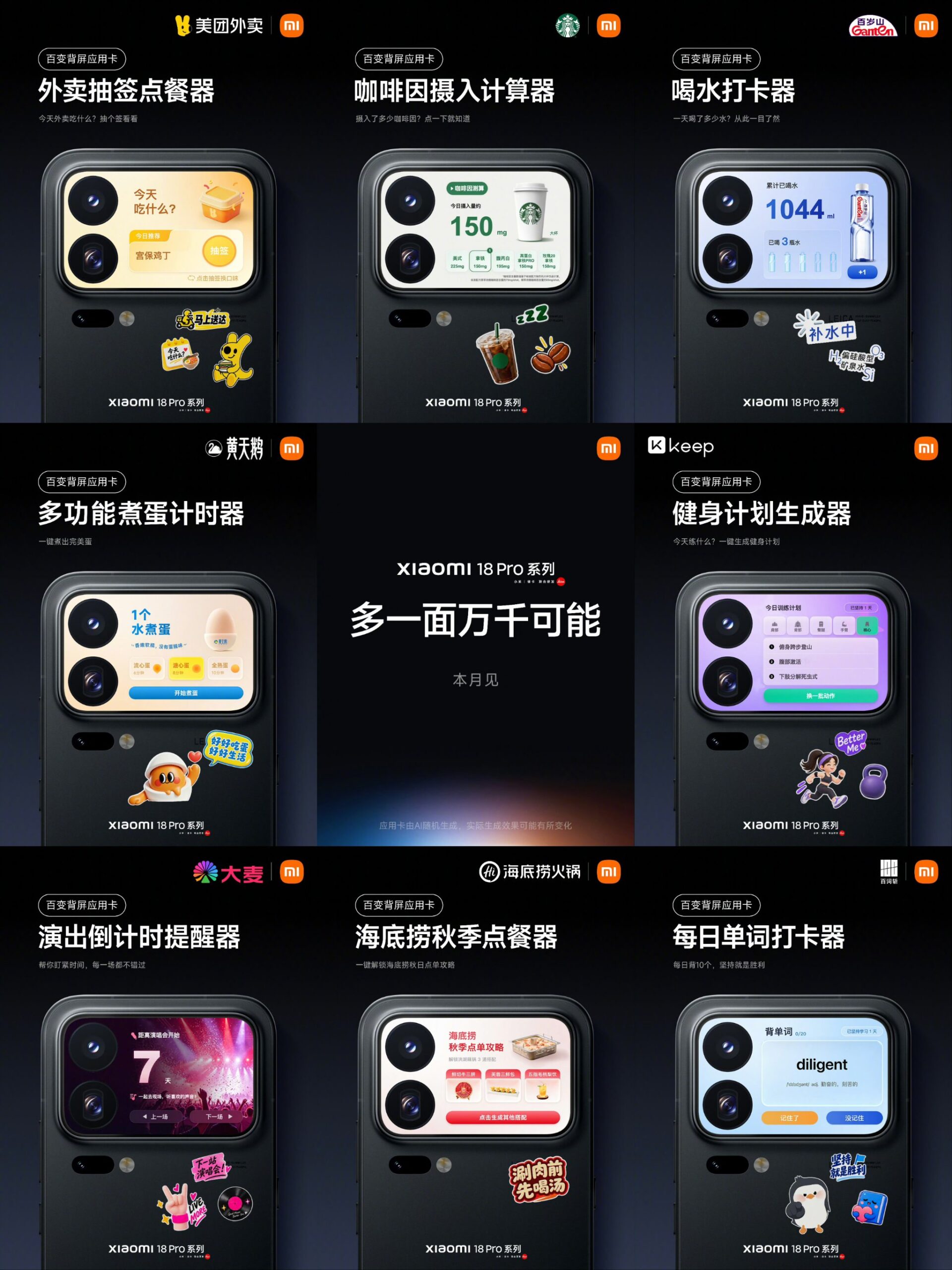
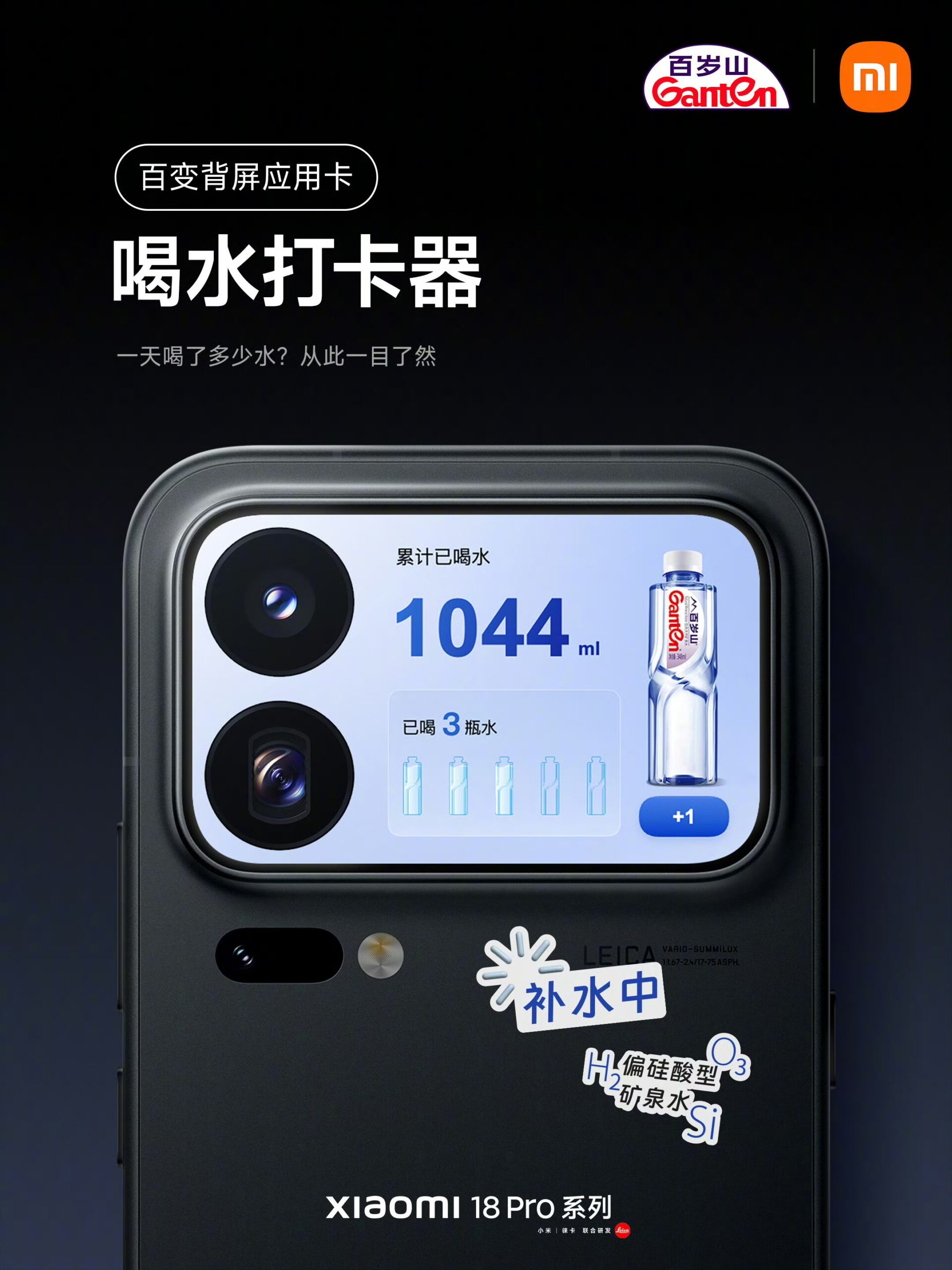
    Xiaomi calls this feature application cards on the rear screen. It is not a decorative element showing the time — although Xiaomi itself notes in fine print that the content of the cards in the promotional graphics is generated by AI, and the images are for illustrative purposes. In the shown graphics, the screen supports among others:

    • water intake counter with a “+1 glass” button,
    • minutnik do jajek z trzema trybami: 6 minut na płynne żółtko, 8 na półpłynne, 10 na twarde,
    • kalkulator kofeiny — Americano 225 mg, Flat White 195 mg, Latte 150 mg,
    • timer pomodoro z sesją 25 minut, z pauzą obsługiwaną wprost z pleców telefonu,
    • odliczanie dni do koncertu, kartę zamówienia jedzenia i losowanie zestawu ćwiczeń.
    Teaser serii Xiaomi 18 Pro: tapeta na tylnym ekranie zmienia się jak karuzela.

    Platforma jest otwarta na zewnętrznych partnerów: na materiałach widać osiem kart, w tym Starbucks, Haidilao, Meituan, Keep i Damai, a do tego karty przygotowane przez twórców internetowych.

    Drugie zastosowanie jest prostsze i pewnie ważniejsze na co dzień: ekran działa jako podgląd do selfie robionego głównym aparatem, z trybami wideo, zdjęcie i portret. Xiaomi zastrzega przy tym w drobnym druku, że postać na pokazowym selfie oraz zawartość karty z licznikiem wody zostały wygenerowane przez AI, a grafiki są poglądowe.

    Wszystko może trafić na tylny ekran

    Osobna gałąź kampanii — pod hasłem „wszystko może trafić na tylny ekran» — pokazuje ekran jako miejsce na animowaną maskotkę. Zestaw licencji robi wrażenie w Chinach: postacie z „Battle Through the Heavens», eksponaty z chińskiego programu telewizyjnego „Skarby narodowe» (figura oficera z dynastii Qin, maska z brązu z Sanxingdui, ceramiczne figurki z okresu Wei Północnej), a z zachodniej klasyki Van Gogh i „Dziewczyna z perłą».

    You can also upload a photo of your pet — the system recognizes its features and builds an animated character from them.

    3D animated figures on the back screen — from Xiao Yan to «Girl with a Pearl Earring».
    Uploaded pet photo turns into an animated mascot on the back of the phone.
    Application cards on the back screen of Xiaomi 18 Pro — comparison

    AI attaches someone to the photo who wasn’t with you

    The second feature that has its own teaser is AI group photo. The slogan is «take a group photo with everything you dream of». In the video, a photo of a person and a character from a game merge into one shot, where both pose side by side.

    Teaser funkcji AI wspólne zdjęcie — dwa osobne kadry scalone w jeden.

    Ekran, którego sąsiad w metrze nie przeczyta

    Dzień po plakacie specyfikacyjnym Xiaomi pokazało kolejną funkcję serii: ekran prywatyzujący. Nie działa tak, jak folie prywatyzujące, które przyciemniają cały wyświetlacz. Tutaj czernieją wybrane prostokąty, a reszta ekranu zostaje jasna i czytelna.

    Film pokazuje to w pięciu sytuacjach. W metrze przychodzi powiadomienie i z boku widać w jego miejscu czarny prostokąt, podczas gdy zegar, widżety i tapeta pozostają widoczne. W kawiarni aplikacja do zamawiania kawy jest w pełni czytelna, a unoszące się nad nią okienko czatu czarne. W biurze przy podzielonym ekranie jedna połówka jest zaczerniona, druga, z notatkami, całkowicie normalna. Na ekranie blokady jedno powiadomienie z listy znika pod czarnym paskiem, sąsiednie zostają.

    Ekran prywatyzujący w serii Xiaomi 18 Pro: czernieją pojedyncze fragmenty, nie cały wyświetlacz.

    Protection is set individually for each application, and it can be activated in two ways. On the left edge of the phone, there is an orange AI button that can be assigned to turn on protection with one click. The second way is a voice command to the Xiao AI assistant, and it’s not a one-time command, but conditional: “when arriving at the office, turn on protection in messengers,” “when returning home, turn off all protection.” The fine print states that such rules are configured in the expert mode of the assistant.

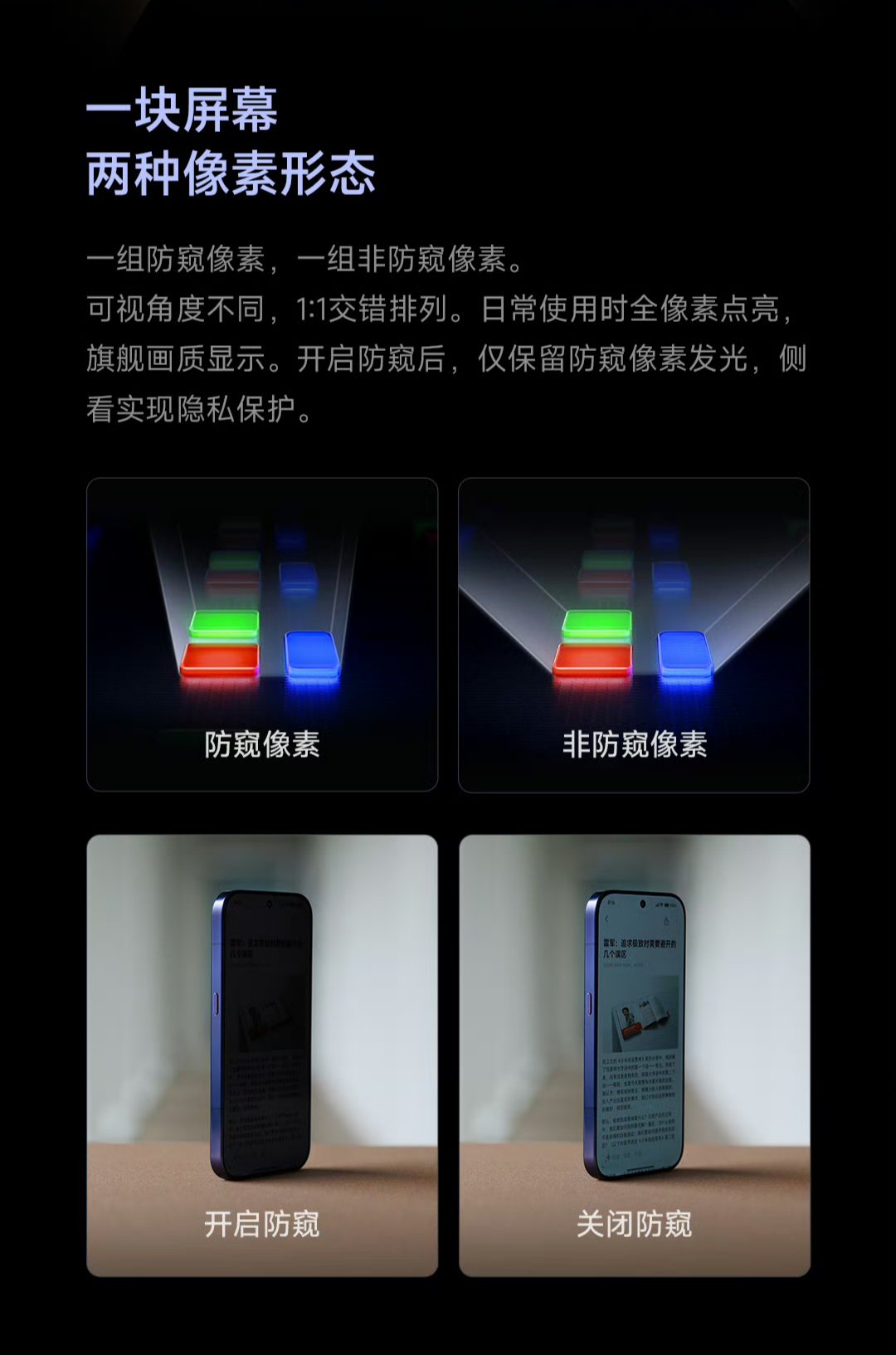
    Xiaomi also described how it works, and it is not an overlay or software mode. In the panel, there are two types of pixels — privacy and regular — arranged alternately in a 1:1 ratio. They differ in the angle at which they emit light: the regular one spreads it in a wide cone to the sides, while the privacy one emits a narrow column straight ahead. On a daily basis, all of them light up, and when protection is activated — only the privacy ones.

    Two types of pixels in the Xiaomi 18 Pro screen — privacy and regular, arranged alternately 1:1
    Two types of pixels in the Xiaomi 18 Pro screen — privacy and regular, arranged alternately 1:1

    Xiaomi also mentions privacy films: they work like micro-blinds, thus reducing brightness, distorting the image, and straining the eyes. The manufacturer claims that the quality does not decrease because each pixel retains a full set of RGB subpixels regardless of the mode. It sounds reasonable, but it is still a manufacturer’s declaration, not a measurement.

    The same principle is applied by Galaxy S26 Ultra. Samsung calls it Flex Magic Pixel and also divides pixels into two types, narrow and wide. The difference lies in what each manufacturer has published: Samsung provided measured angles — at 45 degrees, the side brightness drops to 3.5 percent, at 60 below one. Xiaomi did not provide a single degree, only showing images of the screen viewed from the side.

    Specification from the leaked poster

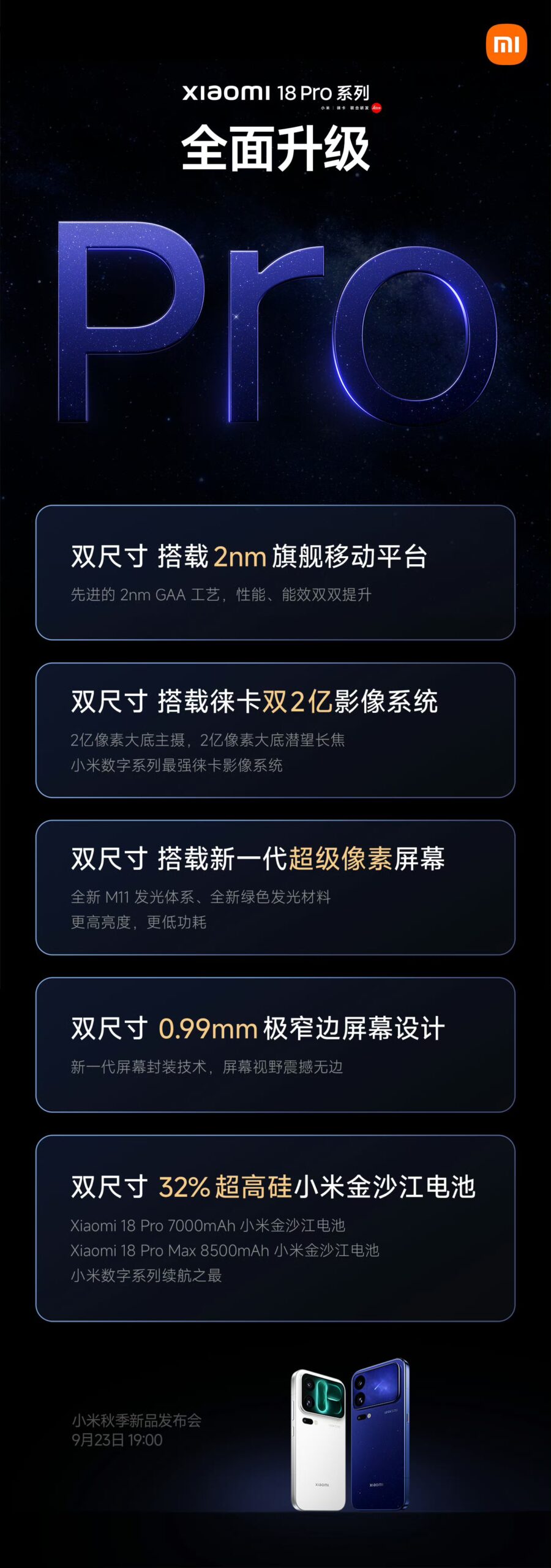
    A poster titled “upgrade in every field” is circulating online, attributed to Xiaomi. Each of its points is marked with the note “both sizes” — the parameters refer to both models, which the poster mentions by name.“both sizes”: Xiaomi has been talking about two models from the start and mentions them by name on the same poster.

    ParameterXiaomi 18 ProXiaomi 18 Pro Max
    Battery7000 mAh8500 mAh
    CellXiaomi “Jinshajiang”, 32% siliconXiaomi “Jinshajiang”, 32% silicon
    ProcessorSnapdragon 8 Elite Gen 6 (2 nm)Snapdragon 8 Elite Extreme Gen 6 (2 nm)
    Main camera200 Mpix, large sensor200 Mpix, large sensor
    Telephoto lensperiscope 200 Mpix, large sensorperiscope 200 Mpix, large sensor
    Screen“super pixel”, emission M11“super pixel”, emission M11
    Screen frame0.99 mm0.99 mm

    The poster calls this set of cameras the most powerful Leica system in the numerical series of Xiaomi, and the batteries — the longest-lasting in this series. Regarding the screen, it mentions the new M11 emission system and a new green emission material: higher brightness with lower energy consumption.

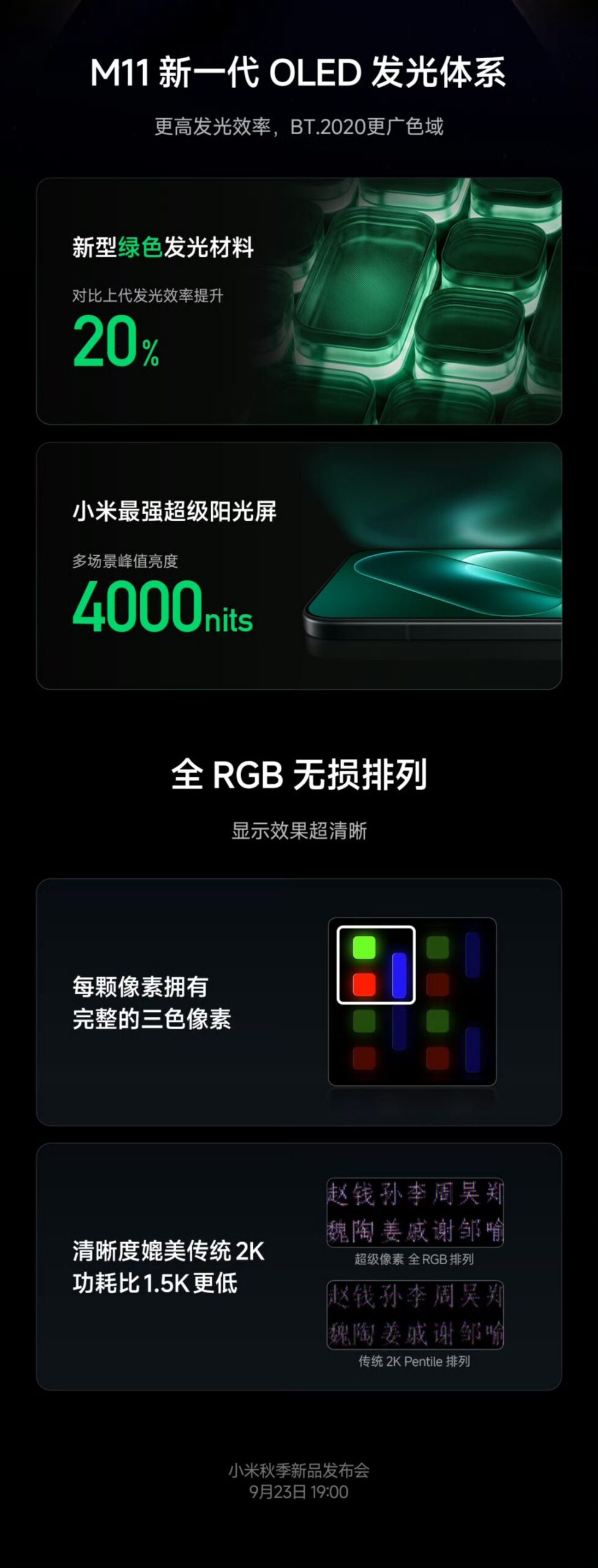
    A separate graphic adds the screen parameters. The peak brightness is expected to reach 4000 nits, and the new green emission material is said to increase the luminous efficiency by 20 percent compared to the previous generation. Additionally, there is a BT.2020 gamut and a pixel arrangement where each pixel has a complete set of RGB subpixels — Xiaomi compares it to the classic Pentile and claims that the sharpness rivals 2K screens with lower power consumption than 1.5K. The manufacturer does not specify the resolution in pixels.

    Screen parameters of the Xiaomi 18 Pro series — 4000 nits peak brightness and full RGB arrangement
    Screen parameters of the Xiaomi 18 Pro series — 4000 nits peak brightness and full RGB arrangement

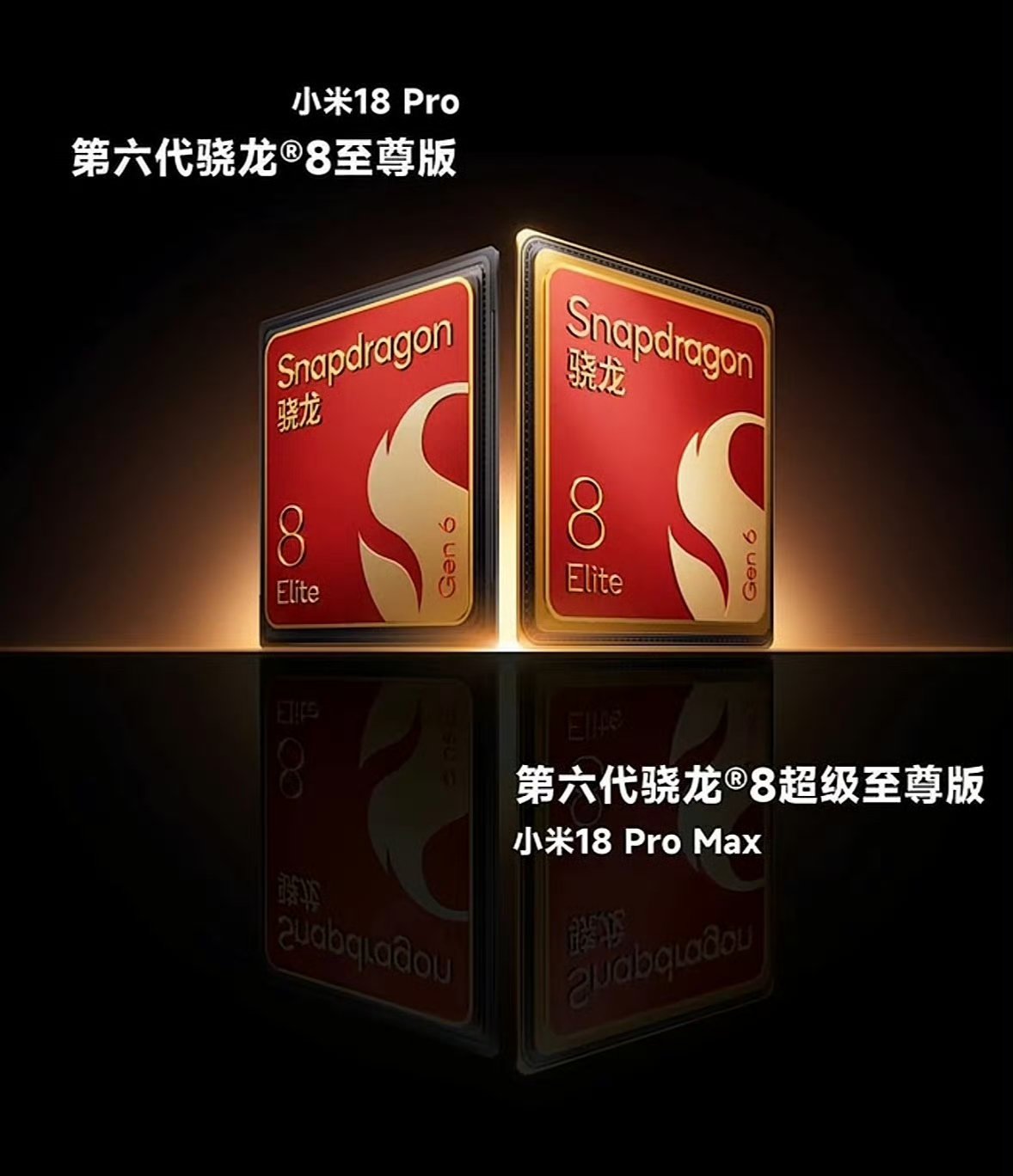
    Separate graphics clarify the matter that the specification poster was silent about: each model gets a different layout. The Xiaomi 18 Pro features Snapdragon 8 Elite Gen 6. The Xiaomi 18 Pro Max — a more powerful Snapdragon 8 Elite Extreme Gen 6 (SM8975). It’s worth knowing this, as older leaks referred to this chip as «Gen 6 Pro» — that was a placeholder name that Qualcomm ultimately replaced with the Extreme designation. An entry in the Geekbench database from September 16 showed a unit with 16 GB of memory, two cores clocked up to 5.01 GHz, and HyperOS 4 on Android 17.

    Processors of the Xiaomi 18 Pro series — Snapdragon 8 Elite Gen 6 in Pro and Elite Extreme Gen 6 in Pro Max
    Processors of the Xiaomi 18 Pro series — Snapdragon 8 Elite Gen 6 in Pro and Elite Extreme Gen 6 in Pro Max
    Leaked infographic with the specification of the Xiaomi 18 Pro series

    Frame narrower by 0.19 mm

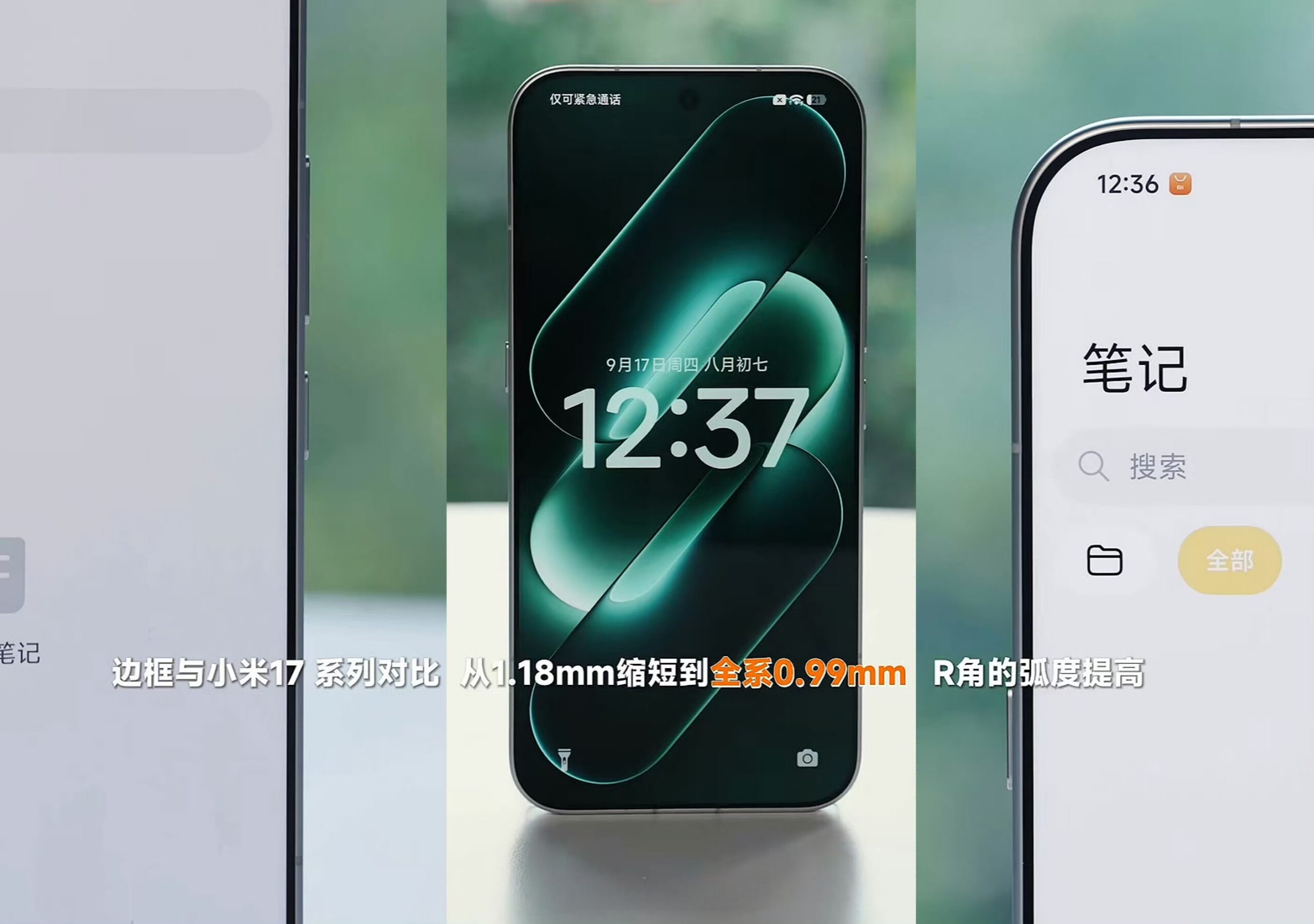
    One of the materials shows the front and provides a detail that can be compared to its predecessor: the frame around the screen has slimmed down from 1.18 mm in the Xiaomi 17 series to 0.99 mm — and this is true for the entire series, not just the larger model. The radius of the screen corners has also increased.

    Front Xiaomi 18 Pro — ramka zwężona z 1,18 mm w serii Xiaomi 17 do 0,99 mm
    Front Xiaomi 18 Pro — ramka zwężona z 1,18 mm w serii Xiaomi 17 do 0,99 mm

    Aparat: Leica i zakres 17–75 mm

    Na obudowie widnieje grawer LEICA VARIO-SUMMILUX 1:1.67-2.4/17-75 ASPH. Odczytaliśmy go z renderu w pełnej rozdzielczości i potwierdzają go cztery niezależne materiały. Oznacza jasność f/1,67–2,4 i zakres ogniskowych 17–75 mm.

    Tu pojawia się nieścisłość, którą warto znać. Plakat specyfikacyjny wymienia dwa aparaty — główny i peryskopowy, oba 200 Mpix. Tymczasem na plecach widać trzy oczka: dwa w wyspie i jedno w module pod nią. Xiaomi nie opisało dotąd tego trzeciego, a zakres zaczynający się od 17 mm sugeruje, że w zestawie jest jeszcze szerokokątny obiektyw. Do środy to pozostaje pytaniem otwartym.

    Cztery kolory

    Seria wychodzi w czterech wykończeniach: granatowym, białym, grafitowym i różowym. Róż jest tu najbardziej nieoczekiwany — we wcześniejszych materiałach się nie pojawiał.

    Xiaomi 18 Pro in four colors — navy, white, graphite, and pink, each with a matching wallpaper for the back screen
    Xiaomi 18 Pro in four colors — navy, white, graphite, and pink, each with a matching wallpaper for the back screen

    The most beautiful detail: the wallpaper on the back screen is matched to the color of the case — blue with navy, green with white, orange with graphite, and pink with pink. In some renders, it looks like a static print, but it is the same screen in wallpaper mode, not a cheaper version without a display.

    One of the circulating materials refers to the navy variant by the English name Starry River Blue, with a glittering star dust effect — but its origin cannot be confirmed. Official Chinese color names for Xiaomi have not yet been released.

    What is missing from any of the materials

    The materials do not include diagonal screens or pixel resolutions. We also do not know the refresh rate, dimming method, or the parameters of the back display itself: its size, resolution, and brightness. There is a lack of charging power, dimensions, weight, IP resistance class, memory variants, and any price.

    Leaks fill some of these gaps, but these are no longer Xiaomi’s words. GSMArena reported in April 6.3 inches for the 18 Pro and 6.9 inches for the 18 Pro Max with a flat LTPO OLED panel, and a July post from tipster Digital Chat Station mentioned 100 W wired charging and support for wireless charging. Treat these numbers as hints, not specifications.

    It is still unknown whether and when the series will reach Europe. The entire campaign is Chinese, and the partners on the back screen — Meituan, Haidilao, Starbucks CN — are brands from that market. The Chinese poster, however, mentions a purchase in 12 installments without interest.

    What it means for accessories

    One thing is clear in every render: the cutout in the case must cover the entire island along with the screen, not just two holes for the lenses. A case that covers the display with plastic takes away its meaning. The same goes for the camera glass — a sensible cover only hides the optics» openings and leaves the area above the screen free.

    Xiaomi has not yet provided the dimensions of the case, so the compatibility of accessories from the previous generation can only be discussed conditionally today. What is certain is what is visible: the layout of the back is different from the Xiaomi 17 series, and the previous generation does not have an additional screen at all. We will provide specifics about compatibility after September 23.

    Everything that fits the new series is gathered in one place — accessories for the Xiaomi 18 series — with separate shelves for accessories for the Xiaomi 18 Pro and accessories for the Xiaomi 18 Pro Max. Xiaomi talks about two sizes, so the cases will likely not be interchangeable between them — we will confirm this when we know the dimensions.

    Summary

    The Xiaomi 18 Pro and 18 Pro Max are the first Xiaomi phones where the second screen is not a novelty glued to the case, but an integrated platform with its own applications built into the camera island. Additionally, there are dual 200 Mpix with Leica, optics ranging from 17–75 mm, and batteries of 7000 and 8500 mAh — all of this is still pre-release material, not a manufacturer statement.

    The conference is on Wednesday, September 23 at 1:00 PM Polish time. Then we will know the prices, diagonals, and whether the series will even go beyond China.

    FAQ — frequently asked questions

    When is the Xiaomi 18 Pro premiere?

    September 23, 2026, at 7:00 PM Chinese time, which is 1:00 PM in Poland. The date comes from the poster of the autumn Xiaomi conference that leaked before the premiere.

    What is the difference between Xiaomi 18 Pro and 18 Pro Max?

    Rozmiarem obudowy, baterią (7000 wobec 8500 mAh) i procesorem — Pro dostaje Snapdragona 8 Elite Gen 6, Pro Max mocniejszy Elite Extreme Gen 6. Aparaty, ekran i szerokość ramki plakat podaje jako wspólne dla obu rozmiarów.

    Co to jest ekran na plecach Xiaomi 18 Pro?

    Dotykowy, kolorowy wyświetlacz wbudowany w wyspę aparatu, obok obiektywów. Obsługuje karty aplikacji — od licznika wody po minutnik i timer pomodoro — wyświetla animowane maskotki i służy jako podgląd do selfie robionego głównym aparatem.

    Jaki procesor ma Xiaomi 18 Pro?

    Różny w obu modelach. Xiaomi 18 Pro dostaje Snapdragona 8 Elite Gen 6, a Xiaomi 18 Pro Max mocniejszy Snapdragon 8 Elite Extreme Gen 6. Oba w procesie 2 nm.

    Ile kosztuje Xiaomi 18 Pro?

    Cena nie została podana w żadnym materiale — ani w juanach, ani w euro. Poznamy ją 23 września.

    Czy etui z Xiaomi 17 Pro pasuje do Xiaomi 18 Pro?

    Xiaomi nie podało jeszcze wymiarów obudowy, więc pewnej odpowiedzi dziś nie ma. Układ tyłu jest jednak wyraźnie inny, a poprzednia generacja nie ma dodatkowego ekranu w wyspie — po premierze uzupełnimy półki obu modeli o akcesoria z potwierdzonym dopasowaniem.

    Czy Xiaomi 18 Pro trafi do Polski?

    For now, there is no information about it. All materials concern the Chinese premiere.

  • Honor Magic 9 — premiere on September 28, three models and two 200 MP cameras

    Honor Magic 9 — premiere on September 28, three models and two 200 MP cameras

    Honor will showcase the Magic 9 series in Beijing on September 28, 2026. The date was confirmed by the brand’s president, Li Jian, and reservations in China have already begun. The strongest argument for the new series is the set of two 200-megapixel sensors and imaging developed in collaboration with ARRI — the German film camera company known to anyone who has watched the credits of a major production.

    Note: this article was created before the official presentation. The release date, collaboration with ARRI, Snapdragon configuration, and set of photography accessories come from Honor’s materials; screen diagonals, battery capacities, and layout divisions among models are still leaks from Chinese services. Everything will be confirmed on September 28.

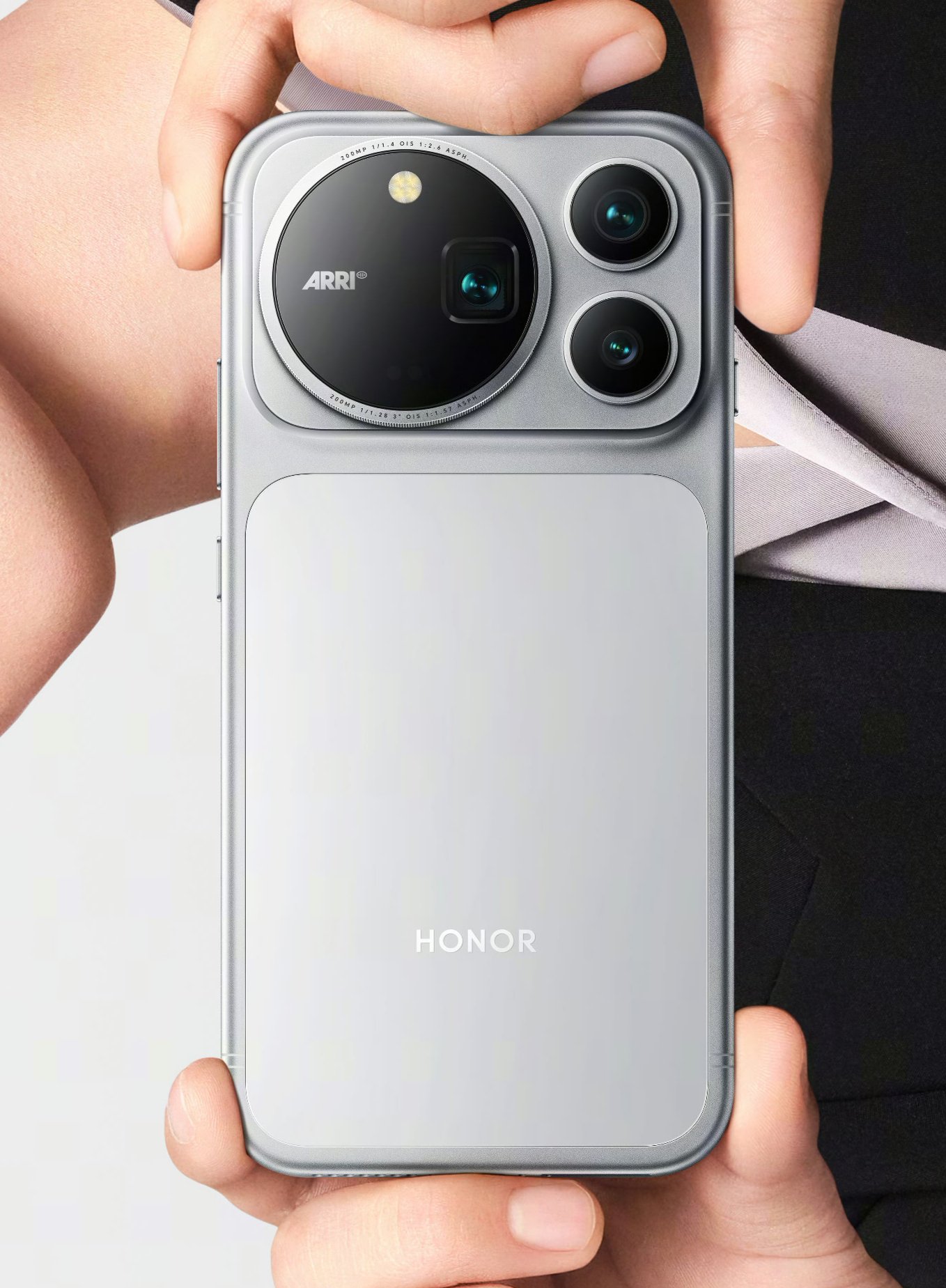
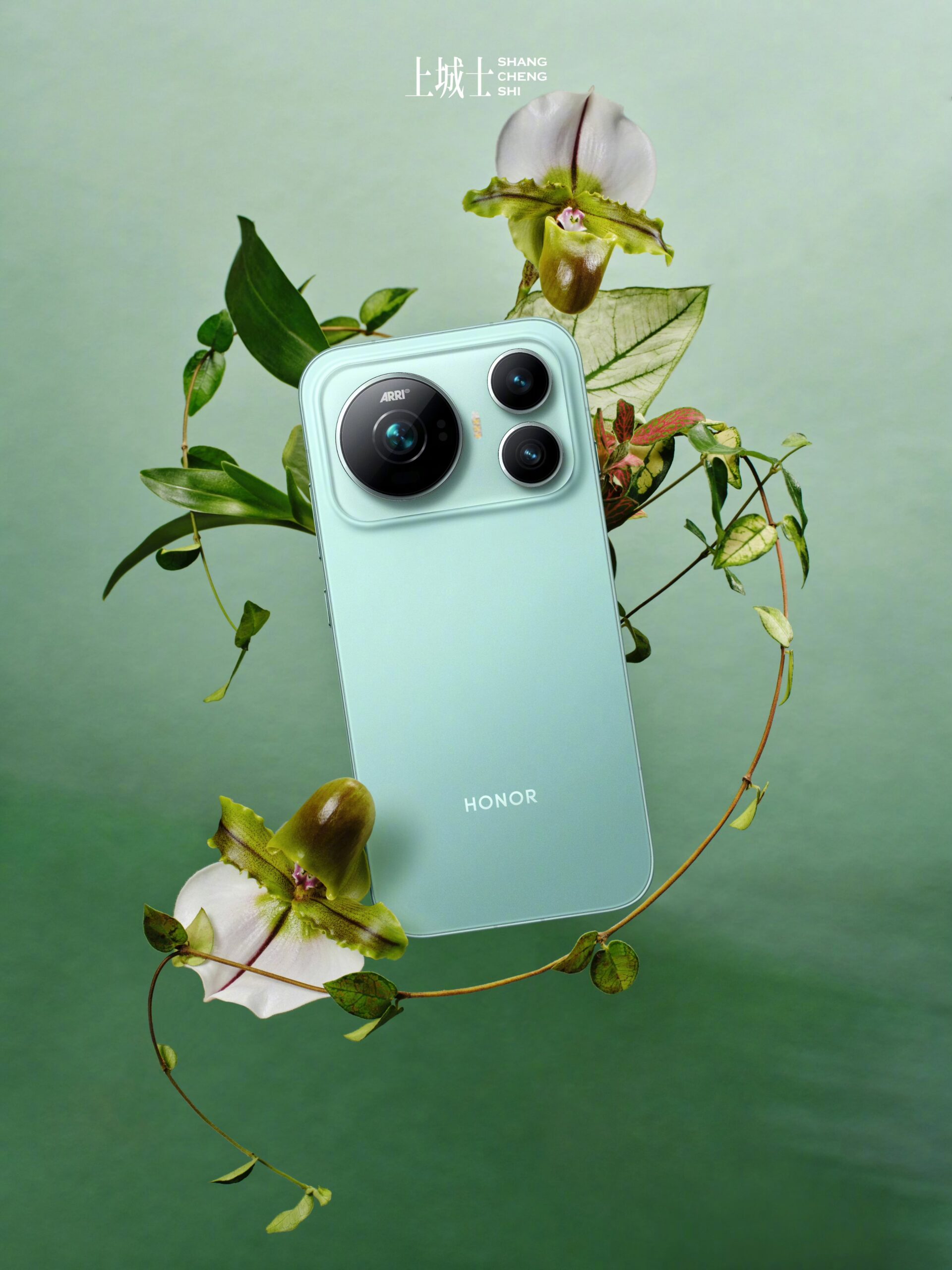
    Honor Magic 9 Pro Max in Silver Salt color with ARRI ring

    Photos reveal more than announcements

    In the official renders, it’s worth paying attention to the ring around the camera module — Honor has engraved the full specifications of both sensors on it. It can be read that the main camera is 200 MP on a 1/1.28-inch sensor with an f/1.57 aperture and three-stage stabilization, and the periscope is 200 MP on a 1/1.4-inch sensor with an f/2.6 aperture. This is the same set described by Chinese services, but here it is provided by the manufacturer itself, in fine print on the housing.

    Logo ARRI sits on the module itself, next to the lens. The brand doesn’t make phones — it makes cameras used for shooting feature films — so its involvement pertains to color grading and video mode, not the optics themselves.

    Five colors of the entire series

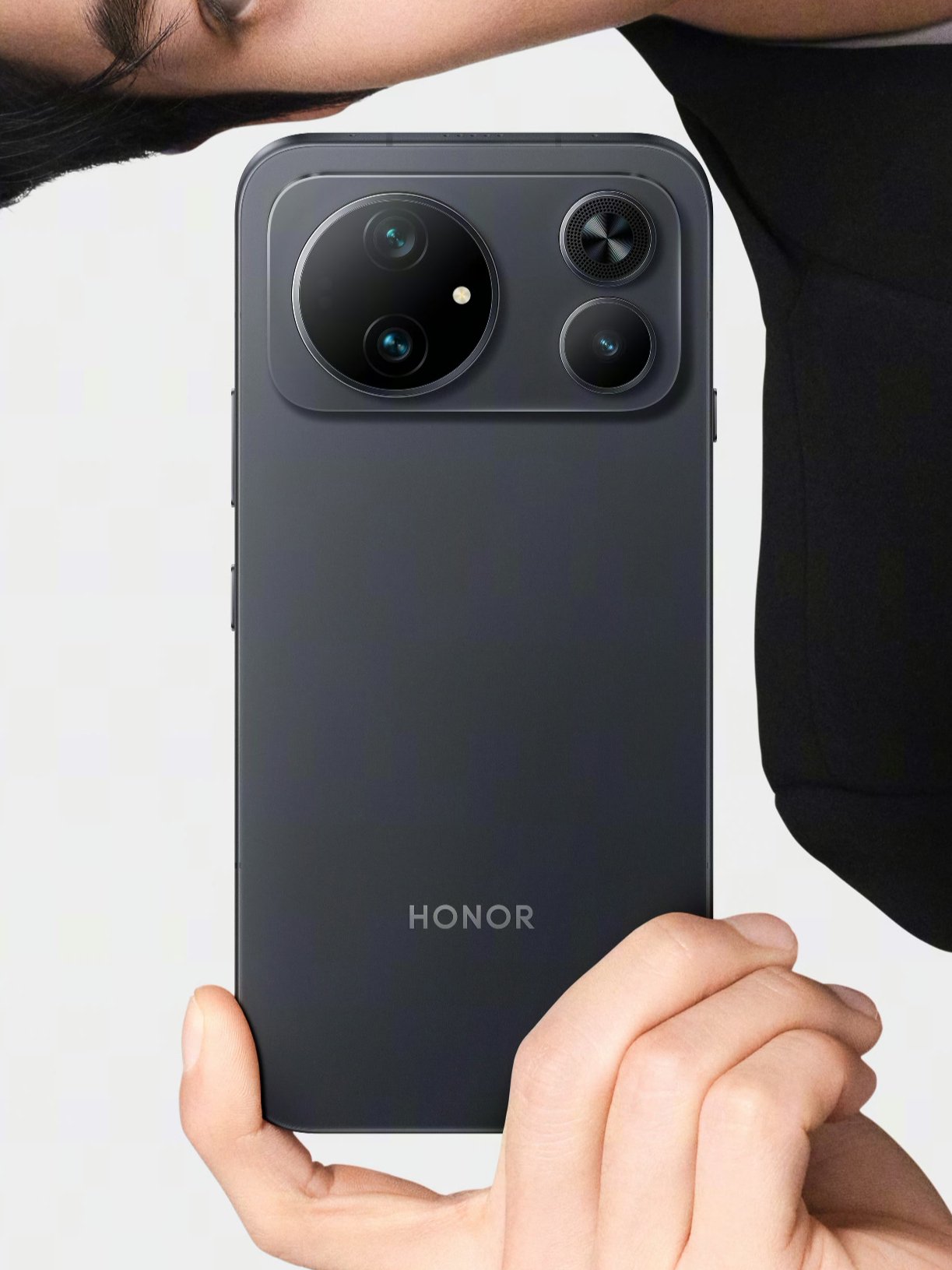
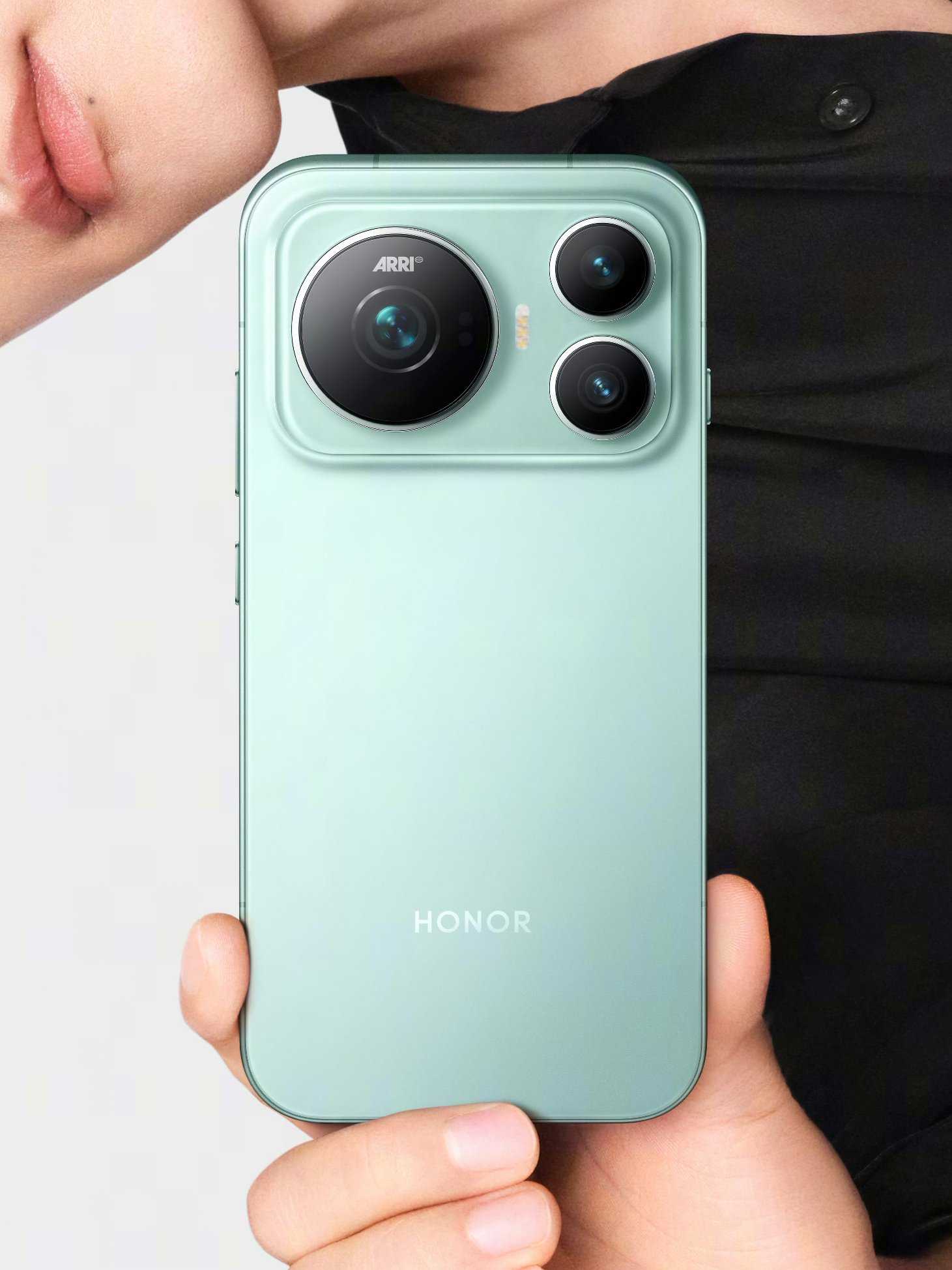
    Honor showcased the series in five variants. The names are cinematic, and it’s no coincidence: Curtain Black refers to the curtain, Opening White to the opening credits, and Silver Salt alludes to silver salt, which is part of traditional photography chemistry.

    Pełna paleta to Curtain Black, Opening White, Olive Green, Silver Salt i Popcorn Yellow. Żółty i oliwkowy to matowe, jednolite tyły bez połysku — takie wykończenie mniej się brudzi, ale mocniej pokazuje zarysowania, więc przy tych dwóch kolorach etui nie jest kwestią gustu.

    ⚠ Nie każdy kolor dotyczy każdego modelu. Drobny druk na plakatach Honora mówi wprost: Silver Salt jest zarezerwowany dla Magic 9 Pro Max, a Curtain Black, Opening White i Olive Green obejmują Magic 9 i wersję wydajnościową. Twarzą kampanii jest Xiao Zhan, globalny ambasador flagowców Honora.

    Telephoto lenses instead of digital zoom

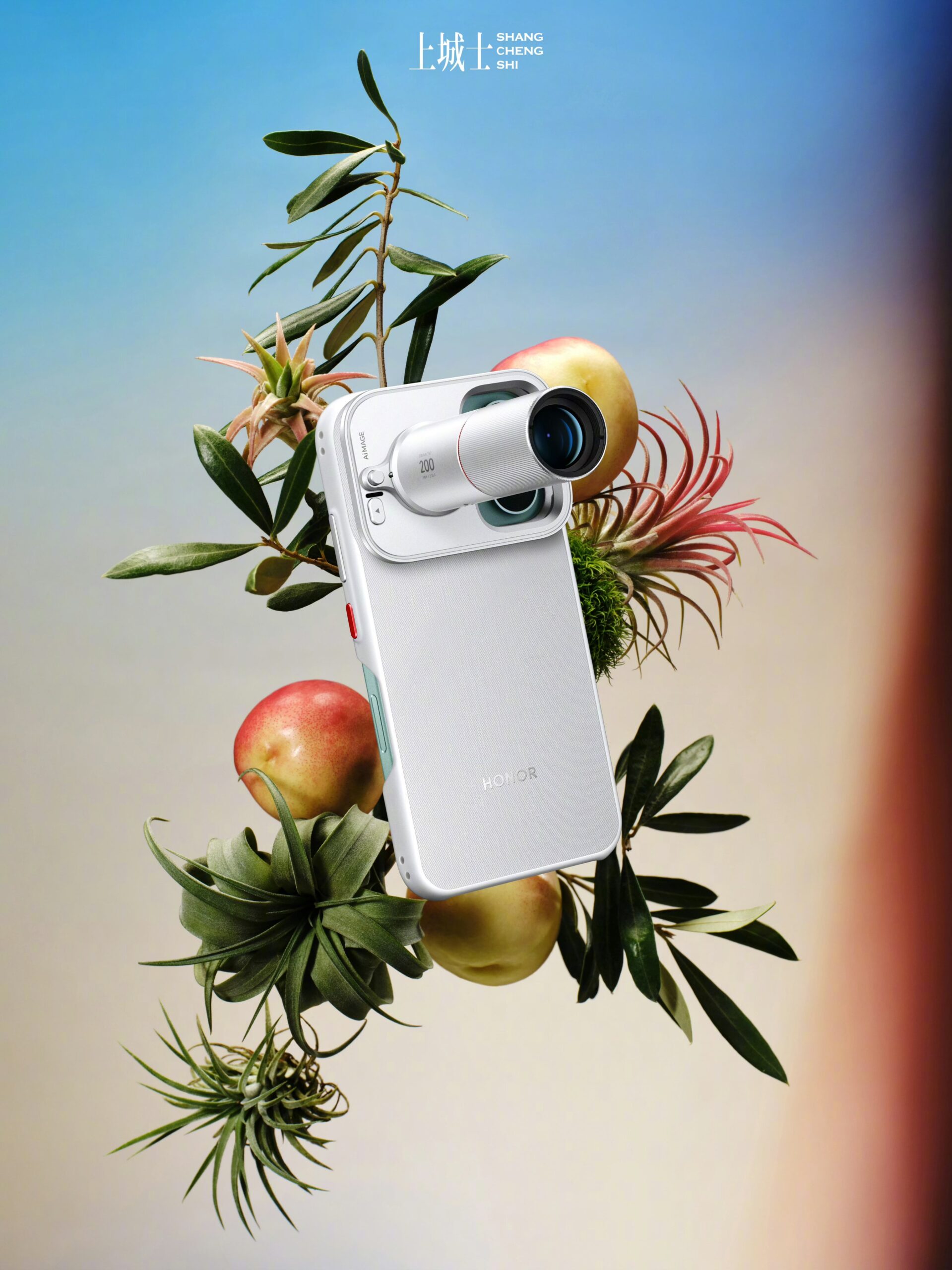
    The most interesting element of the premiere is not part of the phone. Honor has prepared a Master Camera Kit — a set with two attachable lenses: a compact 200 mm (81 mm long, 88 grams) for everyday carry and a 500 mm for situations where digital zoom fails: birds, animals, sports from the stands.

    Honor Magic 9 with an attachable telephoto lens from the Master Camera Kit

    For the buyer of accessories, there is one practical conclusion. Such a lens is mounted on a dedicated case with a ring, not on any housing — this is a rule we have already seen with OPPO and vivo camera sets. Whoever reaches for this set will practically use two cases: a photographic one for sessions and a regular, thinner one for the rest of the day.

    Three models, not two

    The series is divided into three variants, each with a different concept.

    • Magic 9 — a compact flagship, about 6.36 inches, with a pair of 200 MP sensors. For those who do not want a large phone but do not want to give up the camera.
    • Magic 9 in performance version — 6.8 inches, fiberglass housing, refresh rate up to 165 Hz and, most interestingly, active cooling with a fan and a battery of 11,000 mAh. This is the answer for gaming and long video recording, where regular flagships slow down due to overheating.

    ⚠ This variant is unlikely to be available in Poland. Honor has not announced its distribution outside of China, and such variants usually remain on the Chinese market. There is no European date for the entire series, historically Honor brings flagships several weeks to several months after the Chinese debut.
    – Magic 9 Pro Max — the top model, with the narrowest bezels in this class and an anti-reflective coating on the screen.

    This division also explains the confusion surrounding the processor. Reports about the Snapdragon 8 Elite Gen 5 likely refer to the performance version, not the base model — and the collaboration with ARRI, according to the fine print on the posters, includes Magic 9 and Magic 9 Pro Max.

    11,000 mAh battery confirmed by Honor

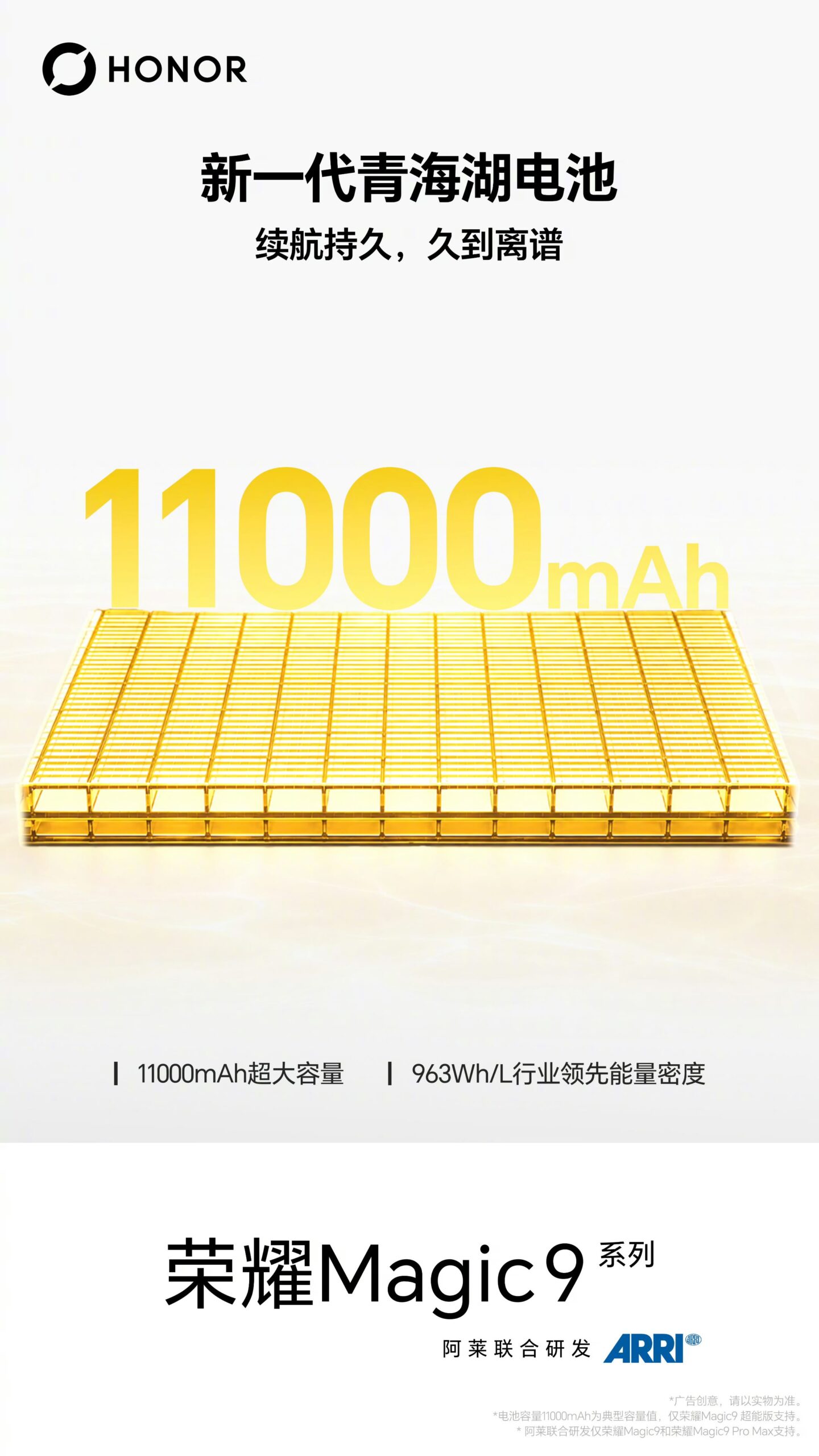
    This is no longer a leak. Honor released a separate material dedicated solely to the battery, providing two numbers: 11,000 mAh typical capacity and 963 Wh/l energy density, which it describes as industry-leading. The manufacturer calls this the new generation of its Qinghai Lake battery.

    Official poster of Honor Magic 9 with 11,000 mAh battery

    The fine print under the graphic is just as important as the number itself: 11,000 mAh applies only to the performance version, and the collaboration with ARRI — only for the Magic 9 and Magic 9 Pro Max models. Honor thus separates these two arguments: either a record battery with a fan, or cinematic color grading.

    For comparison: the phones we described this week have 8,000 mAh. The performance version of Magic 9 adds another three thousand to that.

    Specifications: Magic 9 and Magic 9 Pro Max

    Parameter Magic 9 Magic 9 Pro Max
    Screen approx. 6.36–6.37″ 1.5K 120 Hz, flat OLED approx. 6.8″ 1.5K 120 Hz LTPO, flat OLED
    Processor Snapdragon 8 Elite (disputed version — see below) Snapdragon 8 Elite Gen 6, 2 nm
    Main camera 200 MP, 1/1.4″, OIS 200 MP, 1/1.28″, f/1.57, OIS 3°
    Ultrawide 50 MP 50 MP
    Telephoto 200 MP, 1/1.56″, periscope 3.5× 200 MP, 1/1.4″, periscope 85 mm, f/2.6
    Front 55 MP, square matrix 55 MP, square matrix
    Imaging ARRI ARRI
    Battery approx. 8000 mAh 8800 mAh (leak)
    Charging 80 W + 50 W wirelessly 100 W + 50 W wirelessly
    Additionally — 3D face recognition

    Where sources disagree

    Two things should be taken with a grain of salt, as reports are conflicting.

    Processor division in the series. Some leaks mention Snapdragon 8 Elite Gen 5 in a 3 nm process, while others state that the entire series belongs to the first wave with Gen 6 in 2 nm. Most likely, both are true, only referring to different models — Gen 5 is often attributed to the performance version, while Gen 6 to the others. The premiere will clarify.

    Battery capacity in the Pro Max. You will encounter both 8800 mAh and reports of a peak version reaching 10,000 mAh. The latter number would be a record for a phone of this size, so it’s even more worth waiting for official data.

    There is also context that explains the timing. Qualcomm is showcasing the Snapdragon 8 Elite Gen 6 at the Snapdragon Summit from September 22 to 24, and Honor is entering four days later. This is the shortest possible interval — the brand wants to be first with the new chip before the competition does.

    What it means if you have Magic 7 or Magic 8

    If photography is your top priority, the jump is real: two 200 MP sensors instead of one and color science developed with ARRI is a different league than previous generations. If you mainly use your phone as a phone, feel free to wait for the European premiere and the first tests — Honor usually brings the Magic series to our market with a few weeks delay and in a narrower lineup.

    Accessories from the previous generation will not fit. The camera module changes shape and size, so cases from Magic 8 or Magic 8 Pro are out of the question. Protection for earlier models can be found in the categories of Honor Magic 7, and all brand accessories are collected in the Honor category.

    Summary

    Which model has a 11,000 mAh battery?

    Exclusively performance version — Honor notes this in the fine print of its own material. The other models in the series have smaller batteries.

    What colors does Honor Magic 9 come in?

    Five: Curtain Black, Opening White, Olive Green, Silver Salt, and Popcorn Yellow. The names refer to cinema and traditional photography. Note: Silver Salt is intended exclusively for the Pro Max.

    What is the Master Camera Kit?

    A set with two attachable telephoto lenses: 200 mm for everyday carry and 500 mm for shooting from a distance. They are mounted on a dedicated case with a ring.

    Will the case from Honor Magic 8 fit Magic 9?

    No. The camera module changes shape and dimensions, so a case dedicated to the new series will be needed.


    External sources: Gizmochina — premiere on September 28 and 2 nm chip, Nokiamob — Master Camera Kit and 500 mm extender, IT Home — official announcement of the date, Chinaz — first wave of Snapdragon in 2 nm

  • vivo X500, X500 Pro and Pro Max – specifications, colors and release

    vivo X500, X500 Pro and Pro Max – specifications, colors and release

    The vivo X500 series will be showcased on September 21, 2026, at 7:00 PM Chinese time. The manufacturer has already confirmed the date, four colors of both main models, and the key selling point: a periscope telephoto lens 200 MP on a 1/1.4 inch sensor in the Pro Max version.

    The photographic ambassador of the brand is Jay Chou, who unboxed the Pro Max before the premiere — and in the process revealed an accessory that vivo has not mentioned a word about.

    Note: this article was created before the official presentation. It is based on official vivo materials and leaks from Chinese services and Weibo. Full specifications and prices will be confirmed on September 21.

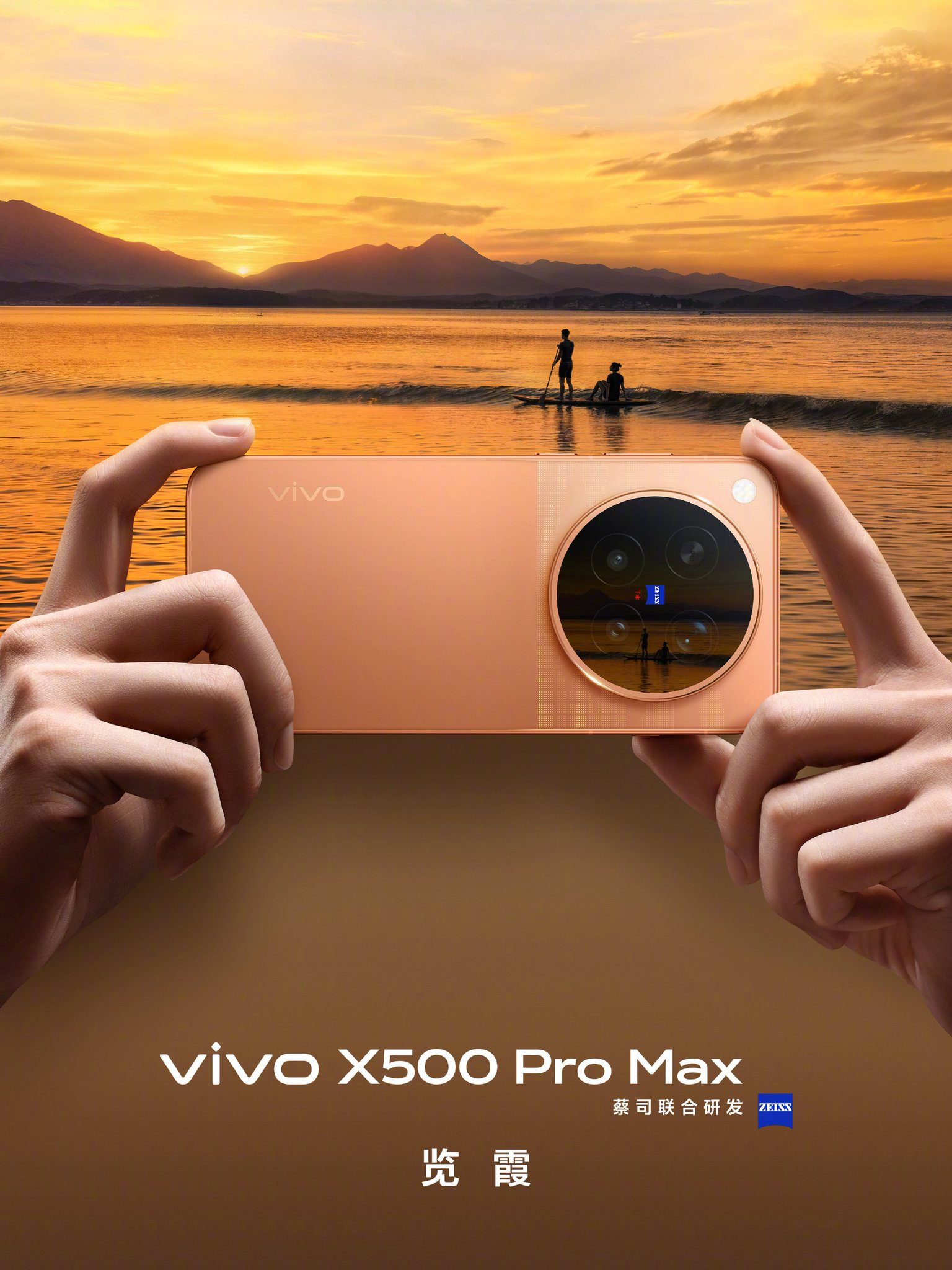
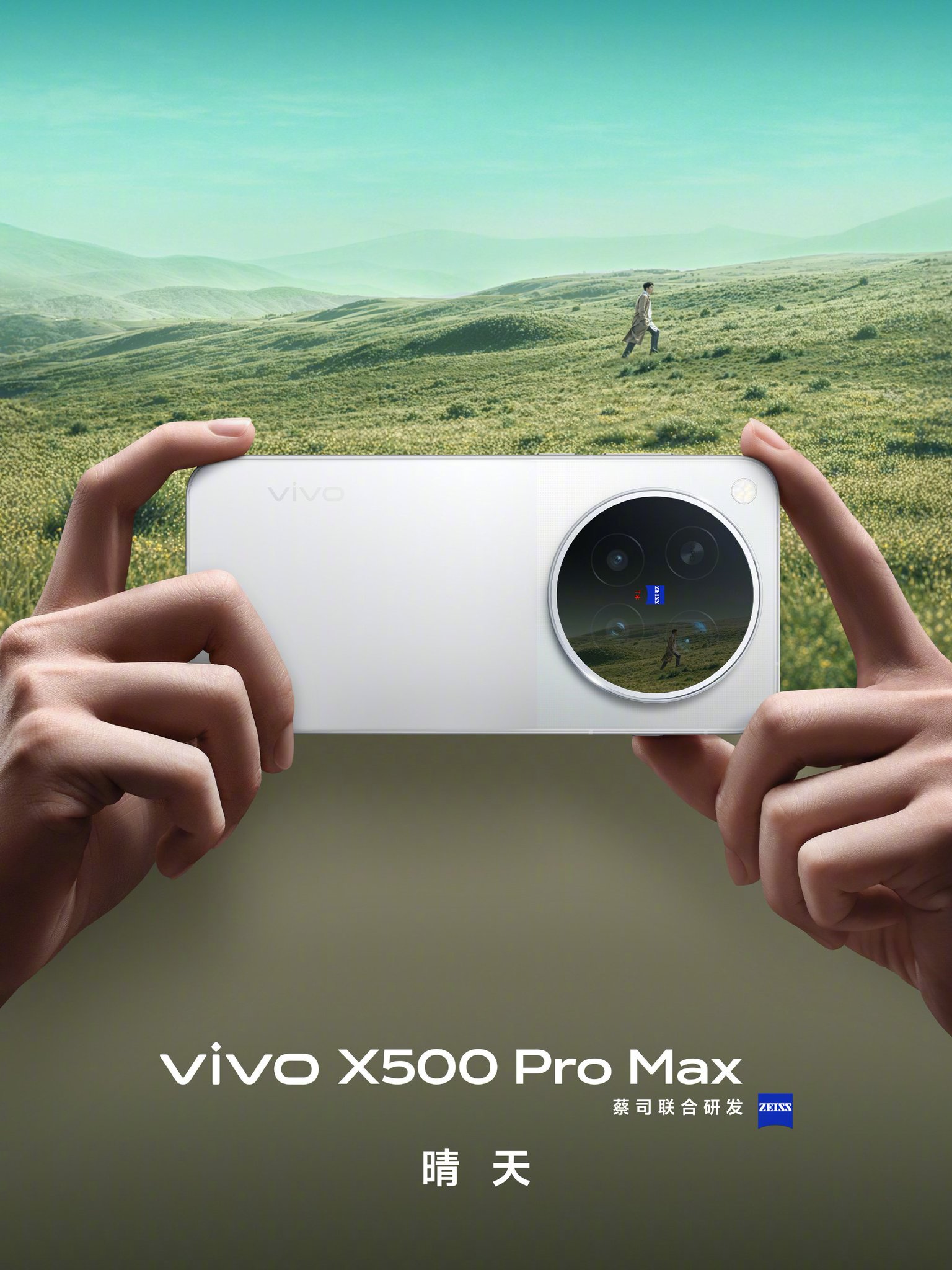
    vivo X500 Pro Max in the Aurora glow color

    Three models instead of two

    vivo is breaking the series into three variants and for the first time is using the name Pro Max.

    Parametr vivo X500 X500 Pro X500 Pro Max
    Ekran 6,59″ 1.5K płaski OLED ok. 6,36″ 1.5K, 144 Hz 6,83–6,85″ 2K LTPO, 144 Hz
    Panel — — BOE Q11
    Procesor Dimensity 9600M (3 nm) Dimensity 9600 Pro (2 nm) Dimensity 9600 Pro (2 nm)
    Bateria 7500 mAh ok. 6400 mAh ok. 8000 mAh
    Ładowanie 90 W + 40 W bezprzewodowo brak danych 90 W
    Aparat główny 50 MP Sony LYT-828, 1/1,28″ Phantom 900 50 MP Phantom 900, gimbal 3-osiowy
    Teleobiektyw 64 MP Sony LYT-610 64 MP LYT-610, 85 mm 200 MP Samsung HP0, 1/1,4″
    Ultraszeroki 50 MP 50 MP 50 MP
    Stabilizacja CIPA 5.5 CIPA 7.0 CIPA 7.0
    System OriginOS 7 OriginOS 7 OriginOS 7

    Wersja podstawowa nie jest tu wcale ubogim krewnym. Zdjęcia ekranu „O telefonie” z chińskiego demo pokazują Dimensity 9600M taktowany 4,21 GHz, 12 GB RAM z 24 GB pamięci rozszerzonej, 512 GB miejsca, dodatkowe 50 GB z kompresji i osobny układ obrazu BlueImage V3+.

    vivo X500 — ekran O telefonie z Dimensity 9600M i baterią 7500 mAh

    Peryskop 200 MP — najmocniejszy argument Pro Maksa

    Sercem X500 Pro Max jest teleobiektyw peryskopowy 200 MP na sensorze Samsung HP0 formatu 1/1,4 cala. To nietypowe podejście: większość producentów daje największą matrycę aparatowi głównemu, a tele traktuje jako dodatek. vivo odwraca ten porządek.

    Do tego dochodzi zoom 30×, stabilizacja CIPA 7.0 i obsługa dokręcanego telekonwertera 400 mm. Aparat główny to 50 MP z trzyosiowym gimbalem i zakresem dynamiki deklarowanym na 17 EV.

    Wideo robi wrażenie na papierze: 4K 240 kl./s, 8K w RAW, zwolnione tempo 4K 960 kl./s oraz 4K 120 kl./s w 10-bitowym Log. Całość powstaje w ramach trwającej od lat współpracy z Zeissem.

    Moduł aparatu vivo X500 Pro Max na zdjęciu z Weibo

    Model podstawowy dostaje sensor Sony LYT-828 1/1,28″ znany z X300 Pro, peryskop 64 MP LYT-610 i obsługę telekonwertera 200 mm. Stabilizacja na poziomie CIPA 5.5.

    Zestaw twórcy i tajemniczy kwadratowy ekran

    The most interesting element of the premiere is not the phone. During Jay Chou’s unboxing a small square display flashed by, one that vivo had never announced. The manufacturer confirmed that it is an external preview monitor.

    The idea is simple: you connect it to the phone and record yourself with the main camera instead of the front one, watching the frame on a separate screen. For anyone shooting vlogs, beauty content or unboxings from a tripod, that is the difference between a selfie lens and a full-blown rear camera.

    The monitor is part of the creator kit for the X500 Pro Max, which also includes a dedicated case, two teleconverters, a grip with a remote and a strap. vivo has been building an ecosystem of photo accessories around the X series for several generations, but this is the first time a separate display lands in the box.

    vivo X500 Pro Max colors

    vivo showed four variants, all with a two-tone back and, in some colors, particles that catch the light at an angle.

    “Capture the night” — a dark, muted version.

    vivo X500 Pro Max in the Capture the night color

    “Sunny day” — a white that vivo describes as “dispersing clouds”.

    vivo X500 Pro Max in the Sunny day color

    “Earth echo” — a silver variant with particles reminiscent of the Milky Way.

    vivo X500 Pro Max in the Earth echo color

    The fourth is “Aurora glow” — the warm orange seen in the image that opens the article.

    The base model gets the same three colors — sunny day, capture the night and earth echo — and instead of aurora glow it gets “Dawn”.

    Kiedy premiera i co z Europą

    Chińska prezentacja odbędzie się 21 września 2026 o 19:00. Dla Indii przecieki mówią o październiku lub listopadzie, po serii V70.

    Europejskiej daty nie ma. vivo od kilku lat przywozi serię X na nasz rynek w okrojonym składzie i z opóźnieniem liczonym w miesiącach, więc na X500 Pro Max w polskiej dystrybucji nie ma co liczyć od razu — o ile w ogóle się pojawi.

    Czy warto czekać, jeśli masz X300?

    Jeśli używasz vivo X300 Pro, aparat główny masz ten sam — LYT-828 wraca w podstawowym X500. Skok dotyczy przede wszystkim teleobiektywu i to on jest tu powodem wymiany, nie reszta specyfikacji.

    Jeśli natomiast fotografia z długiej ogniskowej to Twój główny scenariusz, peryskop 200 MP na matrycy 1/1,4 cala jest po prostu w innej klasie niż wszystko, co vivo dawało wcześniej.

    Accessories from the X300 series will not fit — the camera module changes radically, from rectangular to a large circle in the middle of the casing. Cases and glasses for the new series usually appear with us within a few days of the debut; all vivo phone accessories can be found in one category.

    Summary

    vivo X500 Pro Max is a phone built around a telephoto lens, not around the main camera — and that’s the most interesting part. Additionally, it features a 2-nanometer Dimensity 9600 Pro, a battery around 8000 mAh, and an ecosystem of accessories that has grown this generation with an external preview monitor.

    The base model looks more reasonable than base versions usually do: 7500 mAh, 90 W, a flat 1.5K screen, and a main sensor from last year’s Pro.

    FAQ — frequently asked questions

    When is the vivo X500 premiere?

    September 21, 2026, at 7:00 PM Chinese time. The premiere in India is expected in October or November, and the European date has not been announced.

    What is the difference between vivo X500 Pro Max and X500 Pro?

    Primarily the screen and telephoto lens. Pro Max has a 6.83–6.85 inch screen and a 200 MP periscope on a 1/1.4″ sensor, while Pro is compact — about 6.36 inches — and gets a 64 MP telephoto lens with a focal length of 85 mm. Pro Max also has a larger battery.

    What processor does the vivo X500 have?

    The base version gets the Dimensity 9600M in a 3 nm process, clocked at 4.21 GHz. Both Pro models use the stronger Dimensity 9600 Pro made in 2 nm.

    What is that square screen included with the X500 Pro Max?

    It is an external preview monitor. It allows you to record yourself with the main rear camera instead of the front one, seeing the frame on a separate display. It comes as part of the creator kit along with a case, two teleconverters, a grip, and a strap.

    What colors does the vivo X500 Pro Max come in?

    Four: capture the night, sunny day, earth echo, and aurora glow. Instead of aurora glow, the base model gets „dawn”.

    Does the case from the vivo X300 fit the X500?

    No. The camera module changes shape from rectangular to a large circle placed in the middle of the body, so a case dedicated to the new series will be needed.


    Źródła zewnętrzne: Gizmochina — zestawienie specyfikacji serii X500, IT Home — oficjalne kolory, Notebookcheck — potwierdzona data premiery, iXBT — specyfikacja Pro Max

  • OPPO Find X10 Pro Max — three 200 MP cameras and premiere on 22 September

    OPPO Find X10 Pro Max — three 200 MP cameras and premiere on 22 September

    OPPO Find X10 and Find X10 Pro Max will be unveiled on 22 September 2026 at 7:00 PM Chinese time. The Pro Max model features the world’s first set of three 200-megapixel cameras, and both versions come with an 8000 mAh battery designed to maintain its capacity for five years.

    This is a launch that changes the balance of power in the photography segment. Until now, manufacturers provided one 200 MP sensor and built all communication around it. OPPO is introducing three: in the main, ultra-wide, and periscope lenses simultaneously.

    Note: this article was written before the official presentation. The battery capacity, the camera setup and the composition of the series come from OPPO’s own materials, which we describe below next to each graphic; the prices, the full specification of the Find X10 E and some of the parameters are still leaks from Chinese sites. Everything will be confirmed on 22 September.

    Hasselblad camera teaser in the OPPO Find X10 series

    It is worth pausing on this poster, because it is OPPO’s own material and it says more than the leaks do. The headline says it outright: ultra-sharp Hasselblad camera, and under the names of both models there is a note that the module was co-developed with Hasselblad. The manufacturer splits its promises into three tiles:

    • Sharp detail — on the left, the upgraded set of two 200 MP lenses for the Find X10; on the right, with the Pro Max badge, the world premiere of a set of three 200 MP lenses. That settles which variant gets what.
    • Color reproduction — the second generation of the Danxia lens, responsible for color accuracy.
    • True light and shadow — LUMO, the native light and shadow engine.

    When is the OPPO Find X10 premiere?

    The conference will take place on 22 September 2026 at 7:00 PM Chinese time. The date was given by OPPO itself in the ad that opens the Weibo app, with the slogan “world premiere on 22 September”.

    ⚠ Many Western outlets are circulating the date of 17 September, and it is misleading: that day hosts a separate ColorOS 17 conference, for the system that will debut on the Find X10 series. The phone itself will be shown five days later.

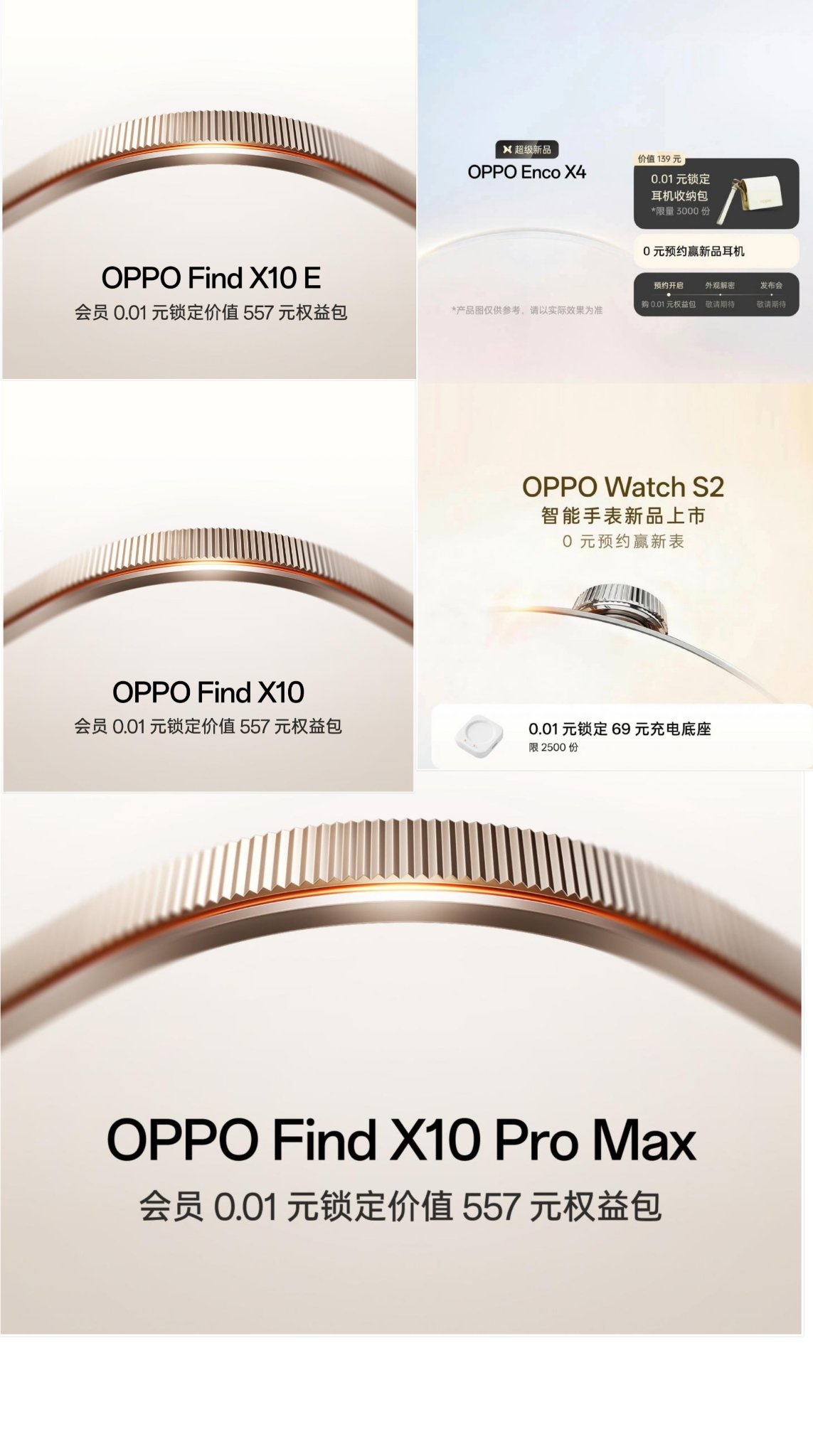
    Reservations in China have already begun. Customers can lock in a benefits package worth 557 yuan for a nominal fee, and at the same time they can reserve the Enco X4 headphones and the Watch S2 smartwatch, which will be showcased on the same day.

    Reservation page for the OPPO Find X10 series along with Enco X4 and Watch S2

    The screenshot of the reservation page itself is more interesting than it looks. Under each of the three phones — Find X10 E, Find X10 and Find X10 Pro Max — there is the same formula: for one cent (0.01 yuan) a programme member locks in a benefits package worth 557 yuan. OPPO does the same with the accessories shown on the same day:

    • OPPO Enco X4 labelled “super new product” — a free reservation with a prize draw for the headphones, plus a case valued at 139 yuan to be locked in for one cent, limited to 3000 units.
    • OPPO Watch S2 — also a free reservation with a prize draw for the watch, and on top of that a charging stand worth 69 yuan for one cent, limited to 2500 units.

    At the bottom of the page there is also a timeline: reservations open, design reveal and the conference. In other words, OPPO planned the campaign in three stages, and the design was meant to be shown before the launch itself.

    Change in the series lineup — Pro disappears, E appears

    The most important organizational change: there is no intermediate Pro model in this generation. The offer jumps from the basic version straight to Pro Max, and the Ultra variant is on a separate track and will not appear in September.

    However, the reservation page shows a new model — Find X10 E. OPPO has not revealed anything specific about it yet apart from the name, suggesting a cheaper variant opening the series.

    Model Status
    Find X10 E premiere 22 September, no full specification
    Find X10 premiere 22 September
    Find X10 Pro dropped in this generation
    Find X10 Pro Max premiere 22 September, flagship model
    Find X10 Ultra separate schedule, no date

    Three 200 MP cameras — what does it really mean

    OPPO advertises it as the world premiere of a set of three 200 MP lenses. In the Find X10 Pro Max, the sensor of this resolution receives the main camera, ultra-wide, and periscope telephoto lens — none have been neglected.

    The leaked apertures look like this: f/1.5 for the main, f/2.2 for ultra-wide, and f/2.1 for telephoto, with stabilization at CIPA level 7.5. The basic Find X10 model gets a set of two 200 MP lenses.

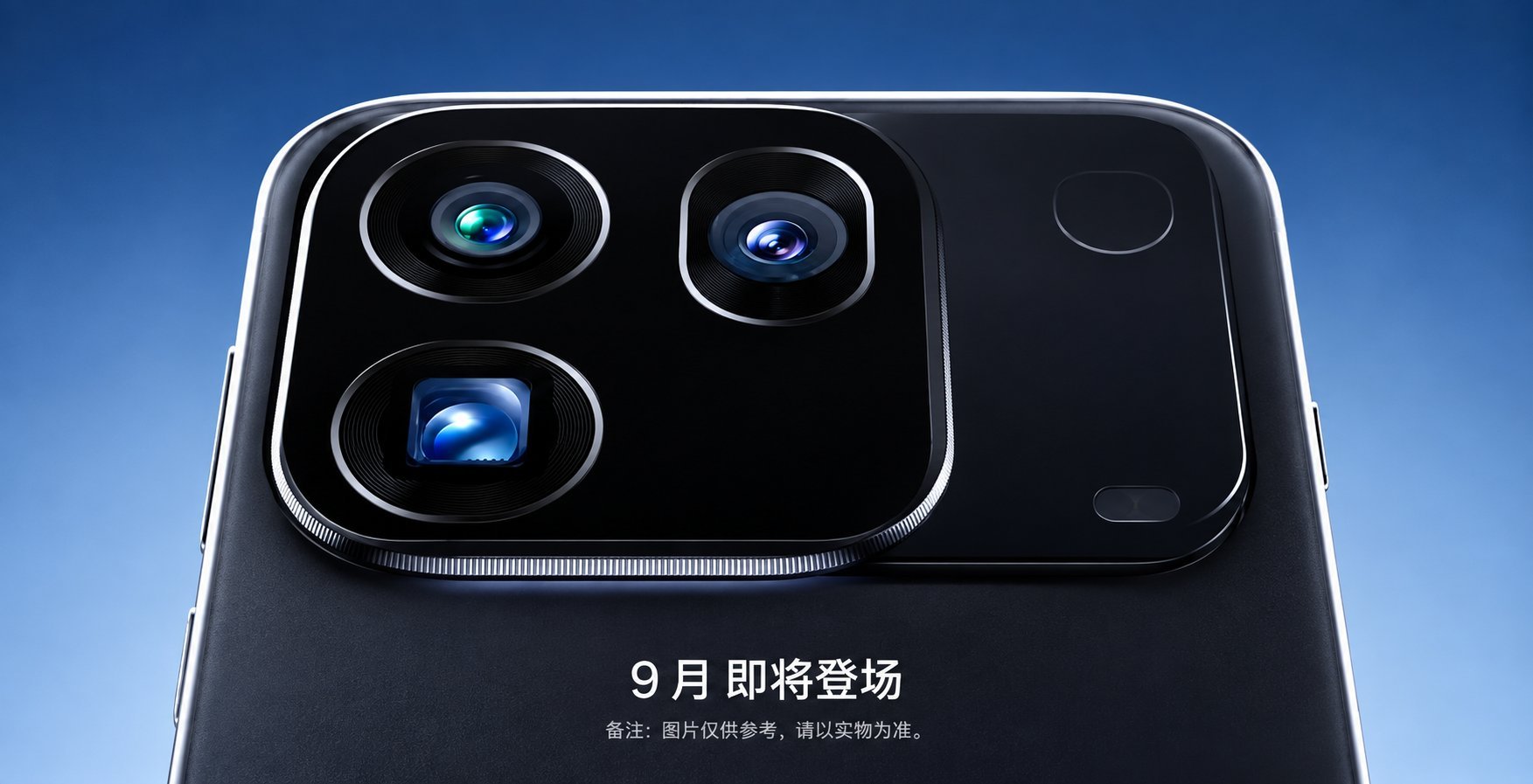
    OPPO Find X10 Pro Max camera module

    This is the official design teaser, captioned “coming in September”. It shows a rectangular island with heavily rounded corners, framed by a knurled, fluted ring resembling the edge of a camera lens. The three lenses sit on the left side of the island, while the flash and the sensor ended up in a separate section on the right. The small print underneath is the standard disclaimer that the image is for reference only.

    For anyone buying accessories, this is the single most important illustration in the whole set: the shape and size of the island determine the cutout in the case, and the fluted ring is the element most easily scratched when the phone is put down on its back.

    However, the resolution is the least interesting part. OPPO announces three things that make a bigger difference in practice:

    • Second generation Danxia lens responsible for color reproduction
    • LUMO — new native light and shadow engine
    • DeepPix — real-time HDR processing with a range of up to 17 EV per frame

    Additionally, it features 4K 60 fps recording in HDR directly in regular video mode, without switching to a special mode. The entire project was created in collaboration with Hasselblad, continued from several generations of Find X.

    8000 mAh battery that is supposed to last five years

    Both versions — Find X10 and Pro Max — receive a silicon-carbon battery with a capacity of 8000 mAh, dubbed by OPPO the glacier battery. The manufacturer claims that it will retain its usable capacity for five years, which is a direct response to the most common criticism of large silicon batteries.

    Charging, according to leaks, is 80 W wired and 50 W wirelessly.

    If you are planning to buy one, it is worth having a charger ready in advance. Manufacturers have not been including one in the box for years, and an 8000 mAh battery plugged into an old 18 W brick takes well over three hours to fill. In our range you will find wall chargers with power matched to flagships, as well as wireless chargers — at the declared 50 W without a cable, this is no longer emergency charging but a real alternative to the wire.

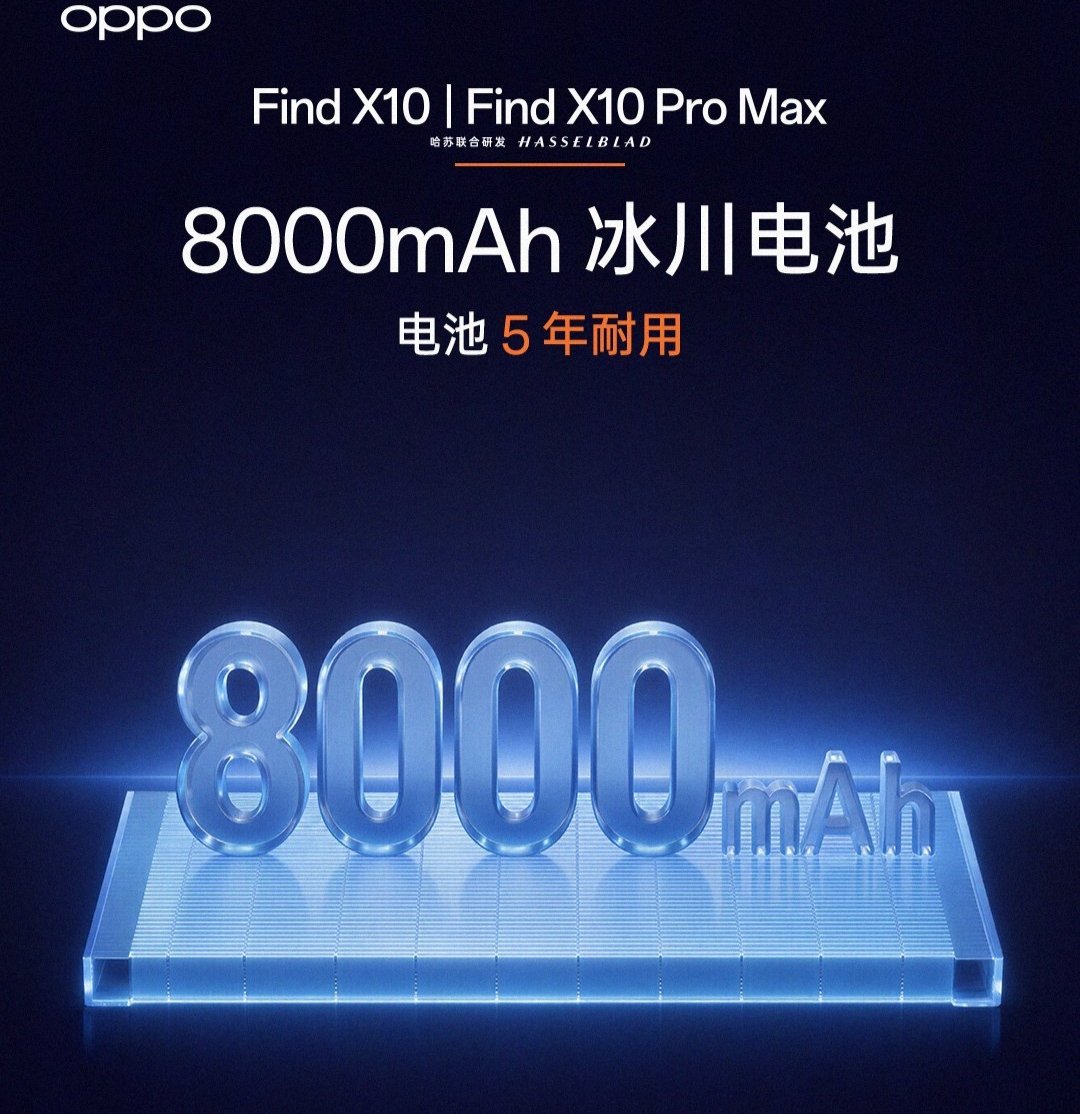
    OPPO Find X10 — 8000 mAh battery

    The graphic carries OPPO’s logo and leaves no room for guesswork: 8000 mAh is the capacity of the “glacier” cell, and the caption beside it declares a five-year battery lifespan. Both figures apply to the Find X10 as well as the Pro Max — the poster names both models in its heading.

    Specifications of OPPO Find X10 and Find X10 Pro Max

    Parameter Find X10 Find X10 Pro Max
    Screen 6.59″ 1.5K OLED 6.78–6.82″ 2K OLED, 144 Hz
    Panel Tianma, eye protection mode Tianma, eye protection mode
    Processor Dimensity 9600 (3 nm) Dimensity 9600 Pro (TSMC 2 nm)
    Memory no confirmation LPDDR6 + UFS 5.0
    Cameras set of two 200 MP three 200 MP lenses
    Stabilization no data CIPA 7.5
    Battery 8000 mAh 8000 mAh
    Charging 80 W / 50 W wireless 80 W / 50 W wireless
    System ColorOS 17 (Android 17) ColorOS 17 (Android 17)
    Resistance IP68/IP69 (leak) IP68/IP69 (leak)

    The discrepancy regarding the Pro Max screen is real: some sources report 6.78 inches, while others 6.82. This will be clarified on the release day.

    Colors of OPPO Find X10 Pro Max

    The ad that opens Weibo showed four official colors: moon white, warm orange, ice blue and light titanium. In the material, the Find X10 Pro Max appeared in moon white and the base version in ice blue — the Find X10 E stood alongside them.

    It is worth noting one caveat here. At the beginning of September, renders of the casing circulated online, which OPPO officially denied — Zhuo Shijie from OPPO stated directly that the real phone looks better than what was shown in the leaks. Therefore, until 22 September, it is advisable to treat unofficial visualizations with caution.

    How much will the OPPO Find X10 cost?

    Chinese sources mention a starting price around 7499 yuan, and for the Pro Max, there is a figure of around 8200 Hong Kong dollars. These are still leaks — OPPO has not provided any official prices.

    The Polish premiere has not been announced yet. Historically, the Find X series reaches our market a few weeks to a few months after the Chinese debut, usually in a narrower configuration than in China.

    Is it worth waiting if you have the Find X9?

    If photography is the most important thing for you, the jump is real — three 200 MP sensors and CIPA 7.5 stabilization are in a different league than the previous generation. The same goes for the battery: 8000 mAh with a declared five-year lifespan will be noticeable every day.

    If you use the Find X9 or Find X9 Pro mainly as a phone, rather than a camera, you can calmly wait for the European premiere and real tests. Especially since with such a large camera module, it’s worth checking how the phone feels in hand first.

    Accessories for the previous generation will not fit — the camera module and the dimensions of the casing change enough that the case from the Find X9 will not work. This is a rule with every generation change. Protection for the new models is collected in the Oppo Find X10 and Oppo Find X10 Pro Max categories.

    What to prepare before the premiere

    There are two things worth having before the phone hits distribution.

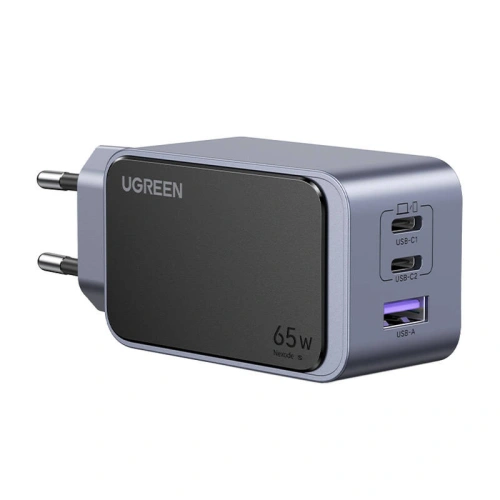
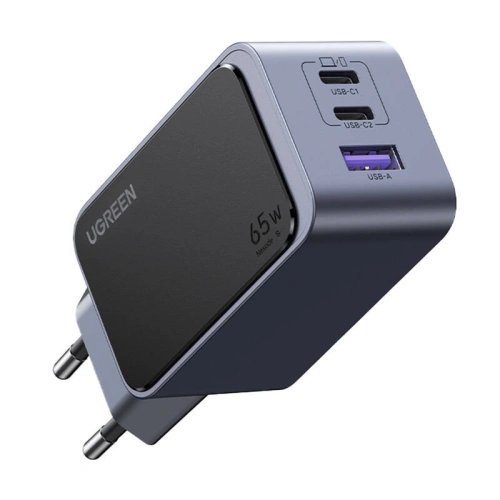
    A charger with the appropriate power. Look for models 65 W or stronger with USB Power Delivery support (the fast charging standard). With a capacity of 8000 mAh, the difference between a good charger and a random one is over two hours of waiting.

    A power bank if you travel a lot. With such a battery, it makes sense only to have a power bank from 20,000 mAh upwards — a smaller one won’t even be enough for a full charge.

    Cases and glass for new OPPO models usually appear with us within a few days of the debut — they are collected in the Oppo Find X10 Series category. You can find all accessories for this brand in the OPPO category.

    Summary

    OPPO Find X10 Pro Max is a premiere built around one strong argument: three 200 MP cameras at once, which no one else has today. Additionally, a 2-nanometer Dimensity 9600 Pro, an 8000 mAh battery with a five-year declaration, and the debut of ColorOS 17.

    The caveat remains the same as with every Chinese premiere: on 22 September, we will learn about the Chinese version of events. The European composition of the series, prices, and timing may differ.

    FAQ — frequently asked questions

    When is the OPPO Find X10 premiere?

    22 September 2026 at 7:00 PM Chinese time. The date was given by OPPO itself in an ad on Weibo. The 17 September date circulating online refers to a separate ColorOS 17 conference, not to the phone’s launch.

    Does the Find X10 Pro Max really have three 200 MP cameras?

    Yes, and OPPO confirmed this in its own teaser materials. The 200 MP sensor is assigned to the main lens, ultra-wide, and periscope telephoto lens. This is the first such set on the market.

    What happened to the Find X10 Pro model?

    It is not present in this generation. OPPO jumps from the base version straight to Pro Max, while Ultra follows a separate schedule. Instead of Pro, a new, cheaper Find X10 E appears.

    What battery does the OPPO Find X10 have?

    8000 mAh in both versions, a silicon-carbon cell. OPPO claims to maintain capacity for five years. Charging according to leaks: 80 W wired and 50 W wireless.

    How much does the OPPO Find X10 Pro Max cost?

    There are no official prices yet. Chinese leaks suggest the series will start around 7499 yuan, and for Pro Max, around 8200 HKD.

    Will the case from Find X9 fit the Find X10?

    No. The camera module and the dimensions of the casing are changing, so a case dedicated to the new generation will be needed.


    External sources: GSMArena — pre-order and 8000 mAh battery, T3 — confirmation of three 200 MP cameras, IT Home — details of the camera setup, Gizmochina — series reservations

  • iPhone Duo or Galaxy Z Fold 8? Comparison of Foldables

    iPhone Duo or Galaxy Z Fold 8? Comparison of Foldables

    iPhone Duo vs Galaxy Z Fold 8 is a choice between two foldable phones in passport format, with an internal screen of the same diagonal of 7.6 inches. iPhone wins with IP68 dust resistance and the Apple ecosystem. Samsung Galaxy Z Fold 8 is 53 g lighter, thinner, cheaper by 1,250 PLN, and has Galaxy AI in Polish.

    The choice will mainly depend on the system you are already using. We compared both phones parameter by parameter based on the official specifications of Apple and Samsung, and at the end of each section, we provide a brief verdict.

    One caveat: iPhone Duo will be available for sale only on October 23, so this is a comparison of manufacturer data, not a test.

    iPhone Duo vs Galaxy Z Fold 8: key differences in the table

    ParametriPhone DuoGalaxy Z Fold 8
    Ekran wewnętrzny7,6″, 1878 × 2670 px, 430 ppi, wykończenie matowe7,6″ (4:3), 2448 × 1848 px, 403 ppi
    Ekran zewnętrzny5,4″, 1398 × 2034 px, 460 ppi5,5″ (16:10), 1972 × 1248 px, 428 ppi
    Jasność szczytowa3000 nitów3000 nitów
    Wymiary po złożeniu117,8 × 84,1 × 11,3 mm123,9 × 81,9 × 9,7 mm
    Grubość po rozłożeniu5,2 mm4,5 mm
    Masa254 g201 g
    ProcesorApple A20 ProSnapdragon 8 Elite Gen 5 for Galaxy
    Pamięć256 GB, 512 GB, 1 TB, 2 TB256 GB, 512 GB, 1 TB
    Aparaty z tyłu48 MP + 48 MP ultraszerokokątny50 MP + 50 MP ultraszerokokątny
    Teleobiektyw❌❌
    Aparaty z przodu12 MP (zewn.) + FaceTime pod ekranem10 MP (zewn.) + 10 MP (wewn.)
    Bateriadwa ogniwa, Apple nie podaje mAh4 800 mAh, dwa ogniwa
    Ładowanie przewodowe50% w ok. 20 min (ładowarka 60 W)63% w ok. 30 min (ładowarka 45 W)
    Ładowanie bezprzewodoweMagSafe i Qi2 do 25 WQi do 20 W, ładowanie zwrotne
    BiometriaTouch ID w przycisku bocznymczytnik w przycisku bocznym
    Karta SIMwyłącznie eSIM (dwa numery)nano-SIM + eSIM (dwie linie naraz)
    OdpornośćIP68IP48
    Rysik✅ Apple Pencil (USB-C), obsługa później w 2026❌ brak obsługi S Pen
    SystemiOS 27Android 17, One UI 9
    Aktualizacjemin. 5 lat poprawek bezpieczeństwa7 generacji Androida, 7 lat poprawek
    AI po polsku❌✅
    Cena w Polsce (od)9 999 zł8 749 zł

    Data: specyfikacja iPhone’a Duo, porównanie Galaxy Z Fold 8 i Fold 8 Ultra i informacja prasowa Samsunga

    Appearance and format: two passports, different proportions

    Both phones when folded resemble a passport, rather than a narrow bar like the Galaxy Z Fold 8 Ultra. However, the differences are noticeable in hand. The iPhone Duo is 6 mm shorter and 2 mm wider, but it has a thickness of 11.3 mm, while the Fold 8 is only 9.7 mm.

    An even greater difference concerns weight. The Fold 8 weighs 201 g and according to Samsung is the lightest Fold in history. The iPhone Duo weighs 254 g, over a quarter more. When unfolded, the thickness difference decreases, but the Fold 8 is still thinner: 4.5 mm versus 5.2 mm.

    Po lewej rozłożony iPhone Duo, po prawej Galaxy Z Fold 8. Źródła: Apple Newsroom, Samsung Newsroom

    Apple wykonało obudowę z tytanu Grade 5 z lustrzanym polerem. Samsung postawił na technologię Flex Titanium, czyli tytanową warstwę pod ekranem, która ma wzmacniać panel i z czasem ograniczać widoczność zagięcia.

    Werdykt: Galaxy Z Fold 8. Jest lżejszy o 53 g i cieńszy po złożeniu o 1,6 mm.

    Ekrany i zagięcie

    Na papierze to remis. Oba ekrany wewnętrzne mają 7,6 cala, odświeżanie do 120 Hz i jasność do 3000 nitów. iPhone ma odrobinę gęstsze piksele (430 wobec 403 ppi), ale z normalnej odległości tej różnicy nie zobaczysz.

    Liczy się wykończenie. iPhone Duo ma matową powłokę nanostrukturalną, która tłumi odblaski i według Apple ogranicza widoczność linii zgięcia. Samsung stosuje wykończenie o niskim współczynniku odbicia i funkcję Vision Booster, ale nie opisuje ekranu jako matowego.

    Drugą różnicą są proporcje. W Fold 8 ekran wewnętrzny ma format 4:3, bliski kwadratu, wygodny do czytania i pracy na dokumentach. Według Apple oba ekrany Duo mają te same proporcje, więc po rozłożeniu treść skaluje się proporcjonalnie, a przejście z małego ekranu na duży jest płynne.

    Uwaga: część właścicieli Fold 8 zauważyła, że rogi ekranu wewnętrznego lekko się uginają pod naciskiem. Samsung w odpowiedzi dla użytkowników w Korei Południowej wyjaśnił, że to celowa strefa amortyzująca, która chroni wyświetlacz, a nie wada. Dotyczy to też Fold 8 Ultra. Relacjonuje SamMobile.

    Werdykt: remis z lekką przewagą iPhone’a Duo za matowe wykończenie.

    Wydajność i system: A20 Pro kontra Snapdragon

    iPhone Duo dostał A20 Pro, ten sam czip co iPhone 18 Pro, z komorą parową połączoną bezpośrednio z procesorem. Samsung używa Snapdragona 8 Elite Gen 5 for Galaxy z 12 lub 16 GB RAM. To flagowe układy tej generacji, więc w codziennym użyciu żadnemu z telefonów nie zabraknie mocy. Który jest szybszy w grach, pokażą testy.

    Większa różnica jest w oprogramowaniu. iOS 27 na iPhonie Duo po raz pierwszy daje Split View, czyli dwie aplikacje obok siebie. Samsung rozwija wielozadaniowość od siedmiu generacji Foldów: One UI dzieli ekran na trzy aplikacje i dodaje okna pływające.

    Galaxy AI po polsku, Apple Intelligence bez polskiego

    Dla polskiego użytkownika to jedna z najważniejszych różnic w tym porównaniu. Galaxy AI obsługuje język polski: działają m.in. tłumaczenie rozmów na żywo i Asystent pisania.

    Apple Intelligence działa w 16 językach, wśród których polskiego nie ma. Jeśli funkcje AI są dla Ciebie ważne, Fold 8 daje dziś wyraźnie więcej.

    Funkcje iOS 27, których w Polsce nie będzie

    iOS 27 starts in the European Union cut down. Apple announced in June that due to the requirements of the EU Digital Markets Act (DMA), it is suspending the new Siri AI in the EU. Along with it, you won’t get the new Siri app, enhanced Visual Intelligence, integrated writing tools, or Siri mode in the camera.

    This is important because these features were presented by Apple as the biggest advantage of the large Duo screen. On the Polish iPhone Duo, today you only get the foldable screen and Split View.

    Updates: 7 generations at Samsung, minimum 5 years at Apple

    Samsung promises for the Galaxy Z Fold 8 series seven generations of Android updates and seven years of security patches, which starting with Android 17 provides support until Android 24. Apple does not specify how many versions of iOS the iPhone Duo will receive. In documents for the British regulator, it declares for iPhones a minimum of five years of security patches from the launch.

    In practice, iPhones usually receive updates longer than this minimum, but on paper Samsung’s guarantee is stronger.

    Verdict: performance is a draw until tests, and the software in Poland favors the Fold 8: Galaxy AI in Polish and longer declared support.

    Cameras: 48 MP vs 50 MP, both without telephoto lens

    The sets are almost identical. The iPhone Duo has two 48 MP cameras (main and ultra-wide), while the Fold 8 has two 50 MP cameras. Neither has a telephoto lens, but both offer 2x optical zoom, which is a crop from the center of the main sensor.

    Both manufacturers similarly utilize the second screen. On the iPhone Duo, the Duo Preview feature shows a preview of the shot to the person being photographed. Samsung allows simultaneous recording with the front and rear cameras, with a preview on the external screen.

    With the main camera of the Duo, you can record 4K Dolby Vision video at 120 fps, while the Fold 8 has the My FanCam feature, which automatically tracks a chosen person and crops the recording to social media format.

    Who takes better photos will only be shown by tests. The 10 MP telephoto lens with 3x zoom and the 200 MP camera have been reserved by Samsung for the Fold 8 Ultra, which we demonstrate in the comparison of the Ultra with the Galaxy Z Fold 8.

    Batteri og lading

    Samsung oppgir konkret: 4 800 mAh i to celler. Apple avslører ikke kapasiteten. Det er bare kjent at Duo også har to celler, en i hver halvdel, og ifølge produsenten varer den opptil 24 timer med typisk bruk.

    Rask lading ifølge produsentene ser slik ut:

    • iPhone Duo: 50% på omtrent 20 minutter med USB PD 60 W-lader, 50% på omtrent 30 minutter med MagSafe og 35 W-lader, trådløst på MagSafe og Qi2-ladere opptil 25 W.
    • Galaxy Z Fold 8: 63% på omtrent 30 minutter med 45 W-lader og 3A-kabel, trådløst opptil 20 W (Qi), og i tillegg omvendt lading av andre enheter.

    None of them comes with a charger in the box. For the Duo, choose a USB PD wall charger with a power of at least 60 W, and for the Fold 8, a 45 W charger compatible with Samsung’s fast charging (USB PD with PPS). We described specific models in the guide on chargers for the Galaxy Z Fold 8 Ultra, as both Folds charge at the same power.

    Verdict: undecidable, as Apple does not provide capacity. The Duo charges faster wirelessly (25 W vs. 20 W), while the Fold 8 can charge other devices.

    Durability: IP68 vs IP48

    Here, the iPhone has a clear advantage. IP68 class means complete dust resistance, and Apple claims that the Duo is resistant to immersion up to 6 m for 30 minutes.

    The Galaxy Z Fold 8 has IP48. Samsung claims resistance to immersion up to 1.5 m in fresh water for 30 minutes, but it only partially protects against dust, as the standard covers particles larger than 1 mm. The manufacturer itself advises against using it on the beach and by the pool.

    On the front, the iPhone has a Ceramic Shield 2 layer, which Apple claims is 3x more scratch-resistant than the previous generation. By 2026, the Duo will also get support for Apple Pencil, while Samsung has dropped the S Pen stylus already in the Galaxy Z Fold 7.

    Verdict: iPhone Duo. IP68 is a real advantage in a phone with a movable hinge.

    Price and availability in Poland

    MemoryiPhone DuoGalaxy Z Fold 8
    256 GB9 999 zł8 749 zł
    512 GB10 999 zł9 599 zł
    1 TB12 999 zł11 299 zł
    2 TB15 999 złunavailable

    Manufacturer’s catalog prices as of September 10, 2026. Samsung’s store has promotions, so the Fold 8 can be cheaper.

    The difference in the base version is 1 250 zł in favor of Samsung. For the price of the basic Duo, you can buy the Fold 8 with 512 GB and have 400 zł left. The Fold 8 is already on sale, while the iPhone Duo goes on pre-sale on October 16 at 14:00 and will be in stores on October 23. Only Apple offers the 2 TB version.

    Before purchasing, check the SIM card. iPhone Duo does not have a tray and only supports eSIM. Galaxy Z Fold 8 has a nano-SIM slot and supports eSIM, with a maximum of two active lines at the same time according to SamMobile. If you are using a physical card, ask your operator for an eSIM before switching to Duo.

    Verdict: Galaxy Z Fold 8. It is cheaper in every capacity and available immediately.

    Which foldable phone to choose: iPhone Duo or Galaxy Z Fold 8?

    The choice is simpler than the length of the table suggests:

    • Choose iPhone Duo if you have an iPhone, Mac, or Apple Watch, care about dust resistance, and plan to write with a stylus. However, be prepared for a higher price, greater weight, and lack of AI in Polish.
    • Choose Galaxy Z Fold 8 if you use Android, want a lighter phone, AI in Polish, and richer multitasking. You save 1,250 PLN and can buy it immediately, but you have to reckon with weaker dust protection (IP48) and lack of a stylus.
    • Consider another model if you care about close-ups from a distance. Neither of these foldables has a telephoto lens; for example, iPhone 18 Pro (4x) or Galaxy Z Fold 8 Ultra (3x) has one.

    Switching from iOS to Android (or vice versa) is rarely worth it for a foldable phone. Apple Watch works exclusively with iPhone, iMessage and FaceTime won’t transfer to Android, and Galaxy Watch doesn’t work with iPhone. You can transfer data using the Move to iOS app or Samsung Smart Switch, but you won’t be able to move the accessory ecosystem and subscriptions.

    In the iPhone Duo vs Galaxy Z Fold 8 showdown, there is no single winner. The key takeaways:

    1. The screen is a draw. Both have 7.6 inches, and the Duo stands out with a matte finish.
    2. Fold 8 is lighter and thinner. 201 g and 9.7 mm compared to 254 g and 11.3 mm.
    3. Duo is more waterproof and will get a stylus. IP68 versus IP48, and support for Apple Pencil will appear in 2026.
    4. Fold 8 has AI in Polish and longer support. Apple Intelligence doesn’t support Polish, and Siri AI doesn’t work in the EU at launch.
    5. Fold 8 is cheaper by 1,250 PLN and available immediately with a full range of accessories.

    All about the iPhone Duo itself, including full specifications and Polish pricing, can be found in our article on the foldable iPhone Duo.

    Accessories for Galaxy Z Fold 8 and iPhone Duo: what you can buy today

    To praktyczna różnica, o której łatwo zapomnieć. Do Galaxy Z Fold 8 w naszej ofercie jest już kilkadziesiąt produktów: etui, szkła, folie i osłony aparatu. Kategoria akcesoriów do iPhone’a Duo czeka na pierwsze modele, które producenci przygotują po publikacji oficjalnych wymiarów.

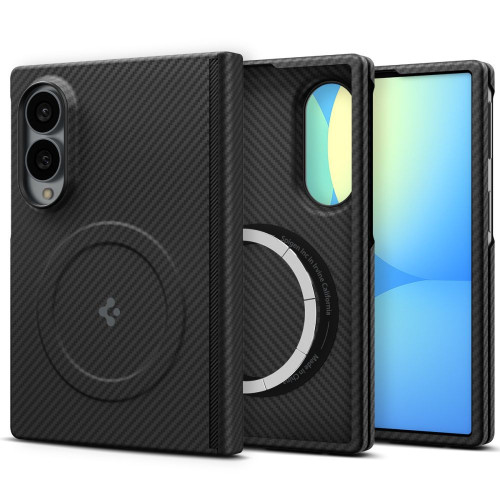
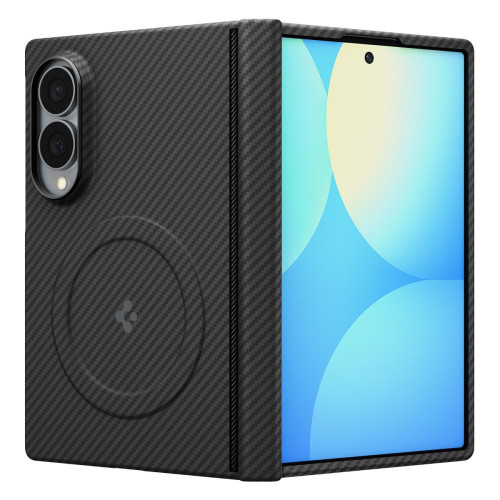
    Spigen Airskin Aramid MagSafe

    Spigen Airskin Aramid MagSafe to cienkie etui z włókna aramidowego z pierścieniem magnetycznym. Fold 8 nie ma wbudowanych magnesów, więc dopiero z takim etui przyczepisz go do ładowarek i uchwytów MagSafe, a telefon zachowa swoją największą zaletę, czyli niską masę.

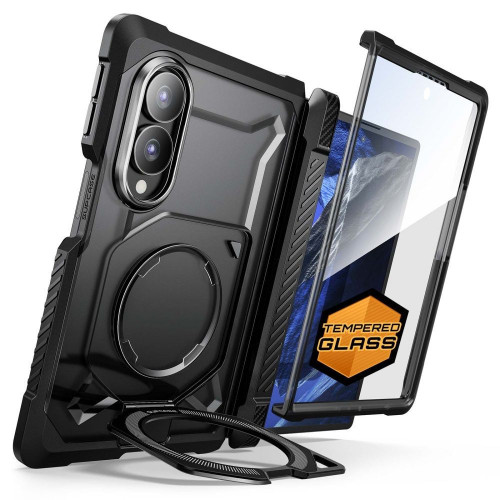
    Supcase UB Grip Mag MagSafe

    Supcase UB Grip Mag MagSafe is a choice for those who want stronger protection and a more secure grip. The case will not improve dust resistance but will protect the edges and hinge area from drops and scratches.

    Tech-Protect Easy Set Foil & Glass Fit+ 4in1

    Tech-Protect Easy Set Foil & Glass Fit+ 4in1 combines a foil for the inner screen with glass for the outer screen, which is exactly how a foldable should be protected. Why rigid glass is not suitable for the inner screen is explained in the review of glasses for Galaxy Z Fold 8.

    [hs_products ids=»142087,141063,142722″ cols=»3″ title=»Accessories for Galaxy Z Fold 8″]

    FAQ: iPhone Duo vs Galaxy Z Fold 8

    Which is better: iPhone Duo or Samsung Galaxy Z Fold 8?

    Neither wins in everything, and whether the iPhone or Samsung Galaxy turns out to be better mainly depends on the system you are already using. The iPhone Duo is more waterproof (IP68) and will receive support for Apple Pencil in 2026, while the Galaxy Z Fold 8 is lighter by 53 g, cheaper by 1,250 PLN, and has Galaxy AI in Polish.

    How much does Galaxy Z Fold 8 cost, and how much is the iPhone Duo?

    The Samsung Galaxy Z Fold 8 costs in Poland from 8,749 PLN, while the iPhone Duo starts at 9,999 PLN, in both cases for the 256 GB version. You can buy the Samsung immediately, while the Duo will hit stores on October 23.

    What does iPhone Duo have that Samsung doesn’t?

    Full dust and water resistance rated IP68, a version with 2 TB of storage, a matte finish on the internal screen, and built-in MagSafe magnets, so it works with magnetic chargers without an additional case. It will also receive support for Apple Pencil by 2026.

    What does Galaxy Z Fold 8 have that iPhone Duo doesn’t?

    Galaxy AI in Polish, multitasking with three apps side by side and floating windows, a nano-SIM slot, lower weight (201 g compared to 254 g), and a thinner body. It is also cheaper by 1,250 PLN and already available.

    Does Galaxy Z Fold 8 support S Pen?

    No. Galaxy Z Fold 8 and Fold 8 Ultra do not support S Pen. Samsung dropped the stylus starting with Galaxy Z Fold 7 in 2025.

    Does iPhone Duo have a SIM card?

    No. iPhone Duo only supports eSIM, with a maximum of two numbers simultaneously. Galaxy Z Fold 8 has a nano-SIM slot and supports eSIM, so it will work with a traditional card.

    Does the case for Samsung Fold 8 fit iPhone Duo?

    No. The phones have different dimensions and differently arranged cameras, so each requires a dedicated case.

    Źródła: specyfikacja iPhone’a Duo, informacja prasowa Apple, Apple o wstrzymaniu Siri AI w UE, porównanie Galaxy Z Fold 8 i Fold 8 Ultra na stronie Samsunga, informacja prasowa Samsunga o Galaxy Z Fold 8, SamMobile o rogach ekranu Fold 8, SamMobile o kartach SIM w serii Z8

  • Foldable iPhone Duo: price in Poland, specifications, release

    Foldable iPhone Duo: price in Poland, specifications, release

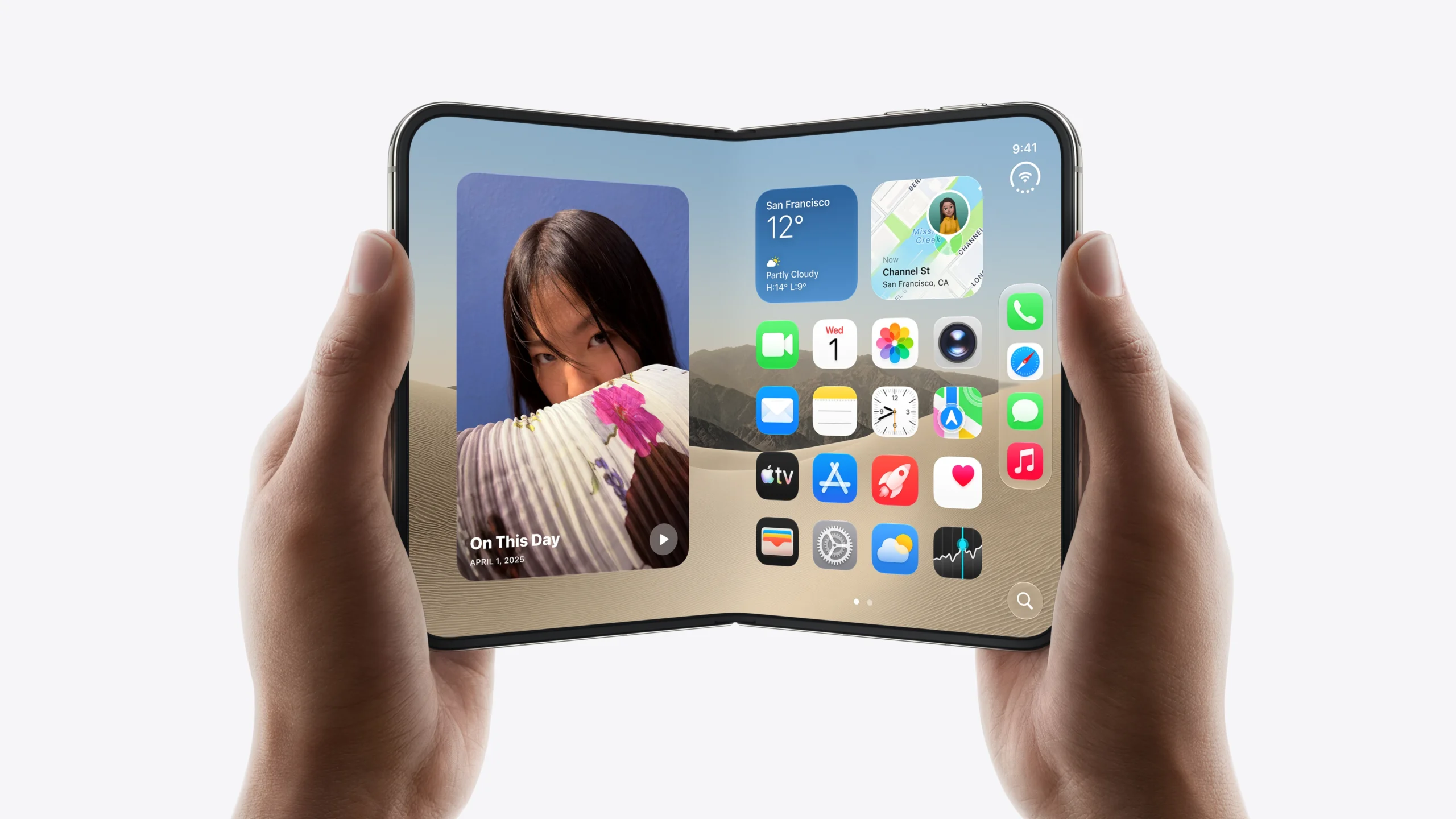
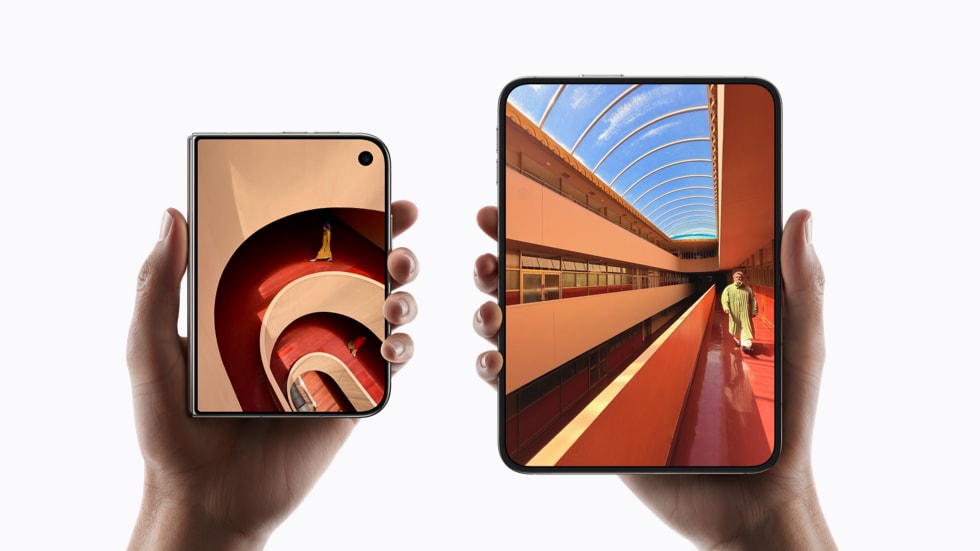
    iPhone Duo is the first foldable iPhone, known from leaks as the iPhone Fold. Apple revealed it on September 9, 2026: the phone unfolds like a book, has a 7.6-inch internal screen, a 5.4-inch external screen, and Touch ID instead of Face ID. In Poland, it costs from 9,999 PLN, pre-orders start on October 16, and sales begin on October 23.

    We waited seven years for a foldable iPhone since the debut of the first Galaxy Fold. In leaks, it was also referred to as iPhone Ultra or iPhone 18 Ultra, and before the conference we gathered all the reports in the announcement of the iPhone 18 Pro launch. Apple did not explain where the name Duo came from.

    Below is the specification confirmed by Apple, the Polish price list, differences compared to the Galaxy Z Fold 8, and three compromises that are less talked about. At the end, a practical section: what to use to charge the iPhone Duo and how to protect its screens.

    iPhone Duo specification: key parameters

    ParametriPhone Duo
    Wewnętrzny ekran7,6″, OLED, 1878 × 2670 px, 120 Hz, matowe wykończenie
    Zewnętrzny ekran5,4″, OLED, 1398 × 2034 px, 120 Hz
    Wymiary po złożeniu117,8 × 84,1 × 11,3 mm
    Grubość po rozłożeniu5,2 mm
    Masa254 g
    Obudowatytan Grade 5, Ceramic Shield 2 z przodu, Ceramic Shield z tyłu
    CzipA20 Pro z komorą parową
    Aparaty z tyłu48 MP główny + 48 MP ultraszerokokątny
    Aparaty z przodu12 MP Center Stage + FaceTime pod ekranem
    BiometriaTouch ID w przycisku bocznym
    Bateriadwie baterie, do 24 h typowej pracy
    Szybkie ładowanie50% w ok. 20 min (ładowarka 60 W)
    Ładowanie bezprzewodoweMagSafe i Qi2 do 25 W
    ZłączeUSB-C (USB 3 do 10 Gb/s, DisplayPort)
    Łączność5G, modem Apple C2, Wi-Fi 7, Bluetooth 6
    OdpornośćIP68 (6 m, 30 min)
    Karta SIMwyłącznie Dual eSIM
    Pamięć256 GB, 512 GB, 1 TB, 2 TB
    Kolorygwiezdna biel, nocne niebo

    Dane: specyfikacja techniczna iPhone’a Duo na stronie Apple

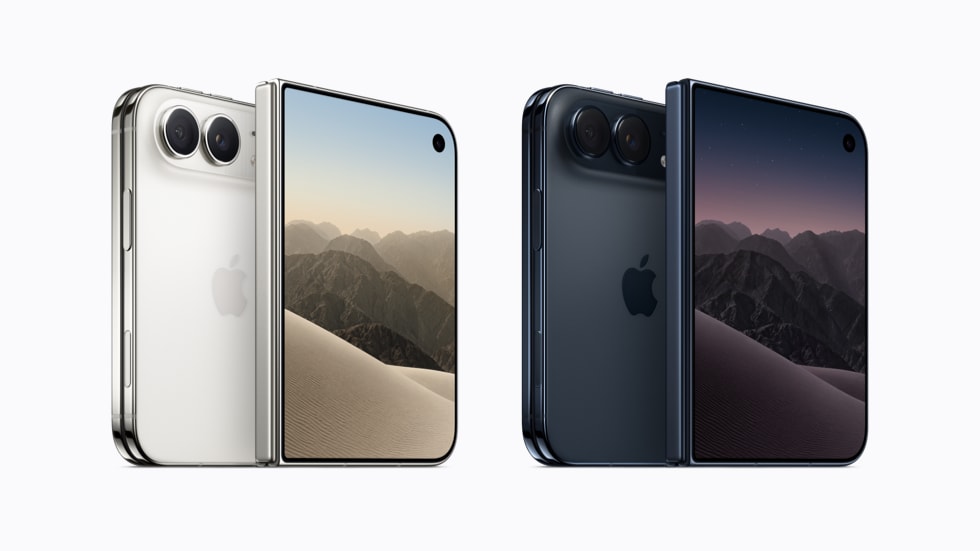
    Po lewej iPhone Duo po rozłożeniu, po prawej oba kolory: gwiezdna biel i nocne niebo. Źródło: Apple Newsroom

    Kiedy premiera iPhone’a Duo w Polsce i ile kosztuje?

    iPhone Duo trafi do Polski w pierwszej fali i kosztuje od 9 999 zł za wersję 256 GB. Sklep Apple podaje dwie daty: przedsprzedaż od piątku 16 października o 14:00 i dostępność od piątku 23 października 2026. Tego dnia telefon debiutuje w ponad 70 krajach i regionach, a 28 kolejnych dostanie go tydzień później.

    To prostuje spekulacje, że składany iPhone może na starcie ominąć Polskę. W sklepie Apple działa już konfigurator iPhone’a Duo z cenami w złotówkach.

    PamięćCena w PolsceCena w USA
    256 GB9 999 zł1 999 USD
    512 GB10 999 zł2 199 USD
    1 TB12 999 zł2 599 USD
    2 TB15 999 zł3 199 USD

    Leaks about the iPhone Fold mentioned a price of around $2,000, and they turned out to be accurate. The Polish price includes 23% VAT, while the American price is quoted without tax, which explains a large part of the difference in conversion. The 2 TB variant costs 15,999 zł, which is 5,700 zł more than the iPhone 17 Pro Max with the same memory in Apple’s August price list.

    Two screens and a hinge: how the foldable iPhone works

    The iPhone Duo opens like a book, just like the Galaxy Z Fold. When folded, it has a passport format: the 5.4-inch external screen provides 90% of the display area of the iPhone 18 Pro. When opened, you get 7.6 inches, and according to Apple, it’s a screen that is 50% larger than that of the iPhone 18 Pro Max.

    According to Apple, both screens have the same aspect ratio, so content scales proportionally, and the transition from the small screen to the large one is smooth. Additionally, there’s ProMotion up to 120 Hz, Always-On, and brightness up to 3000 nits in sunlight. By 2026, the Duo will support the Apple Pencil (USB-C).

    Screen crease and matte finish

    The internal screen features a nanostructured finish, which is a matte surface known from MacBook Pros and iPad Pros. It reduces glare and, according to Apple, limits the visibility of the crease line. The screen is protected by a polymer layer that, according to Apple, is up to 40% stiffer than materials previously used in the industry.

    The panel is surrounded on both sides by layers of durable glass, glued in such a way that they slide relative to each other like the pages of a book. Underneath, a titanium plate reinforces the whole structure. The hinge is made up of over 100 components, and together with the built-in magnet system, it ensures a secure and pleasant closing.

    Po lewej ekran zewnętrzny i wewnętrzny, po prawej Split View z Safari i aplikacją Siri. Źródło: Apple Newsroom

    iOS 27 na składanym ekranie

    System dostał osobny układ pod iPhone’a Duo. Dock i przyciski nawigacji przesuwają się na bok, a Dynamic Island wyświetla się pionowo przy krawędzi. Po rozłożeniu widzisz dwie strony ekranu głównego, z widżetami Dzisiaj po lewej.

    Największa nowość to Split View, czyli dwie aplikacje otwarte obok siebie. Żaden wcześniejszy iPhone tego nie potrafił, a na czerwcowej prezentacji iOS 27 podczas WWDC 2026 Apple jeszcze tego trybu nie pokazało. Odłożony na stół Duo przechodzi w tryb StandBy na dowolnym ekranie, także bez ładowarki.

    Netflix, Zoom i Slack mają już wersje dopasowane do dużego wyświetlacza.

    Aparaty iPhone’a Duo: dwa obiektywy 48 MP bez teleobiektywu

    At the back, there are two cameras: the main Fusion 48 MP (f/1.6, sensor stabilization) and the ultra-wide Fusion 48 MP (120°, macro), the same as in the iPhone 18 Pro. Instead of a telephoto lens, you get 2x optical quality zoom: the camera crops the center of the 48 MP sensor and saves a 12 MP photo.

    With the main camera, you can record 4K Dolby Vision video at 120 fps. At the front, there are two cameras: Center Stage 12 MP on the external screen and a FaceTime camera hidden under the internal screen.

    Sample photos from Apple: on the left, the main 48 MP camera, on the right, a group selfie from the Center Stage camera. Source: Apple Newsroom

    Two screens provide features that are not available on any other iPhone:

    • Duo Preview: the photographed person sees the frame on the external screen and can adjust their pose.
    • Selfie tylnymi aparatami: z podglądem na zewnętrznym ekranie, w wyższej rozdzielczości niż z przodu.
    • Inteligentna migawka: model AI sam robi zdjęcie, gdy wykryje, że pozujesz.
    • Animacja dla dziecka: na zewnętrznym ekranie pojawiają się Fistaszki, które ściągają wzrok malucha w stronę obiektywu.
    • Duo FaceTime: druga osoba dołącza do rozmowy przez ekran zewnętrzny.

    Wydajność i bateria składanego iPhone’a

    Duo ma ten sam czip A20 Pro co iPhone 18 Pro, ale chłodzi go komora parowa połączona bezpośrednio z procesorem. Według Apple przy długim obciążeniu daje to do 35% wyższą wydajność niż w iPhonie 17 Pro. Punktem odniesienia jest zeszłoroczny model, a nie iPhone 18 Pro z tym samym czipem.

    Zysk ma być odczuwalny w grach i przy długiej pracy na dwóch aplikacjach.

    W każdej połowie obudowy siedzi osobna bateria, a obie działają jak jedna. Apple nie podaje pojemności w mAh, tylko czasy pracy:

    ScenariuszCzas pracy według Apple
    Typowe użytkowaniedo 24 h
    Wideo na ekranie zewnętrznymdo 44 h
    Wideo na ekranie wewnętrznymdo 31 h
    Streaming na ekranie zewnętrznymdo 37 h
    Streaming na ekranie wewnętrznymdo 26 h

    Three compromises of the foldable iPhone

    There will be time for evaluation after the tests, but the specifications already show three weaknesses of the Duo. Check them out before ordering.

    1. It is the heaviest iPhone in history. It weighs 254 g and has a thickness of 11.3 mm when folded. Even the iPhone 18 Pro Max weighs 249 g. According to 9to5Google’s report, the Galaxy Z Fold 8 weighs 201 g at 9.7 mm, while the Pixel 11 Pro Fold weighs 239 g at 10.1 mm.

    The slimmest iPhone in the history of the Duo is only when unfolded: 5.2 mm.

    2. No Face ID or telephoto lens. Apple is returning to Touch ID on the side button, which works when the phone is open and closed. You can also unlock the Duo with an Apple Watch. If you often take photos from a distance, the iPhone 18 Pro with a 4x telephoto lens will do it better.

    3. Only eSIM and no Apple Intelligence in Polish. The Duo does not have a tray for a physical SIM card and supports only eSIM, with a maximum of two active numbers at the same time. Apple Intelligence works in 16 languages, among which Polish is not included.

    The new Siri AI launches on September 14 as a beta in English, but according to Apple, it will initially not be available in the EU, and thus also in Poland.

    You also won’t be able to immediately use the new iPhone Handoff feature (one number on two iPhones). Initially, it only works on T-Mobile networks in the USA and Telekom in Germany.

    Cases and screen protection for the iPhone Duo

    Apple showed off two of its own cases right away. iPhone Duo Case consists of two parts, one for each half, and costs 399 PLN. iPhone Duo Folio has a stand that allows you to set the phone at different angles and costs 629 PLN. Both can be ordered from October 16.

    On the left, the two-part iPhone Duo Case, on the right, the Folio with a stand. Source: Apple Newsroom

    The case for the foldable iPhone usually consists of two separate shells, as it needs to allow the hinge freedom of movement. No case from iPhone 17 or 18 will fit. Apple provided the official dimensions on September 9, so accessory manufacturers are just starting production.

    Screen protection for the foldable follows its own rules, which we have already outlined in glass and films for the Galaxy Z Fold 8:

    • External screen: tempered or hybrid glass, just like in a regular iPhone.
    • Internal screen: only flexible film, as rigid glass will not withstand bending.
    • Do not remove the factory layer of the internal screen: it is part of the display, not a transport film.
    • Matte effect: glossy film will cover the nanostructural finish, so choose matte film for Duo.

    We have already prepared the category of accessories for iPhone Duo, with separate sections for cases, films, and glasses. Products will appear in it when manufacturers release models compatible with Duo.

    How to charge the iPhone Duo: chargers and power banks

    There is no need to wait here. The box does not include a wall charger, and the iPhone Duo has specific requirements. Apple provides two values:

    • 50% in about 20 minutes with a USB PD wall charger of 60 W or higher and a USB-C cable supporting 60 W,
    • 50% in about 30 minutes with a MagSafe charger connected to a wall charger of 35 W or stronger.

    Wireless charging works with MagSafe and Qi2 up to 25 W. Qi2 15 W chargers should also work, just slower. The 20 W wall charger from the iPhone 12 era will also suffice, but charging will take longer than Apple states.

    The Duo will be available for sale only on October 23, so the chargers below were selected based on the parameters provided by Apple, not from our own tests with this phone.

    UGREEN Nexode Air 65W

    UGREEN Nexode Air 65W exceeds the 60 W threshold that Apple requires for the fastest charging. It has two USB-C ports and one USB-A, and thanks to GaN (gallium nitride) technology, it is small despite its high power. You will get the full 65 W with one connected device. When charging two at the same time, the power is divided between the ports, and the Duo may not receive the required 60 W.

    Satechi 3-in-1 Qi2 25W

    Satechi 3-in-1 Qi2 25W ładuje telefon pełną mocą Qi2 25 W, a przy okazji zegarek i słuchawki. Składana konstrukcja zajmuje po złożeniu niewiele miejsca, więc sprawdzi się też w podróży.

    Tech-Protect PB40 LifeMag 10 000 mAh

    Tech-Protect PB40 LifeMag is a magnetic power bank in the Qi2.2 standard, meaning it supports 25 W wireless charging. You attach it to the back of your phone and charge on the go without a cable. With a phone weighing 254 g, you will definitely feel each power bank in your hand.

    If you prefer a simple desk charger, Tech-Protect A54 MagSafe 25W Qi2.2 provides the same power in the form of a single disc.

    [hs_products ids=»76151,135816,141166,141896″ cols=»4″ title=»Chargers for iPhone Duo»]

    You can find more models in the categories inductive chargers and MagSafe accessories.

    Is it worth buying the iPhone Duo?

    It depends on what you use your phone for:

    • Buy if you want a large screen for movies, reading, and working on two applications, and you do not plan to leave the Apple ecosystem.
    • Choose the iPhone 18 Pro if you care about the telephoto lens, Face ID, and a lighter body. It is also noticeably cheaper.
    • Consider Galaxy Z Fold 8 if you use Android and weight and price matter more than water resistance.

    Also remember that this is the first generation. Apple did not specify how many opening cycles the hinge is designed for, and weaknesses of the first generation in new device categories are usually only improved in the second.

    Summary

    iPhone Duo is the first foldable iPhone and also the heaviest and most expensive iPhone that Apple has released. Key facts:

    1. Poland is in the first wave. Pre-order on October 16 at 2:00 PM, sales start on October 23, price from 9,999 PLN.
    2. Two screens with the same aspect ratio. 5.4 inches when folded, 7.6 inches when unfolded, with a matte finish and Split View.
    3. Compromises are real. 254 g, 11.3 mm when folded, no Face ID and telephoto lens, only eSIM, and Siri AI does not work in the EU at launch.
    4. The advantage over Samsung is IP68 and the ecosystem. Galaxy Z Fold 8 is lighter and cheaper.
    5. You can buy chargers today. A 60 W wall charger and a 25 W Qi2 charger will utilize the full capabilities of Duo.

    Tak, iPhone Duo jest wyposażony w technologię Face ID, która umożliwia odblokowanie telefonu za pomocą rozpoznawania twarzy.

    No. The foldable iPhone has Touch ID in the side button, which works when the phone is open and closed. You can also unlock it with an Apple Watch.

    Can I split the screen into two apps on the iPhone Duo?

    Yes. Split View opens two apps side by side on the inner screen, and even two windows of the same app, e.g. Safari. This is the first iPhone with such a feature.

    Can I put two SIM cards in the iPhone Duo?

    You can’t insert a physical card at all. The iPhone Duo only supports Dual eSIM, meaning two active numbers in digital form, so check if your operator issues eSIM before purchasing.

    Can I apply tempered glass to the inner screen of the iPhone Duo?

    No. Only flexible film is suitable for the inner screen, as rigid glass will not withstand bending. Use tempered glass only on the outer screen.

    Sources: Apple press release about the iPhone Duo, technical specifications of the iPhone Duo, iPhone Duo prices in the Apple store, prices in the USA and release dates on MacRumors, comparison of weight and thickness with Androids on 9to5Google, list of countries and languages from Apple Intelligence

  • Premiera iPhone’a 18 Pro i 18 Pro Max: co pokaże Apple

    Premiera iPhone’a 18 Pro i 18 Pro Max: co pokaże Apple

    iPhone 18 Pro and iPhone 18 Pro Max will debut on September 9, 2026 during the «Surprise and shine» conference at Apple Park. The date has been confirmed by Apple itself. Along with them, we will see the first foldable iPhone, two new watches, and AirPods 5. The basic iPhone 18 will not be at this conference, it will debut in spring 2027.

    Apple splits the year into two parts and for the first time shows a phone with a foldable screen. Instead of four premieres in September, we will get three, all from the highest shelf.

    Below: what will appear, what will be missing, and when sales will start. Finally, a question that we hear most often in the accessories store, whether the case from the iPhone 17 Pro will fit the eighteen.

    Note: the article was created before the conference. Apple confirmed the date and the event itself. Specifications, prices, and model lists come from leaks. We will update the text on September 9, after the presentation.

    When is the premiere of the iPhone 18 Pro? Date, pre-sale, and start of sales

    The conference will take place on Wednesday, September 9, 2026, at 7:00 PM Polish time. Apple sent invitations on August 26 and published the event on its website. You can watch the broadcast on apple.com, on YouTube, and in the Apple TV app.

    Promotional graphic for the Apple Surprise and shine conference on September 9, 2026

    Invitation graphic for the September conference. Source: Apple

    The sale dates have not yet been announced, but they follow Apple’s long-standing pattern.

    EventDateSource
    “Surprise and shine” conferenceWednesday, September 9, 2026, 7:00 PMconfirmed by Apple
    Pre-order startSaturday, September 12, 2026expected
    Sales startFriday, September 18, 2026expected

    One detail in this schedule is unusual. Pre-orders usually start on the first Friday after the conference, which would be September 11. This year marks the 25th anniversary of the 2001 attacks, and Apple consistently avoids this date for commercial launches.

    The same maneuver was executed by the company in 2015 with the iPhone 6s, shifting the order start to Saturday. Poland was included in the first wave of iPhone 17 sales (September 19, 2025), so September 18 is a realistic date for us as well.

    What will Apple show on September 9? Six devices

    According to Bloomberg, we will see six new products at the conference. Three of them are phones.

    DeviceWhat to expect
    iPhone 18 Pro6.3″, A20 Pro, narrower Dynamic Island (controversial)
    iPhone 18 Pro Max6.9″, largest battery in iPhone history, variable aperture
    iPhone Duofirst foldable iPhone, 7.6–7.8″ screen inside
    Apple Watch Series 12new processor, longer battery life, possible ceramic case
    Apple Watch Ultra 4Maps and photos via satellite
    AirPods 5two variants: with ANC and without

    All six items are leaks. Apple has only confirmed the date and the fact of the event.

    The name of the foldable model is not certain. In leaks, it is referred to as iPhone Fold, but internally Apple is said to use the term iPhone Duo; in our store, you will find it as iPhone Duo.

    What we won’t see at the conference

    This is just as important as the list of premieres. Base iPhone 18, iPhone 18e, and iPhone Air 2 are set to debut only in spring 2027, most likely in March or April. According to Mark Gurman from Bloomberg, iPhone Air 2 was never planned for 2026, so this is not a delay, but a new rhythm of releases.

    There will also be a lack of several other things:

    • Apple Watch SE 4 will not appear this year.
    • iPad mini, iMac and MacBook Pro are expected in the fall, outside of the September conference.
    • Face ID under the screen will not make it to the iPhone 18 Pro. The technology is not ready.

    What does this mean in practice: if you are waiting for a cheaper iPhone from this generation, September will not give you anything. The real choice for the fall is the iPhone 18 Pro, iPhone 18 Pro Max, or the discounted seventeen.

    iPhone 18 Pro and iPhone 18 Pro Max: what is changing

    The diagonals remain unchanged: 6.3 inches for the Pro version and 6.9 inches for the Pro Max. Changes are inside and in the camera.

    ParametriPhone 18 Pro (przeciek)iPhone 18 Pro Max (przeciek)
    Ekran6.3″, LTPO+6.9″, LTPO+
    ProcesorA20 Pro, 2 nmA20 Pro, 2 nm
    RAM12 GB12 GB
    Pamięć256 GB–2 TB256 GB–2 TB
    Aparat główny48 MP, zmienna przysłona niepewna48 MP ze zmienną przysłoną
    Aparat przedni24 MP24 MP
    Bateria4 288 mAh5 567 mAh
    ModemApple C2Apple C2
    Grubość8.8–9 mm (sporne)8.8–9 mm (sporne)
    Face ID pod ekranem❌❌

    Cztery zmiany zasługują na osobny komentarz.

    Zmienna przysłona w aparacie głównym. To pierwszy taki mechanizm w iPhonie. Funkcję zapowiedział Ming-Chi Kuo, a koreański ETNews donosił w kwietniu 2026 o starcie produkcji aktuatorów. Zmienna przysłona daje ręczną kontrolę nad głębią ostrości i lepiej radzi sobie po zmroku. Część przecieków sugeruje, że trafi wyłącznie do wersji Pro Max.

    Procesor A20 Pro w litografii 2 nm. TSMC dostarcza pierwszy układ Apple w tym procesie. Uwaga na liczby krążące w sieci: 10–15% wyższej wydajności ALBO 25–30% niższego poboru energii to parametry samego procesu N2, których nie wolno sumować. Realny zysk Apple rozdzieli między jedno i drugie.

    Węższa Dynamic Island. Ice Universe claims that the island will slim down by about 35%, from 20.7 mm to 13.5 mm. Digital Chat Station denies this and pushes the change to the iPhone 19. This is the most contentious point of the entire leak.

    Węższa Dynamic Island na zdjęciu prototypu iPhone'a 18 Pro z przecieku

    Prototype photo where Dynamic Island is clearly narrower. Source: MacRumors

    Camera Control is set to be simplified. According to Instant Digital, the button will lose its capacitive layer and will only respond to pressure. For the case, this is irrelevant, as the cutout remains in place.

    Colors of the iPhone 18 Pro and 18 Pro Max

    Reports from the supply chain mention four finishes, each with an assigned Pantone code: Dark Cherry (wine red with a purple undertone), Light Blue, Dark Gray, and Silver. The palette is common for both models.

    On the left, color renderings; on the right, production line mockups. Source: Macworld and MacRumors

    Dark Cherry is set to replace Cosmic Orange as the primary color, which you will see in all promotional materials. The orange from the seventeenth generation is being discontinued.

    Foldable iPhone Duo: Apple’s first such phone

    This is the most anticipated element of the conference. Apple enters the foldable phone market seven years after Samsung and immediately aims for the high end.

    ParameteriPhone Duo (leak)
    Internal display7.6–7.8″, aspect ratio 4:3
    External display5.3–5.5″
    Thickness unfoldedapprox. 4.5 mm
    Thickness folded9–9.5 mm
    BiometricsTouch ID in the power button
    Cameras48 MP wide + 48 MP ultra-wide
    Battery5,400–5,800 mAh
    ProcessorA20, 12 GB RAM, vapor chamber
    Price (estimates)from approx. $2,000

    Mockup i zdjęcie z przecieku pokazują dwa aparaty i brak teleobiektywu. Źródło: Sonny Dickson via MacRumors

    Projekt wyróżniają dwie rzeczy, na które Apple wyraźnie postawiło.

    Zagniecenie ma być praktycznie niewidoczne. Apple pracowało nad tym bez oglądania się na koszty i opracowało nowy materiał. Przecieki mówią o głębokości zagniecenia poniżej 0.15 mm i kącie poniżej 2,5 stopnia. Zawias ma być wykonany ze stopu Liquidmetal.

    Nie będzie Face ID. W tak cienkiej obudowie nie zmieścił się moduł TrueDepth, więc Apple wraca do Touch ID wbudowanego w przycisk zasilania. To pierwszy flagowy iPhone bez rozpoznawania twarzy od 2017 roku.

    Brakuje też teleobiektywu. Dwa aparaty 48 MP to mniej niż w Pro Max. A przy szacunkach zaczynających się od około 2 000 dolarów i sięgających blisko 3 000 dolarów za wersję 1 TB mówimy o najdroższym iPhonie w historii.

    Apple Watch Series 12, Ultra 4 i AirPods 5

    Both watches will receive at least the S11 processor, longer battery life, and improvements in activity tracking. Mark Gurman announces no changes in appearance compared to Series 11 and Ultra 3.

    The distinguishing feature of Ultra 4 is expected to be satellite functions: Apple Maps via satellite and sending and receiving photos in Messages without network coverage. For those hiking in the mountains, this is a significant change, not just cosmetic.

    There will be no Touch ID in the watch, a band with health sensors, or blood sugar measurement. The latter feature is expected to appear only around 2030. There will also be no Apple Watch SE 4.

    If you’re wondering whether it’s worth the wait, our comparison of Apple Watch Ultra 2 and Ultra 3 will be helpful. You can find bands and screen protection for both series in the Apple Watch category.

    AirPods 5: again two variants, with ANC and without

    Apple is expected to show two models of AirPods 5: with active noise cancellation and without it. References to both variants were found in the code of macOS 26.7.

    There is also a version circulating about the H3 chip, which would reduce audio latency and improve battery life. This is still speculation, not confirmed information.

    Heart rate measurement is reserved for Pro models. If you are looking for headphones with health features, the direction remains AirPods Pro 3.

    iPhone 18 Pro, price in Poland: how much will it cost?

    No one knows the price yet. The reference point is the current Apple price list. iPhone 17 Pro starts at 5,799 PLN, 17 Pro Max at 6,299 PLN, both prices for the 256 GB version. For the Pro Max with 2 TB, you will pay 10,299 PLN.

    Analysts are predicting a price increase. The main forecast (Jeff Pu) suggests 250–300 dollars more than the seventeen, although some analysts are betting on 100–200 dollars. In a pessimistic scenario, the iPhone 18 Pro in Poland would start around 6,800 PLN.

    It is worth debunking one myth circulating online: 2 nm lithography chips are not twice as expensive. TSMC has raised the price of the N2 wafer by 10–20% compared to N3. The “50%” figure refers to the camera module with a variable aperture, not the processor.

    Will the case from the iPhone 17 Pro fit the 18 Pro?

    This gets interesting, as the answer is different for the case and different for camera protection.

    Case: most likely yes. OtterBox has already introduced cases described as fitting both the iPhone 17 Pro and 18 Pro. Matt Ronge from Astropad hears the same from suppliers: the body is expected to remain the same dimensions, with an unchanged button layout and cutouts.

    Comparison of the iPhone 17 Pro and iPhone 18 Pro dummies showing the same dimensions

    Dummy of the iPhone 17 Pro (on the left) compared to the dummy of the iPhone 18 Pro. Source: Vadim Yuryev via MacRumors

    The same is visible in our offer. Cases that have made it to the iPhone 18 Pro category have the suffix “for Apple iPhone 18 Pro / 17 Pro” in their names, one case for two models. This is how products from Tech-Protect, Benks, as well as the Guess and Karl Lagerfeld series are described.

    Camera protection: no longer. We have lens island and glass covers available separately for the iPhone 18 Pro, even though the cases are common. The camera island grows from 11.23 to 11.54 mm, and that is enough for the cover from the seventeen to no longer fit.

    Note: not all leaks agree. A report attributed to Tata mentions a body thicker by 2 mm, i.e., 9.9–10.9 mm instead of 8.75 mm in the iPhone 17 Pro. If true, no case from the seventeen would fit. Mark Gurman also called the display of cases for the 18 Pro on Best Buy shelves “a bit premature.” We will have certainty on September 9.

    Tech-Protect BasicMag MagSafe

    Matowa obudowa z wbudowanym pierścieniem magnetycznym, opisana przez producenta jako pasująca do iPhone’a 17 Pro i 18 Pro. Trzyma się ładowarek MagSafe bez adapterów.

    Benks Magnetic Crystal

    Przezroczysta wersja z magnesami i osobnym wycięciem na Camera Control. Jeśli kupujesz iPhone’a w kolorze Dark Cherry, to etui go nie zasłoni.

    Benks Ultra Shield HD Glass

    Screen glass with a frame that facilitates bubble-free installation. Repairing the screen on an iPhone Pro costs thousands of zlotys, so the glass pays for itself with the first drop.

    Tech-Protect Cam Fit

    Cover for the entire camera island, designed exclusively for the iPhone 18 Pro. This is the element you won’t transfer from the seventeenth.

    [hs_products ids=»142073,142624,142492,142097″ cols=»4″ title=»Accessories for iPhone 18 Pro»]

    You can also find the full offer in the category iPhone 18 Pro Max. The category of accessories for the foldable iPhone Duo will be filled after the premiere when Apple provides the official dimensions.

    If you are transitioning from an older model, a review of MagSafe accessories will be useful. The standard does not change between generations, so you can transfer magnetic chargers and power banks without additional purchases.

    Summary

    The Apple conference will take place on September 9, 2026, at 19:00 Polish time. Apart from the official pricing of the current generation, this is the only confirmed information in this article. The rest are leaks of varying degrees of credibility.

    Four things worth remembering:

    1. We will see three phones, not four. iPhone 18 Pro, iPhone 18 Pro Max, and the foldable iPhone Duo. The basic eighteen, model 18e, and iPhone Air 2 will debut in spring 2027.
    2. The biggest change is the camera, not the screen. The variable aperture is the first of its kind in iPhone history and may only be available on the Pro Max.
    3. Foldable iPhone ditches Face ID. Touch ID returns in the power button, and the price is expected to start at around $2,000.
    4. iPhone 17 Pro cases should fit, camera covers do not. Manufacturers describe the cases as common for both generations, but the camera island protection has been prepared separately.

    We will update the article on September 9, when Apple will provide the official specifications, prices, and sales dates in Poland. It’s worth revisiting our comparison of iPhone 16 Pro and 17 Pro to assess whether the upgrade makes sense.

    FAQ: most common questions about iPhone 18 Pro

    When is the iPhone 18 Pro premiere?

    The iPhone 18 Pro will be unveiled on September 9, 2026, at 7:00 PM Polish time during the “Surprise and shine” conference. The date has been confirmed by Apple. Sales should start on Friday, September 18, with pre-orders beginning on Saturday, September 12.

    Will there be a regular iPhone 18?

    Not at the September conference. The basic iPhone 18, iPhone 18e, and iPhone Air 2 are expected to debut in spring 2027, likely in March or April.

    How much will the iPhone 18 Pro cost? Price in Poland

    The price has not been announced. The current iPhone 17 Pro costs from 5,799 PLN in Poland, and the main forecast from analysts suggests an increase of around 250–300 dollars. This would start at around 6,800 PLN.

    Will the foldable iPhone be released this year?

    Yes, according to all leaks, it will debut on September 9 along with the Pro series. It is expected to be called iPhone Duo, have a 7.8-inch screen when unfolded, and feature Touch ID instead of Face ID. Price estimates start at around 2,000 dollars.

    Does the case from the iPhone 17 Pro fit the iPhone 18 Pro?

    Most likely yes. Case manufacturers, including OtterBox, Tech-Protect, and Benks, describe the new cases as compatible with both models. The camera covers are already separate, as the camera island is slightly growing.

    What colors will the iPhone 18 Pro have?

    Leaks from the supply chain indicate four finishes: Dark Cherry, Light Blue, Dark Gray, and Silver. Dark Cherry, which is a wine red with a purple undertone, is set to replace Cosmic Orange as the leading color.

    What else will Apple show on September 9?

    In addition to the three phones, Apple Watch Series 12, Apple Watch Ultra 4, and AirPods 5 in two variants: with active noise cancellation and without it, are expected. iPads and Mac computers are set for a separate launch in the fall.

    Sources: official Apple event page, announcement of the conference and list of six devices on MacRumors, complete leak summary about iPhone 18 Pro, leaks about the foldable iPhone, what to expect from Apple Watch Series 12 and Ultra 4, OtterBox on compatibility of iPhone 17 Pro cases with 18 Pro, iPhone Air 2 and 18e not until spring 2027

  • POCO F9 Pro and F9 Ultra: everything we know before the premiere

    POCO F9 Pro and F9 Ultra: everything we know before the premiere

    POCO F9 Pro and F9 Ultra will debut globally on September 1, 2026 at an online event. This date has been confirmed by POCO itself. Both models are global versions of the Redmi K100 Pro and K100 Pro Max, but with noticeably smaller batteries than the Chinese originals. Leaks indicate Snapdragon 8 Elite Gen 5, a 200 MP camera, and an 8,050 mAh battery in the Ultra version.

    There are a few days left until the premiere, and most of the cards are already on the table. POCO itself has shown both phones in their premiere colors, and GSMArena has published the full specification leak.

    Below you will find a clear division between what the manufacturer has officially confirmed and what comes solely from leaks. Additionally, a complete comparison table of both models and an answer to the question of which one makes sense for whom.

    Note: This article was created before the official premiere. Data marked as leaks have not been confirmed by the manufacturer. We will update it on September 1, 2026, after the event.

    When is the POCO F9 premiere? The date is already certain

    The global premiere of the POCO F9 series will take place on September 1, 2026 during an online presentation. The date has been confirmed by POCO itself, making it one of the few certainties in this article, alongside the model names and colors.

    We will see two models: POCO F9 Pro and POCO F9 Ultra. The manufacturer has already shown both phones in selected colors: Ultra in Dark Cherry, Pro in Aurora Green.

    It’s a short time from announcement to release, typical for the brand. POCO rarely drags out pre-launch campaigns and usually puts phones on sale a few days after the showcase.

    What POCO has officially confirmed and what is a leak

    This division matters because both operate alongside each other online, without a label.

    InformationStatus
    Release date September 1, 2026✅ confirmed by POCO
    Two models: F9 Pro and F9 Ultra✅ confirmed by POCO
    Colors Dark Cherry and Aurora Green✅ officially shown
    Full technical specification❌ leak
    Battery capacities❌ leak
    Prices in euros❌ leak

    Leaks have unusually strong foundations here. Both phones are global versions of Redmi models that have already debuted in China: F9 Pro corresponds to Redmi K100 Pro, and F9 Ultra to Redmi K100 Pro Max.

    However, this does not mean that the specifications are identical. Global versions receive noticeably smaller batteries than their Chinese originals and this is the most important information from the entire leak.

    ModelBattery in ChinaBattery globallyDifference
    Redmi K100 Pro → POCO F9 Pro8,580 mAh6,330 mAh−2,250 mAh
    Redmi K100 Pro Max → POCO F9 Ultra9,070 mAh8,050 mAh−1,020 mAh

    POCO F9 Pro loses over a quarter of its capacity compared to the Chinese original. The screen diagonal also changes: the Redmi K100 Pro has 6.56 inches, while the POCO F9 Pro has 6.59 inches.

    POCO F9 Pro and F9 Ultra specifications: full table

    All data in the table comes from leaks and pertains to the Chinese counterparts.

    ParametrPOCO F9 Pro (przeciek)POCO F9 Ultra (przeciek)
    Odpowiednik w ChinachRedmi K100 ProRedmi K100 Pro Max
    Ekran6.59″, 1156 × 2510 AMOLED6.9″, 1200 × 2608 AMOLED
    Odświeżanie185 Hz185 Hz
    Jasność szczytowa4 500 nitów4 500 nitów
    SzkłoGorilla Glass 7iGorilla Glass 7i
    ProcesorSnapdragon 8 Elite Gen 5Snapdragon 8 Elite Gen 5
    RAM12 lub 16 GB12 lub 16 GB
    Pamięć256 lub 512 GB256 lub 512 GB
    Aparat główny200 MP z OIS200 MP z OIS
    Teleobiektyw50 MP, zoom optyczny 2.5×50 MP peryskop, zoom 5×
    Ultraszerokokątny8 MP50 MP
    Selfie32 MP32 MP
    Bateria6 330 mAh8 050 mAh
    Ładowanie przewodowe100 W100 W
    Ładowanie bezprzewodowe50 W50 W
    Konstrukcjametalowa ramka, plecy z tworzywametalowa ramka, pierścień LED
    OdpornośćIP68IP68
    Głośnikistrojone przez Bosestrojone przez Bose

    Trzy pozycje z tej tabeli zasługują na komentarz.

    Ładowanie bezprzewodowe 50 W. Bazy specyfikacji podają je dla obu modeli, razem z ładowaniem zwrotnym 27 W po kablu i 22.5 W bezprzewodowo. To wartości nietypowo wysokie jak na indukcję.

    185 Hz is not just a number for the folder. A panel with such a refresh rate makes sense mainly in games, and that’s exactly how POCO positions the entire F series.

    LED ring in the Ultra version is an element that is not present in the Pro. The backlight near the speaker module on the camera island signals notifications.

    Beware of the resistance class: the specification bases indicate IP68 for global versions, while the Chinese originals have IP66/68/69. Some leaks attribute IP69 to POCO models as well. Resolution on September 1.

    Beware of the processor: the Chinese Redmi K100 Pro uses a more power-efficient variant of the Snapdragon 8 Elite Gen 5 V Series with a lower clocked graphics chip. It is unclear whether POCO F9 Pro will get the same variant or the full version of the chip. In the case of F9 Ultra, leaks indicate the standard version.

    What are the differences between POCO F9 Pro and F9 Ultra?

    Both phones have the same processor, the same screen in terms of refresh rate and brightness, and the same main camera of 200 MP. The real differences are three.

    Ultrawide camera: 8 MP vs 50 MP. This is the biggest difference in specifications and also the most often overlooked. With the identical main camera, it is the «wide angle» that determines whether landscape and interior photos will be useful.

    Bateria: 6 330 mAh kontra 8 050 mAh. Różnica to ponad 1 700 mAh, więcej, niż dzieli kolejne generacje tego samego modelu. W Ultra to zapas na drugi dzień pracy bez ładowarki.

    Zoom: 2.5× kontra 5× peryskop. Peryskop w wersji Ultra daje realny zasięg optyczny, a nie kadrowanie cyfrowe.

    Ekran w Ultra jest większy (6.9″ wobec 6.59″), ale to różnica, którą część osób uzna za wadę, nie zaletę.

    Nasz wybór: jeśli fotografujesz szerokim kątem lub potrzebujesz baterii na dwa dni, dopłata do wersji Ultra ma sens. Jeśli używasz głównie aparatu głównego, POCO F9 Pro daje ten sam procesor i ten sam sensor 200 MP.

    Co POCO F9 Ultra zmienia względem POCO F8 Ultra?

    POCO F8 Ultra zadebiutował 26 listopada 2025 i wciąż jest aktualnym flagowcem marki; zestawiliśmy go wcześniej z poprzednikiem w porównaniu F8 Ultra i F7 Ultra. Zestawienie obu modeli pokazuje, gdzie leży realny postęp, a gdzie go nie ma.

    ParametrPOCO F8 UltraPOCO F9 Ultra (przeciek)
    ProcesorSnapdragon 8 Elite Gen 5Snapdragon 8 Elite Gen 5
    Ekran6.9″, 1200 × 2608, 120 Hz6.9″, 1200 × 2608, 185 Hz
    Aparat główny50 MP200 MP
    Ultraszerokokątny50 MP50 MP
    Teleobiektyw50 MP peryskop, zoom 5×50 MP peryskop, zoom 5×
    Bateria6 500 mAh8 050 mAh
    Ładowanie przewodowe100 W100 W
    Ładowanie bezprzewodowe50 W50 W
    OdpornośćIP68IP68

    Wnioski są trzy. Procesor się nie zmienia: to ten sam Snapdragon 8 Elite Gen 5, więc skoku wydajności nie będzie. Zmienia się aparat główny i odświeżanie, czyli 200 MP zamiast 50 MP oraz 185 Hz zamiast 120 Hz. Bateria rośnie o 1 550 mAh, co przy tym samym układzie powinno przełożyć się wprost na czas pracy.

    Reszta zostaje bez zmian: ładowanie 100 W po kablu i 50 W indukcyjnie, ta sama przekątna i rozdzielczość, ta sama klasa odporności. Jeśli masz F8 Ultra, sensownym powodem do wymiany są tylko bateria i odświeżanie.

    Ile będzie kosztować POCO F9 Pro i F9 Ultra?

    Ceny nie zostały potwierdzone. Z przecieków wynika, że POCO F9 Pro wystartuje od 799 EUR w wersji 12 GB / 256 GB. POCO F9 Ultra ma kosztować 999 EUR za wariant 16 GB / 512 GB.

    In terms of conversion, it’s roughly 3,400 PLN for the Pro version and about 4,200 PLN for the Ultra. These are the leaked starting prices for the European market, and POCO traditionally cuts them with promotions in the first days of sales.

    It’s worth keeping in mind that Polish launch prices are rarely a straightforward conversion from euros. We will know the real amounts on September 1st.

    100 W Charging: What to Prepare Before the Launch

    Both models are expected to support 100 W wired charging. At this power level, it matters which charger you connect.

    Full 100 W in Xiaomi and POCO phones usually requires the manufacturer’s charger with the proprietary HyperCharge protocol, and the charging speed from chargers of other brands can be lower. We described the same mechanism in our guide on chargers for POCO F8 Ultra. USB Power Delivery (USB PD) chargers from other brands will charge the phone quickly, but usually slower than the manufacturer’s block. We will confirm this after the launch, when we know the official charging specifications.

    Regardless, a powerful GaN charger (gallium nitride) will be useful from day one, and it will also handle a laptop. We have gathered the smallest high-power designs in the ranking of GaN chargers.

    Tech-Protect PowerVision NC100W-GaN: 100 W with power preview

    Trzy porty, moc 100 W i wyświetlacz pokazujący aktualny pobór w watach. Przy telefonie, którego prędkość ładowania zależy od protokołu, możliwość sprawdzenia realnej mocy jest praktyczna.

    UGREEN Nexode Pro 100W GaN: kompaktowa kostka do plecaka

    Three ports in a casing that you can easily throw into your backpack. It will charge your phone, tablet, and laptop, and GaN technology keeps the operating temperature low.

    [hs_products ids=»142549,76146″ cols=»2″ title=»GaN Chargers 100 W»]

    To charge at high power, you also need the right cable. Check USB-C to USB-C cables with a current capacity of 5 A and power banks for fast charging if you often charge your phone outside the home.

    Will accessories from POCO F8 fit F9?

    Almost certainly not. We do not know the official dimensions of POCO F9, but the change in the camera island layout and diagonal compared to the F8 series means that cases and glass from the previous generation should not fit. We will know the dimensions on September 1st.

    This is a standard situation when changing generations, and it is worth remembering before you buy accessories in advance. Dedicated cases and glass for POCO F9 will be available for sale after the premiere.

    Until then, you can check the offer for the predecessors: cases and glass for POCO F8 Pro and accessories for POCO F8 Ultra. The scale of this offer well shows what to expect with F9.

    Summary

    POCO F9 Pro and F9 Ultra debut on September 1, 2026 during an online presentation. Apart from the date, only the model names and colors are officially confirmed.

    Three things to remember before the premiere:

    1. Global versions have smaller batteries than the Chinese ones. F9 Pro loses to the Redmi K100 Pro by as much as 2,250 mAh, and F9 Ultra loses to the K100 Pro Max by 1,020 mAh.
    2. The ultra-wide camera differentiates these models more than the zoom. 8 MP in Pro compared to 50 MP in Ultra is a difference noticeable in every wide-angle photo.
    3. Battery of 8,050 mAh in the Ultra version is a value rarely found in a phone with a flagship processor.

    We will update the article on September 1, when POCO provides the official specifications and Polish prices.

    Źródła: pełny przeciek specyfikacji i cen POCO F9 w GSMArena, potwierdzona data globalnej premiery i kolory w GSMArena, premiera Redmi K100 Pro i K100 Pro Max w Chinach — GSMArena, karta specyfikacji POCO F9 Ultra — GSMArena, specyfikacja i ceny w Europie według Android Authority

    FAQ: najczęstsze pytania o POCO F9

    Kiedy wychodzi POCO F9?

    Globalna premiera serii POCO F9 odbędzie się 1 września 2026 podczas eventu online. Datę potwierdziło samo POCO. Sprzedaż zwykle rusza w ciągu kilku dni od prezentacji.

    Czy Xiaomi i POCO to to samo?

    POCO to podmarka Xiaomi, działająca jako osobna linia produktowa. Telefony powstają na bazie modeli Xiaomi i Redmi, ale mają własną nazwę i pozycjonowanie. POCO F9 Pro i F9 Ultra to przebrandowane Redmi K100 Pro i K100 Pro Max.

    Ile będzie kosztować POCO F9 Ultra?

    According to leaks, the POCO F9 Ultra will start at 999 EUR for the 16 GB RAM and 512 GB storage variant, which is about 4,200 PLN. The Pro version is expected to start at 799 EUR for 12 GB RAM and 256 GB. Prices have not been confirmed by the manufacturer.

    What are the differences between the POCO F9 Pro and F9 Ultra?

    Three things: an ultra-wide camera (8 MP vs. 50 MP), battery (6,330 mAh vs. 8,050 mAh), and zoom (2.5× vs. periscope 5×). The processor, main camera 200 MP, and refresh rate 185 Hz are identical.

    Is the POCO F9 Ultra a flagship?

    Yes. Snapdragon 8 Elite Gen 5, main camera 200 MP, 100 W charging, and speakers tuned by Bose make it a flagship set. POCO traditionally offers such specifications cheaper than higher-positioned brands.

    Does the case from POCO F8 fit the POCO F9?

    Almost certainly not. The diagonal and the layout of the camera island change, so accessories from the F8 series should not fit. We will have certainty on September 1, when POCO will provide the official dimensions.

    Are POCO phones good?

    POCO aims for high performance at a lower price than premium brands. The F series features flagship processors, bright displays, and fast charging, usually at the cost of minor details: updates may be shorter, and cases less frequently use more expensive materials. For gamers and those demanding performance, it is a strong proposition.
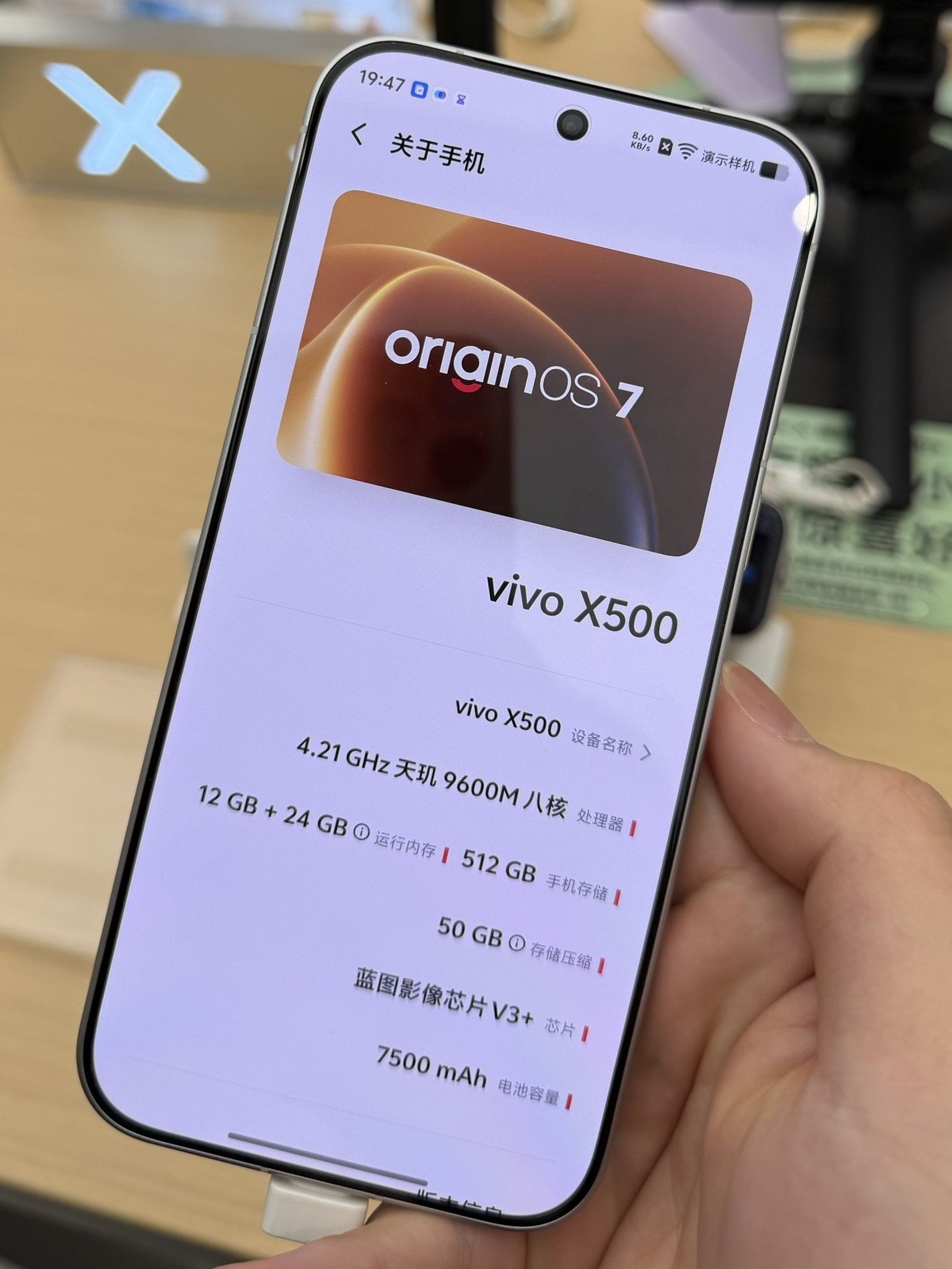
  • ColorOS 17 — what’s new and which phones will receive the update

    ColorOS 17 — what’s new and which phones will receive the update

    ColorOS 17 — co nowego i które telefony dostaną aktualizację

    OPPO uruchomiło zamkniętą betę ColorOS 17. Wiemy już, które telefony dostaną ją jako pierwsze, jak zmieni się wygląd systemu i — co najciekawsze — że przy okazji znika osobna nakładka Realme UI.

    Zebraliśmy to, co potwierdzone, i oddzieliliśmy od tego, co na razie jest przeciekiem.

    Które telefony są w becie ColorOS 17

    Rejestracja do zamkniętych testów ruszyła 6 sierpnia 2026, z pulą 300 miejsc na model. Na rynku globalnym objęła sześć urządzeń:

    Telefon Akcesoria w naszym sklepie
    OnePlus 15 etui i szkła do OnePlus 15
    OnePlus 15R etui i szkła do OnePlus 15R
    OPPO Find X9 Pro etui i szkła do Find X9 Pro
    OPPO Reno15 Pro etui i szkła do Reno15 Pro
    OPPO Reno15 Pro Mini akcesoria do serii Reno15
    Realme GT 8 Pro etui i szkła do realme GT8 Pro

    W Chinach lista jest szersza — obejmuje też Find X9 Ultra, Find X9s Pro, Find N6, tablet Pad 5 Pro oraz OnePlus 15T i OnePlus Tablet 3 Pro.

    Kompilacje beta trafiają do testerów w dwóch turach: 11 i 13 sierpnia 2026. Okno rejestracji już się zamknęło, więc jeśli nie zdążyłeś — pozostaje czekać na otwartą betę albo stabilne wydanie.

    Czy warto instalować betę?

    Uwaga: zamknięta beta to oprogramowanie testowe. Zanim ją zainstalujesz, zrób
    kopię zapasową — powrót do stabilnej wersji zwykle wymaga wyczyszczenia telefonu.

    Krótko: if this is your only phone, skip it. The closed beta is early software where contactless payments, banking, or the camera may not work. Additionally, reverting to the previous version usually requires wiping the phone.

    Beta makes sense if you have a spare device and want to report bugs. Otherwise, the stable version will come on its own and will just work.

    What’s new in ColorOS 17

    New Apple-inspired look

    The most noticeable change is the graphical layer. According to reports, OPPO is adopting solutions reminiscent of Liquid Glass from Apple systems — semi-transparent layers that refract what is underneath them.

    However, it is worth tempering expectations here. People who have seen early builds describe the effect more as «liquid acrylic» than glass — the light refraction is clearly weaker than with Apple. Additionally, there are more consistent corner rounding and light effects in notifications.

    More refinement than revolution

    And this is probably the most important information for those considering the update. OPPO has confirmed that ColorOS 17 focuses on refining the interface rather than overhauling the way it operates. Don’t expect a new settings layout or a rearrangement of gestures.

    For some users, this is an advantage — there’s no need to learn anything new. For those who were hoping for significant changes, the update may seem unimpressive.

    Podstawa: Android 17

    ColorOS 17 ma bazować na Androidzie 17. Google wydaje kolejne wersje systemu jesienią, więc harmonogram się zgadza — a OPPO od kilku lat trzyma się rytmu, w którym nowa nakładka pojawia się w ciągu kilku tygodni od premiery czystego Androida.

    ColorOS 16 a ColorOS 17 — co się właściwie zmienia

    Jeśli masz dziś ColorOS 16, oto uczciwe zestawienie tego, na co możesz liczyć.

    ColorOS 16 ColorOS 17
    Podstawa Android 16 Android 17
    Wygląd matowe, jednolite panele półprzezroczyste warstwy, efekty świetlne
    Zaokrąglenia niespójne między ekranami ujednolicone w całym systemie
    Układ ustawień bez zmian bez zmian
    Gesty i nawigacja bez zmian bez zmian

    Krótko mówiąc: zmienia się to, co widać, a nie to, jak się telefonu używa. Jeśli szukasz nowych funkcji, ta aktualizacja Cię nie zaskoczy. Jeśli zależy Ci na tym, żeby wszystko działało tak jak dotąd, tylko wyglądało nowocześniej — dostaniesz dokładnie to.

    Warto też pamiętać o rzeczy, o której przy okazji aktualizacji rzadko się mówi: nowa wersja Androida to także nowe poprawki bezpieczeństwa. To zwykle mocniejszy argument za aktualizacją niż sam wygląd.

    Koniec Realme UI — co to znaczy dla użytkowników

    To wątek, który w polskich mediach dotąd przeszedł niemal bez echa.

    Realme potwierdziło pod koniec lipca 2026, że wygasza własną nakładkę Realme UI i przechodzi na ColorOS. Nowe telefony mają wychodzić już z ColorOS-em, a starsze modele dostaną go wraz z aktualizacją.

    Zanim jednak ktokolwiek zacznie się martwić: w praktyce niewiele się zmienia. Realme UI i ColorOS dzielą wspólny kod co najmniej od 2022 roku, więc mówimy przede wszystkim o zmianie nazwy i ujednoliceniu wyglądu, a nie o wymianie systemu.

    Trzy zastrzeżenia, o których warto wiedzieć:

    • Ogłoszenie dotyczyło rynku indyjskiego. Nie ma potwierdzenia, że w tym samym kształcie obejmie Europę.
    • Nie ma harmonogramu. Realme nie podało, kiedy starsze modele dostaną ColorOS.
    • Lista wspieranych telefonów krążąca po sieci jest domniemana, nie oficjalna. Realme nie opublikowało jeszcze wykazu.

    Jeśli masz telefon Realme, na razie nie musisz nic robić. Akcesoria oczywiście zostają te same — etui i szkła pasują niezależnie od tego, jaka nakładka chodzi na telefonie.

    Kiedy stabilna wersja ColorOS 17?

    Oficjalnej daty nie ma. Po harmonogramie bety i rytmie poprzednich lat można zakładać, że stabilne wydanie ruszy jesienią 2026, zaczynając od najnowszych flagowców.

    The order is usually as follows: first China, then India, and finally Europe. It can take several weeks between the first and the last market, so if the update doesn’t come immediately — that’s normal.

    How to check if your phone has received an update

    The procedure is the same on all OPPO, OnePlus, and Realme phones:

    1. Open Settings
    2. Go to System and updates
    3. Select Software update
    4. Tap the refresh icon or wait for the automatic check

    If an update is available, you will see it on this screen. It’s worth connecting the phone to a charger and Wi-Fi — system packages can weigh several gigabytes, and an interrupted installation is the most common cause of problems after an update.

    Before a major update, it’s always a good idea to make a backup. Even if theoretically the data remains untouched, a few minutes for a backup is a cheap way to ensure peace of mind.

    Frequently Asked Questions

    Will my phone get ColorOS 17? If it’s a flagship OPPO, OnePlus, or Realme from the last two years — most likely yes. There is no complete list yet; six models from the beta are just the beginning, not a complete list of supported devices.

    Is ColorOS 17 a big change? No. OPPO itself describes it as a refinement of the interface. The appearance will change, but not the way of operation.
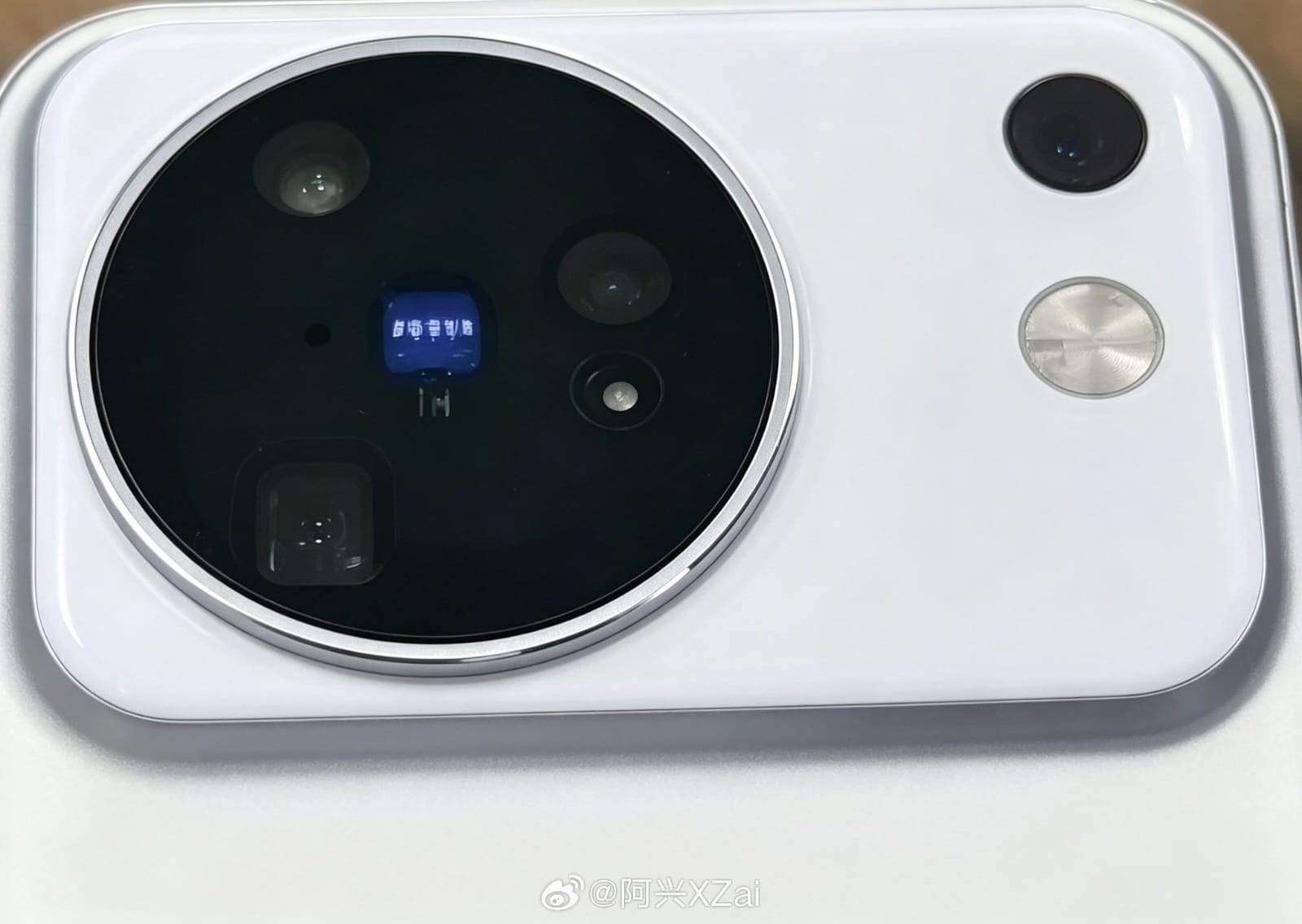
    Will I lose data during the update? With a regular update of the stable version — no. When installing a beta and later reverting to an older version — usually yes, so make a backup before the beta.

    Will Realme UI disappear from my phone? Not overnight. The change concerns future updates, it was announced in the Indian market, and the systems have been sharing common code for years anyway.

    Is it worth waiting to buy a phone for ColorOS 17? No. Phones purchased today will receive the update, and the release date is unknown. Choose the hardware based on what it offers now.

    Will I need to change the case after the update? No — the system update does not change the dimensions of the phone. All accessories for OPPO devices fit the same.

    Summary

    ColorOS 17 promises to be a smooth update: a refreshed look inspired by Apple solutions, based on Android 17, and tidying up instead of a revolution. The biggest organizational change is the phasing out of Realme UI, although for users, this mainly means a different name on the system information screen.
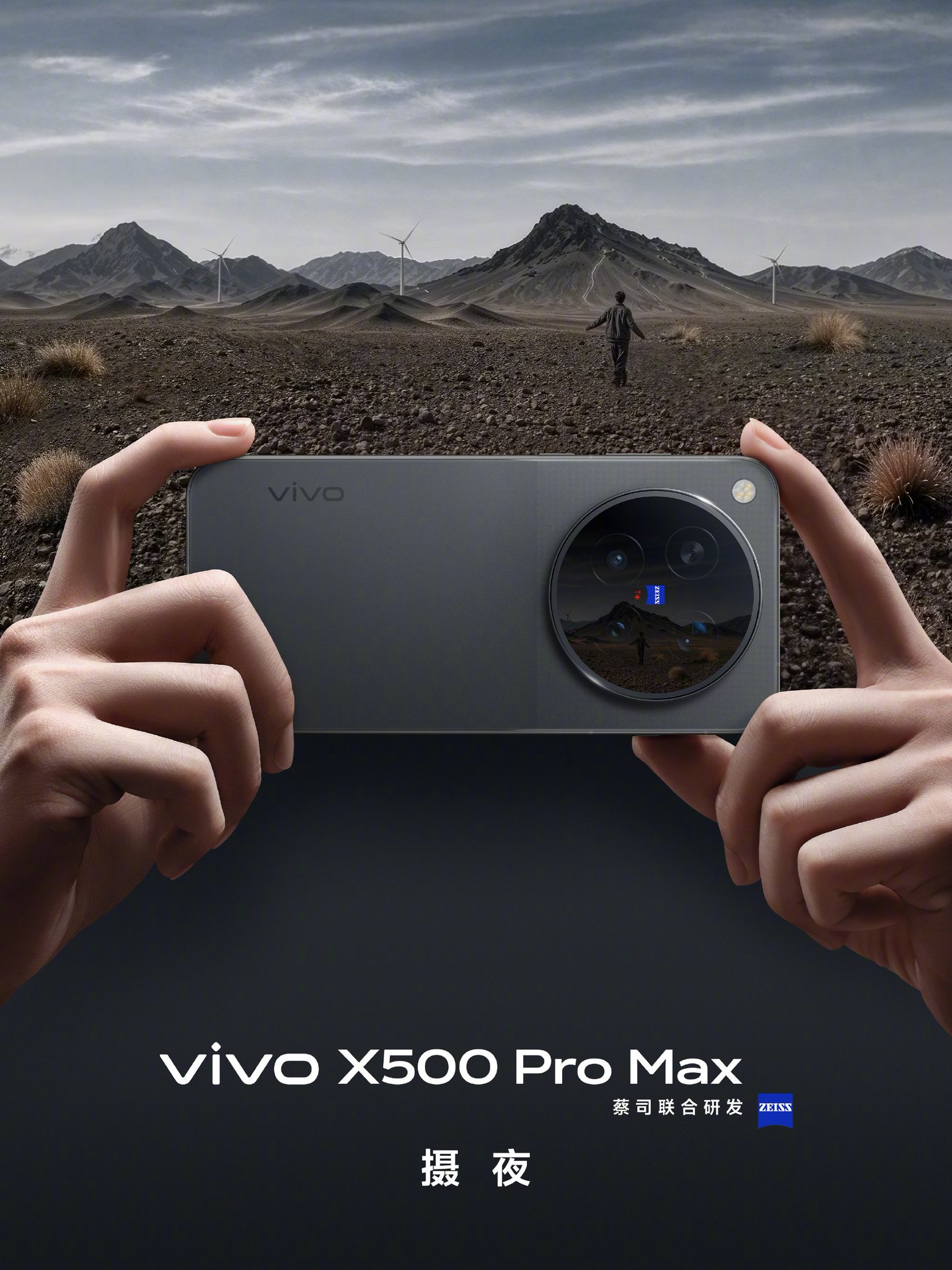
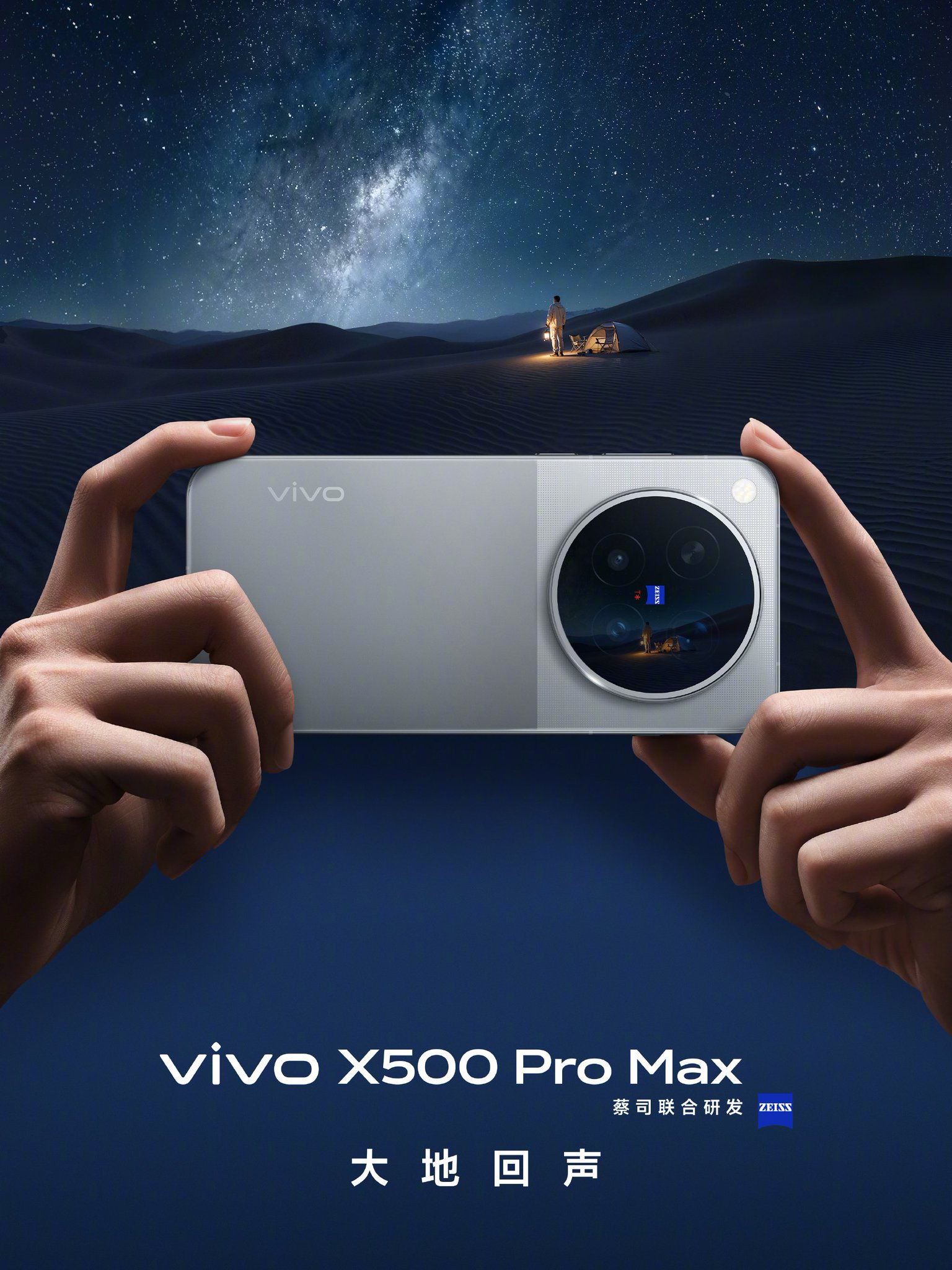
    Regardless of which version of the system you have, accessories for OPPO devices remain the same — the update does not change the dimensions of the phone.
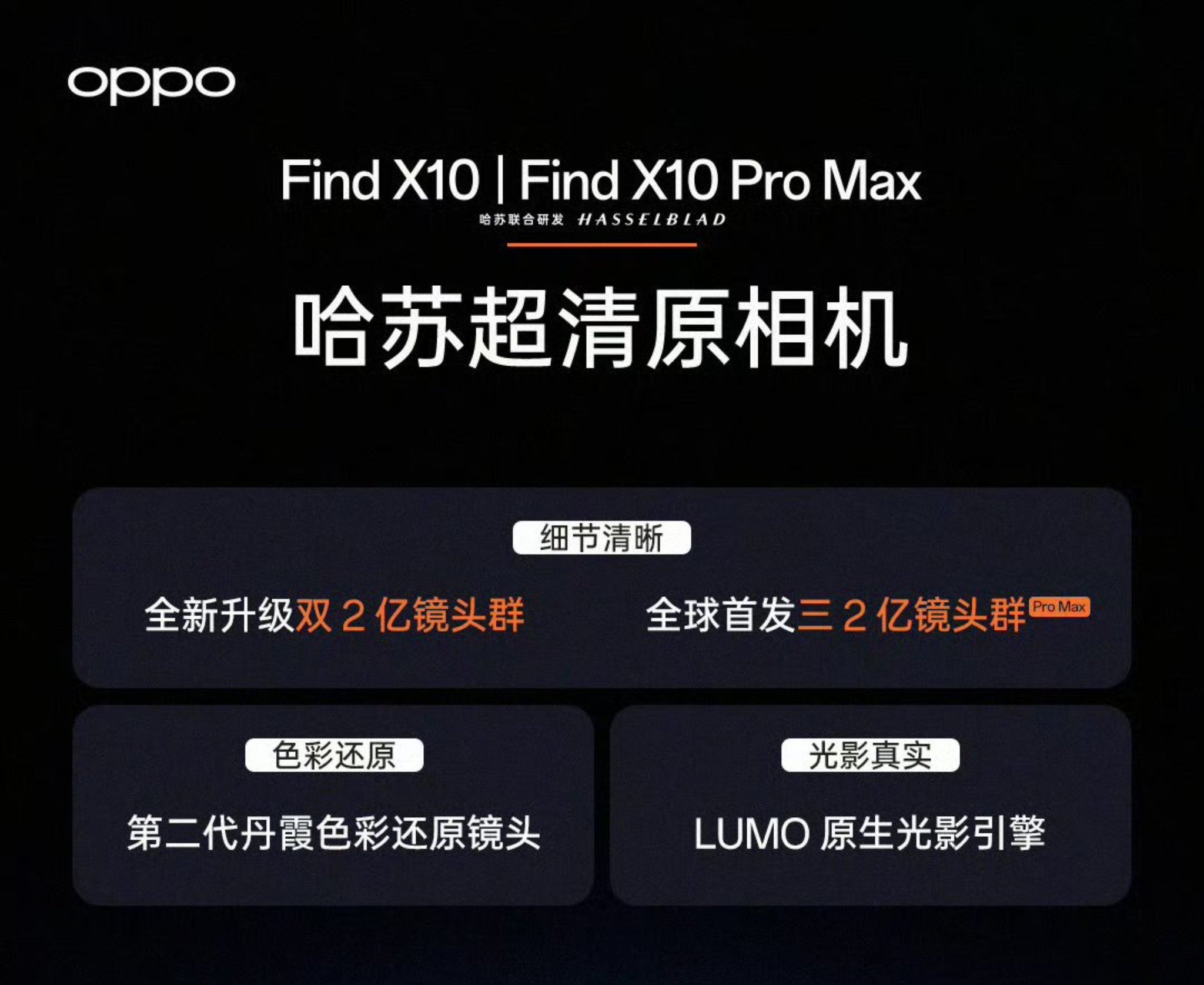
    The beta is already in the hands of testers, and builds are reaching them on August 11 and 13. We expect the stable version of ColorOS 17 in the fall. We will update this article when OPPO provides the official list of devices and timelines for Europe.


    Źródła: start zamkniętej bety i zmiany w wyglądzie za GSMArena, koniec Realme UI za GizChina; zakres zmian potwierdzony przez 91mobiles, lista urządzeń za Notebookcheck.

    Część informacji pochodzi z przecieków i zapowiedzi. Zaktualizujemy artykuł po oficjalnej premierze.